
TL;DR
IdeaClyst acts as a digital war room for your ideas, combining AI-driven critique, discovery, and organization. It helps founders validate faster, stay private, and make smarter decisions—without relying on cloud tools.
Ever stared at three open tabs, each holding a different startup idea, and felt that knot tighten in your stomach? That’s the founder’s reality—facing big decisions with tiny certainty. What if there was a way to turn that chaos into clarity—an environment designed to test, debate, and refine ideas before you commit?
Enter IdeaClyst, a tool that acts like a war room for your brain. It’s more than just software; it’s a strategic command center that combines AI, structured critique, and a local workspace. This isn’t about replacing your gut feeling but about sharpening it with data, debate, and disciplined thinking. Ready to see how it can turn your idea fog into a clear runway? Let’s dive in.
A war room for your next idea
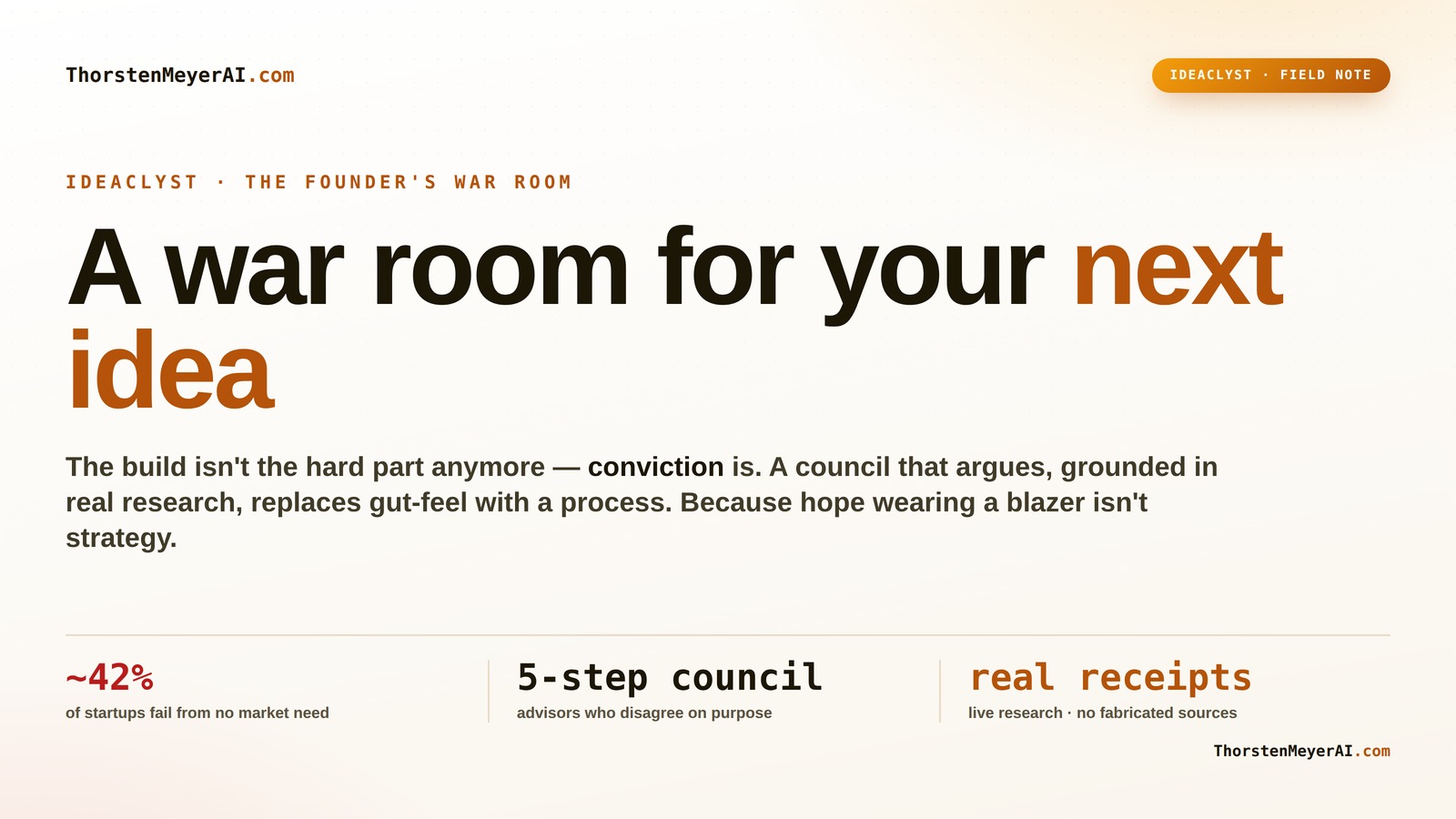
The build isn’t the hard part anymore — conviction is. Knowing which idea deserves the next six months, and being able to defend it. Most founders answer with gut feel and optimistic math. That’s hope wearing a blazer. IdeaClyst replaces it with a process.
The most expensive decision is what to build
The single most valuable thing a tool can do is talk you out of the wrong six months. The numbers make the case better than any pitch.
![DeskFX Free Audio Effects & Audio Enhancer Software [PC Download]](https://m.media-amazon.com/images/I/41fXbDohyuS._SL500_.jpg)
DeskFX Free Audio Effects & Audio Enhancer Software [PC Download]
Transform audio playing via your speakers and headphones
As an affiliate, we earn on qualifying purchases.
As an affiliate, we earn on qualifying purchases.
Three tools in one — on your own machine
Strip away the framing and IdeaClyst is three things at once, all running locally with nothing leaving your laptop.
An AI council
Pressure-tests an idea you bring it — advisors who argue on purpose.
A discovery engine
Finds ideas you didn’t know to look for by hunting real demand signals.
A founder’s workspace
Carries winners from “interesting” all the way to “ready to build.”

Building AI-Powered Products: The Essential Guide to AI and GenAI Product Management
As an affiliate, we earn on qualifying purchases.
As an affiliate, we earn on qualifying purchases.
Advisors who disagree on purpose
Not one confident, agreeable answer — a structured five-step deliberation where models play different roles and turn on their own work. The disagreement is the feature.
The five-step deliberation
A council that leads with the bad news surfaces the objections you’d otherwise find the expensive way, on month five.
Product strategy
Who’s it for, what’s the wedge, why now, what’s the business model.
Technical architecture
What would it actually take to build — and where’s the risk.
Critique pass
The council turns on its own work. Where’s the hand-waving? What kills this?
Second, independent critique
A different voice, a different angle — so blind spots don’t survive.
Final synthesis
Everything into one coherent founder packet: strategy, architecture, validation, plan.

AI Driven Tools for Sustainable Public Administration (Premier Research Source)
As an affiliate, we earn on qualifying purchases.
As an affiliate, we earn on qualifying purchases.
When IdeaClyst cites a source, it actually fetched it
The hard departure from “ask an AI what it thinks of my startup.” It runs in a strict, real-data-only mode — if it can’t gather genuine evidence, it says so plainly rather than inventing a plausible paragraph.
Confidence with receipts
No fabricated statistics, no imaginary competitors, no made-up citations. The packet survives a skeptical co-founder or a sharp investor because the reasoning has receipts.
Market research first
Scouts the landscape before the council reasons about anything.
Competitor read
Real positioning, pricing signals, feature claims — differentiation vs. reality.
Validation with links
Not “talk to customers” — concrete signals & sources you can click.

Scaling Lean: Mastering the Key Metrics for Startup Growth
As an affiliate, we earn on qualifying purchases.
As an affiliate, we earn on qualifying purchases.
From the blank page to build-ready
Evaluation is half the problem; the blank page is the other half. And a plan is worthless if it dies in a tab you never reopen.
Bring a space, not an idea
“AI for accountants,” “tools for indie game studios” — plus your goal and real capacity. It hunts demand signals across HN, Reddit, Product Hunt, GitHub, pricing pages.
- An honest market read — leads with the bad news when a space is hard
- An opportunity map — high pain, thin competition
- Ranked candidates — wedge, who pays, effort, risk, confidence
- each with KILL CRITERIA — when to walk away
A home and a forward path
Every promising idea gets carried forward, with every artifact in plain files on your disk.
- Validation tooling — sprint board, interview list, evidence browser
- Founder profile — a personal-fit lens; same discovery, different advice
- Build workspaces — funnel, personas, landing draft, version history
- “Build this idea” → a PRD + task queue, ready for a coding agent
Key Takeaways
- A digital war room like IdeaClyst centralizes idea development, making collaboration faster and clearer, especially for remote teams.
- Grounding critique and strategy in live web research prevents costly assumptions and keeps ideas relevant.
- Using an AI council that argues and critiques from different angles surfaces blind spots and improves decision quality.
- Keeping your idea workspace updated and visible ensures momentum and continuous improvement.
- Customize your environment to fit your team style—whether physical or digital—to boost engagement and productivity.
What Is a Digital War Room and Why It Matters
A digital war room is a central hub where your team can gather, organize, and scrutinize ideas—without the physical constraints of a conference room. Discover more about digital collaboration tools at Wilderness Sense. Think of it as a command center that combines visual boards, real-time feedback, and decision-making tools, all online.
For example, a startup founder might use a digital war room to map out customer personas, prototype features, and track validation experiments. It’s a space where ideas are visible, progress is tracked, and everyone’s voice is heard, no matter where they’re dialing in from.
This environment boosts collaboration, speeds up decision-making, and reduces the risk of building something nobody wants. For more on innovative collaboration spaces, see this article about digital war rooms. It’s especially vital for remote teams or those experimenting with multiple ideas at once.
Why it matters: In today’s fast-paced, often remote work landscape, having a centralized, accessible space for idea development isn’t just convenient—it’s strategic. It enables faster iteration, minimizes miscommunication, and fosters a culture of transparency. Without it, teams risk siloed thinking, delayed feedback, and missed opportunities to pivot early.
Ultimately, a well-structured digital war room transforms chaotic brainstorming into a disciplined, high-velocity innovation process—crucial for startups trying to stay ahead in competitive markets.
Why a War Room Supercharges Your Idea Development
Imagine trying to build a house without a blueprint. You might get lucky, but more often, you’ll waste time and materials. A war room does the same for ideas—it creates a visual, shared blueprint that everyone can see, critique, and improve upon. This shared clarity reduces misunderstandings and aligns the team’s efforts towards common goals.
It’s proven that teams with clear, visible workflows are 30% faster at hitting milestones. Learn more about effective project management at Lookatworth. But beyond speed, the quality of ideas improves because team members can see dependencies, potential pitfalls, and alternative paths more easily. For example, a SaaS founder used a digital war room to iterate on their onboarding flow, incorporating feedback from sales, support, and users. This collaborative refinement led to a 15% reduction in churn within two months, demonstrating how transparency accelerates meaningful improvements.
Furthermore, a dedicated space for critique and iteration fosters a culture of continuous improvement. When everyone can see progress—whether it’s a new feature diagram, customer feedback, or technical risks—motivation and accountability naturally increase. The tradeoff is that maintaining this environment requires discipline and regular updates; neglecting it can lead to stale ideas and lost momentum. Nonetheless, the payoff in faster, smarter development makes it worth the effort.
In essence, a war room turns scattered, disjointed efforts into a cohesive, dynamic process—empowering teams to develop ideas more thoroughly and with greater confidence.
Physical vs. Digital War Rooms: Which Fits Your Team?
| Physical War Room | Digital War Room | ||
|---|---|---|---|
| Real space, tangible artifacts, sticky notes, whiteboards. | Accessible anywhere, real-time updates, integrated tools. | Needs a dedicated room, setup, and often, physical presence. | Works for remote teams, flexible, low-cost or free. |
For example, a product team in a shared office might use a physical war room with banners and whiteboards to track ideas. But a remote startup might rely on a digital setup like IdeaClyst, which offers the same clarity without the space constraints.
While physical war rooms foster immediate face-to-face interaction and tactile engagement, they are limited by geography, space, and scalability. Digital war rooms, on the other hand, provide unmatched flexibility—allowing teams to collaborate asynchronously, from anywhere, and scale easily as the team grows or shifts to hybrid models. The tradeoff is that digital environments require discipline to keep updated and organized. Choosing the right fit depends on your team’s structure, culture, and growth plans, but embracing digital tools often offers more resilience and adaptability in today’s distributed work environment.
How to Turn Your Idea Space into a Powerhouse
- Gather your team and define your core questions or problems.
- Set up your digital space—think of it as your command center. Use IdeaClyst to create structured sections for strategy, critique, and validation.
- Populate the space with raw ideas, sketches, or hypotheses. Keep it visual and accessible.
- Run structured debates—use the AI council for critique, architecture, and risk assessment.
- Document decisions, action items, and next steps directly in the space. Version everything as Markdown files.
- Review progress weekly, adjust your focus, and keep ideas visible and alive.
For example, a founder might run weekly review sessions in IdeaClyst, where each idea gets a dedicated critique cycle and a final decision document. Find more tips on startup idea validation at MobQuotes. This regular rhythm ensures all voices are heard and that progress doesn’t stall. It also creates a historical record, enabling reflection on what worked and what didn’t—crucial for continuous learning. The key is consistency: without regular reviews, the momentum can fade, and ideas risk becoming stale or forgotten. By embedding these routines, teams turn their idea space into an active, evolving powerhouse that drives smarter, faster decisions.
How IdeaClyst’s AI Council Turns Ideas Into Action
IdeaClyst’s secret sauce is its AI council—an assembly of models that argue, critique, and refine ideas from multiple angles.e your ideas from multiple angles. Think of it as assembling a diverse panel of expert advisors, each with their own perspective and specialty. This setup matters because human intuition alone can overlook biases or blind spots. The AI council systematically challenges assumptions, questions feasibility, and probes market fit, providing a multi-faceted critique that deepens your understanding.
For instance, one AI might evaluate the market potential by analyzing current trends and competitor data, while another assesses technical risks based on architecture patterns. This layered critique helps surface hidden flaws and unexamined assumptions, which are often the root causes of project failures or pivots. The final report synthesizes these diverse insights into clear recommendations, action plans, or pivot points. This process not only saves time by catching issues early but also elevates decision quality by integrating multiple expert perspectives. Unlike simple AI tools that merely generate ideas or summaries, the AI council actively debates, critiques, and refines—making your idea validation more rigorous and comprehensive.
Tradeoffs include the need for careful configuration and understanding of AI strengths and limitations. But the payoff is a more robust, defensible plan that’s less likely to encounter costly surprises later on.
Grounding Your Ideas in Reality: Why Live Web Research Matters
Many AI tools spit out generic market insights that sound good but aren’t verified. Relying solely on static reports or outdated data can lead to misguided strategies and wasted resources. IdeaClyst avoids this trap by anchoring its critique and strategy in live web research—an approach that brings real-time, relevant insights directly into your decision-making process.
This means that instead of basing your product assumptions on last year’s market data, your team can access current customer trends, recent competitor moves, and breaking news, all pulled dynamically from the web. This ongoing, live data feed helps you stay aligned with actual market conditions and adapt quickly when new information surfaces. For example, testing a new feature might reveal via real-time research that competitors have launched similar offerings or that customer preferences have shifted, prompting a strategic pivot before heavy investments. This proactive approach reduces the risk of building on false premises or outdated assumptions, which is a common pitfall in startup development. The implication is clear: in a landscape where market conditions change rapidly, grounding your ideas in fresh, live data isn’t just a luxury—it’s a necessity for informed, effective decision-making.
Making Your Ideas Visible and Actionable
Visibility is everything. When ideas sit in your head or buried in email threads, they stay vague and easy to ignore. A war room—digital or physical—makes everything transparent and trackable, transforming vague concepts into concrete, actionable steps. This clarity is essential for maintaining momentum and ensuring accountability across your team.
In IdeaClyst, every critique, strategy, and test lives as a Markdown file—an accessible, version-controlled document that can be easily updated and shared. This structure allows teams to track the evolution of ideas, decisions, and experiments over time, creating a transparent history that informs future iterations. Visual cues like color-coded labels, progress bars, and task assignments further clarify priorities and status, reducing misunderstandings and duplication of effort. The tradeoff is that maintaining this visibility requires discipline—regular updates, clear labeling, and organized workflows. However, the payoff is substantial: it ensures that ideas are not only visible but also actionable, enabling teams to move swiftly from insight to implementation and avoiding the pitfalls of forgotten or stalled projects.
Keeping Your War Room Alive Over Time
The best war rooms aren’t static; they evolve with your project’s needs. Regular check-ins, fresh ideas, and ongoing critiques keep the environment dynamic and valuable. Without continuous engagement, even the best setups risk stagnation, leading to stale ideas and lost momentum.
For example, many teams hold weekly standups within their digital war rooms, reviewing progress, adding new insights, and adjusting plans accordingly. This routine ensures that the environment remains active and relevant, fostering a culture of continuous learning and adaptation. Additionally, because all updates, critiques, and decisions are stored as plain files in the system, revisiting past discussions or pivot points becomes straightforward. This historical record supports reflection, learning, and incremental improvement over time. The tradeoff is that maintaining discipline in these routines takes effort, but the benefits—sustained innovation, responsiveness, and a living repository of knowledge—are well worth it. The key is embedding these practices into your team’s workflow to ensure your idea space remains a vibrant, evolving asset.
Personalizing Your Idea Command Center
Every team is different, and your war room should reflect your unique workflow, culture, and goals. Customization isn’t just about aesthetics; it’s about making the environment more engaging and aligned with how your team operates. A personalized space encourages consistent use and fosters a sense of ownership.
In IdeaClyst, you can tailor sections for different phases—brainstorming, validation, roadmapping—or add branding like logos and color schemes to boost team pride. For example, a design team might theme their workspace with visual icons for each project, making it more lively and motivating. You might also set up custom templates for critique cycles or validation tests that match your process. The tradeoff is that over-customization can sometimes lead to complexity, so it’s important to strike a balance between personalization and simplicity. The goal is to create a command center that feels intuitive, inspiring, and aligned with your team’s identity, ultimately making daily use more natural and effective.
Supporting Brainstorming, Strategy, and Execution All in One Place
A comprehensive war room supports the entire lifecycle of an idea—from initial spark to final execution. This integration minimizes context switching, preserves momentum, and ensures that insights and decisions are easily accessible at every stage.
For example, a SaaS startup might start by collecting raw ideas, then move into detailed architecture critiques, run validation experiments, and finally track launch metrics—all within their digital war room. Having all these stages interconnected allows team members to see how early insights influence later decisions, creating a cohesive development process. This continuity reduces the risk of siloed efforts, duplicated work, or forgotten assumptions. It also fosters a mindset where iteration and refinement are continuous, rather than isolated steps. The main tradeoff is that maintaining such an integrated environment requires discipline and clear workflows, but the benefits of faster, more aligned development far outweigh the effort. Ultimately, a central idea hub becomes the backbone of an agile, responsive product development cycle.
Frequently Asked Questions
What exactly is a digital war room?
A digital war room is an online environment where your team can visualize, discuss, and track ideas, strategies, and progress. It acts as a central hub that enhances collaboration and speeds decision-making, especially for remote or distributed teams.How does a war room help with idea validation?
A war room makes ideas visible and subject to continuous critique. When combined with tools like IdeaClyst’s AI council, it grounds ideas in real data and diverse perspectives, reducing risks of building products nobody wants.Do I need a physical space, or can I do this digitally?
While physical spaces work well for some teams, digital war rooms like IdeaClyst offer unmatched flexibility, especially for remote or hybrid teams. They are cost-effective, easy to update, and accessible from anywhere.What should I include in my war room to make it effective?
Include visual boards, critique sections, validation plans, and progress trackers. Use plain files or visual tools to keep everything transparent and actionable. Regular updates and clear labels help maintain momentum.How can small teams set up a war room without breaking the bank?
Leverage free or low-cost tools like IdeaClyst, Trello, or Notion. Focus on simple structures—whiteboards, shared documents, or markdown files—that everyone can access and update easily.Conclusion
Think of IdeaClyst as your personal command center for innovation—an environment where ideas are challenged, validated, and refined with precision. It’s more than just a tool; it’s a strategic ally in making smarter, faster decisions.
If you want to turn your chaotic idea pile into a well-oiled machine, setting up a digital war room might just be your best move. Remember, clarity, debate, and visibility aren’t luxuries—they’re essentials in today’s fast-paced startup world.