

📊 Full opportunity report: AI Changelog Digest For Open-source Maintainers on IdeaNavigator AI — validation score, market gap, and execution plan.

Get the latest gadgets delivered free — and shop member deals
- Fast, free delivery on millions of items
- Access to Prime Big Deal Days deals on October 6–7
- Prime Video, Amazon Music and more included
TL;DR
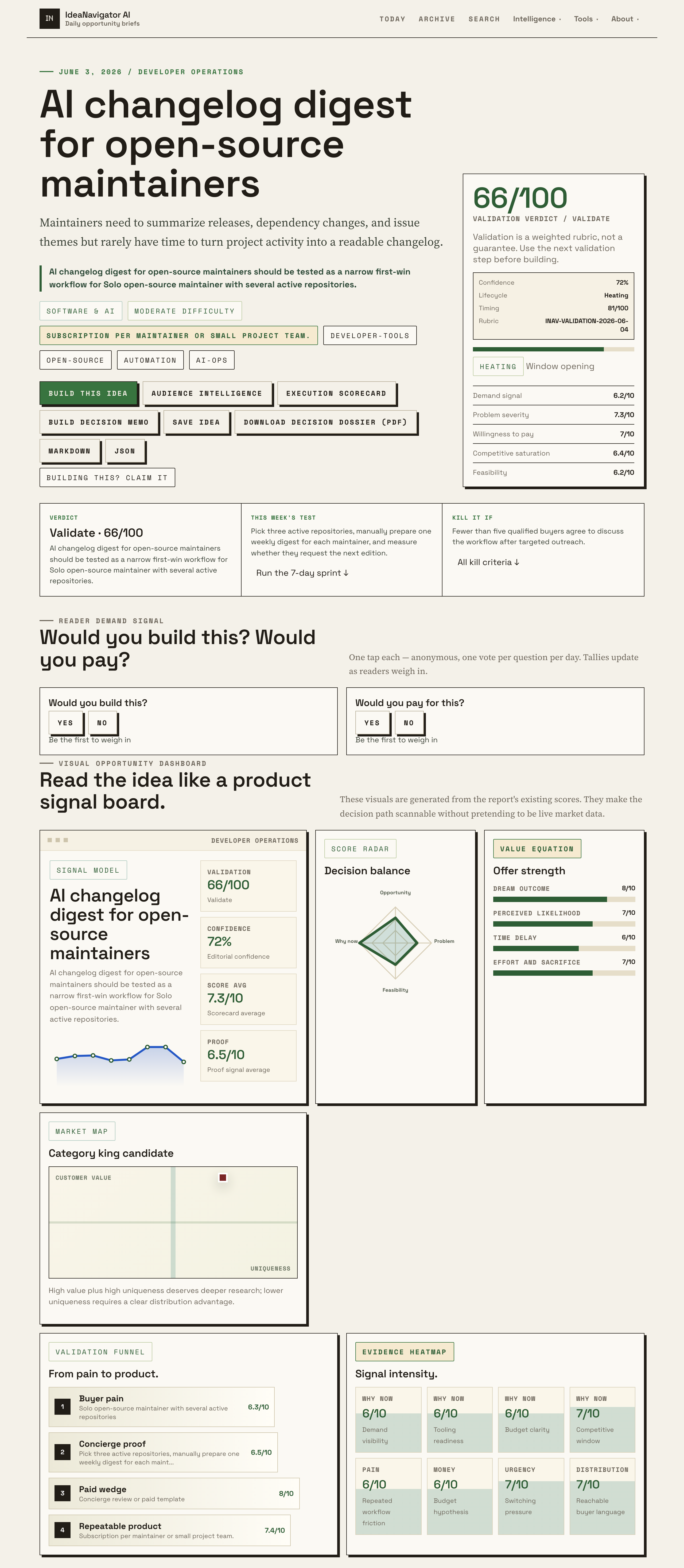
An experimental AI-driven changelog digest for open-source maintainers is being tested. It automates summarizing releases, issues, and dependencies, easing maintenance tasks. The project aims to validate its usefulness through initial testing with select repositories.
AI-powered changelog digest for open-source maintainers is currently in a testing phase, targeting solo maintainers managing multiple repositories. The tool aims to automate the process of summarizing releases, dependency changes, and issue themes, reducing manual effort and improving communication with users.
The initiative is designed for individual open-source maintainers with several active repositories who struggle to produce comprehensive changelogs due to time constraints. The proposed minimum viable product (MVP) involves a weekly digest generator that scans repositories for recent releases, merged pull requests, and top issues, then drafts a changelog email for the maintainer’s review. This process leverages repository metadata, release feeds, and AI summarization techniques, making it feasible without a full developer-relations team.
According to sources from IdeaNavigator AI, the testing involves selecting three active repositories, manually preparing one weekly digest for each, and measuring whether maintainers request subsequent editions. The model aims to provide a lightweight, subscription-based service tailored for small projects and individual developers.
Potential Impact on Open-Source Maintenance Workflow
This development could significantly reduce the time and effort required for open-source project maintenance, especially for solo developers managing multiple repositories. Automating changelog creation can improve transparency, user communication, and project visibility, potentially leading to increased adoption and contributor engagement. The initiative also demonstrates how AI can streamline developer operations and lower the barrier to effective project management.
AI-powered changelog generator for open-source projects
As an affiliate, we earn on qualifying purchases.
As an affiliate, we earn on qualifying purchases.
Growing Need for Automated Release Summaries in Open Source
Maintainers often find it challenging to keep up with the demand for clear, timely release notes amidst busy schedules. Currently, many rely on manual summaries, which can be inconsistent or incomplete. Recent advances in AI, combined with the availability of repository metadata and release feeds, have made automated summarization more practical. Previous efforts to automate documentation and changelog generation have shown promise, but a dedicated, lightweight digest tool tailored for solo maintainers remains an emerging concept. This project builds on these trends, aiming to offer a simple, effective solution for small-scale open-source projects.
“Leveraging AI to automate changelog summaries could transform how individual maintainers manage their projects.”
— an anonymous researcher
automated release notes tool for developers
As an affiliate, we earn on qualifying purchases.
As an affiliate, we earn on qualifying purchases.
Unconfirmed Aspects of the AI Changelog Tool’s Effectiveness
It is not yet clear how accurately the AI summarization will capture the most relevant updates or how maintainers will perceive the quality of autogenerated drafts. The long-term adoption and integration into existing workflows remain to be tested, and user feedback will be crucial for refinement. Additionally, the scalability of the solution for larger projects or teams is still uncertain.
dependency update notification software
As an affiliate, we earn on qualifying purchases.
As an affiliate, we earn on qualifying purchases.
Next Steps in Validating the Changelog Digest System
The initial testing phase will involve collecting feedback from participating maintainers, measuring engagement with the generated digests, and assessing the accuracy and usefulness of the summaries. Based on these results, developers plan to refine the AI models and expand testing to more repositories. Further integration with existing project management tools and potential commercialization through subscription plans are also under consideration.
open-source project maintenance tools
As an affiliate, we earn on qualifying purchases.
As an affiliate, we earn on qualifying purchases.
Key Questions
How will the AI generate the changelog summaries?
The AI will analyze repository metadata, recent releases, merged pull requests, and top issues to produce concise summaries of project activity, which are then drafted into an email for the maintainer’s review.
Is this tool available for public use now?
No, it is currently in a testing phase with selected repositories. Broader availability will depend on the outcomes of initial validation and refinement.
Will this AI tool replace manual changelog writing?
The goal is to assist and automate the process, not replace human oversight. Maintainers will review and approve the generated summaries to ensure accuracy and relevance.
What are the costs associated with this service?
The service is planned to operate on a subscription model, targeting individual maintainers or small project teams, with pricing yet to be finalized.
Can this tool help larger open-source projects?
While initially aimed at solo maintainers, future versions may scale to support larger teams, but current focus is on small projects for initial validation.
Source: IdeaNavigator AI
Halloween Picks
halloween
As an affiliate, we earn on qualifying purchases.