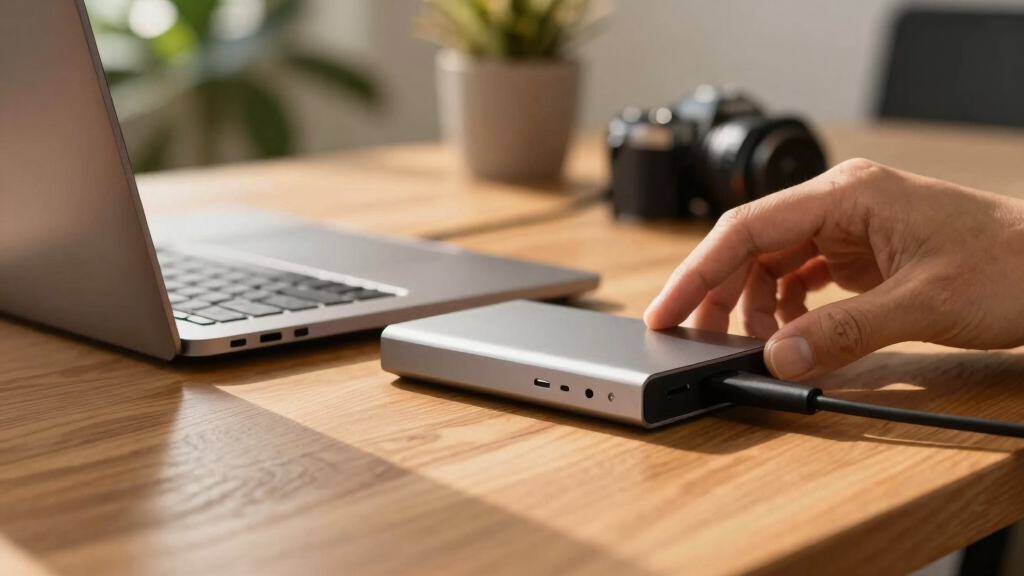

This guide explains how to connect, configure, and use a portable external hard drive for data storage or backup. It is designed for users new to external drives or those seeking a straightforward setup. Completing this task will enable secure, portable storage of files, with clear steps to ensure proper connection and data management.

Get the latest gadgets delivered free — and shop member deals
- Fast, free delivery on millions of items
- Access to Prime Big Deal Days deals on October 6–7
- Prime Video, Amazon Music and more included

Seagate Portable 2TB External Hard Drive HDD
- ✔ Storage Capacity: 2TB
- ✔ Connectivity: USB 3.0
- ✔ Compatibility: PC, Mac, PlayStation, Xbox
Seagate Portable 1TB External Hard Drive HDD – USB 3.0 for PC, Mac, PlayStation, & Xbox
- ✔ Storage Capacity: 1TB
- ✔ Connectivity: USB 3.0
- ✔ Compatibility: PC, Mac, PlayStation, Xbox

UnionSine 1TB Ultra Slim Portable External Hard Drive HDD – USB 3.0 for PC, Mac, Laptop, PS4, Xbox One, Xbox 360
- ✔ Capacity: 1TB
- ✔ Interface: USB 3.0
- ✔ Transfer Speed: up to 125MB/s read, 103MB/s write
Difficulty: Beginner | Time: 15-30 minutes
What You’ll Need
Tools & Materials:
- Portable external hard drive
- USB cable (included with drive)
- Computer with available USB port
Knowledge:
- Basic understanding of computer operation
- Familiarity with file management (copying, moving files)
Ensure your computer meets the drive’s compatibility requirements (USB 3.0 or higher recommended). Have your password or user credentials ready if encryption or security software is involved.
Seagate Portable 2TB External Hard Drive HDD
<p>The <strong>Seagate Portable 2TB</strong> stands out for offering a generous storage capacity in a portable, easy-to-use package. Its <strong>plug-and-play setup</strong> with USB 3.0 ensures fast data transfer across multiple devices, including Windows, Mac, and gaming consoles like PlayStation and Xbox. Compared with other options, it provides a broader compatibility range and larger capacity, making it ideal for users who need to store large files or backups without fuss. However, the slightly higher cost per gigabyte and lack of included backup software are notable tradeoffs. Its capacity is fixed at 2TB, which might be insufficient for some users, but it strikes a good balance between size and performance.</p>
Pros:
- Easy to set up with plug-and-play design
- Compatible with multiple devices including gaming consoles
- Reliable and portable storage
Cons:
- Storage capacity may vary slightly
- No included backup software
- Limited to 2TB capacity
Best for: Users needing large storage and broad device compatibility
Not ideal for: Those with limited budget or who prefer built-in backup solutions
Bottom line: A versatile, high-capacity drive ideal for users who need reliable storage across various devices.
“A versatile, high-capacity drive ideal for users who need reliable storage across various devices.”
Seagate Portable 1TB External Hard Drive HDD – USB 3.0 for PC, Mac, PlayStation, & Xbox
<p>The <strong>Seagate 1TB</strong> offers a straightforward, affordable option for users who prioritize easy storage on the go. Its <strong>plug-and-play setup</strong> with USB 3.0 ensures quick data transfer, and its lightweight design makes it ideal for carrying around. Compared to larger drives, it is perfect for casual users or those with limited storage needs. However, reformatting may be required for Mac users, and it lacks backup software, which could be a drawback for those seeking integrated data management. Its 1TB capacity is suitable for everyday file storage but may fall short for users with extensive media libraries.</p>
Pros:
- Easy plug-and-play setup
- Lightweight and portable
- Compatible with multiple platforms
Cons:
- Reformatting needed for Mac
- Limited to 1TB storage
- No backup software included
Best for: Casual users needing portable storage on a budget
Not ideal for: Power users with large files or backups requiring more capacity
Bottom line: A cost-effective, portable drive best suited for light storage needs and casual users.
“A cost-effective, portable drive best suited for light storage needs and casual users.”
UnionSine 1TB Ultra Slim Portable External Hard Drive HDD – USB 3.0 for PC, Mac, Laptop, PS4, Xbox One, Xbox 360
<p>The <strong>UnionSine 1TB Ultra Slim</strong> is designed for those who need <strong>maximum portability without sacrificing speed</strong>. Its ultra-slim profile and lightweight build make it easy to carry in a pocket or bag. With transfer speeds reaching up to 125MB/s read and 103MB/s write, it outperforms many bulkier drives and is well-suited for fast transfers of photos, videos, and other large files. The heat dissipation design and durable shell add to its reliability in mobile scenarios. The main limitation is its 1TB capacity, which might be insufficient for users with large media archives. Also, it requires a USB connection for power, so it cannot operate solely via bus power on some devices.</p>
Pros:
- Fast data transfer speeds
- Ultra-slim and lightweight
- Heat dissipation design for stable performance
Cons:
- Limited to 1TB capacity
- No included backup software
- Requires USB connection for power
Best for: Travelers and mobile professionals needing fast, compact storage
Not ideal for: Users requiring large capacity or backup software features
Bottom line: An excellent choice for portability and speed, best for users who prioritize mobility and quick transfers.
“An excellent choice for portability and speed, best for users who prioritize mobility and quick transfers.”
As an Amazon Associate we earn from qualifying purchases.
Before You Start
Back up any important data before connecting the drive, in case of initial setup issues. Remove any physical obstructions from your workspace to prevent accidental disconnection during setup.
Step-by-Step Instructions
Step 1: Unpack and prepare the drive
Remove the external hard drive from its packaging and inspect it for damage. Connect the included USB cable to the drive and ensure the cable is in good condition.
Tip: Use a high-quality, undamaged USB cable to prevent connection issues.
Check: Drive is physically intact, and the USB cable is securely connected to both the drive and your computer.
Step 2: Connect the drive to your computer
Plug the USB cable into an available USB port on your computer. Wait a few seconds for the operating system to recognize the device.
Tip: Use a USB port directly on the computer, not through hubs, to ensure stable power and data transfer.
Check: Your computer detects the drive—look for a notification or check in your file explorer.
Step 3: Power on the drive (if applicable)
If your drive has a power button, press it to turn on the device. Wait for any indicator lights to confirm it’s powered on.
Tip: Some portable drives are bus-powered and turn on automatically when connected; verify if your model requires manual power.
Check: Drive’s indicator light is active, and your OS shows the device as connected.
Step 4: Initialize or format the drive (if needed)
If the drive is new or not recognized, open your OS’s disk management tool (Disk Management on Windows, Disk Utility on Mac). Follow prompts to initialize or format the drive to a compatible file system (NTFS for Windows, exFAT for cross-platform use).
Tip: Choose a file system based on your needs—use exFAT for compatibility between Windows and Mac. Be aware that formatting deletes all data on the drive.
Check: Drive appears as a formatted, accessible volume in your file explorer, ready for data transfer.
Step 5: Transfer files to the drive
Open your file explorer, select files or folders you want to store or back up, then drag and drop them onto the external drive’s window or copy and paste.
Tip: Verify file transfer completion before disconnecting the drive to prevent data loss.
Check: Files are visible on the drive, and their sizes match the originals, indicating successful transfer.
Step 6: Safely eject the drive
Before disconnecting, use the ‘Eject’ or ‘Safely Remove Hardware’ option in your operating system to prevent data corruption. Wait for confirmation that it’s safe to unplug.
Tip: Never disconnect the drive while files are being transferred or if the system indicates active data access.
Check: OS confirms it’s safe to remove the device, and no transfer activity is ongoing.
Common Mistakes to Avoid
- Disconnecting the drive before ejecting properly. — Always use the safe eject option to disconnect to avoid data corruption.
- Using an incompatible or damaged USB cable. — Use the cable included with the drive or a high-quality replacement; inspect for damage regularly.
- Not formatting the drive before use, leading to recognition issues. — Initialize and format the drive in your OS’s disk management tools before transferring files.
- Connecting the drive through a USB hub that supplies insufficient power. — Connect directly to a computer port or use a powered hub if necessary.
Troubleshooting
Problem: Drive is not recognized by the computer.
Solution: Try reconnecting the USB cable, switch to a different port, or restart your computer. Check for driver updates or compatibility issues.
Problem: Drive shows as unallocated space or unformatted.
Solution: Open disk management, initialize and format the drive with a compatible file system, following prompts.
Problem: Data transfer is very slow.
Solution: Use a USB 3.0 port, ensure the cable is high-quality, and close other data-heavy applications.
What Success Looks Like
The external drive appears in your file explorer with accessible storage capacity, and files copied to the drive open correctly. The drive is recognized without errors, and data can be transferred seamlessly.
Next Steps
Regularly back up important files to the drive, safely eject after use, and periodically check for drive health or errors. For ongoing use, organize files and keep the drive in a safe, cool location. Consider encrypting sensitive data if needed.
Frequently Asked Questions
Can I use the external hard drive with both Windows and Mac?
Yes, but format the drive with a compatible file system like exFAT for smooth cross-platform use. Be aware that formatting will erase existing data.
How do I securely erase data from the drive?
Use disk management tools or dedicated software to format or wipe the drive, ensuring all data is irrecoverable. Follow the instructions specific to your OS.
What should I do if my drive is making unusual noises?
Stop using the drive immediately, back up any recoverable data if possible, and consider replacing it. Unusual noises can indicate hardware failure.
Is it safe to use the drive while charging?
If your drive is bus-powered, it draws power from the USB port and does not require charging. If it has an external power source, use it as directed, and disconnect when not in use to prolong the drive’s lifespan.
Fall Picks
fall essentials
As an affiliate, we earn on qualifying purchases.