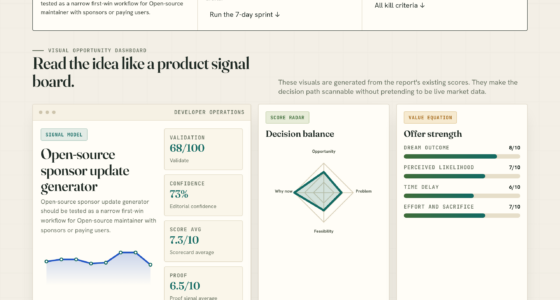

📊 Full opportunity report: The Model Is Only 10%: The Real Lesson of the New SDLC on ThorstenMeyerAI.com — validation score, market gap, and execution plan.

Get the latest gadgets delivered free with Prime
- Fast, free delivery on millions of items
- Prime Video, Amazon Music and more included
- Member-only deals all year
TL;DR
A recent whitepaper emphasizes that in AI-assisted software engineering, the actual AI model is only a small part of the system. The focus should be on the harness and context engineering, which drive performance and cost-efficiency.
A new Google whitepaper, The New SDLC With Vibe Coding, states that the AI model accounts for only about 10% of a system’s behavior. The paper emphasizes that the real skill lies in configuration, verification, and context engineering, which collectively determine system performance and cost. This insight challenges common assumptions about AI development and has significant implications for how teams allocate resources and design workflows.
The whitepaper, authored by Addy Osmani, Shubham Saboo, and Sokratis Kartakis, highlights that most failures in AI agents stem from configuration errors—missing tools, vague rules, or noisy context—rather than the underlying model. Experiments cited in the paper show that changing the harness—prompts, tools, and middleware—can dramatically improve agent performance, often more than upgrading the model itself. For example, a coding agent moved from outside the Top 30 to the Top 5 on a benchmark by only modifying the harness, not the model.
The authors argue that costs are driven by token economy, making disciplined, structured approaches more economical in the long run. While vibe coding appears free initially, it incurs high operating costs due to token waste, maintenance, and security vulnerabilities. Conversely, investing upfront in schema design, testing, and context management reduces marginal costs over time.
The model is only 10%
A Google whitepaper argues software’s biggest shift is from writing code to expressing intent. Its sharpest claim: the model you obsess over is the smallest part of the system — the scaffolding around it does the real work.
The clearest map yet of how serious AI development works — and mostly tool-agnostic. But it’s a Google funnel: the concepts are neutral, the on-ramps point to Gemini, Jules & the ADK. If the harness is 90% and it’s yours, your moat and your costs both live there — so own your scaffolding, route across models, and remember: AI amplifies whatever engineering culture it lands in.
Implications for AI Development Strategies
This whitepaper fundamentally shifts the understanding of AI system design, emphasizing that the real value lies in how AI is integrated and controlled, not in the model itself. Organizations that focus on harness and context engineering can achieve better performance at lower costs, gaining a durable competitive advantage. It also suggests that AI teams should prioritize configuration, tooling, and verification over chasing the latest models.
As an affiliate, we earn on qualifying purchases.
Background on the Evolving AI Development Paradigm
As AI adoption accelerates, many teams have historically focused on acquiring or upgrading models, assuming performance improvements come primarily from better models. However, recent experiments and industry reports indicate that system behavior is dominated by how models are integrated and guided. The whitepaper builds on earlier insights from Andrej Karpathy and others, reinforcing that the shift towards ‘agentic engineering’—structured, verified, and well-scaffolded AI workflows—is now central to successful AI deployment.
“The model is only 10% of what determines behavior; the harness and context are 90%.”
— Addy Osmani
software configuration management software
As an affiliate, we earn on qualifying purchases.
As an affiliate, we earn on qualifying purchases.
Unclear Aspects of Implementation and Industry Adoption
It is not yet clear how widely organizations will adopt the recommended practices of harness and context engineering. The specific methods for scaling these approaches across diverse projects and teams are still being developed. Additionally, the long-term impact on AI model development cycles remains to be seen, as some industry players may continue to prioritize model upgrades.
As an affiliate, we earn on qualifying purchases.
Next Steps for AI Teams and Developers
Organizations should evaluate their current AI workflows, focusing on improving harness and context management. Future research and industry discussions are likely to explore standardized frameworks for structured AI integration, along with tools that facilitate better configuration and verification. Monitoring how these practices influence cost and performance over time will be critical.
As an affiliate, we earn on qualifying purchases.
Key Questions
Why is the model only 10% of system behavior?
The whitepaper explains that most of the system’s behavior depends on how the model is integrated, configured, and guided through prompts, tools, and verification processes, which constitute the remaining 90%.
What is harness engineering in AI development?
Harness engineering involves designing and managing the prompts, tools, rules, and observability layers that control how the AI model operates within a system, significantly impacting performance and reliability.
How does cost factor into this new approach?
Cost is driven by token economy; disciplined harness and context management reduce unnecessary token usage, lowering operational costs compared to vibe coding, which appears cheap but is more expensive long-term.
Will this change how AI models are developed?
While model development continues, the whitepaper suggests that the focus should shift towards better system integration, configuration, and verification to maximize value and control costs.
Is this approach applicable to all AI systems?
The principles are broadly applicable, especially in professional and enterprise AI deployments where performance, cost, and reliability are critical.
Source: ThorstenMeyerAI.com
Halloween Picks
halloween
As an affiliate, we earn on qualifying purchases.