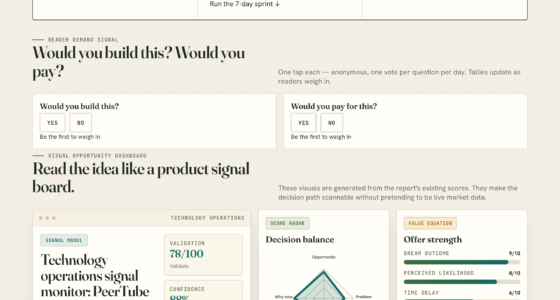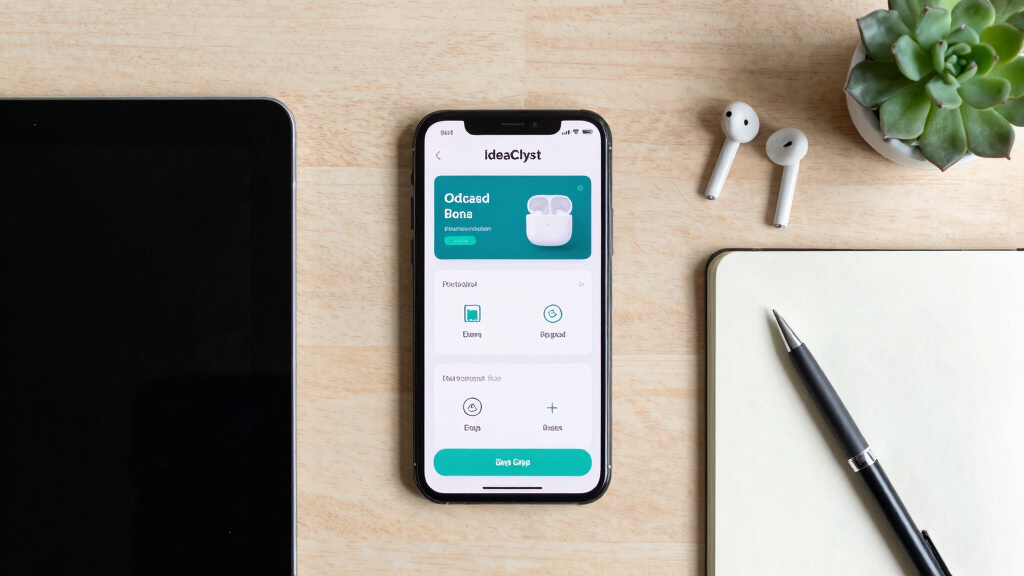

📊 Full opportunity report: A War Room for Your Next Idea: Inside IdeaClyst on ThorstenMeyerAI.com — validation score, market gap, and execution plan.
Listen free for 30 days with Audible
Thousands of audiobooks and originals — cancel anytime.
Start your free trialAs an affiliate, we earn on qualifying purchases.
TL;DR
IdeaClyst is a local-first AI tool that acts as a decision-making war room for startup founders, providing structured validation and debate on ideas. It aims to reduce costly failures by compressing research and fostering critical thinking.
IdeaClyst has been introduced as a local-first AI-powered war room designed for startup founders to rigorously evaluate their ideas before committing significant resources. It provides a structured, multi-model council that pressure-tests ideas through debate, all while keeping data on the founder’s own machine. This development matters because it offers a new approach to reducing startup failure risk by accelerating and improving the validation process.
IdeaClyst is an open-source tool that runs entirely on a founder’s local machine, eliminating concerns about data privacy and cloud dependencies. It functions as a three-in-one platform: an AI council that critically evaluates ideas, a discovery engine that surfaces new opportunities, and a workspace that consolidates insights into a comprehensive plan. The AI council consists of multiple models that deliberate on key aspects such as product strategy, technical architecture, and potential risks, providing a balanced, multi-perspective assessment.
Unlike traditional validation methods, which can be costly and time-consuming, IdeaClyst leverages AI to condense research from months into hours, helping founders avoid building products nobody wants. It is explicitly designed to prevent founders from relying solely on agreement from an AI, instead fostering constructive disagreement that reveals potential flaws. The output is a detailed founder’s report, stored as Markdown files, facilitating version control and seamless integration into pitches or planning documents.
A war room for your next idea
The build isn’t the hard part anymore — conviction is. Knowing which idea deserves the next six months, and being able to defend it. Most founders answer with gut feel and optimistic math. That’s hope wearing a blazer. IdeaClyst replaces it with a process.
The most expensive decision is what to build
The single most valuable thing a tool can do is talk you out of the wrong six months. The numbers make the case better than any pitch.
Three tools in one — on your own machine
Strip away the framing and IdeaClyst is three things at once, all running locally with nothing leaving your laptop.
An AI council
Pressure-tests an idea you bring it — advisors who argue on purpose.
A discovery engine
Finds ideas you didn’t know to look for by hunting real demand signals.
A founder’s workspace
Carries winners from “interesting” all the way to “ready to build.”
Advisors who disagree on purpose
Not one confident, agreeable answer — a structured five-step deliberation where models play different roles and turn on their own work. The disagreement is the feature.
The five-step deliberation
A council that leads with the bad news surfaces the objections you’d otherwise find the expensive way, on month five.
Product strategy
Who’s it for, what’s the wedge, why now, what’s the business model.
Technical architecture
What would it actually take to build — and where’s the risk.
Critique pass
The council turns on its own work. Where’s the hand-waving? What kills this?
Second, independent critique
A different voice, a different angle — so blind spots don’t survive.
Final synthesis
Everything into one coherent founder packet: strategy, architecture, validation, plan.
When IdeaClyst cites a source, it actually fetched it
The hard departure from “ask an AI what it thinks of my startup.” It runs in a strict, real-data-only mode — if it can’t gather genuine evidence, it says so plainly rather than inventing a plausible paragraph.
Confidence with receipts
No fabricated statistics, no imaginary competitors, no made-up citations. The packet survives a skeptical co-founder or a sharp investor because the reasoning has receipts.
Market research first
Scouts the landscape before the council reasons about anything.
Competitor read
Real positioning, pricing signals, feature claims — differentiation vs. reality.
Validation with links
Not “talk to customers” — concrete signals & sources you can click.
From the blank page to build-ready
Evaluation is half the problem; the blank page is the other half. And a plan is worthless if it dies in a tab you never reopen.
Bring a space, not an idea
“AI for accountants,” “tools for indie game studios” — plus your goal and real capacity. It hunts demand signals across HN, Reddit, Product Hunt, GitHub, pricing pages.
- An honest market read — leads with the bad news when a space is hard
- An opportunity map — high pain, thin competition
- Ranked candidates — wedge, who pays, effort, risk, confidence
- each with KILL CRITERIA — when to walk away
A home and a forward path
Every promising idea gets carried forward, with every artifact in plain files on your disk.
- Validation tooling — sprint board, interview list, evidence browser
- Founder profile — a personal-fit lens; same discovery, different advice
- Build workspaces — funnel, personas, landing draft, version history
- “Build this idea” → a PRD + task queue, ready for a coding agent
Why Founders Need a Structured Idea War Room
Startup failures often stem from building products with no market need, a problem that costs millions annually. Traditional validation is slow and expensive, especially for early-stage founders. IdeaClyst addresses this by providing a local, AI-driven environment that accelerates critical evaluation, reduces costs, and improves decision confidence. Its multi-model council ensures diverse perspectives, helping founders identify risks early and make more informed choices, ultimately increasing their chances of success.
AI Prompts for Entrepreneurs: 400 Ways to Grow Your Business with ChatGPT: Transform Ideas, Boost Sales, and Automate Your Business Using AI-Powered Prompts
As an affiliate, we earn on qualifying purchases.
As an affiliate, we earn on qualifying purchases.
Background and Innovation in Startup Validation Tools
As of 2026, startup founders face mounting pressure to validate ideas quickly and cost-effectively. While AI tools have proliferated, many rely on cloud-based services that raise privacy concerns or require subscriptions. Traditional validation methods—surveys, customer interviews, and consulting—remain slow and costly. IdeaClyst emerges as a response to these challenges, emphasizing local processing, open-source transparency, and structured debate among AI models. Its design reflects a broader shift toward more private, self-contained tools that empower founders to own their data and insights.
“IdeaClyst transforms the way founders validate ideas by providing a local, multi-model debate platform that surfaces risks early and keeps data private.”
— Thorsten Meyer, founder of ThorstenMeyerAI.com

1001 Prompts for Unlocking Generative AI in Local Government
As an affiliate, we earn on qualifying purchases.
As an affiliate, we earn on qualifying purchases.
Unanswered Questions About IdeaClyst’s Adoption and Effectiveness
It is still unclear how widely IdeaClyst will be adopted by early-stage founders and whether its AI council approach consistently yields better validation outcomes than traditional methods. The effectiveness of multi-model debate in real-world scenarios remains to be empirically tested, and user experiences will influence its future development and integration into startup workflows.

Scaling Lean: Mastering the Key Metrics for Startup Growth
As an affiliate, we earn on qualifying purchases.
As an affiliate, we earn on qualifying purchases.
Next Steps for IdeaClyst and Its Community
The developers plan to release the full open-source code and gather user feedback through pilot programs. Future updates may include enhanced discovery features, integrations with existing planning tools, and empirical studies of its impact on startup success. Monitoring adoption rates and validation outcomes will be key to assessing its long-term viability.

Anatomy of an AI-Powered Business — How to Use AI to Find, Pressure-Test, and Commit to a Business Idea Worth Building: An Idea Validation Blueprint for … (The Founder's Blueprint Series Book 1)
As an affiliate, we earn on qualifying purchases.
As an affiliate, we earn on qualifying purchases.
Key Questions
How does IdeaClyst ensure data privacy?
All data, ideas, and reports are stored locally on the founder’s machine, with no data sent to external servers. The platform is open-source under the MIT license, allowing full transparency and control.
Can IdeaClyst replace traditional customer validation?
Not entirely. IdeaClyst is designed to accelerate and improve early-stage idea validation through AI-driven research and debate. It complements direct customer engagement but does not replace real-world validation activities like interviews or pre-sales.
Is IdeaClyst suitable for all types of startups?
Its design targets early-stage founders seeking structured validation and risk assessment. Its effectiveness may vary depending on the complexity of the idea and the founder’s familiarity with AI tools.
How does the multi-model council work?
It stages five structured steps: product strategy, technical architecture, critique, independent critique, and synthesis. Different models deliberate from varied perspectives, and their disagreements help surface potential flaws.
What are the costs associated with using IdeaClyst?
Since it is open-source and runs locally, there are no subscription fees or cloud costs. The primary investment is time to set up and learn the tool.
Source: ThorstenMeyerAI.com
Grilling season Picks
grills
As an affiliate, we earn on qualifying purchases.