USB-C charging stations range from compact desk chargers to high-port-count hubs for a whole household. My best overall pick is the Anker Prime 200W 6-Port GaN Desktop Charging Station, which balances substantial output with a manageable number of ports. For larger device collections, the 420W 10-Port Station stands out for its USB-C-heavy layout, while the Anker Nano 67W 6-in-1 is a more compact choice with an extension cord. The main tradeoff is between charging power per device and the number of devices you can connect at once; high total wattage does not automatically mean every port delivers that much power. Read on for the full breakdown, ranking logic, and advice on matching a station to your devices.

Get the latest gadgets delivered free with Prime
- Fast, free delivery on millions of items
- Prime Video, Amazon Music and more included
- Member-only deals all year
Complete the kit



Key Takeaways
- The Anker Prime 200W 6-Port GaN model is the most balanced pick: it combines meaningful total output with fewer, more useful ports than the large multi-device stations.
- High port counts favor shared charging, not necessarily fast charging: the 20-port 270W model and 30-port 150W model can connect many devices, but their total output is spread across those connections.
- USB-C-first layouts are easier to match to newer devices: the 420W 10-port station has five USB-C ports, while the Zobirez 750W model splits its ten ports evenly between USB-C and USB-A.
- Built-in cables reduce clutter but limit cable choice: the 245W 10-port and 380W 8-port models include four cables, a helpful feature when their cable type and reach suit your setup.
- Power-strip features change the job of the product: the Anker 9-in-1 adds surge protection and AC outlets, while most picks in this lineup focus on USB charging alone.
| 420W 10-Port USB Charging Station with 5 USB-C Ports |  | Best for Mixed-Device Capacity | Ports: 10 total, including 5 USB-C | Listed total output: Up to 420W; product information also lists 320W | Described fast-charge outputs: Two 65W ports, three 45W ports, and five 30W ports | VIEW LATEST PRICE | See Our Full Breakdown |
| Anker Prime 200W 6-Port GaN Desktop Charging Station |  | Best for Laptop Charging | Total output: 200W | Ports: 6 USB ports | USB-C output: Up to 100W per port when two USB-C ports are used simultaneously | VIEW LATEST PRICE | See Our Full Breakdown |
| Anker 6-Port Desktop Charger, 112W | 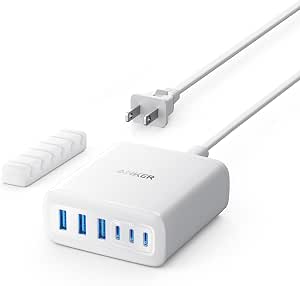 | Best for a Simple Mixed-Port Desk | Ports: 3 USB-C and 3 USB-A | Total power: 112W | Maximum USB-C output: 30W per port | VIEW LATEST PRICE | See Our Full Breakdown |
| 20-Port 270W USB Charging Station with 10 USB-C and 10 USB-A Ports |  | Best for Shared Spaces | Total ports: 20 | Port mix: 10 USB-C and 10 USB-A | Total output: 270W | VIEW LATEST PRICE | See Our Full Breakdown |
| 10-Port 245W GaN Charging Station with Four USB-C Cables |  | Best for Cable-Ready Households | Total ports: 10 | Port mix: 6 USB-C and 4 USB-A | Maximum combined output: 245W | VIEW LATEST PRICE | See Our Full Breakdown |
| MEKIOJEO 12-Port 380W Aluminum Alloy Charging Station |  | Best for Mixed-Device Desks | Total power: 380W | USB ports: 12 total: 8 USB-C and 4 USB-A | Maximum USB-C PD output: 65W on a dedicated port | VIEW LATEST PRICE | See Our Full Breakdown |
| Anker Nano 67W 6-in-1 Charging Station with 5 ft Extension Cord |  | Best Compact Desk and Travel Pick | Model: A9129 | USB ports: 2 USB-C and 2 USB-A | AC outlets: 2 | VIEW LATEST PRICE | See Our Full Breakdown |
| Anker Nano 150W USB-C Charging Station with 4 USB-C and 2 USB-A Ports |  | Best for Fast USB-C Charging | Model: A1A05 | Total output: 150W | Ports: 4 USB-C and 2 USB-A | VIEW LATEST PRICE | See Our Full Breakdown |
| 50W 12-Port USB Charging Station with USB-A and USB-C |  | Best Simple Multi-Device Value | Ports: 12 total: 6 USB-C and 6 USB-A | Total output: 50W | Maximum total current: 10A | VIEW LATEST PRICE | See Our Full Breakdown |
| 150W 30-Port USB-C Charging Station |  | Best for Charging Many Low-Power Devices | Ports: 30 USB-C | Total output: 150W | Output voltage: 5V | VIEW LATEST PRICE | See Our Full Breakdown |
| 380W 8-Port USB-C Charging Station with Four Cables |  | Best for Multiple Laptop Users | Total ports: 8 | Port configuration: 2 × 100W USB-C, 3 × 30W USB-C, 3 × 30W USB-A | Stated total output: 380W | VIEW LATEST PRICE | See Our Full Breakdown |
| Anker 112W 6-Port Desktop Charger | 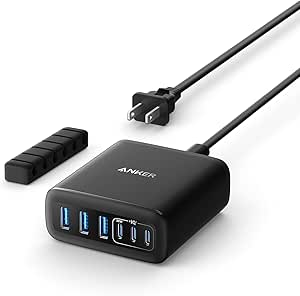 | Best for Compact Desks | Total output: 112W | Ports: 3 USB-C, 3 USB-A | Maximum USB-C output: 30W per port | VIEW LATEST PRICE | See Our Full Breakdown |
| Anker 9-in-1 Desktop Charger and Power Strip with 100W USB-C, Surge Protection, and 5 ft Flat Plug Cord | 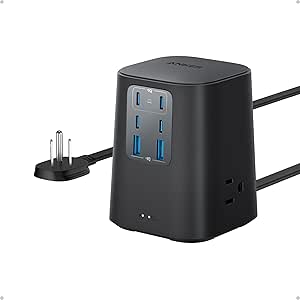 | Best USB-C Station with AC Outlets | AC outlets: 3 | USB ports: 4 USB-C and 2 USB-A | USB-C1/C2 output: Up to 100W each when used individually | VIEW LATEST PRICE | See Our Full Breakdown |
| Zobirez 10-Port 750W Charging Station with 5 USB-C and 5 USB-A Ports |  | Best for Organized Multi-Device Charging | Total ports: 10 | Port configuration: 5 USB-C, up to 120W each; 5 USB-A, up to 30W each | Stated total output: Up to 750W | VIEW LATEST PRICE | See Our Full Breakdown |
| Anker Nano 7-in-1 Charging Station, 100W |  | Best for Cable-Free Desktop Charging | Ports: 3 USB-C, 1 USB-A, 3 AC outlets | Maximum USB-C output: 100W per port when used alone | Retractable cable length: 2.3 ft (70 cm) | VIEW LATEST PRICE | See Our Full Breakdown |
| USB C charging station | Ports |
|---|---|
| 420W 10-Port USB Charging Stat | 10 total, including 5 USB-C |
| Anker Prime 200W 6-Port GaN De | 6 USB ports |
| Anker 6-Port Desktop Charger | 3 USB-C and 3 USB-A |
| 20-Port 270W USB Charging Stat | — |
| 10-Port 245W GaN Charging Stat | — |
| MEKIOJEO 12-Port 380W Aluminum | — |
| Anker Nano 67W 6-in-1 Charging | — |
| Anker Nano 150W USB-C Charging | 4 USB-C and 2 USB-A |
| 50W 12-Port USB Charging Stati | 12 total: 6 USB-C and 6 USB-A |
| 150W 30-Port USB-C Charging St | 30 USB-C |
| 380W 8-Port USB-C Charging Sta | — |
| Anker 112W 6-Port Desktop Char | 3 USB-C, 3 USB-A |
| Anker 9-in-1 Desktop Charger a | — |
| Zobirez 10-Port 750W Charging | — |
| Anker Nano 7-in-1 Charging Sta | 3 USB-C, 1 USB-A, 3 AC outlets |
More Details on Our Top Picks
420W 10-Port USB Charging Station with 5 USB-C Ports
For a household or shared desk with a large mix of devices, this station stands out for its 10 ports, including five USB-C, plus eight short cables in the box. Two wider bays can fit bulkier devices or cases, giving it a more organized setup than the Anker Prime 200W 6-Port GaN Desktop Charging Station, which has fewer ports and no listed device bays. Its described port outputs include two 65W and three 45W connections, so it can serve some laptop and tablet setups alongside phones. The main tradeoff is a conflicting total-output claim: the title says 420W, while product information also lists 320W. I would not choose it based on the headline wattage alone, and the interface details are less clearly specified than Anker’s.
Pros:- Ten ports, including five USB-C connections, support a crowded charging setup.
- Eight short mixed charging cables are included.
- Two wider slots accommodate larger devices or protective cases.
- Built-in protections cover over-current, over-voltage, overcharge, overload, overheating, and short circuits.
Cons:- The listed total output conflicts between 420W and 320W.
- The product data does not clearly identify detailed port-interface specifications.
- Its numerous ports and included bays may be unnecessary for a small desk setup.
Best for: Families or shared workspaces charging many USB-C devices, especially buyers who want included cables and room for larger devices.
Not ideal for: Buyers who need a clearly documented total power budget or precise port-by-port compatibility before connecting several power-hungry devices.
- Ports:10 total, including 5 USB-C
- Listed total output:Up to 420W; product information also lists 320W
- Described fast-charge outputs:Two 65W ports, three 45W ports, and five 30W ports
- Included cables:8 short mixed charging cables
- Wider slot dimensions:Two slots, each 1.57 in wide and 1.77 in high
- Material:Flame-retardant ABS
- Weight:1.6 lb
- Protection:Over-current, over-voltage, overcharge, overload, overheat, and short-circuit protection
Our verdict“Choose it for high device capacity and included organization, but not if you need an unambiguous total-output specification.”
Anker Prime 200W 6-Port GaN Desktop Charging Station
This is the strongest fit here for a desk where fast USB-C laptop charging matters more than the number of ports. The Anker Prime provides six USB ports and can deliver up to 100W from each of two USB-C ports when both are in use, a clearer high-power use case than the Anker 6-Port Desktop Charger, 112W, whose USB-C ports top out at 30W. Temperature monitoring adds a layer of device protection, while its compact footprint keeps it suited to a permanent workstation. The tradeoff is capacity: the 10-Port 245W GaN Charging Station offers more connections and includes USB-C cables, while this Anker includes only an AC cord and is explicitly not intended for travel. Its 1.24-pound weight also makes it less convenient to move between work locations.
Pros:- Two USB-C ports can each provide up to 100W when used simultaneously.
- Six ports allow charging of several devices from one desktop unit.
- Temperature monitoring helps protect connected devices.
- Compact, sturdy shape is suited to a stable desk setup.
Cons:- Not intended for travel.
- At 1.24 lb, it is relatively heavy for moving between workspaces.
- The included package lists an AC cord and guide, but no device charging cables.
Best for: Desk-based laptop users who want to charge two high-power USB-C devices alongside several phones or accessories.
Not ideal for: Travelers, or buyers who need more than six connections and want charging cables included.
- Total output:200W
- Ports:6 USB ports
- USB-C output:Up to 100W per port when two USB-C ports are used simultaneously
- Dimensions:4.4 × 3.0 × 1.4 in
- Weight:1.24 lb
- Power source:Corded electric
- Included:5 ft AC power cord and welcome guide
- Warranty:24 months
Our verdict“Pick this Anker for a stationary desk that needs high-output USB-C charging, rather than maximum port count or portability.”
Anker 6-Port Desktop Charger, 112W
The appeal here is a straightforward balance: three USB-C and three USB-A ports in a small desktop charger, with a silicone organizer to keep cords from spreading across the desk. Compared with the Anker Prime 200W 6-Port GaN Desktop Charging Station, this model gives up substantial USB-C output—30W maximum per USB-C port rather than up to 100W on two Prime ports—but it still suits phones, earbuds, and many tablets without paying for laptop-focused power. Its 10.65-ounce weight and compact dimensions also make it easier to reposition than the heavier Prime. The limit is clear for laptop owners: 30W USB-C charging is not the reason to buy this unit, and cables are not included. I’d choose it for everyday mixed-device charging, not as a workstation’s main high-power laptop supply.
Pros:- Three USB-C and three USB-A ports cover both newer and older devices.
- Compact dimensions suit a crowded desk.
- Light 10.65-ounce build is easier to reposition than the Anker Prime 200W.
- Included silicone organizer helps keep charging cables grouped.
Cons:- USB-C output is limited to 30W per port.
- USB-C charging cables are not included.
- Its 112W total output is less suited to several high-demand devices charging together.
Best for: Phone and tablet users who want a compact desk charger with both USB-C and USB-A ports and a simple cable organizer.
Not ideal for: Laptop users who need high-wattage USB-C charging or buyers who want charging cables supplied in the box.
- Ports:3 USB-C and 3 USB-A
- Total power:112W
- Maximum USB-C output:30W per port
- Maximum USB-A output:18W per port
- Dimensions:3.0 × 3.2 × 1.3 in
- Weight:10.65 oz (302 g)
- Included accessory:Silicone cable organizer
- Warranty:18 months
Our verdict“Choose this model for tidy, everyday phone and tablet charging, but select the Anker Prime if your setup depends on laptop-level USB-C power.”
20-Port 270W USB Charging Station with 10 USB-C and 10 USB-A Ports
With 20 total ports and 11 adjustable dividers, this station is built for classrooms, offices, or family charging areas where keeping many phones and tablets together matters more than fast charging. Its ten USB-C ports give it a newer-device mix than the 20-port count alone suggests, while removable dividers let buyers adjust the bays for different cases. The 10-Port 245W GaN Charging Station is a more sensible desk choice when some laptop charging is needed; this 20-port model lists USB-C output at only 5V/3A per port and USB-A at 5V/2.4A, so it is focused on lower-power devices. Ten mixed cables are included, but the North American two-pin Type A plug narrows its fit. The large capacity is useful, though it can be excessive for a personal desk.
Pros:- Twenty ports serve a large number of devices at one station.
- Ten USB-C and ten USB-A ports support a mix of newer and older devices.
- Eleven adjustable, removable dividers help separate devices and accommodate cases.
- Includes ten mixed USB cables and multiple electrical protections.
Cons:- USB-C output is limited to 5V/3A per port, so it is not a high-power laptop charger.
- The two-pin North American Type A plug limits compatibility in other regions.
- Its 20-port capacity may take up space without benefit in a small personal setup.
Best for: Schools, offices, and households that need a shared, organized place to charge many phones, tablets, and other lower-power USB devices.
Not ideal for: Laptop users seeking high-wattage USB-C charging, or buyers outside North America who need a different plug type.
- Total ports:20
- Port mix:10 USB-C and 10 USB-A
- Total output:270W
- USB-C output:Up to 5V/3A per port
- USB-A output:Up to 5V/2.4A per port
- Dividers:11 adjustable, removable
- Included cables:10 mixed USB cables
- Plug type:Type A, 2-pin North American
- Safety features:Over-temperature, over-voltage, overload, short-circuit, and overcurrent protection
Our verdict“Choose this station for a shared charging area with many phones and tablets, not for fast-charging laptops or a compact desk.”
10-Port 245W GaN Charging Station with Four USB-C Cables
This station pairs a 10-port layout with four included USB-C cables, which makes it a convenient fit for a shared home desk where several devices need charging straight out of the box. Six USB-C ports and four USB-A ports give it a more USB-C-heavy mix than the 420W 10-Port USB Charging Station, while its detachable five-foot power cord can make placement easier. The first USB-C port supports up to 65W for a laptop; the other ports are listed at up to 20W each, so buyers should not treat all six USB-C connections as laptop-ready. Compared with the Anker Prime 200W, it offers more ports and cables but less clearly specified high-power USB-C capability beyond that first port. The manual may contain incorrect information, another reason to verify setup details.
Pros:- Ten ports include six USB-C and four USB-A connections.
- The first USB-C port supports up to 65W for a laptop.
- Four USB-C-to-USB-C cables are included in two lengths.
- Detachable five-foot power cord offers flexible placement.
Cons:- Only the first USB-C port is specified for laptop charging.
- The other ports provide up to 20W each, limiting their suitability for higher-power devices.
- The manual may contain incorrect information.
Best for: Households or shared desks that need many mixed-device ports, included USB-C cables, and one higher-output laptop connection.
Not ideal for: Buyers who need multiple laptops charged at high speed or want thoroughly consistent documentation for every port.
- Total ports:10
- Port mix:6 USB-C and 4 USB-A
- Maximum combined output:245W
- First USB-C port:Up to 65W
- Other port output:Up to 20W each
- Power cord:Detachable, 5 ft
- Included USB-C cables:2 × 6.6 ft and 2 × 3.3 ft USB-C-to-USB-C cables
- Input voltage:110V AC
- Warranty:24 months
Our verdict“Pick this station for a cable-ready shared setup with one laptop connection, but choose the Anker Prime for clearer support for two high-power USB-C devices.”
MEKIOJEO 12-Port 380W Aluminum Alloy Charging Station
The MEKIOJEO stands out for pairing eight USB-C ports with four USB-A ports, giving a shared desk more USB-C capacity than the 12-port 50W USB Charging Station, which splits its connections evenly between the two types. Its listed 380W total output and dedicated 65W USB-C PD port make it a better fit for a laptop alongside phones and accessories, though the 65W output is confined to that port. The aluminum body and GaN design are aimed at managing heat in a crowded setup, while the five-foot cord adds placement flexibility. Compared with the Anker Nano 150W station, this model offers twice as many ports but is less clearly suited to buyers prioritizing a portable, lightweight charger. It still needs a 120V outlet and is not a battery-powered option.
Pros:- Eight USB-C and four USB-A ports accommodate a varied collection of devices
- Dedicated 65W USB-C PD port supports compatible laptop charging
- Aluminum alloy body is designed to dissipate heat and resist scratches
- Five-foot cord allows flexible placement on a desk
Cons:- The 65W output is limited to one dedicated USB-C port
- Requires a corded 120V power source
- Its high port count may be unnecessary for people charging only a few devices
Best for: Households or shared desks with several USB-C devices plus a laptop that can charge through the dedicated 65W port
Not ideal for: People who need multiple high-power laptop ports, a built-in battery, or charging away from a 120V outlet
- Total power:380W
- USB ports:12 total: 8 USB-C and 4 USB-A
- Maximum USB-C PD output:65W on a dedicated port
- Other listed outputs:30W and 20W
- Material:Aluminum alloy
- Charging technology:GaN
- Power cord:5 ft (1.5 m)
- Input voltage:120V
Our verdict“Choose the MEKIOJEO if your desk needs many USB-C connections and one dedicated laptop-charging port, but skip it if several devices need high-power USB-C charging at once.”
Anker Nano 67W 6-in-1 Charging Station with 5 ft Extension Cord
The Anker Nano is the lineup’s most flexible small-format choice for someone who wants USB-C charging and AC outlets in one compact unit. Its two USB-C and two USB-A ports sit alongside two AC outlets, so it can power accessories that still use a conventional plug—something the USB-only MEKIOJEO 12-Port station cannot do. USB-C output reaches 67W, but the provided details do not promise that full output across both ports at once. The five-foot cord and flat plug help with awkward outlet placement, while the small footprint suits a bag or crowded desk. The tradeoff is capacity: it has half the USB port count of the Anker Nano 150W, and it lacks surge protection. The cord is also fixed rather than detachable.
Pros:- Combines two USB-C ports, two USB-A ports, and two AC outlets
- USB-C output supports charging up to 67W
- Compact body, flat plug, and five-foot cord help with travel and tight spaces
- Housing uses 75% post-consumer recycled plastics
Cons:- No surge protection is listed
- Power cord is not detachable
- Six total connections provide less USB charging capacity than the 12-port MEKIOJEO
Best for: Travelers and compact-desk users who need a laptop-capable USB-C connection, a few device ports, and two AC outlets
Not ideal for: People charging many USB devices at once or anyone who needs surge protection for connected equipment
- Model:A9129
- USB ports:2 USB-C and 2 USB-A
- AC outlets:2
- Maximum USB-C output:67W
- Maximum USB-A output:12W
- Cord length:5 ft (1.5 m), non-detachable
- Dimensions:3.94 × 3.66 × 0.75 in
- Surge protection:None
- Housing material:75% post-consumer recycled plastics
Our verdict“Pick this Anker for a compact mix of USB charging and AC outlets, but choose a higher-port-count station if you regularly charge a crowd of devices.”
Anker Nano 150W USB-C Charging Station with 4 USB-C and 2 USB-A Ports
For buyers who value charging speed over a very large port count, the Anker Nano 150W is the strongest match here. Its four USB-C ports include two that can each reach 100W when used individually, a more capable laptop-charging arrangement than the MEKIOJEO’s single dedicated 65W port. PowerIQ 4.0 distributes power among connected devices, so six devices can share one AC outlet without requiring a separate charger for each. The compact 0.64-pound body also makes it easier to pack than the 12-port 50W station, though its six connections serve fewer devices. It is a corded charger, not a power bank, and the package does not include charging cables. Buyers needing AC outlets, wireless charging, or USB data-hub functions should look elsewhere.
Pros:- Four USB-C and two USB-A ports charge up to six devices
- USB-C1 and USB-C2 each support up to 100W when used individually
- PowerIQ 4.0 distributes power among connected devices
- Lightweight body suits travel and small workspaces
Cons:- Requires AC power and cannot work as a power bank
- Charging cables are not included
- Provides six ports rather than the 12 available on the MEKIOJEO station
Best for: Laptop owners and mobile professionals who want a portable, multiport USB-C station with high output available from either of its first two ports
Not ideal for: People who need more than six charging connections, AC outlets, included cables, or charging without wall power
- Model:A1A05
- Total output:150W
- Ports:4 USB-C and 2 USB-A
- Maximum individual USB-C output:100W on USB-C1 or USB-C2 when used individually
- Weight:0.64 lb without cord; 0.84 lb with cord
- Dimensions:5.9 × 2.7 × 0.87 in
- Input:AC power
- Included charging cables:None
- Built-in battery:No
Our verdict“Choose the Anker Nano 150W if laptop charging speed and portability matter more than maximizing the number of connected devices.”
50W 12-Port USB Charging Station with USB-A and USB-C
This station suits buyers who need many basic charging connections more than high-speed laptop power. Its six USB-C and six USB-A ports give it a balanced layout for older and newer phones, earbuds, and other low-voltage devices. Compared with the 30-port USB-C station, it offers fewer connections but adds USB-A support and a detachable cord, making it a more adaptable choice for mixed-device households. The stated 50W total output and 2.4A maximum per port set a clear limit: this is not a substitute for a high-wattage USB-C PD station like the Anker Nano 150W, and the provided specs do not list a fast USB-C PD output. The compact shell and electrical protections help with everyday organization, but every device still needs a wall outlet for power.
Pros:- Six USB-C and six USB-A ports support a mix of newer and older devices
- Detachable 1.4 m cord makes packing and replacement easier
- Compact body suits a desk or travel kit
- Lists protections for overheating, overcharging, overcurrent, overload, and short circuits
Cons:- 50W total output is modest for charging many devices at once
- Maximum stated current is 2.4A per port, with no USB-C PD output listed
- Requires a power outlet and cannot charge devices independently
Best for: Families or shared spaces charging several phones, earbuds, and other standard USB devices without needing laptop-level USB-C power
Not ideal for: Laptop users or anyone seeking high-speed USB-C PD charging and substantial power for several devices at once
- Ports:12 total: 6 USB-C and 6 USB-A
- Total output:50W
- Maximum total current:10A
- Maximum current per port:2.4A
- Output voltage:5V
- Input:100–240V, 50/60Hz
- Dimensions:13.5 × 6 × 3 cm
- Power cord:1.4 m, detachable
- Protection features:Overheat, overcharge, overcurrent, overload, and short-circuit protection
Our verdict“Choose this station for numerous everyday USB connections at modest power, not for fast laptop charging or demanding multi-device loads.”
150W 30-Port USB-C Charging Station
With 30 USB-C ports, this station is built around one particular need: organizing a large group of low-voltage devices at a shared charging point. That capacity far exceeds the 12-port MEKIOJEO, but the headline port count does not mean laptop-ready power. The listed output is 5V and up to 2.4A per port, so this model is better suited to phones and similar USB devices than laptops or other equipment that needs high-wattage USB-C PD. Its 150W total output is divided across as many as 30 connections, which can limit charging speed when the ports are in use. Compared with the 50W 12-Port USB Charging Station, it offers much more USB-C capacity but gives up USB-A ports. It also depends on a corded power source.
Pros:- Provides 30 USB-C ports for a centralized charging area
- 150W total output supports a large group of low-voltage USB devices
- Includes overcurrent, overcharging, and short-circuit protection
- Power cable is included
Cons:- 5V output and 2.4A stated per-port limit are not suited to laptop-level USB-C PD
- All ports are USB-C, so devices needing USB-A connections require separate adapters or cables
- Power is shared across a large number of connections, which can constrain charging speed
Best for: Schools, event teams, or shared offices that need many USB-C connections for phones and other low-voltage devices
Not ideal for: Laptop owners, users needing USB-C PD, or anyone expecting all 30 devices to charge at high speed
- Ports:30 USB-C
- Total output:150W
- Output voltage:5V
- Total output current:30A
- Maximum current per port:5V/2.4A stated
- Input voltage:240V
- Power source:Corded electric
- Included accessories:Power cable
- Protection:Overcurrent, overcharging, and short-circuit protection
Our verdict“Pick this station for high-volume charging of USB-C phones and similar low-power devices, but not for laptops or fast charging.”
380W 8-Port USB-C Charging Station with Four Cables
For a shared desk where several people need USB-C charging, this station stands out for pairing two 100W USB-C ports with six additional ports and four included cables. That makes it more ready to use out of the box than the Anker 112W 6-Port Desktop Charger, which includes a cable organizer but no charging cables and caps USB-C ports at 30W each. The tradeoff is that the stated 380W total output is shared across connected devices, so two laptop ports do not mean every device always gets its maximum rate. Its three USB-A ports also make it useful for older accessories, while the GaN III design is intended to keep a high-capacity unit compact. I’d choose it for a mixed-device household or office, but not for buyers who need predictable full-speed charging on every port at once.
Pros:- Two USB-C ports rated up to 100W can serve compatible laptops.
- Eight total ports support a mix of USB-C and USB-A devices.
- Includes four USB-C cables and a 5 ft power cord.
- GaN III technology is designed to support a compact form and heat management.
Cons:- Available power is distributed across ports when several devices are connected.
- The listed 3A output current may limit charging for some devices.
Best for: Households or small teams charging multiple laptops, phones, and tablets from one shared desktop station.
Not ideal for: People who need guaranteed maximum charging speed on several devices simultaneously or want a precise per-port power allocation.
- Total ports:8
- Port configuration:2 × 100W USB-C, 3 × 30W USB-C, 3 × 30W USB-A
- Stated total output:380W
- Charging technology:GaN III
- Input voltage:100–240V
- Included cables:1 × 3.3 ft 100W braided USB-C cable, 2 × 3.3 ft USB-C-to-USB-C cables, 1 × 6.6 ft USB-C-to-USB-C cable
- Included power cord:5 ft
Our verdict“Choose this station for a shared setup that needs two high-power laptop ports, plentiful connections, and included cables.”
Anker 112W 6-Port Desktop Charger
My compact-desk pick is the Anker 112W 6-Port Desktop Charger: its footprint is just 3.0 × 3.2 inches, yet it provides three USB-C and three USB-A ports. Compared with the 380W 8-Port USB-C Charging Station with Four Cables, it gives up high-power laptop charging and two ports, but takes up less room and includes a silicone organizer to keep cables together. Each USB-C port is rated up to 30W, a practical fit for phones, tablets, earbuds, and some lightweight devices rather than demanding laptops. The key catch is that charging cables are not included, so the tidy organizer does not make it ready to charge on its own. I’d pick it for a neat bedside or work desk with existing cables, not as a laptop-centric hub.
Pros:- Six ports combine three USB-C and three USB-A connections.
- Compact 3.0 × 3.2 × 1.3 in body suits crowded desks.
- Silicone cable organizer helps keep charging leads grouped.
- USB-A ports provide a home for older accessories.
Cons:- USB-C output is limited to 30W per port.
- USB charging cables are not included.
Best for: Desk and bedside users who already own cables and want six mixed USB ports in a small footprint.
Not ideal for: Laptop users who need USB-C charging above 30W per port, or buyers who want cables included.
- Total output:112W
- Ports:3 USB-C, 3 USB-A
- Maximum USB-C output:30W per port
- Maximum USB-A output:18W per port
- Dimensions:3.0 × 3.2 × 1.3 in (77 × 82 × 33 mm)
- Weight:10.65 oz (302 g)
- Included accessories:Silicone cable organizer
- USB charging cables:Not included
Our verdict“Pick this small desktop charger for phones and tablets if you value a tidy footprint more than fast laptop charging.”
Anker 9-in-1 Desktop Charger and Power Strip with 100W USB-C, Surge Protection, and 5 ft Flat Plug Cord
This Anker is the most convincing fit for someone who wants a USB-C charging station and a small power strip in one desktop unit. Alongside six USB ports, it has three AC outlets, so a laptop charger, monitor, or desk lamp can share the same cord. Its USB-C1 and USB-C2 ports each reach up to 100W when used individually, giving compatible laptops more headroom than the 30W USB-C ports on the Anker 112W 6-Port Desktop Charger. That speed claim has a clear limit: it applies to either port used alone, not both delivering 100W at the same time. The 300-joule surge protection and flat-plug 5 ft cord add practical desk utility, though the plastic enclosure may feel less substantial than a dedicated charging station with a metal body.
Pros:- Three AC outlets and six USB ports combine desk power and device charging.
- USB-C1 and USB-C2 support up to 100W when each is used individually.
- 300-joule surge protection and an 8-point safety system are specified.
- 5 ft cord with a flat plug can suit tight spaces behind furniture.
Cons:- The 100W rating applies to USB-C1 or USB-C2 when used individually.
- Plastic enclosure may be less appealing to buyers seeking a more substantial build.
Best for: Laptop users building a desk setup who also need AC outlets for a monitor, lamp, or other equipment.
Not ideal for: Buyers seeking several simultaneous high-wattage USB-C laptop outputs or a charging-only station with no extra AC outlets.
- AC outlets:3
- USB ports:4 USB-C and 2 USB-A
- USB-C1/C2 output:Up to 100W each when used individually
- Surge protection:300 joules
- Safety system:8-point
- Cord length:5 ft
- Voltage:125V
- Enclosure material:Plastic
Our verdict“Choose this Anker when AC outlets matter as much as USB-C charging and you can work within its single-port 100W limit.”
Zobirez 10-Port 750W Charging Station with 5 USB-C and 5 USB-A Ports
The Zobirez stands apart from the other picks with fixed device slots, ten ports, and ten included charging cables. The upright bays can keep phones and smaller devices organized, while two wider spaces accommodate larger devices or cases; that makes it more of a charging dock than the cable-focused 380W 8-Port USB-C Charging Station with Four Cables. Five USB-C ports are listed at up to 120W each, but buyers should match that claim against their own device and cable capabilities rather than assume every laptop will charge at that rate. The station is also specified for 120V input, which narrows its fit compared with models listing a wider input range. I’d favor it for a busy home with many devices to park and charge, not for a portable setup or a buyer who needs broad input-voltage compatibility.
Pros:- Ten total ports support up to five USB-C and five USB-A devices.
- Fixed slots keep devices upright, with two wider bays for larger devices or cases.
- Includes ten short charging cables for several device types.
- Lists over-current, over-voltage, overload, overheat, overcharge, and short-circuit protections.
Cons:- Actual laptop charging speeds depend on device and cable compatibility.
- The listed 120V input may limit use in locations with different mains voltage.
Best for: Families or shared offices that want to charge and store many phones, tablets, and compatible laptops upright in one place.
Not ideal for: Travelers needing a compact station or buyers who require input-voltage compatibility beyond the listed 120V.
- Total ports:10
- Port configuration:5 USB-C, up to 120W each; 5 USB-A, up to 30W each
- Stated total output:Up to 750W
- Input voltage:120V
- Material:Flame-retardant ABS
- Included cables:1 × 3.28 ft 100W USB-C-to-USB-C cable, 5 short USB-C cables, 2 short iPhone cables, 2 short Micro USB cables
- Protection:Over-current, over-voltage, overload, overheat, overcharge, and short-circuit protection
Our verdict“Choose the Zobirez for a stationary, high-capacity family charging dock where organized device storage matters as much as USB-C output.”
Anker Nano 7-in-1 Charging Station, 100W
For a compact desk where loose charging leads are the main annoyance, the Anker Nano 7-in-1 has a distinct advantage: two built-in USB-C cables retract into the unit when not in use. It also combines three USB-C ports, one USB-A port, and three AC outlets, giving it more connection variety than the Anker 112W 6-Port Desktop Charger, which has more USB ports but no AC outlets or built-in leads. The LCD shows charging status, and each USB-C port is rated up to 100W when used alone. That rating is not a promise of full power across multiple connected devices, since output is shared. The 2.3 ft retractable leads suit close desktop use rather than distant devices, and the power cord itself does not retract. I’d choose it for a tidy workstation, not a room-wide charging hub.
Pros:- Two retractable USB-C cables reduce loose leads on the desktop.
- Combines three USB-C ports, one USB-A port, and three AC outlets.
- LCD display shows charging status.
- 300J surge protection and an adhesive pad are specified.
Cons:- USB-C power is shared across ports when multiple devices are connected.
- Retractable cables extend only 2.3 ft and suit nearby desktop devices.
- The power cord is not retractable.
Best for: Desk users who want built-in USB-C leads, charging-status visibility, and AC outlets in one compact station.
Not ideal for: People charging devices more than a few feet from the station or expecting multiple USB-C devices to receive full 100W simultaneously.
- Ports:3 USB-C, 1 USB-A, 3 AC outlets
- Maximum USB-C output:100W per port when used alone
- Retractable cable length:2.3 ft (70 cm)
- Dimensions:4.76 × 2.86 × 2.09 in (121 × 72.6 × 53.2 mm)
- Weight:21.69 oz (615 g)
- Surge protection:300J
- Input voltage:240V
- Enclosure material:Plastic
Our verdict“Pick the Nano for a tidy workstation with nearby devices, built-in USB-C leads, and occasional AC outlet needs.”
How We Picked
I ranked these USB-C charging stations by how well their stated power, port mix, and physical setup fit common charging jobs. I weighed total output alongside port count, since a large number of connections can still mean modest power per device when several gadgets charge together. I also looked at the balance of USB-C and USB-A, included cables, extension cords, and added power-strip features, because these details affect desk fit and everyday convenience.
The ranking favors useful power and a practical layout over the biggest headline wattage or port count alone. That puts the Anker Prime 200W near the top as a balanced desktop choice, while high-capacity stations rank better for shared or bulk charging than for a few power-hungry devices. Compact models earn a place for simpler setups, and products with less output or older-port emphasis suit narrower needs. Where product names provide limited detail about per-port output or power sharing, I avoid assuming that every port can deliver its maximum simultaneously.
Factors to Consider When Choosing USB C Charging Stations
Before choosing a station, I would map the devices you actually charge together, then match that pattern to the station’s output and layout. A large number on the box can hide limits in how power is shared, while extra ports may go unused on a personal desk. These factors help separate a convenient everyday charger from a station built for a household, office, or organized charging shelf.
Match Total Output to Simultaneous Charging
Start with the devices you expect to charge at the same time, not the sum of every device in the house. A laptop can draw far more power than earbuds or a phone, so several small devices may fit comfortably on a modest station while a laptop-heavy setup calls for greater output. Check the station’s stated total wattage and, when available, the maximum output of each port and the power-sharing rules. A high total figure describes the station’s overall capacity, not a promise that each connected device gets its preferred rate. If the manufacturer does not spell out per-port limits, leave extra headroom rather than building a setup around an assumption.
Choose Ports for Your Actual Device Mix
Count USB-C and USB-A devices separately, including accessories that still use older cables. A USB-C-heavy station can reduce the need for adapters as newer phones, tablets, and laptops move to that connector, but a household with legacy accessories may still benefit from USB-A ports. A station with many total ports may be less useful than one with fewer ports in the right mix. Also check whether ports are spaced and arranged so that bulky plugs or adapters do not block neighbors. Planning for the devices you use now, plus a small amount of near-term growth, helps avoid paying for a port layout that does not suit your cables.
Separate High Port Count From Fast Charging
Port count answers how many devices can be connected; it does not answer how quickly they charge. A 30-port station with a lower total output may suit low-power accessories better than laptops, even though it can connect a much larger group. For mixed devices, prioritize the power available to the ports you will use for laptops or tablets, then check what remains when other ports are occupied. Avoid choosing by a headline wattage alone if the station’s sharing behavior is unclear. This distinction is especially useful when comparing high-capacity group stations with compact desktop chargers.
Decide Whether Built-In Cables Help or Hinder
Integrated cables can make a shared charging point tidier and save the trouble of supplying a separate cable for every device. They are less flexible if their length, connector type, or placement does not fit the devices being charged. A built-in cable can also be harder to replace than a detachable one if it becomes damaged. For a fixed shelf where several people charge similar devices, included cables may be a practical convenience; for a changing mix of gadgets, open ports and replaceable cables offer more choice. Check cable reach against the distance from the station to the device, not just the distance to the wall outlet.
Check Desk Placement, Cord Reach, and AC Needs
Measure the space where the station will sit and note where the nearest outlet is before selecting a large multi-port unit. An extension cord or flat plug can make placement easier, while a heavier station may work better as a stationary charging hub than as a portable accessory. If you also need to plug in a lamp, monitor, or other AC device, a model with power-strip outlets can serve a different role from a USB-only station. Surge protection is a separate feature from USB charging capacity, so check that it is explicitly listed if it matters to your setup. Keep ventilation and access to ports in mind when placing a high-output station among other desk equipment.
Pay for Capacity You Can Use
More wattage and more ports are worthwhile when several people charge at once or when the station handles power-hungry devices. They add little value if you mainly charge a phone, watch, and earbuds, where a smaller station may take up less room and simplify cable management. At the same time, buying too close to your current needs can leave no room for a laptop or an additional family device later. I would prioritize a sensible margin for likely new devices over a large capacity chosen only for its headline specification. The best value is the station whose port layout and output match a real charging routine, not simply the model with the biggest numbers.
Frequently Asked Questions
Does a station with more USB-C ports charge each device faster?
No. More USB-C ports give you more places to connect devices, but charging speed depends on the output available to each port and how the station shares power. When several devices draw power together, a station may reduce output to one or more ports. Compare per-port ratings and simultaneous-use details where available, especially if you plan to charge a laptop alongside phones. If those details are missing, treat the headline wattage as a total capacity figure rather than a guarantee for every connection.
Can a high-wattage charging station safely charge a phone with a lower power requirement?
A station’s maximum wattage is its available capacity, not power forced into every connected device. Compatible devices and chargers negotiate the power they can use, so a phone does not automatically draw the station’s full output. Still, check that the station supports the charging standards required by your devices and comes from a reputable manufacturer. For a mixed collection that includes phones, tablets, and laptops, port-specific output information is more useful than total wattage alone. If a device has an unusual charging requirement, check its documentation before buying.
Should I choose a station with built-in cables or use my own?
Built-in cables suit a fixed charging spot where the included connectors and reach match the devices that use it. They can reduce clutter and make a shared station easier to use without everyone bringing a cable. Detachable cables are a better fit if devices change often, cable lengths need to vary, or you want to replace a damaged cable independently. Check whether the built-in cables are USB-C, how far they reach, and whether enough separate ports remain for your other devices. If the details do not match your setup, a station with open ports gives you more control.
Is a USB charging station with 20 or 30 ports a good choice for a family?
It can be a good fit when many low-power devices need a shared place to charge, such as earbuds, watches, and phones. The important question is whether the station has enough total output for the devices charging at the same time, not just enough ports for everyone to plug in. A high port count can be less useful if laptop charging is part of the routine or if power is spread thin across occupied ports. Think about where the station will sit, how devices will be identified, and whether you need USB-C-only connections or a USB-A mix. For a smaller household, a lower-port model with more power available to each device may be more practical.
When is a charging station with AC outlets and surge protection worth choosing?
Choose a model with AC outlets when you want one desktop unit to handle both USB charging and plug-in equipment, such as a lamp or monitor. Surge protection may also be useful when the station is meant to act as a small power hub rather than a USB-only charger. Those features do not automatically mean its USB ports provide more power, so compare USB output separately. Check the number and placement of AC outlets, cord reach, and the stated protection details against your needs. If you only need to charge USB devices, a simpler station may take up less space and avoid features you will not use.
Conclusion
For most desks, my best overall recommendation is the Anker Prime 200W 6-Port GaN Desktop Charging Station: it offers a more balanced combination of output and port count than the bulkier high-port alternatives. The best value for a large shared setup is the 420W 10-Port Station, especially if its five USB-C ports fit your device mix; buyers who need maximum connection count should compare it with the 20-port 270W and 30-port 150W models, while recognizing that more ports do not mean faster charging. For a best premium, multi-purpose choice, the Anker 9-in-1 is the standout when AC outlets and surge protection matter alongside USB charging. Beginners with a small desk setup can start with the Anker Nano 67W 6-in-1 and its extension cord, while anyone who wants built-in cables should compare the 245W 10-port and 380W 8-port stations against their cable needs. For mixed USB-A and USB-C collections, the Zobirez 10-Port 750W model offers an even split; for an all-USB-C group, the 150W 30-Port station is the more specialized option. Match your choice to the devices you charge together and the power each needs, rather than buying by port count alone.