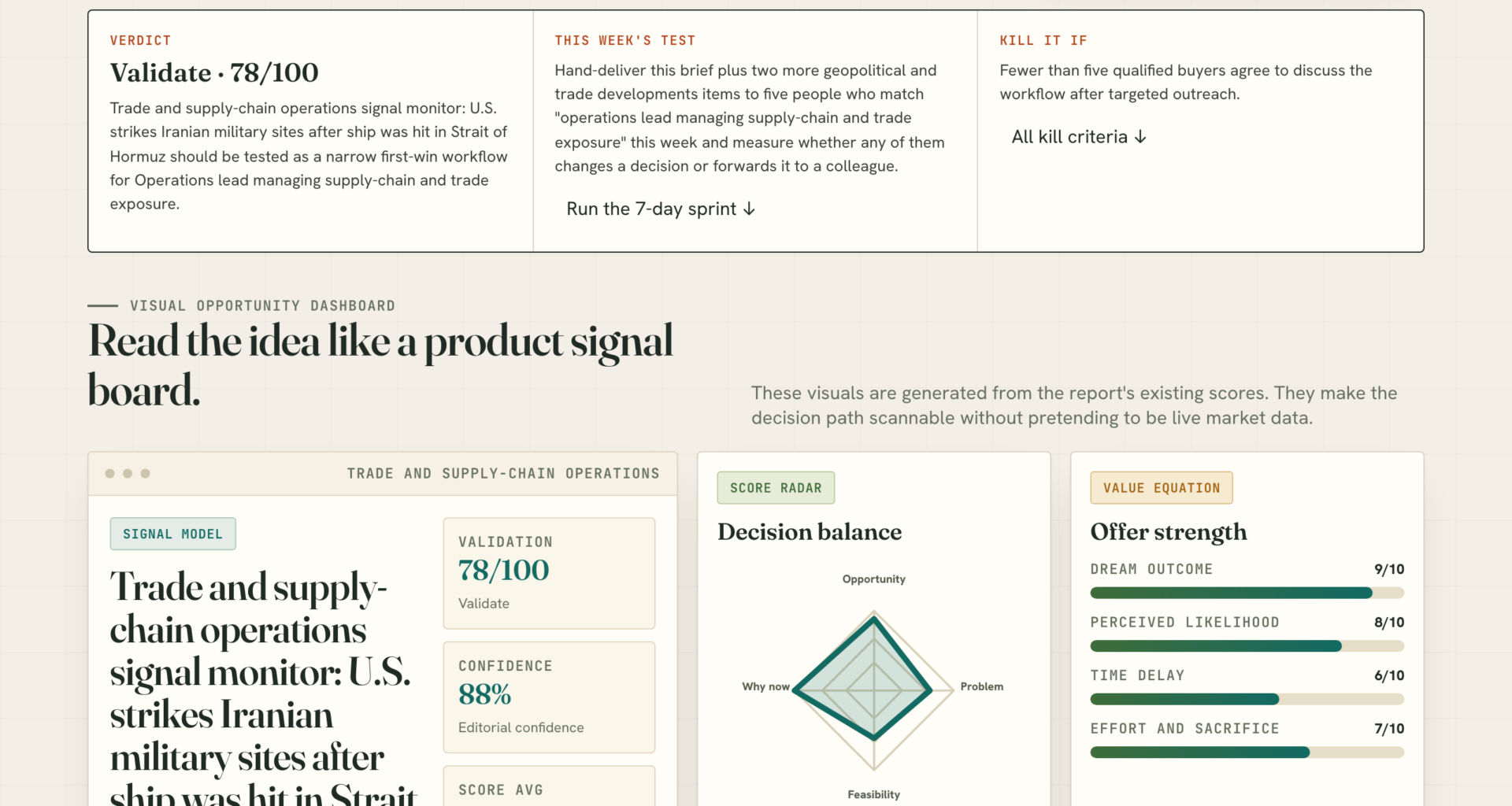

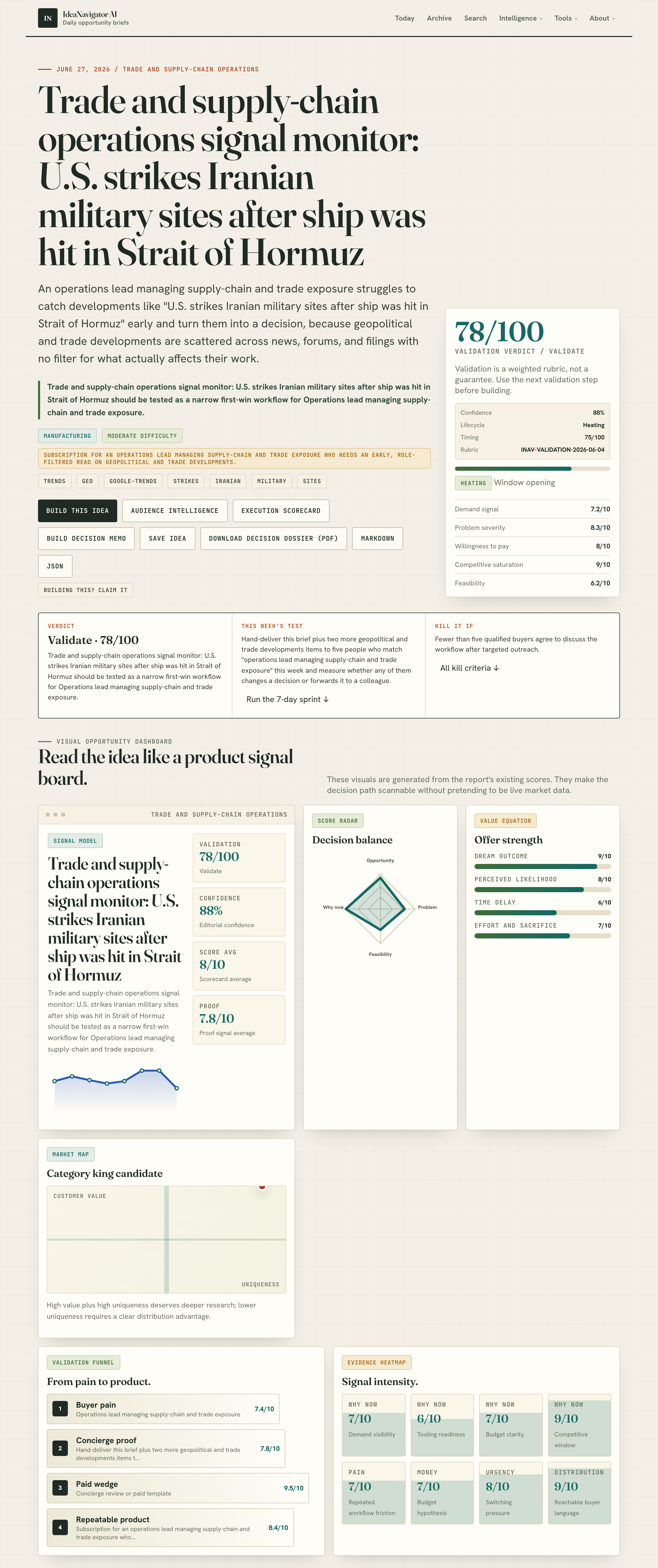
📊 Full opportunity report: Trade and supply-chain operations signal monitor: U.S. strikes Iranian military sites after ship was hit in Strait of Hormuz on IdeaNavigator AI — validation score, market gap, and execution plan.
Listen free for 30 days with Audible
Thousands of audiobooks and originals — cancel anytime.
Start your free trialAs an affiliate, we earn on qualifying purchases.
TL;DR
The U.S. conducted military strikes against Iranian military sites after a commercial ship was hit in the Strait of Hormuz. This development has significant implications for regional stability and global trade routes.
The United States has launched military strikes against Iranian military sites in response to an attack on a commercial ship in the Strait of Hormuz, according to official U.S. military statements. This escalation comes amid rising tensions over maritime security and regional stability, with immediate implications for global trade routes and supply chains.
U.S. officials confirmed that the strikes targeted Iranian military infrastructure believed to be responsible for the attack on a commercial vessel in the Strait of Hormuz. The operation was conducted early this morning and involved missile strikes on multiple Iranian military sites, including radar and missile launch facilities, as reported by the Pentagon.
Iranian authorities have not officially responded to the strikes, though state media have condemned what they describe as unwarranted aggression. The incident follows recent tensions in the region, where Iran and the U.S. have exchanged warnings and military posturing over maritime security concerns.
Analysts note that this military action marks a significant escalation in the ongoing maritime conflict, which has previously involved proxy engagements and political rhetoric. The strike’s precise targets and the extent of Iranian military capability affected remain undisclosed, with Iran’s government calling for restraint.
Implications for Regional Stability and Global Trade
This military action by the U.S. underscores the escalation of tensions in the Strait of Hormuz, one of the world’s most critical maritime chokepoints. The attack on a commercial vessel and subsequent strikes could disrupt global oil supplies and trade routes, increasing volatility in energy markets and supply chains worldwide.
For international businesses and governments, the event highlights the heightened risk of maritime conflict in the region, which could lead to increased insurance costs, shipping delays, and broader geopolitical instability. The incident also signals a potential shift in U.S. policy toward Iran, possibly prompting regional allies to reassess their security strategies.

Alarm System for Home Security,24Pcs WiFi+GSM/4G No Monthly Fee Wireless Security System, Phone App Control,Real-Time Alert,Auto Alarm Dial,Compatible with Alexa & Google,No Monthly Fee
- Remote App Control: Manage system remotely via app
- Event Log Viewing: Check alarm history anytime
- Family Access Sharing: Share access with family members
As an affiliate, we earn on qualifying purchases.
As an affiliate, we earn on qualifying purchases.
Recent Escalations in Iran-U.S. Maritime Tensions
Over the past year, tensions between Iran and the United States have intensified, especially over Iran’s nuclear program and regional influence. Several incidents involving ships and military vessels have raised alarms, with Iran often denying involvement in attacks attributed to it by Western nations. The Strait of Hormuz has been a focal point, with Iran threatening to close the waterway and the U.S. increasing naval presence.
The attack on the commercial ship, which was not publicly identified but described as a significant maritime incident, prompted the U.S. to respond militarily for the first time in recent months. Prior to this, diplomatic efforts to de-escalate had been ongoing, but recent events suggest a hardening of positions.
This escalation follows a series of warnings from U.S. officials about Iran’s military activities and attempts by Iran to develop advanced missile systems, which they claim are defensive. The current strikes are viewed as a direct response to the attack, though Iran has condemned the military action.
“The strikes targeted Iranian military infrastructure responsible for recent hostile actions in the Strait of Hormuz.”
— U.S. Pentagon spokesperson

Optimus 3.0 GPS Tracker Bundle – Vehicle & Asset Tracking – 1+ Mo Battery
- Real-Time GPS Tracking: Accurate and discreet tracking
- Heavy Duty Magnet Case: Secure attachment to vehicles and assets
- Monthly Subscription Required: Service plan needed for operation
As an affiliate, we earn on qualifying purchases.
As an affiliate, we earn on qualifying purchases.
Unconfirmed Details and Regional Reactions
It is not yet clear whether Iran’s military infrastructure was significantly damaged or if there will be further retaliatory actions. The full extent of the attack’s impact on regional security and shipping routes remains unknown, and Iran’s next move is unpredictable at this stage.
International reactions are still emerging, with some allies urging restraint and others calling for increased security measures in the Strait of Hormuz. The broader geopolitical implications are still unfolding as assessments and diplomatic responses develop.

Maritime Autonomous Vehicles: Methods and measurements (Radar, Sonar and Navigation)
As an affiliate, we earn on qualifying purchases.
As an affiliate, we earn on qualifying purchases.
Expected Developments and Diplomatic Responses
Further military actions or retaliations by Iran cannot be ruled out, and regional tensions are likely to remain elevated in the short term. Diplomatic efforts may be intensified to prevent wider conflict, with international actors calling for de-escalation.
Monitoring of the region will continue, focusing on Iranian military movements and international shipping activity. The U.S. and allies are expected to issue additional statements and possibly increase naval patrols in the area.

Research on Key Technologies of Intelligent Manufacturing for Ships: Ship Virtual Assembly and Curvature Plate Forming Decision Technology
As an affiliate, we earn on qualifying purchases.
As an affiliate, we earn on qualifying purchases.
Key Questions
What prompted the U.S. to strike Iranian military sites?
The strikes were a response to an attack on a commercial vessel in the Strait of Hormuz, which the U.S. attributes to Iran’s military forces.
Could this lead to a wider conflict?
While escalation is possible, it remains uncertain whether further military actions will occur. Diplomatic efforts are ongoing to prevent wider conflict.
What impact could this have on global oil supplies?
The Strait of Hormuz is a key shipping route for oil; disruptions could lead to increased energy prices and supply chain instability.
How has Iran responded officially?
Iran’s government has condemned the strikes and called for restraint, but no official military response has been announced yet.
What are the next steps for international diplomacy?
Expect continued diplomatic engagement, possible increased naval presence, and monitoring of regional developments to prevent further escalation.
Source: IdeaNavigator AI
Back to school Picks
back to school
As an affiliate, we earn on qualifying purchases.