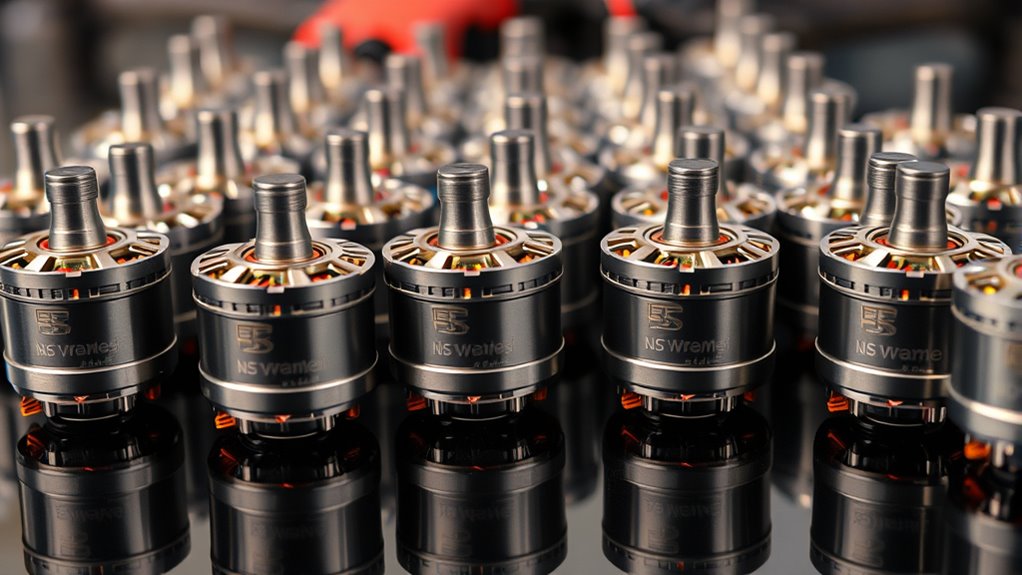

For a balanced 5-inch build, I’d start with the iFlight XING2 2207 1855KV as my best overall pick: its 6S-oriented KV suits pilots seeking controlled power rather than maximum RPM. The EMAX ECO II 1900KV is a value-focused alternative, while the RCINPOWER AOS Supernova 1980KV stands out for pilots prioritizing a performance-oriented freestyle setup. The main tradeoffs among 2207 FPV motors are KV and battery match, motor construction, and whether the listing provides a matched four-motor set. Check your propeller, frame, and flight style before choosing; continue reading for my full comparison and selection guidance.

Get the latest gadgets delivered free with Prime
- Fast, free delivery on millions of items
- Prime Video, Amazon Music and more included
- Member-only deals all year
Complete the kit



Key Takeaways
- 1855–1980KV models dominate the 6S-oriented choices: the XING2 1855KV, Axisflying AE2207 V2 1860KV, XING-E Pro 1800KV, and AOS Supernova 1980KV offer several ways to tune a 5-inch build without defaulting to the highest listed KV.
- The EMAX ECO II 1900KV is the clearest value-minded direction: it appears in two closely named listings, so check the exact item and package contents rather than assuming those listings differ in motor design.
- High-KV variants need a deliberate battery and propeller match: the XING2 2755KV and SUNFUN 2450KV/2750KV listings are not interchangeable with their lower-KV versions for typical 6S setups.
- Pack size changes the practical choice: several listings specify four motors, while the XING-E Pro 1800KV hollow-shaft listing is a single motor; account for a complete, matched set before buying.
- 2207 and 2207.5 are close size labels, not a full compatibility guarantee: verify mounting pattern, shaft, propeller fit, and frame clearance from the exact listing, especially for the SUNFUN and SPARKHOBBY variants.


| fpv motor | Weight | KV | Shaft diameter |
|---|---|---|---|
| SPARKHOBBY XSPEED 2207.5 1700K | 36g with cable | — | 4mm |
| XING2 2207 1855KV / 2755KV Bru | 31.6g | — | — |
| 4PCS 2207.5 Brushless Motor 19 | 34g | 1960KV | — |
| SUNFUN SF2207 Brushless Motor | — | — | — |
| EMAX ECO II Series 2207 Brushl | 2.08 ounces | 1900KV | — |
| iFlight XING2 2207 Brushless M | — | 1855 KV | 5 mm |
| EMAX ECO II Series 2207 Brushl | 33.5 g | 1900 KV | — |
| Axisflying 4pcs AE2207 V2 2207 | — | 1860 KV | 5 mm |
| XING-E Pro 2207 1800KV Brushle | 33.8 g per motor | — | — |
| MAD BSC 2207.5 V2.0 1777KV 199 | 34 g | — | 5 mm |
| iFlight XING-E Pro 2207 1800KV | 33.8g | 1800KV | 5mm |
| EMAX ECO II Series 2207 Brushl | 2.08 ounces | 2400KV | — |
| DYS SUNFUN 2207 1750KV 6S Dron | — | 1750KV | 5mm |
| AXISFLYING Bando 2207 2207.5 1 | 35.5g | 1960KV | 4mm |
| RCINPOWER AOS Supernova 2207 B | 31g without wires | 1980KV | 4mm hollow |
More Details on Our Top Picks
SPARKHOBBY XSPEED 2207.5 1700KV/1900KV Brushless Motor for Quadcopter Drones
The XSPEED’s clearest advantage is its stated 5–6-inch propeller range, which gives builders more room to tune a quad than the SUNFUN SF2207’s product description, which focuses on battery-matched KV options. Choose 1700KV for a lower-RPM 6S-style setup or 1900KV where a faster response suits the build; the listing supplies separate power and current figures for each. Its 190mm leads also offer more routing slack than the XING2 2207’s 160mm cables, a practical help on frames with awkward arm layouts. The tradeoff is weight: at 36g per motor, it is heavier than the XING2’s listed 31.6g, and the two KV versions have notably different stated dimensions. I’d verify clearance and ESC capacity before choosing a configuration.
Pros:- Two KV configurations let builders match motor speed to their intended setup.
- Listed for 5–6-inch propellers, giving more prop-size flexibility than many 5-inch-focused options.
- 190mm lead wires provide extra room for routing compared with the XING2’s 160mm leads.
- Product data provides separate maximum-power and peak-current figures for both KV versions.
Cons:- At 36g with cable, it is heavier than the listed XING2 2207.
- Dimensions differ substantially between the 1700KV and 1900KV versions, so fit should be checked against the frame.
- The listing does not specify a complete battery-and-ESC pairing for each configuration.
Best for: 5–6-inch quad builders who want a choice of KV and extra cable length for flexible wiring.
Not ideal for: Weight-conscious builders or pilots who need a clearly specified, compact motor footprint; the 36g weight and differing dimensions between KV versions call for frame checks.
- Stator:22 × 7.5mm
- KV options:1700KV or 1900KV
- Configuration:12N14P
- Shaft diameter:4mm
- Weight:36g with cable
- Lead wire:24AWG × 190mm
- Mounting pattern:16 × 16mm, M3
- Propeller size:5–6 inches
Our verdict“Pick the XSPEED if propeller range and long leads matter more to your build than minimizing motor weight.”
XING2 2207 1855KV / 2755KV Brushless FPV Motor for RC Drones (4pcs)
The XING2 2207 is the lineup’s weight-conscious pick: its stated 31.6g per motor is below the SPARKHOBBY XSPEED’s 36g, a useful difference for pilots trying to keep a 5-inch build nimble. Its titanium-alloy shaft and impact-resistant aluminum hood also give it a durability-focused pitch, while precision balancing is aimed at smoother running. The choice between 1855KV and 2755KV is unusually broad, but buyers should pay close attention to the listing’s differing battery guidance: it cites 3–6S for one option and 3–5S for the other. Compared with the SUNFUN SF2207, which lists three KV choices and included screws, this set’s standout is lower stated motor weight, not a more complete installation kit. Propellers are not included, and fit still depends on the frame and setup.
Pros:- Listed 31.6g motor weight is lower than the SPARKHOBBY XSPEED’s stated 36g.
- Titanium-alloy shaft and impact-resistant aluminum hood emphasize resistance to physical knocks.
- Precision-balanced construction is intended to limit vibration.
- Four-motor set includes mounting hardware.
Cons:- Battery guidance varies by KV option, so buyers must confirm the correct version for their setup.
- Propellers are not included.
- The listing names 5.1-inch propellers and specific voltage ranges, so it may be a less straightforward fit for other builds.
Best for: FPV builders prioritizing lower motor weight and a reinforced shaft-and-bell design for 5.1-inch propeller setups.
Not ideal for: First-time builders seeking unambiguous battery guidance or a fully specified kit; the two KV options have different stated voltage ranges, and propellers are not included.
- Stator:22 × 7mm
- KV options:1855KV or 2755KV
- Weight:31.6g
- Cable length:160mm
- Mounting pattern:16 × 16mm
- Materials:Aluminum and titanium alloy
- Pack quantity:4 motors
- Propeller guidance:5.1-inch propellers
Our verdict“Choose the XING2 if reducing motor weight and getting a reinforced four-motor set matter more than simple, uniform setup guidance.”
4PCS 2207.5 Brushless Motor 1960KV 6S FPV Motor 5mm Shaft
This KONKER set is the most direct choice here for a pilot who already plans to run 6S with 1960KV motors. Its stated 948W maximum power and 1820g maximum force point toward a power-focused freestyle or racing build, while the 5mm propeller mounting holes differ from the SPARKHOBBY XSPEED’s 4mm shaft specification. That distinction makes propeller-hub compatibility a key buying check, rather than a detail to assume. At 34g each, it sits between the lighter XING2 and heavier XSPEED on listed weight. The fixed 1960KV configuration is simpler than the SUNFUN SF2207’s several KV choices, but less adaptable if you want to change battery voltage or tune around another motor speed. No propellers or accessories are listed.
Pros:- 1960KV configuration is explicitly specified for 6S use.
- Listed maximum power of 948W and maximum force of 1820g suit power-focused builds.
- 5mm propeller mounting differs clearly from the XSPEED’s 4mm shaft specification.
- Four-motor set is listed at 34g per motor, lighter than the XSPEED’s stated 36g.
Cons:- Fixed 1960KV configuration offers less tuning flexibility than the SUNFUN’s three KV choices.
- The 5mm propeller mounting requires compatible propellers.
- Propellers and other accessories are not listed as included.
Best for: Pilots building a 6S freestyle or racing quad who want a fixed 1960KV motor and compatible 5mm propeller mounting.
Not ideal for: Builders who need multiple KV choices, a different battery target, or a 4mm-compatible propeller setup.
- Stator:22 × 7.5mm
- KV:1960KV
- Configuration:12N14P
- Battery support:6S
- Propeller mounting:M5
- Weight:34g
- Maximum power:948W
- Maximum force:1820g
Our verdict“Pick this KONKER set for a 6S build that matches its 1960KV rating and 5mm propeller mounting.”
SUNFUN SF2207 Brushless Motor – 1750KV/2450KV/2750KV, 5mm Threaded Shaft, 16x16mm M3 Mounting Pattern, Aluminum Alloy Housing for RC Multirotor Builds
The SUNFUN SF2207 earns its place through choice and included mounting hardware: the four-motor pack offers 1750KV for 6S or 2450KV and 2750KV for 4S, plus lock nuts and M3 screws. That makes it easier to match the motor choice to a planned battery than the single-1960KV KONKER set, though the KONKER supplies more specific power and thrust figures. Its 5mm threaded shaft calls for compatible propellers, while the 16 × 16mm pattern follows a common mounting layout also listed for the EMAX ECO II. At 35.44g per motor, it is heavier than the XING2’s 31.6g, so this is not the lineup’s lightest option. I’d choose it for a matched four-motor build, not for replacing one motor or chasing minimum weight.
Pros:- Three KV configurations cover stated 4S and 6S use cases.
- Four-motor pack includes lock nuts and 16 M3 mounting screws.
- 16 × 16mm M3 pattern matches the mounting specification listed for the EMAX ECO II.
- CNC aluminum housing is described as supporting cooling and rigidity.
Cons:- At 35.44g per motor, it is heavier than the XING2’s stated 31.6g.
- The threaded 5mm shaft requires compatible propellers.
- Available as a four-motor set, which is less suited to single-motor replacement.
Best for: Builders assembling a complete four-motor quad who want distinct 4S and 6S KV choices with mounting hardware included.
Not ideal for: Weight-sensitive builds or pilots replacing a single motor; this is a four-pack at 35.44g per motor, and its threaded shaft needs matching propellers.
- Stator:22 × 7mm
- KV options:1750KV (6S), 2450KV or 2750KV (4S)
- Shaft:5mm threaded, with lock nut
- Mounting pattern:16 × 16mm, M3
- Motor dimensions:27.7mm diameter × 32.7mm height
- Single-motor weight:35.44g
- Pack contents:4 motors, 4 lock nuts, 16 M3 screws
Our verdict“Choose the SUNFUN when you want a four-motor kit with hardware and a KV option matched to either a 4S or 6S plan.”
EMAX ECO II Series 2207 Brushless Motor – 1900 KV
The EMAX ECO II is the straightforward pick for builders seeking a 1900KV 2207 with a stated 16 × 16mm mounting pattern. Its rounded bell and reinforced attachment points are aimed at handling the knocks associated with FPV use, while the 9mm EZO bearing and upgraded N52SH curved-arc magnets are presented as support for smooth response and torque. Unlike the SPARKHOBBY XSPEED, this listing gives no power, current, cable-length, or propeller-size figures, so it is harder to compare on electrical limits or installation details. The SUNFUN SF2207 offers more KV choices and a clearly listed hardware kit; the EMAX instead suits someone who has already settled on 1900KV and wants the named bearing and bell features. Its listed weight is 2.08 ounces, so check units and fit against your build before ordering.
Pros:- 1900KV rating gives a clear target for builders matching a specific motor speed.
- Reinforced attachment points and rounded bell are designed with durability in mind.
- 9mm EZO bearing is specifically identified.
- 16 × 16mm mounting pattern is also listed for the SUNFUN SF2207.
Cons:- Product data does not state maximum power, current, cable length, or propeller size.
- The listed weight is 2.08 ounces, making direct comparison with gram-based listings less convenient.
- Unlike the SUNFUN four-pack, this product listing does not specify a full set of included mounting hardware.
Best for: FPV builders committed to a 1900KV 2207 motor who value reinforced bell details, a specified bearing, and a 16 × 16mm mounting pattern.
Not ideal for: Buyers who need published current, power, cable, shaft, or propeller specifications to confirm compatibility; this listing leaves those details unspecified.
- Model:ECO II 2207
- KV:1900KV
- Mounting pattern:16 × 16mm
- Bearing:9mm EZO
- Weight:2.08 ounces
- Magnet type:N52SH curved-arc magnets
- Bell design:Rounded bell with reinforced attachment points
Our verdict“Choose the EMAX ECO II if you already want a 1900KV motor and can verify its unspecified fit and electrical details for your build.”
iFlight XING2 2207 Brushless Motor 1855KV 6S (4 pcs) for FPV Racing Drone
The iFlight XING2 pairs a 1855KV winding with 6S support, making it a good fit for pilots who want quick response without moving to the higher-KV options in this roundup. Its dynamic balancing, N52H curved magnets, and NSK bearings are aimed at smoother running and durability, while the 31.6 g listed weight is lower than the EMAX ECO II 1900KV’s 33.5 g. That can help keep a four-motor build lighter, though motor weight alone does not determine flight feel. The tradeoff is a narrower battery match: this version is specified for 6S, unlike the XING-E Pro 1800KV, which lists 3–6S support. It also offers less flexibility if you later change cell count. The four-motor set is convenient for a complete quad build.
Pros:- Four motors are included for a complete quad build.
- 31.6 g listed weight is lighter than the EMAX ECO II 1900KV’s 33.5 g.
- Dynamic balancing and damping bearings target reduced vibration.
- N52H curved magnets and NSK bearings are specified.
Cons:- The listed configuration is limited to 6S rather than offering the XING-E Pro’s broader cell-count range.
- At 1855KV, it may not suit buyers seeking a higher-KV, more aggressive setup.
- The listed interphase resistance and voltage figures are presented as paired values without explaining their conditions.
Best for: 6S racing pilots who want a four-motor set with vibration-conscious construction and a relatively light listed motor weight.
Not ideal for: Pilots planning to switch between battery cell counts or use packs above 6S; this version is specified for 6S only.
- KV:1855 KV
- Weight per motor:31.6 g
- Voltage:24 V / 16 V
- Peak current:35.08 A / 40.35 A
- Maximum wattage:841.90 W / 645.60 W
- Mounting pattern:16 × 16 mm, φ3 mm
- Shaft diameter:5 mm
- Magnets and bearings:N52H curved magnets; NSK bearings
Our verdict“Choose this four-pack for a comparatively light, smooth-focused 6S race build, but skip it if you need wider battery flexibility.”
EMAX ECO II Series 2207 Brushless Motor for 5-inch FPV Drone (1900KV)
The EMAX ECO II 1900KV is the lineup’s straightforward choice for a 5-inch freestyle or racing build where torque and broad flying-style suitability matter more than a particularly low motor weight. Its N52SH arc magnets, 12N14P stator, and precision EZO bearings provide a defined hardware package, and its 16 × 16 mm M3 mounting pattern matches common frame layouts. Compared with the iFlight XING2 1855KV, it is slightly heavier at 33.5 g and has a modestly higher KV, so it may appeal to pilots wanting a livelier 5-inch setup rather than the XING2’s lighter, 6S-specific proposition. The tradeoff is that the product data does not specify voltage range or electrical output figures. Buyers should confirm battery and ESC compatibility before choosing it.
Pros:- 1900KV rating is suited to responsive 5-inch builds.
- 16 × 16 mm M3 mounting pattern fits many common frames.
- N52SH arc magnets and EZO precision bearings are specified.
- Described for freestyle, racing, and cinematic flying.
Cons:- At 33.5 g, it is heavier than the iFlight XING2 1855KV’s listed 31.6 g.
- Voltage range, maximum current, and power figures are not provided.
- The product is positioned for 5-inch drones, limiting its stated use case.
Best for: 5-inch freestyle and racing builders who want a 1900KV motor with a standard mounting pattern and specified precision bearings.
Not ideal for: Pilots who need clearly stated battery-cell compatibility or detailed current and power limits before matching a motor to an ESC.
- KV:1900 KV
- Weight:33.5 g
- Stator configuration:12N14P
- Magnet type:N52SH arc magnets
- Bearings:EZO 9 × 4 × 4 mm precision bearings
- Shaft:5 mm hollow shaft
- Mounting pattern:16 × 16 mm M3
- Materials:Alloy steel, aluminum, copper
Our verdict“Pick the ECO II for a conventional 5-inch build with a defined bearing and magnet package, provided you can verify its electrical match for your setup.”
Axisflying 4pcs AE2207 V2 2207 1860KV 6S FPV Brushless Motor with 5mm Shaft for FPV Racing Drone Quadcopter
The Axisflying AE2207 V2 makes its case through a simple combination: a 1860KV rating, 6S support, and four motors in the set. Its standout claim is a dustproof and waterproof design, which may suit pilots who fly in conditions where debris or splashes are a concern. That environmental protection claim is a distinction from the EMAX ECO II 1900KV, whose supplied details focus instead on its magnets, bearings, and mounting pattern. The Axisflying data gives less to compare on electrical performance: it omits weight, current limits, power output, and bearing details. Its 5 mm steel shaft is a useful durability specification, but buyers cannot judge likely heat or noise behavior from the listed information. This is a focused option for 6S racers, not the most documented pick in the group.
Pros:- Four motors are included for a quad.
- 1860KV rating and 6S support are specified.
- 5 mm steel shaft is listed.
- Dustproof and waterproof design is claimed.
Cons:- No weight, maximum current, or power figures are provided.
- Noise and thermal performance are not documented.
- The supplied specifications give little detail on bearings or mounting dimensions.
Best for: 6S FPV racers who want a four-motor set and prioritize the stated dustproof and waterproof design.
Not ideal for: Builders who need published motor weight, current limits, or thermal details to compare performance and size an ESC.
- KV:1860 KV
- Cell support:6S
- Shaft diameter:5 mm
- Shaft material:Alloy steel
- Motor size:2207
- Set contents:4 motors
- Protection claim:Dustproof and waterproof
Our verdict“Choose the AE2207 V2 if its stated environmental protection matters more than having a full set of published performance figures.”
XING-E Pro 2207 1800KV Brushless Motor 3-6S Lipo 5mm Hollow Shaft for 5-6inch Propeller Freestyle Drones (1PC)
The XING-E Pro 1800KV stands apart from the other picks by listing 3–6S compatibility for this KV option, giving builders more room to change battery setups than the 6S-specific iFlight XING2 1855KV or Axisflying AE2207 V2. Its 2207 format, NSK bearings, N52H high-temperature magnets, and hollow steel shaft suit pilots seeking a freestyle-oriented motor with useful durability details. It is sold as a single motor, not a quad set, so it works better for a replacement or a staged build than a complete four-motor purchase. The product also lists 2450KV and 2750KV variants, but those are specified for fewer cells; buyers should match the exact version to their battery rather than treating all options as interchangeable. Some supplied power figures use an unusual 18S notation, so I would not rely on those for setup planning.
Pros:- 1800KV option lists support for 3–6S packs.
- NSK 9 × 4 × 4 mm bearings and N52H high-temperature magnets are specified.
- 5 mm hollow steel shaft is designed for a durable, lightweight shaft format.
- 160 mm, 20 AWG lead wire is listed.
Cons:- The package contains one motor, unlike the four-motor XING2 and Axisflying sets.
- The 2450KV and 2750KV options support fewer cells than the 1800KV version.
- Some supplied maximum-power figures cite 18S, which conflicts with the listed cell-support range and needs verification.
Best for: Freestyle builders who want an 1800KV motor with stated 3–6S support, especially for a replacement or incremental build.
Not ideal for: Buyers assembling a complete quad in one purchase, or anyone who needs unambiguous power-test conditions across the listed variants.
- KV options:1800 KV / 2450 KV / 2750 KV
- Motor size:2207 (22 mm × 7 mm)
- Weight:33.8 g per motor
- Shaft:5 mm outer diameter, hollow steel
- Mounting pattern:16 × 16 mm
- Bearings:NSK 9 × 4 × 4 mm
- Cell support:1800KV: 3–6S; 2450KV and 2750KV: 2–4S
- Lead wire:160 mm, 20 AWG
Our verdict“Choose the 1800KV XING-E Pro for battery flexibility or a single-motor replacement, but confirm the variant and electrical data before building around it.”
MAD BSC 2207.5 V2.0 1777KV 1999KV 2111KV Brushless Motor for 5-inch Drones
The MAD BSC 2207.5 V2.0 is the most power-forward entry here on paper, with a stated 970 W maximum power and 1.8 kg maximum thrust. That makes it appealing to 5-inch pilots comparing output figures, while its 34 g weight and 5 mm shaft keep it within a familiar frame format. The listed KV choices—1777, 1999, and 2111—give more tuning range than the fixed 1855KV iFlight XING2, though the supplied data does not map each KV version to separate electrical limits. Its 42 A maximum current also calls for attention when choosing an ESC and propeller. Unlike the XING-E Pro 1800KV, which lists 3–6S support for its 1800KV version, this motor is described as optimized for 6S. It is best for buyers who value stated output figures over broad battery flexibility.
Pros:- Maximum power is listed as 970 W.
- Maximum thrust is listed as 1.8 kg.
- Three KV choices are listed: 1777, 1999, and 2111.
- 34 g weight and 5 mm shaft are specified.
Cons:- The product is optimized for 6S rather than offering the XING-E Pro 1800KV’s stated 3–6S range.
- The supplied data does not separate current and power limits by KV version.
- The 42 A maximum current requires careful ESC and propeller matching.
Best for: 5-inch 6S pilots comparing published power and thrust figures who want several KV choices for tuning a build.
Not ideal for: Pilots using battery setups other than 6S or builders who need KV-specific current and power data before selecting an ESC.
- Motor size:2207.5
- KV options:1777 KV / 1999 KV / 2111 KV
- Weight:34 g
- Maximum power:970 W
- Maximum thrust:1.8 kg
- Maximum current:42 A
- Shaft diameter:5 mm
- Battery compatibility:Optimized for 6S LiPo
Our verdict“Pick the MAD BSC for a 6S 5-inch build where stated power and thrust figures guide the choice, but verify limits for the exact KV variant.”
iFlight XING-E Pro 2207 1800KV Brushless Motor (4 Pack) for FPV Racing Drone
The XING-E Pro 2207 1800KV is the durability-focused choice here: its steel shaft and NSK bearings suit pilots who want a motor built to handle regular racing or freestyle use. At 1800KV, it is aimed at 6S setups rather than the higher-speed feel of the EMAX ECO II 2400KV. Its 33.8g weight is a tradeoff, though, especially beside the RCINPOWER AOS Supernova at 31g. This package includes four motors, making it a practical match for a complete quad build, and the 16×16mm mounting pattern fits compatible frames. Check the frame and ESC match before buying: the mounting pattern is specific, and the motor’s weight is less appealing for builds where every gram matters.
Pros:- Four motors are included for a complete quad build.
- Steel shafts and NSK bearings support a durability-focused setup.
- 1800KV rating is specified for 6S builds.
- 16×16mm mounting pattern is clearly provided for fit checks.
Cons:- At 33.8g per motor, it is heavier than the 31g RCINPOWER AOS Supernova.
- The 16×16mm mounting pattern limits frame compatibility.
- ESC compatibility needs checking against the listed current figures.
Best for: 6S FPV racing or freestyle pilots building a compatible quad who prioritize a four-motor set and durable shaft and bearing construction.
Not ideal for: Weight-conscious racers and builders whose frames do not accept 16×16mm mounting; its 33.8g weight and specified mounting pattern may rule it out.
- Model:XING-E Pro 2207
- KV:1800KV
- Weight:33.8g
- Dimensions:φ28.5 × 33.1mm
- Shaft diameter:5mm
- Mounting holes:16 × 16mm, φ3mm
- Configuration:12N14P
- Package:4 motors
Our verdict“Choose this four-pack for a compatible 6S quad when durable construction matters more than minimizing motor weight.”
EMAX ECO II Series 2207 Brushless Motor – 2400 KV
The EMAX ECO II 2400KV serves a different build from the 6S-focused, lower-KV iFlight XING-E Pro 1800KV: its higher KV is the defining choice for pilots seeking a faster-spinning motor setup. Reinforced attachment points and a rounded bell add some protection against the stresses of flight, while the N52SH curved-arc magnets and 9mm EZO bearing are presented as support for torque and smooth throttle response. But the listing says 2400 rpm, not a clearly stated battery-cell range, so buyers should verify the intended voltage and prop combination rather than assume compatibility. It is also a single motor, unlike the four-motor iFlight and DYS packs. That makes it useful for replacing one motor, but less convenient for a full build.
Pros:- 2400KV rating offers a higher-KV alternative to the 1800KV iFlight XING-E Pro.
- Reinforced attachment points are intended to improve bell durability.
- N52SH curved-arc magnets are specified for torque and throttle response.
- 9mm EZO bearing and 16×16mm mounting size are listed.
Cons:- Package includes only one motor, not a matched quad set.
- Battery-cell compatibility is not stated in the supplied specifications.
- The listed weight of 2.08 ounces is substantially greater than the 31g RCINPOWER figure, though measurement conventions should be checked.
Best for: FPV pilots replacing one motor or choosing a higher-KV 2207 for a setup whose battery, ESC, and prop combination they have already matched.
Not ideal for: Builders who need a complete four-motor set or a clearly documented 6S motor; the package is one motor and the supplied data does not specify cell compatibility.
- Model:EMAX ECO II
- Motor size:2207
- KV:2400KV
- Listed speed:2400 rpm
- Bearing:EZO 9mm
- Mounting size:16 × 16mm
- Weight:2.08 ounces
- Package:1 motor
Our verdict“Pick this single higher-KV motor for a compatible replacement or build, but verify voltage fit and account for buying the other three separately.”
DYS SUNFUN 2207 1750KV 6S Drone Motor for FPV Racing Quadcopter (4 Pack)
The DYS SUNFUN 2207 1750KV stands out for its stated 2–6S LiPo compatibility, a wider battery range than the 6S-only AXISFLYING Bando 1960KV listing. That flexibility may suit pilots who change builds or battery setups, while its relatively low 1750KV rating is aimed at a different power balance from the EMAX ECO II 2400KV. The pack includes four motors and screws, and a 5mm steel hollow shaft is specified. Dynamically balanced rotors and copper windings are listed, but the data omits weight, dimensions, current limits, and mounting-hole measurements. That makes it harder to compare fit and load requirements than the iFlight XING-E Pro, whose key physical specs are more fully stated.
Pros:- Four motors and mounting screws are included.
- Specified support for 2–6S LiPo batteries offers broader cell-range flexibility than the AXISFLYING 6S listing.
- 5mm steel hollow shaft is specified.
- Dynamically balanced rotors and copper windings are listed.
Cons:- Weight and motor dimensions are not provided in the supplied data.
- Mounting-hole pattern and electrical current limits are also unspecified.
- Its 1750KV rating differs from higher-KV choices such as the EMAX ECO II 2400KV and needs a matched setup.
Best for: FPV builders who want a four-motor set with stated 2–6S battery support and can confirm frame fit from the motor’s full documentation.
Not ideal for: Pilots who need published weight, mounting dimensions, or current limits before choosing motors for a tightly specified race build.
- Model:2207 1750KV
- KV:1750KV
- Supported battery voltage:2–6S LiPo
- Shaft diameter:5mm
- Shaft type:Steel hollow shaft
- Winding type:Single strand
- Package:4 motors, screws
Our verdict“Choose this four-pack if broad stated battery compatibility matters and you can verify its missing fit and electrical details before purchase.”
AXISFLYING Bando 2207 2207.5 1960KV FPV Brushless Motor for Drones (4PCS)
The AXISFLYING Bando 1960KV is positioned for 6S freestyle and cinema builds, with a listed maximum power of 962.23W and maximum tensile force of 1819g. Its stated low-temperature operation and protective shaft design point toward a more durability-minded use than the lighter RCINPOWER AOS Supernova 1980KV, which weighs 31g and is presented around efficiency. This Bando weighs 35.5g, so that added mass is a real cost for pilots chasing a lighter quad. Its 4mm shaft also differs from the 5mm shafts on the iFlight and DYS options, making prop fit a necessary check. The four-piece package suits a full build, but the 6S-only specification is less flexible than the DYS motor’s stated 2–6S range.
Pros:- Four motors are included for a complete build.
- 1960KV, maximum power, and maximum tensile force are specified.
- Protective shaft design and long-lasting bearings are described for durability.
- 20# silicone wire is listed at 150mm.
Cons:- At 35.5g, it is heavier than the 31g RCINPOWER AOS Supernova.
- Listed for 6S operation, with no broader cell range given.
- Its 4mm shaft may not fit props intended for the 5mm iFlight or DYS motors.
Best for: 6S freestyle or cinema-drone builders who want a four-motor set with listed power and thrust figures and whose props accept a 4mm shaft.
Not ideal for: Weight-conscious racers, lower-voltage builders, or pilots using props designed for a 5mm shaft.
- KV:1960KV
- Configuration:12N14P
- Motor dimensions:φ27.9 × 32.9mm
- Shaft diameter:4mm
- Working voltage:6S
- Weight:35.5g
- Maximum power:962.23W
- Maximum current:39.83A
- Package:4 motors
Our verdict“Choose this set for a 6S freestyle or cinema build when its 4mm shaft fits your props and its higher listed weight is acceptable.”
RCINPOWER AOS Supernova 2207 Brushless Motor 1980KV 6S LiPo for RC FPV Freestyle 5-inch Drones
At a listed 31g without wires, the RCINPOWER AOS Supernova 1980KV is the weight-conscious pick in this group. Its stated efficiency of more than 86% at 5–11A gives builders a concrete reason to choose it for typical-current operation, while 5–6S support places it near the 6S-ready AXISFLYING Bando 1960KV. The tradeoff is package size: this listing includes one motor, not the four needed for a quad. Its 4mm hollow shaft also calls for prop compatibility checks, and the listed maximum current of 61A on 5S means cooling and ESC matching matter under hard loads. Compared with the heavier Bando, it favors lower motor mass and efficiency claims over a four-motor bundle and a listed tensile-force figure.
Pros:- 31g listed weight without wires is the lightest figure among these five options.
- Efficiency is specified at over 86% for 5–11A operation.
- Supports 5–6S LiPo setups.
- 1980KV rating and 12N14P configuration are provided.
Cons:- Package contains one motor rather than a complete quad set.
- The 4mm hollow shaft may not suit props made for 5mm shafts.
- The listed 61A maximum current on 5S calls for careful ESC matching and cooling.
Best for: Weight-conscious 5-inch freestyle or racing builders who value the stated efficiency data and are buying a single replacement or planning a matched set separately.
Not ideal for: Pilots seeking a complete four-motor pack, props requiring a 5mm shaft, or builds that cannot manage cooling at high current.
- KV:1980KV
- Configuration:12N14P
- Shaft diameter:4mm hollow
- Motor dimensions:φ27.6 × 19.5mm
- Weight:31g without wires
- Supported cells:5–6S LiPo
- Maximum continuous power:1456W on 5S
- Maximum current:61A on 5S
- Package:1 motor
Our verdict“Choose this motor for a lightweight 5–6S build or replacement when efficiency data matters, provided you source the other motors and match the 4mm shaft.”

How We Picked
I compared the 15 listings by the information a pilot can use to match a motor to a build: stated KV, battery compatibility where specified, intended propeller or drone size, shaft and mounting details, and whether the package contains one motor or four. I gave more weight to clear, internally useful specifications than to broad claims, since a motor’s KV and physical fit affect the build more directly than a generic racing or freestyle label.
The ranking favors versatile choices for common 5-inch setups, then separates value-oriented, higher-KV, and more specialized options. It is not a claim of measured thrust or durability: the supplied product details do not provide comparable test data, so I avoid treating similar-looking listings as proof of equal performance. Where product names repeat or offer multiple KV variants, I treat the exact version and pack contents as purchase checks rather than assuming every variation is equivalent.
Factors to Consider When Choosing 2207 Fpv Motors
Before choosing among 2207 FPV motors, I’d match the motor to the whole powertrain instead of selecting by size alone. These checks help avoid a motor that fits the frame but draws more power than the battery, ESC, or propeller setup can comfortably support.
Match KV to battery voltage and propeller load
KV indicates the motor’s approximate unloaded RPM per volt, not a direct measure of thrust or efficiency. A higher-KV motor can suit a lower-voltage setup, but pairing high KV with 6S and an aggressive prop may raise current and heat. Lower-KV options, such as the 1750–1860KV listings here, are common starting points for 6S 5-inch builds, though the right match still depends on propeller pitch and flying style. Check the motor maker’s voltage guidance and compare it with your ESC’s current rating before purchasing. A frequent mistake is treating two motors with the same stator size as equivalent even when their KV differs substantially. When in doubt, use a conservative prop and confirm current draw from reliable build data.
Confirm the complete mechanical fit
The 2207 label describes stator dimensions, but it does not tell you everything needed for installation. Check the motor’s mounting pattern against the frame arms, then verify shaft diameter and the propeller’s mounting method. A threaded shaft, a hollow shaft, and a particular nut arrangement can affect which props and hardware fit. Also compare motor height and bell clearance with the frame and any guards. Do not infer that a 2207.5 motor will fit exactly like every 2207 listing; small differences in mounting or body dimensions can matter. Read the specification for the exact variant you plan to order, especially when a product page groups several versions together.
Choose for your flying style, not a label
Freestyle and racing place different demands on a motor, but product titles alone rarely establish how a motor will feel in the air. Freestyle pilots may favor predictable throttle response and a setup that supports the chosen prop without excessive heat. Racing pilots often tune for fast response, then balance that choice against flight time and the course’s demands. The motor’s KV, propeller, battery, and tune work as a system, so a change in one part can alter the result. Avoid choosing the highest KV simply because it sounds faster; the added current draw may not help a build whose battery or tune is the limiting factor. Start from your established prop and battery combination, then compare motor options within that setup.
Check package quantity and matching
A listing for one motor is not the same purchase as a four-motor set, even when the product names look nearly identical. For a new quad, matched motors simplify assembly and reduce uncertainty about mixing different production versions or specifications. If replacing one damaged motor, compare its KV, shaft, mounting details, and model revision with the other three before ordering a single unit. Confirm whether the listing’s selected variation is a four-pack and whether all included motors share the stated specification. The roundup includes both single-motor and four-piece listings, so pack quantity can change what is practical for a build. Keep a spare only if it matches the motor version already installed.
Budget for the whole powertrain and upkeep
The motor is only one part of the cost and maintenance picture: props, batteries, ESCs, mounting hardware, and replacement parts all shape ownership. Spending more on a motor makes sense when its documented fit, construction details, or support address a specific need in your build. It makes less sense to pay for a feature that does not suit your frame or flying style. Plan for prop strikes and crashes, and check whether replacement bells or other service parts are available before committing to a motor family. After assembly, inspect screws, shafts, and bells periodically, since vibration or impact can reveal problems that a product description cannot. A build with compatible, replaceable parts can be easier to maintain than one chosen around a headline specification.
Frequently Asked Questions
Is 1855KV or 1900KV a better match for a 6S 5-inch quad?
Both can be reasonable starting points, but neither KV number alone determines the right choice. The XING2 1855KV is explicitly presented as a 6S option, while the EMAX ECO II 1900KV listing gives a slightly higher KV figure. Your propeller pitch, battery condition, ESC rating, and throttle tune affect current and heat as much as the small KV difference. If your build is already tuned around 6S, check motor guidance and comparable setup data before changing KV. Choose based on the complete powertrain rather than expecting a noticeable result from the number alone.
Can I use a 2755KV 2207 motor with a 6S battery?
Do not assume that a 2755KV motor is suitable for 6S just because it shares a 2207 size with lower-KV models. The XING2 listing includes both 1855KV and 2755KV variants, and those versions are aimed at different powertrain choices. Check the manufacturer’s voltage recommendation and the exact listing variation before pairing one with a battery. High KV on 6S can produce excessive current or heat with an unsuitable propeller, placing strain on motors, ESCs, and batteries. If the voltage guidance is unclear, choose a clearly specified option instead of guessing.
Should I buy a four-motor kit or replace only one motor?
For a new build, a four-motor pack makes it easier to keep the quad consistent. For a repair, one replacement can work if its model, KV, shaft, mounting pattern, and revision match the other motors. A similar product name is not enough to confirm compatibility, especially when listings combine multiple versions or pack quantities. If the original motor is unavailable, compare specifications carefully and check whether a different motor would call for changes to the tune. Also verify the quantity selector: this roundup includes both single-motor and four-piece listings.
Do 2207 and 2207.5 motors fit the same 5-inch frame?
They may fit, but the size label alone cannot confirm frame compatibility. Verify the mounting-hole pattern, screw size, motor height, arm clearance, and shaft arrangement for the exact model. The SUNFUN listing specifies a 16x16mm M3 mounting pattern, which is useful information to compare against a frame, but other models may need their own specification check. A small difference in body dimensions or mounting can cause interference or an insecure installation. Confirm fit before ordering rather than relying on the 2207-family name.
Should I choose 1800KV, 1980KV, or 2400KV for freestyle?
Start with your battery voltage and propeller, then use KV to narrow the options. The 1800KV XING-E Pro is a lower-KV choice, the AOS Supernova is listed at 1980KV for a 6S freestyle build, and the EMAX ECO II 2400KV is a higher-KV variant that needs a careful voltage and prop match. Freestyle does not automatically call for higher KV; throttle feel, current draw, and flight time are all part of the tradeoff. If you already have a proven 6S prop setup, stay near its established KV range unless you are ready to retune and check temperatures. Confirm the manufacturer’s voltage guidance for the exact motor version.
Conclusion
For a versatile 6S-oriented 5-inch build, I’d choose the iFlight XING2 2207 1855KV as best overall because its stated fit and KV make it an easy starting point to compare against the rest. For best value, the EMAX ECO II 1900KV is the practical pick, with the reminder to verify which of the closely named listings and pack sizes you are buying. The RCINPOWER AOS Supernova 1980KV is my best premium-leaning choice for a pilot building around its stated 6S freestyle use; I would not treat the title alone as proof of measured performance. Beginners should favor a clearly specified, matched four-motor set—such as the Axisflying AE2207 V2 1860KV—and confirm frame fit before ordering. For specific needs, choose the SPARKHOBBY or SUNFUN multi-KV listing only after selecting the exact KV and checking voltage compatibility; their variation range makes careful selection more important than the product-family name.