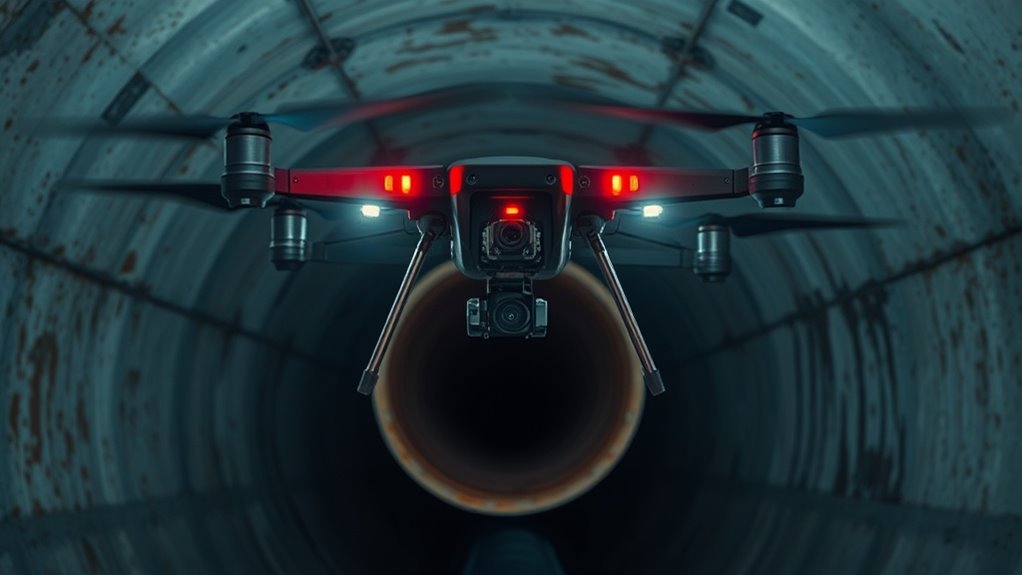
Indoor drones inspect pipes and tunnels using specialized sensors like LiDAR, ultrasonic, infrared, and visual cameras that help them navigate without GPS signals. They build detailed 3D maps, detect obstacles, and adjust their paths in real-time. These advanced systems allow them to safely survey confined spaces, identify issues, and gather high-resolution data. If you want to know how these drones achieve such precision and safety, there’s more to explore.

Get the latest gadgets delivered free — and shop member deals
- Fast, free delivery on millions of items
- Access to Prime Big Deal Days deals on October 6–7
- Prime Video, Amazon Music and more included
Key Takeaways
- Indoor drones use advanced sensors like LiDAR and cameras to map and navigate confined spaces such as pipes and tunnels.
- They rely on SLAM algorithms to build real-time environment models and track their position without GPS signals.
- Sensor data enables obstacle detection and automatic path adjustment, ensuring safe and efficient inspection routes.
- Drones capture high-resolution imagery and detailed 3D maps critical for assessing infrastructure integrity.
- These specialized UAVs improve inspection safety, speed, and accuracy in environments difficult for humans to access manually.
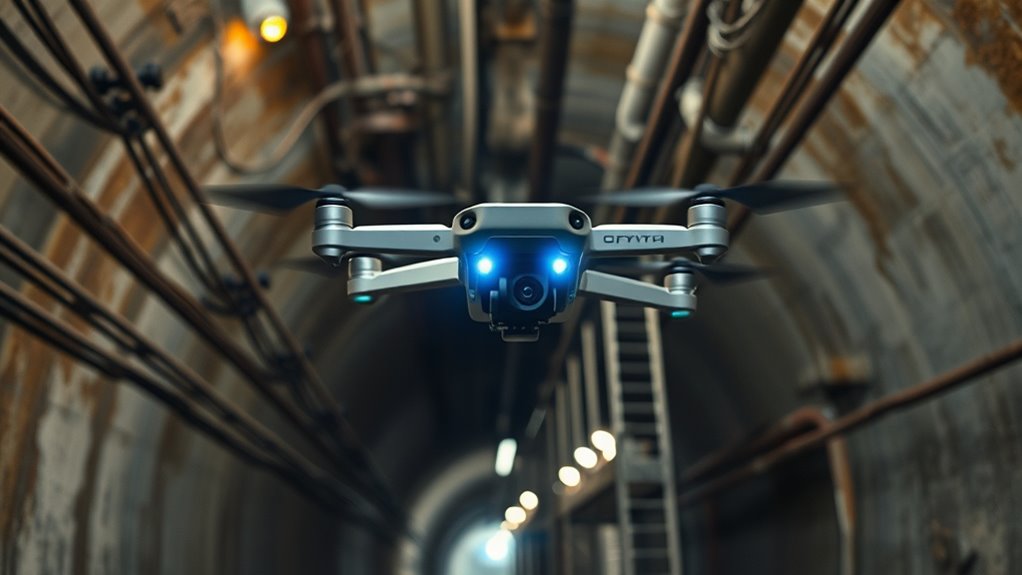
Have you ever wondered how drones can navigate complex indoor spaces? It’s a fascinating blend of robotic navigation and advanced sensor technology that makes it possible. When operating inside pipes, tunnels, or other confined environments, these specialized indoor drones rely on a combination of sensors and intelligent algorithms to move safely and effectively. Unlike outdoor UAVs, which often depend on GPS signals, indoor drones must use alternative methods to understand their surroundings and avoid obstacles.
Robotic navigation is at the core of this capability. These drones are equipped with a range of sensors—such as LiDAR, ultrasonic sensors, infrared cameras, and visual cameras—that gather real-time data on their environment. LiDAR, for example, emits laser pulses that bounce off surfaces and return, creating detailed 3D maps of the surroundings. Ultrasonic sensors measure distances to nearby objects, helping the drone avoid collisions, while infrared sensors can detect temperature differences or locate specific features within pipes or tunnels. Visual cameras provide imagery that can be processed on-the-fly to identify structural anomalies or points of interest.
The sensor technology allows indoor drones to build a thorough understanding of their environment through simultaneous localization and mapping (SLAM). This process enables them to create maps of unseen spaces while tracking their own position within those maps. You don’t have to worry about losing your way in a tunnel or pipe because the drone constantly updates its internal map, adjusting its path as needed. This real-time mapping and navigation ensure that inspection tasks are detailed and precise. Sensor technology plays a crucial role in enabling these capabilities, especially in environments where GPS signals are unavailable.
Furthermore, these drones use sophisticated algorithms that interpret sensor data to make navigation decisions autonomously. They can detect obstacles, narrow passages, or structural defects and adjust their trajectory without human intervention. This level of robotic navigation minimizes the risk of damage to the drone or the infrastructure being inspected. It also allows for continuous operation in environments that are hazardous or difficult for humans to access.
In essence, the synergy between sensor technology and robotic navigation transforms how inspections are conducted inside challenging spaces. These drones can perform detailed inspections of pipes, tunnels, and other confined areas quickly and safely, providing high-resolution data that would be hard to obtain manually. As sensor technology advances, so will the capabilities of indoor drones, making them even more reliable and efficient tools for complex inspections. This innovation is revolutionizing maintenance and safety procedures in industries like utilities, infrastructure, and manufacturing, where understanding the condition of hidden or hard-to-reach spaces is critical.
As an affiliate, we earn on qualifying purchases.
Frequently Asked Questions
How Long Can Indoor Drone Batteries Operate During Inspections?
Your indoor drone’s battery life typically lasts between 15 to 30 minutes per charge, depending on the drone’s size and power management efficiency. To maximize inspection time, you should optimize power management by turning off unnecessary features and maintaining a steady flight pattern. Regularly replacing or recharging batteries guarantees continuous operation, allowing you to complete thorough inspections without interruptions. Proper planning helps you get the most out of each flight.
What Safety Measures Are in Place for Indoor Drone Operations?
You must follow strict safety protocols and emergency procedures when operating indoor drones. Before each mission, conduct thorough checks, verify obstacle detection is active, and have a clear plan for emergencies. You’re trained to respond swiftly if something goes wrong, minimizing risks. These safety measures keep you and your equipment protected, but stay alert—unexpected obstacles or malfunctions can happen, so always be prepared for quick action to prevent accidents.
Can Indoor Drones Operate in Complete Darkness?
Indoor drones can operate in complete darkness thanks to advanced sensor technology. You’ll find that thermal imaging, infrared sensors, and LIDAR enable the drone to navigate and inspect without relying on lighting conditions. These sensors gather data and create detailed images, allowing the drone to perform inspections safely and effectively in low or no-light environments. So, with the right technology, darkness doesn’t hinder your drone’s inspection capabilities.
How Do Drones Navigate Complex Pipe Systems Indoors?
You can navigate complex pipe systems indoors by relying on advanced sensor technologies like LiDAR, ultrasonic sensors, and infrared cameras. These sensors help you overcome navigation challenges by detecting walls, obstacles, and changes in the environment. You actively process this data to map your surroundings and adjust your path in real-time, allowing you to move smoothly through tight spaces and intricate networks without getting lost or stuck.
What Is the Cost Comparison Between Drone Inspections and Manual Methods?
Sure, drone inspections often cost less than manual methods, making you wonder if manual labor is just a costly relic. With their cost efficiency and labor savings, UAVs cut down inspection time, reduce risk, and lower expenses. While initial investment might seem high, the long-term savings in manpower and accuracy outweigh the costs. So, if you’re after smarter spending, drones are the way to go.
As an affiliate, we earn on qualifying purchases.
Conclusion
As you watch indoor drones navigate tight pipes and tunnels, they become your silent explorers, weaving through darkness like glowing fireflies in a cavern. These specialized UAVs turn the unseen into the understood, illuminating hidden worlds with their precise inspections. Just as a lighthouse guides ships through stormy seas, drones lead you safely through complex underground mazes, transforming intimidating infrastructure into clear, manageable pathways. They’re the vigilant eyes in the shadows, making the unseen seen.
As an affiliate, we earn on qualifying purchases.
As an affiliate, we earn on qualifying purchases.
Evergreen bestsellers Picks
bestsellers
As an affiliate, we earn on qualifying purchases.