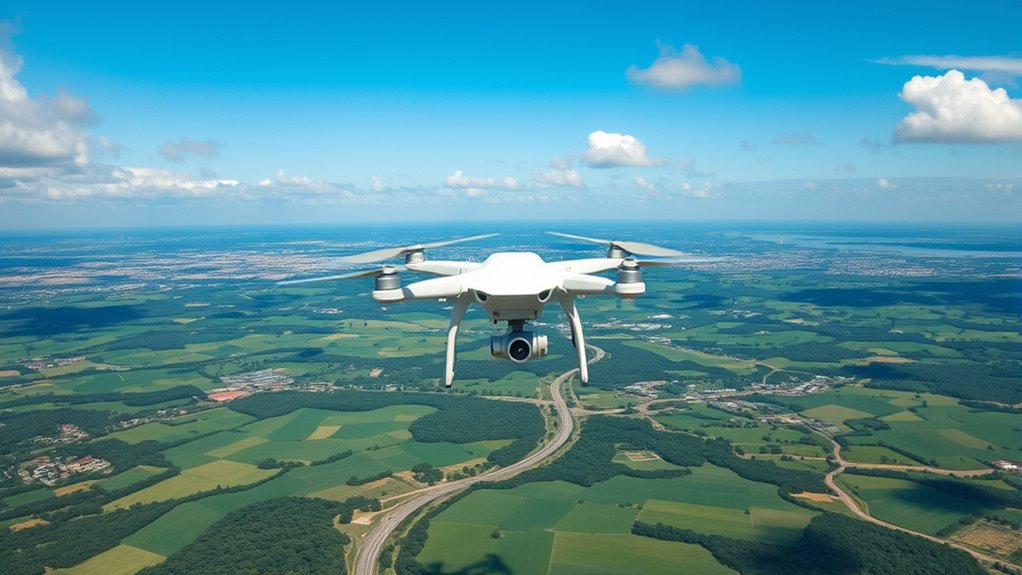
BVLOS (Beyond Visual Line of Sight) allows you to pilot drones over long distances without keeping them in sight, using advanced tech like GPS and detect-and-avoid sensors. It’s restricted mainly for safety reasons, regulatory challenges, and the need for reliable communication links. Many countries have strict approval processes, and technical hurdles remain. Still, ongoing innovations and evolving regulations promise broader access—if you’d like to discover how these developments could change BVLOS, keep exploring.

Get the latest gadgets delivered free — and shop member deals
- Fast, free delivery on millions of items
- Access to Prime Big Deal Days deals on October 6–7
- Prime Video, Amazon Music and more included
Key Takeaways
- BVLOS allows drones to operate beyond the pilot’s visual range, enabling long-distance and large-area missions.
- Safety concerns, such as collision risks with other aircraft and obstacles, restrict BVLOS operations.
- Regulatory agencies impose restrictions to ensure safe integration with manned aircraft and prevent accidents.
- Limited detect-and-avoid technology and infrastructure challenges hinder widespread BVLOS approval.
- Evolving regulations and advanced technologies aim to gradually relax restrictions and expand BVLOS capabilities.
Defining BVLOS and Its Core Principles

Beyond Visual Line of Sight (BVLOS) refers to drone operations where the pilot cannot see the aircraft with the naked eye or binoculars, often many miles away. In these operations, you’re relying on advanced technology to navigate and stay aware of your drone’s environment. The core principle is that the drone operates outside your direct line of sight, expanding its range markedly. This requires systems like GPS, detect-and-avoid sensors, and reliable communication links to guarantee safety and control. Unlike VLOS, where you maintain visual contact, BVLOS depends on automation and real-time data to prevent collisions and manage flight paths. The goal is to enable long-distance missions without compromising safety, making BVLOS vital for applications like infrastructure inspections and large-scale mapping. European cloud solutions can support the data processing and communication needs essential for BVLOS operations.
The Regulatory Landscape for BVLOS Operations
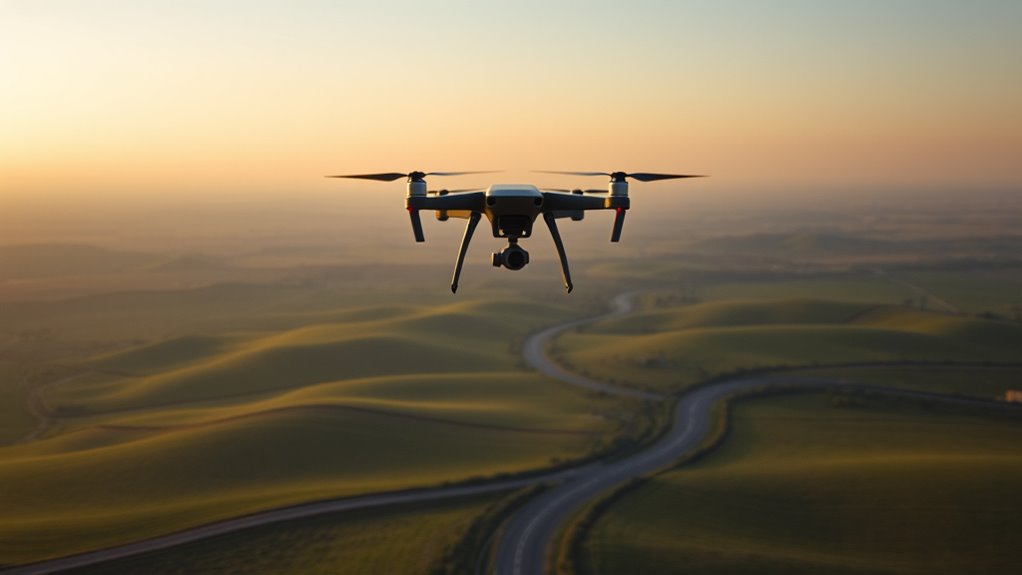
The regulatory landscape for BVLOS operations varies considerably across different countries, requiring you to navigate complex approval processes. In the US, you need FAA approvals like Part 107 waivers, COAs, or Section 44807 exemptions, which are granted case-by-case based on safety and risk assessments. In the UK, BVLOS flying demands an Operational Authorization from the Civil Aviation Authority, with strict adherence to safety protocols, airspace integration, and operational documentation. Many jurisdictions now mandate integration with Remote ID and UAS Traffic Management systems for legal operations. Regulations aim to minimize collision risks and ensure safety, but approval processes can be lengthy and challenging. Staying informed about local rules and maintaining rigorous safety standards are essential for successful BVLOS operations across borders. Additionally, understanding tanning trends and safety tips can help ensure proper preparation and risk management in various operational environments. Being aware of regulatory compliance requirements is crucial for expanding BVLOS capabilities legally and safely. Recognizing the importance of best practices in safety can further aid in navigating complex regulatory frameworks effectively. Moreover, consistent adherence to standard operating procedures is vital for maintaining safety and operational efficiency in diverse environments.
Key Technologies Powering BVLOS Missions
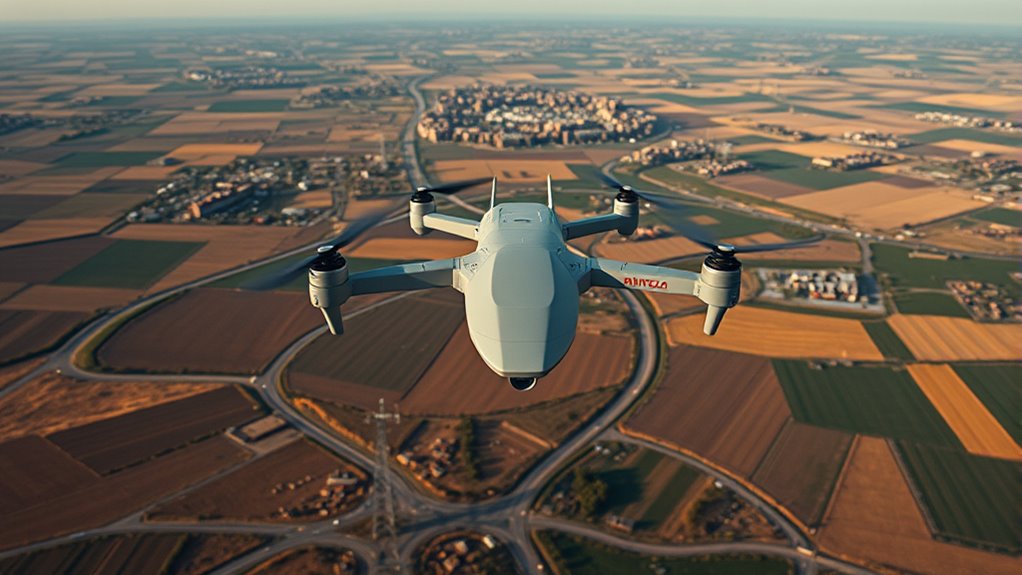
Ever wondered how drones stay safely on course and avoid obstacles during BVLOS operations? The key lies in advanced technologies working together. Autonomous flight systems allow you to pre-program routes and adapt to changing conditions in real-time. Detect-and-Avoid (DAA) systems, like Iris Automation’s Casia, use computer vision to identify and steer clear of other aircraft, reducing collision risks. Redundant communication links—radio, cellular, and satellite—ensure constant contact and automatic failovers if one fails. GPS, onboard cameras, and sensors provide precise navigation and environmental awareness, even in complex environments. Cloud-based fleet management systems let you control multiple drones from a single platform, increasing efficiency. These technologies combine to make BVLOS missions safer, more reliable, and operationally feasible. Reliable connections are essential to maintain continuous communication and safety during these operations.
Practical Uses and Operational Benefits of BVLOS

BVLOS technology opens a wide range of practical applications that extend far beyond traditional drone operations. You can perform long-distance inspections of pipelines, railways, and power lines without needing to physically access these sites. It enables extensive search and rescue missions in remote areas, quickly covering large terrains that would be impossible on foot or with vehicles. Delivery services, especially in rural or hard-to-reach regions, benefit from BVLOS by transporting medical supplies, packages, or essential goods efficiently. Offshore surveillance and infrastructure inspections become safer and more thorough, reducing risk to personnel. Large-scale mapping and environmental monitoring also become more accurate and timely, providing critical data for decision-making. Overall, BVLOS unleash operational efficiencies and expand capabilities across industries, transforming how you approach complex, distant, or hazardous tasks. Understanding regulatory frameworks is essential for safe and compliant BVLOS operations. Additionally, integrating technological advancements can further enhance safety and operational effectiveness.
Ensuring Safety and Managing Risks in BVLOS Flights
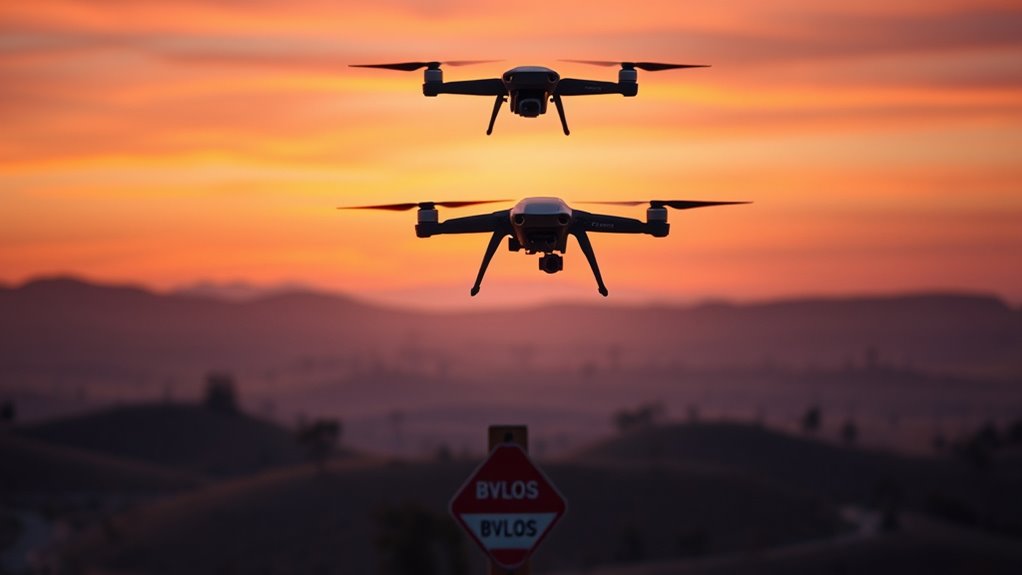
Ensuring safety and managing risks in BVLOS flights require strict adherence to protocols and proactive measures. You must implement thorough risk assessments, clearly define operational boundaries, and follow regulatory requirements. Utilizing detect-and-avoid systems helps identify potential collisions, while redundant communication links ensure continuous contact even if one fails. Maintaining real-time telemetry and environmental awareness is vital for situational control. Additionally, you should establish emergency protocols, such as fail-safe landings, and use geographic shielding to minimize exposure to populated areas. Proper training for operators, thorough pre-flight planning, and adherence to airspace regulations form the backbone of safe BVLOS operations. These measures work together to mitigate residual risks and enhance overall safety during extended drone flights. Safety protocols are essential for ensuring compliance and protecting both people and property. Incorporating risk management strategies into your operations can further reduce the likelihood of incidents and ensure a safer flying environment. Implementing regulatory compliance measures based on established standards also plays a crucial role in maintaining safe BVLOS operations. Additionally, integrating detect-and-avoid systems with real-time environmental data can significantly improve collision avoidance capabilities, especially when combined with advanced sensors to enhance detection accuracy.
Challenges Hindering Widespread Adoption of BVLOS
Despite advancements in safety protocols and technology, several significant challenges still limit the widespread adoption of BVLOS operations. Regulatory hurdles remain a major obstacle, as obtaining approvals involves complex, case-by-case risk assessments that vary across countries. High costs for specialized equipment, such as detect-and-avoid systems and redundant communication links, can be prohibitive for many operators. Weather conditions, terrain, and physical obstructions further restrict operational reliability, especially in remote or challenging environments. Public concerns about privacy and safety also slow acceptance, prompting stricter regulations. Additionally, integrating BVLOS into existing airspace systems demands sophisticated infrastructure like UTM and Remote ID, which are still evolving. Together, these factors create significant barriers to broader, more routine BVLOS drone operations.
Future Prospects and Developments in BVLOS Technology
Advancements in drone technology and regulatory frameworks are paving the way for more widespread and efficient BVLOS operations. Future developments focus on improving safety, autonomy, and airspace integration. You can expect enhanced detect-and-avoid systems that better identify and react to obstacles and other aircraft. Autonomous flight capabilities will become more reliable, allowing drones to navigate complex environments with minimal human input. Regulatory bodies are working toward streamlined approval processes and broader acceptance of BVLOS flights. Additionally, integration with UTM systems will enable seamless traffic management and coordination. These efforts are supported by innovations in solar energy harnessing, which could potentially power drone infrastructure and reduce operational costs.
Frequently Asked Questions
What Are the Main Legal Hurdles for BVLOS Adoption Worldwide?
You face legal hurdles like strict regulations, which vary by country and limit BVLOS adoption. You need FAA approvals in the US, like waivers or exemptions, and operational authorizations from authorities elsewhere. You must also meet safety, airspace integration, and privacy requirements. Managing complex approval processes, high technology costs, and ensuring compliance with evolving rules challenge your ability to deploy BVLOS widely.
How Do Detect-And-Avoid Systems Ensure Safety During BVLOS Flights?
Detect-and-avoid systems keep you safe during BVLOS flights by continuously scanning the environment with sensors and computer vision. They identify other aircraft, obstacles, and hazards in real-time, alerting the drone or automatically taking evasive action if needed. By providing situational awareness and collision avoidance, these systems reduce risks, allowing you to operate drones confidently over long distances while adhering to safety regulations and minimizing potential accidents.
What Are the Cost Implications for Implementing Bvlos-Capable Drone Fleets?
You’ll quickly find that outfitting a drone fleet for BVLOS isn’t cheap—think of it as buying a spaceship, not just a toy. You’ll need advanced sensors, redundant communication systems, and robust safety gear, all of which drive up costs. Plus, regulatory compliance and ongoing maintenance add layers of expense. So, if you’re dreaming of sky-high operations, brace yourself for a hefty investment in technology and safety measures.
How Does Public Perception Impact BVLOS Regulatory Progress?
Your public perception is vital to BVLOS regulatory progress. If people express safety concerns, privacy worries, or distrust drone technology, regulators may impose stricter restrictions or delay approvals. You can help by advocating for transparency, sharing positive use cases, and supporting safety measures. Building public trust is essential for easing regulations, allowing more widespread BVLOS operations that can benefit industries like delivery, surveillance, and emergency response.
What Technological Advancements Are Expected to Simplify BVLOS Operations?
Did you know that 85% of drone accidents involve human error? Technological advancements like improved detect-and-avoid systems, autonomous flight controls, and redundant communication links will make BVLOS operations safer and more reliable. These innovations reduce collision risks, simplify navigation, and enable real-time decision-making. As these technologies improve, you’ll find BVLOS flights easier to manage, opening up new opportunities for long-distance inspections, deliveries, and remote monitoring.
Conclusion
Understanding BVLOS opens a world of endless possibilities, like revealing the skies’ hidden secrets. While regulations and technology pose hurdles, pushing through these barriers can revolutionize industries and expand your horizons beyond what you thought possible. With continued advancements, BVLOS flight will become as common as sunrise, transforming how you see and interact with the world. Embrace the future, because the sky isn’t the limit — it’s just the beginning of your journey.
Evergreen bestsellers Picks
bestsellers
As an affiliate, we earn on qualifying purchases.