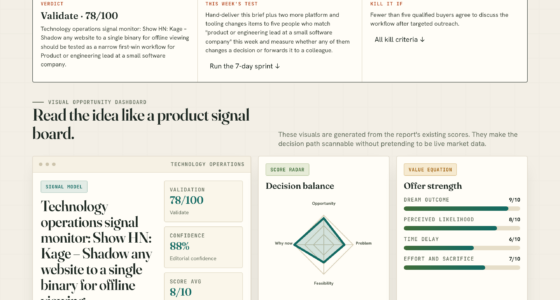
📊 Full opportunity report: Unveiling RingCentral’s AI-Native Strategy For Seamless Business Operations on ThorstenMeyerAI.com — validation score, market gap, and execution plan.

Get the latest gadgets delivered free with Prime
- Fast, free delivery on millions of items
- Prime Video, Amazon Music and more included
- Member-only deals all year
TL;DR
OpenAI has published a report highlighting RingCentral’s approach to building AI-native work environments across engineering and operational teams. While the scope is confirmed, details on deployments and outcomes are still unclear, making the impact uncertain.
OpenAI has published a report confirming that RingCentral is implementing an AI-native strategy across its engineering and operational teams, positioning AI as a core element of its internal workflows. This development signals a broader shift toward integrating artificial intelligence into the fundamental design of business processes, rather than as a standalone feature.
The report states that RingCentral’s approach extends beyond customer-facing applications, embedding AI into multiple layers of internal work. However, it does not specify which AI models or tools are used, nor does it provide measurable data on productivity gains, cost reductions, or service improvements. The report emphasizes the company-wide scope but leaves unclear whether these initiatives are in pilot, deployment, or fully operational stages.
OpenAI’s publication frames RingCentral as an example of an organization adopting AI as part of its operating design, suggesting a strategic move to embed AI into how tasks are conceived and executed internally. Yet, the report does not include concrete details about deployment timelines, employee adoption, or performance metrics.
Implications of RingCentral’s AI-Native Business Model
This development matters because it indicates a potential shift in how companies leverage AI internally, moving beyond customer-facing features to embed AI deeply into software development and business operations. If successful, this approach could influence industry standards for operational efficiency and innovation, though current evidence does not confirm measurable benefits.
For other organizations, RingCentral’s strategy could serve as a case study in cross-functional AI adoption, but the lack of detailed results and technical specifics means the actual impact remains unknown at this stage.
As an affiliate, we earn on qualifying purchases.
Background on AI Integration in Business Operations
Over the past few years, there has been a growing trend of deploying AI within internal workflows, especially in software engineering and operational management. Companies have experimented with automating routine tasks, optimizing decision-making, and enhancing collaboration with AI tools. However, most initiatives remain at the pilot or testing phase, with limited publicly available data on outcomes.
OpenAI’s recent report highlights RingCentral as a notable example of a company claiming to embed AI across multiple internal functions, signaling a possible shift toward more comprehensive AI integration in enterprise settings, though details are sparse.
business process automation software
As an affiliate, we earn on qualifying purchases.
As an affiliate, we earn on qualifying purchases.
Unconfirmed Details on Deployment and Results
It remains unclear which specific AI models or platforms RingCentral is deploying, whether these are in production or pilot phases, and what measurable outcomes have been achieved. The report does not disclose performance metrics, cost savings, or security controls in place. The roles of RingCentral and OpenAI in system design and operation are also unspecified.
AI-powered team collaboration tools
As an affiliate, we earn on qualifying purchases.
As an affiliate, we earn on qualifying purchases.
Next Steps for Verifying AI Impact at RingCentral
Further reporting will depend on RingCentral releasing detailed use cases, deployment timelines, and performance data. Independent evaluations, technical disclosures, and direct statements from RingCentral will be necessary to assess whether the AI-native strategy yields tangible benefits. Watch for updates from the company and third-party analyses to clarify the initiative’s success and challenges.
enterprise AI integration solutions
As an affiliate, we earn on qualifying purchases.
As an affiliate, we earn on qualifying purchases.
Key Questions
What does RingCentral mean by AI-native work?
AI-native work refers to integrating artificial intelligence into the core design and execution of internal processes, rather than adding AI as an afterthought or peripheral tool. It suggests AI is embedded into how tasks are conceptualized and performed across engineering and operations.
Which AI models or tools is RingCentral using?
The available information does not specify which OpenAI models, APIs, or applications RingCentral employs, nor whether these are in active production or testing phases.
Are there any measurable benefits reported?
No, the report does not include concrete data or metrics demonstrating productivity improvements, cost savings, or service quality enhancements resulting from the AI initiatives.
When did RingCentral start this AI-native strategy?
The timing of the initiative remains unspecified in the report. It is unclear whether this is a recent deployment, an ongoing project, or a retrospective account.
Source: ThorstenMeyerAI.com
Halloween Picks
halloween
As an affiliate, we earn on qualifying purchases.