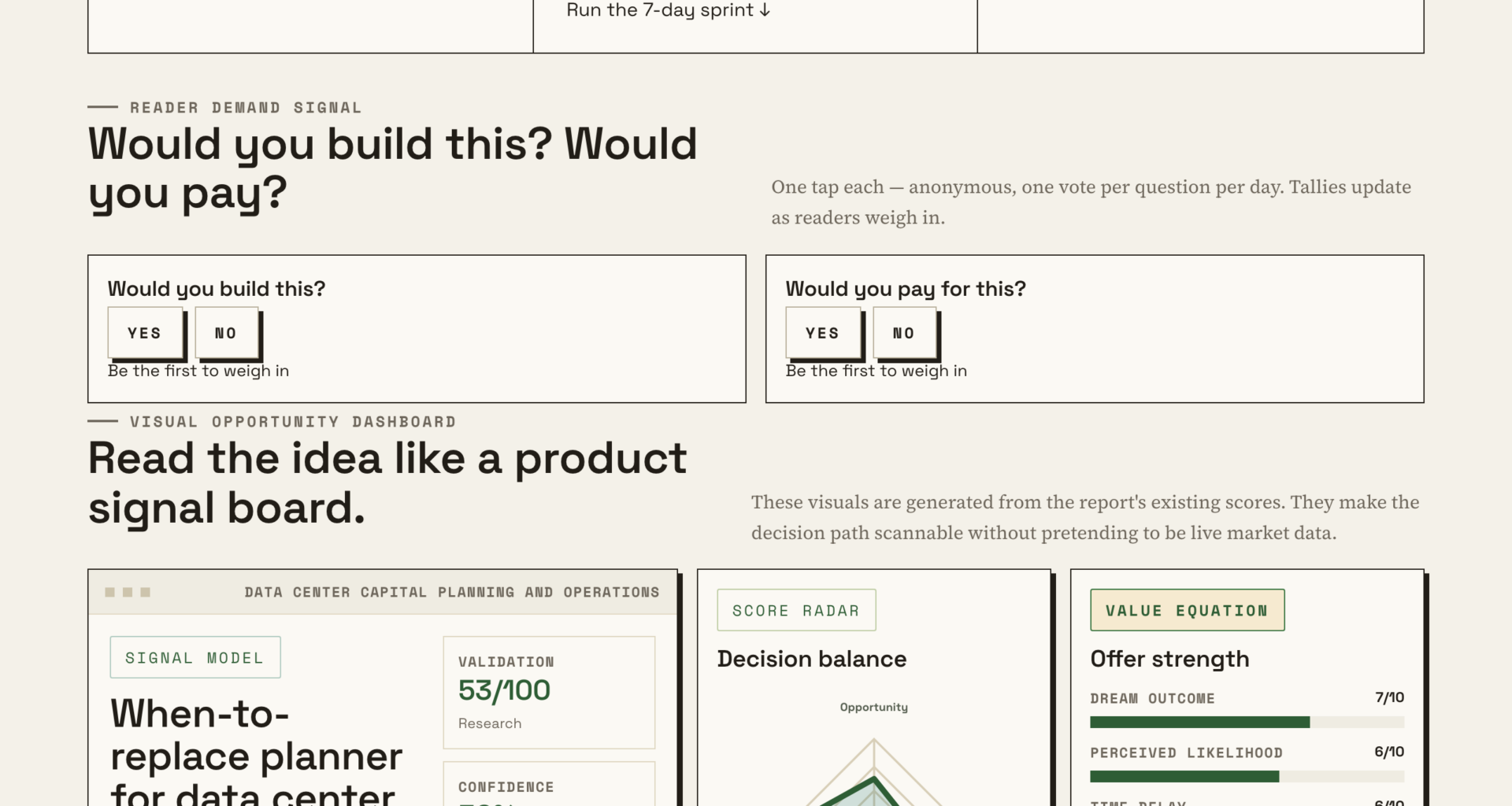

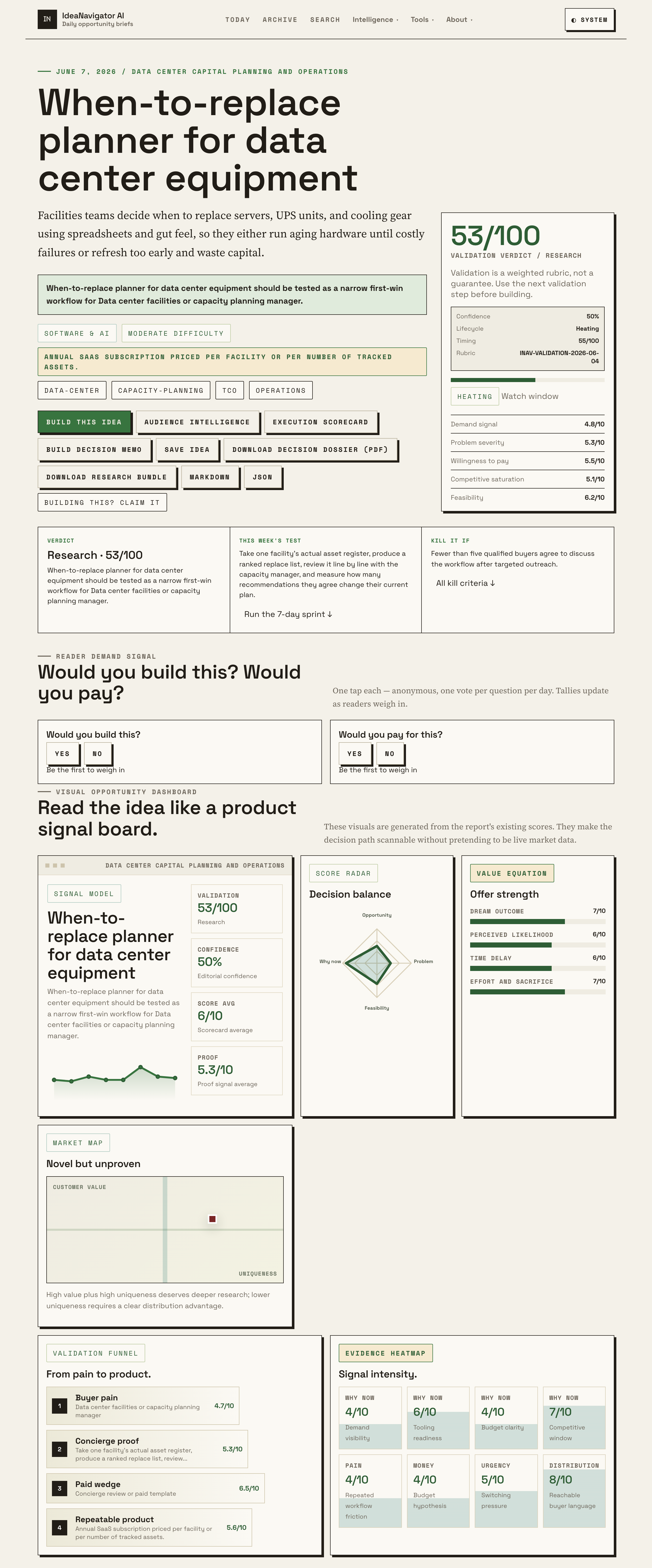
📊 Full opportunity report: Data Center Capacity Planning: When Equipment Replacement Is Needed on IdeaNavigator AI — validation score, market gap, and execution plan.

Get the latest gadgets delivered free with Prime
- Fast, free delivery on millions of items
- Prime Video, Amazon Music and more included
- Member-only deals all year
TL;DR
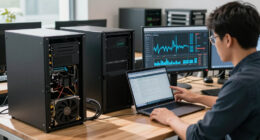
A new equipment replacement planner for data centers is undergoing testing with a pilot facility. It aims to help facilities managers decide when to replace aging hardware based on data, not intuition, potentially reducing costs and downtime.
A new equipment replacement planner for data centers is being tested with a pilot facility to determine optimal hardware refresh timing. Developed by IdeaNavigator AI, this tool aims to provide data-driven recommendations to facilities managers, addressing longstanding challenges in capacity planning and hardware lifecycle management.
The replacement planner ingests a facility’s asset list, including data such as age, power consumption, and maintenance costs. It then generates a ranked list of equipment, indicating which units should be replaced immediately based on rising energy costs and failure risks versus those that can be kept longer for cost efficiency.
According to an anonymous researcher involved in the pilot, the tool’s primary goal is to replace gut-feel decision-making with a data-driven approach, potentially reducing unnecessary capital expenditure and preventing costly failures. The initial validation involves reviewing the ranked recommendations with the facility’s capacity manager and comparing them to the current replacement plan.
Implications for Data Center Cost and Efficiency Optimization
This development could significantly impact how data centers manage hardware lifecycle decisions, especially as rising energy costs and hardware density increase financial and operational pressures. By providing a more precise replacement schedule, the tool could reduce unnecessary hardware refreshes and prevent failures, leading to cost savings and increased reliability.
As data centers face growing demands for energy efficiency and capacity, such tools could become essential components of capacity planning, shifting decision-making from intuition to data-based strategies.
data center server replacement tools
As an affiliate, we earn on qualifying purchases.
As an affiliate, we earn on qualifying purchases.
Growing Pressure for Data Center Hardware Optimization
Data center operators currently rely on spreadsheets and experience to decide when to replace servers, UPS units, and cooling equipment. This approach often results in either premature upgrades, which waste capital, or delayed replacements that risk costly failures.
With energy costs rising and hardware becoming more efficient, the economic tradeoff between keeping aging equipment and upgrading is sharpening. Recent industry discussions highlight the need for tools that can quantify replacement timing more accurately.
“The goal is to replace gut feeling with data-driven insights, making hardware replacement more precise and cost-effective.”
— an anonymous researcher
As an affiliate, we earn on qualifying purchases.
Uncertainties Around Pilot Results and Adoption
It is not yet clear how accurately the tool’s recommendations will align with actual operational needs or how widely it will be adopted if proven effective. The pilot is ongoing, and further validation is needed to assess its impact on decision-making and costs.
As an affiliate, we earn on qualifying purchases.
Next Steps in Validation and Broader Deployment
The initial validation involves reviewing the ranked replacement list with facility managers and comparing it to current plans. If successful, the tool could be refined based on feedback and expanded to additional facilities, potentially becoming a standard part of data center capacity planning processes.
hardware lifecycle management software
As an affiliate, we earn on qualifying purchases.
As an affiliate, we earn on qualifying purchases.
Key Questions
How does the replacement planner determine which equipment should be replaced?
The planner analyzes asset data such as age, energy consumption, and maintenance costs, then ranks equipment based on the risk of failure and inefficiency, recommending replacements where the cost-benefit is highest.
Is this tool available for commercial use now?
The tool is currently in a testing phase with a pilot facility. Broader availability will depend on validation results and further development.
What are the main benefits of using this replacement planner?
It can help facilities reduce unnecessary capital expenditure, prevent costly failures, and improve energy efficiency by providing data-driven replacement recommendations.
Will this replace human decision-making entirely?
It is designed to assist facilities managers by providing recommendations, but final decisions are expected to remain with human operators based on contextual factors.
What challenges might arise in implementing this tool?
Challenges include integrating with existing asset management systems, ensuring data accuracy, and gaining user trust in automated recommendations.
Source: IdeaNavigator AI
Columbus Day / Indigenous Peoples' Day Picks
long weekend sales
As an affiliate, we earn on qualifying purchases.