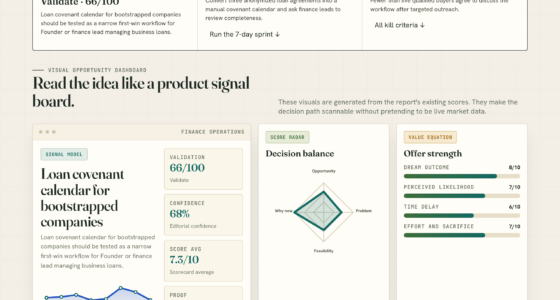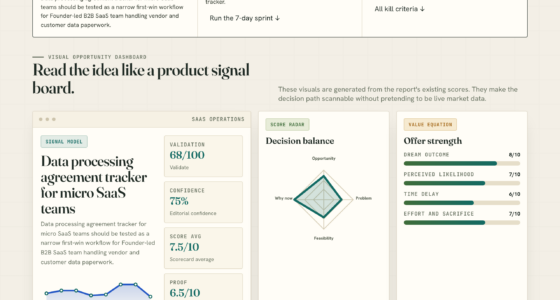

📊 Full opportunity report: Disk Is the Contract: Inside Threlmark’s Local-First Architecture on ThorstenMeyerAI.com — validation score, market gap, and execution plan.
Open a free Amazon Business account
Business pricing, bulk buying and tax-exempt orders.
Create a free accountAs an affiliate, we earn on qualifying purchases.
TL;DR
Threlmark’s architecture design treats local disk storage as the primary data source, eliminating traditional databases. This approach simplifies synchronization, enhances offline capabilities, and makes data more portable and transparent.
Threlmark has adopted a design where the local disk serves as the definitive source of truth for all data, moving away from traditional database reliance. This approach is detailed in the original analysis. This approach aims to simplify data management, improve offline usability, and promote data portability across tools. The system treats each data item as a separate file, with atomic write operations ensuring safety and consistency, making the entire architecture transparent and resilient.
Threlmark’s core principle is to treat the local disk as the single source of truth, where each project item is stored as an individual file. This design eliminates the need for centralized databases or cloud servers, allowing users to edit files directly using simple text editors or external tools. The system employs atomic write techniques—writing to temporary files before renaming—to prevent data corruption during crashes or interruptions. It also adopts a tolerant merging approach, allowing safe updates even when multiple tools or users modify files concurrently.
The directory structure itself acts as a formal contract, with clear organization of project data, metadata, and dependencies. For more on this concept, see Disk Is the Contract: Inside Threlmark’s Local-First Architecture. This transparency enables easy manual inspection, external tool integration, and simplified recovery from errors. Developers highlight that this approach shifts complexity from managing a central database to ensuring file integrity and consistency, which can be addressed through careful design of file operations and conflict resolution strategies.
Disk is the contract: inside a local-first roadmap hub
A Next.js app on top of plain JSON files — no database, no cloud, no accounts. The key decision: the on-disk layout IS the API. Everything else cascades from taking that seriously.
There is no server-of-record — the files are the record
The UI and any external tool reach the same files through the same discipline. The data root defaults to ~/.threlmark — home-based, because it’s a shared hub every one of your apps points at.
Inspectable
Every artifact is a file you can cat, diff, grep, commit.
Portable · no lock-in
Back up with cp, sync with Dropbox / git, migrate trivially.
Interoperable
Any tool in any language joins by reading / writing files.
Restartable
No in-memory state to lose — stateless over the files.
Two disciplined patterns instead of a database
“Just use files” is easy to get wrong. These two patterns — ported from a battle-tested sibling app — are what make file-based state sound rather than reckless.
Atomic writes
Write to a temp file in the same dir, then rename() over the target. Rename is atomic on one filesystem — a crash mid-write leaves the complete old file or the complete new one, never a half.
The board heals itself
A single roadmap.json array races when two tools write at once. One file per card makes writes collision-free. Lane order lives in board.json and reconciles on read.
board.json. It writes an item file — the board fixes itself on Threlmark’s next read. Unknown keys are preserved, so the contract is forward-compatible.The numbers can’t drift from the files
Anything computable from item state is computed — so the displayed numbers can never disagree with the underlying JSON. Priority is the clearest example: it’s calculated on read, never persisted.
priority — computed on read
Impact weighted heaviest; effort the only axis that subtracts. Reused verbatim from the original tool, so imported cards rank identically.
A handoff is a first-class flow event
The genuinely 2026-shaped part: most building is done by AI agents, so Threlmark closes the loop. Watch a card go from ranked to Done without anyone dragging it.
Handoff → report → self-move
The brief carries a reporting protocol. The agent reports through REST or the filesystem — and a done report moves the card itself.
POST /api/projects/:id/
items/:itemId/report
Direct call. Applied immediately.
drop reports/<file>.json
→ ingested on read
Robust even if the server’s down at finish time.
A small formula, and an honest hosting caveat
Because items are globally addressable (<projectId>/<itemId>), the Portfolio ranks everything together by a status-weighted score — finishing beats starting, blockers get a boost.
Portfolio ranking — status-weighted
In-flight work floats to the top; bottlenecks cost the most, so blockers get nudged up.
Static read-only demo
Seeded data, writes to localStorage. Try-before-you-clone.
Personal Node instance
Password-gated, persistent backed-up THRELMARK_DATA_DIR.
Multi-tenant SaaS
Add accounts + per-tenant isolation. A separate build.
src/lib/*/store.ts is the natural seam — the same boundary that keeps the local tool simple is the one you’d extend for multi-tenancy. The architecture doesn’t fight that future; it just doesn’t pay for it until you need it.
Implications of Disk as the Single Data Source
This architecture fundamentally changes how data persistence and collaboration are handled. By making the disk the definitive contract, Threlmark enhances data portability, resilience against system failures, and offline usability. It reduces vendor lock-in, as data remains accessible as plain files, and simplifies deployment by removing dependencies on centralized servers or proprietary databases.
However, this approach introduces new challenges, including managing concurrent edits and ensuring data consistency across multiple files. The safety mechanisms—atomic writes and tolerant merges—are designed to mitigate these risks, but they require careful implementation. Overall, this approach offers a more transparent, flexible, and resilient system, aligning with principles of local-first software design.
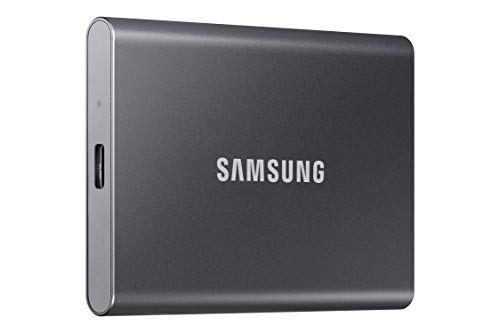
Samsung T7 Portable SSD 1TB Titan Gray, USB 3.2 Gen 2, Up to 1,050MB/s
- Designed for Creators: Fast speeds and durable for creators
- Fast Data Transfer: Up to 1,050MB/s read/write speeds
- High Capacity Storage: Up to 4TB storage capacity
As an affiliate, we earn on qualifying purchases.
As an affiliate, we earn on qualifying purchases.
Background and Evolution of Local-First Design
Traditional project management tools rely heavily on centralized databases or cloud services, which can introduce issues related to vendor lock-in, offline accessibility, and data portability. This shift towards local-first architectures is discussed in detail in the detailed overview. Recent trends in software design advocate for local-first architectures, where data is stored primarily on the user’s device, with synchronization handled as a secondary concern. Threlmark’s approach exemplifies this shift by treating each data item as a separate file, enabling offline work, manual editing, and easier integration with external tools.
Previous developments in this space include peer-to-peer sync protocols and file-based data models, which aim to improve resilience and user control. Threlmark’s implementation builds on these ideas, emphasizing simplicity, transparency, and safety through file-based operations, explicit directory structures, and conflict-tolerant merging techniques.
“Treating the disk as the ultimate contract transforms how we think about data management—making it more transparent, portable, and resilient.”
— Thorsten Meyer, Threlmark developer
![Free Fling File Transfer Software for Windows [PC Download]](https://m.media-amazon.com/images/I/41Vq6ZqHfjL._SL500_.jpg)
Free Fling File Transfer Software for Windows [PC Download]
- User-Friendly FTP Interface: Intuitive FTP client interface
- Reliable Site Maintenance: Easy and dependable FTP site management
- FTP Automation & Sync: Automate and synchronize FTP transfers
As an affiliate, we earn on qualifying purchases.
As an affiliate, we earn on qualifying purchases.
Remaining Challenges and Unanswered Questions
While the architecture’s principles are clear, details about how it handles complex conflict resolution during concurrent edits, large-scale data management, and integration with existing tools are still emerging. It is not yet confirmed how well the system scales in very large projects or how it manages manual manual intervention when conflicts occur. Additionally, the long-term robustness of the self-healing mechanisms remains to be fully validated in diverse real-world scenarios.

NEWQ 2TB External Hard Drive for iPhone, USB-C & Lightning Compatible Photo Storage Device, One-Click Backup Photos/Videos to Free Up Phone Space, Offline Transmission Support, No Computer Required
- Wide Compatibility: Supports iPhone, Android, Windows, Mac
As an affiliate, we earn on qualifying purchases.
As an affiliate, we earn on qualifying purchases.
Upcoming Developments and Future Plans
Threlmark plans to refine its conflict resolution strategies, improve user interfaces for manual conflict management, and expand integration capabilities with other tools and platforms. Further testing in real-world environments will help validate the architecture’s resilience and scalability. The development team also intends to document best practices for directory structures and conflict handling to support broader adoption of local-first principles.

Json Genie Premium: JSON Editor, Viewer & Formatter
- JSON and JSONC file editing: Open, view, and edit JSON files
- Tree-based interface: Fast, intuitive JSON navigation
- JSON formatting options: Pretty print or minified output
As an affiliate, we earn on qualifying purchases.
As an affiliate, we earn on qualifying purchases.
Key Questions
How does Threlmark ensure data safety without a traditional database?
Threlmark employs atomic write operations—writing to temporary files before renaming—to prevent corruption. It also uses tolerant merging to handle concurrent edits safely.
Can users manually edit project files?
Yes, the system’s transparency allows users to open and edit files directly with any text editor, making data portable and easy to inspect.
What are the main advantages of this local-first approach?
It improves offline usability, reduces vendor lock-in, simplifies data recovery, and enhances transparency and interoperability with external tools.
What challenges does this architecture face?
Managing concurrent edits, conflict resolution, and scaling in large projects are ongoing challenges that the development team is working to address.
Source: ThorstenMeyerAI.com
Flea & tick season Picks
flea and tick prevention
As an affiliate, we earn on qualifying purchases.