
For most gear-storage setups, DryTote Rechargeable Silica Gel Desiccant Packs, 5 x 100g stand out as the best overall pick: their large reusable packs suit bins and cases better than a handful of tiny sachets. Vbeijll’s 120g color-indicating packs make moisture status easier to check, while Micro-Pak Dri Clay offers small, single-use packets for separating items or filling tight spaces. The main tradeoff is between reusable capacity and convenience: larger packs need recharging, while smaller packets are easier to distribute but may need more frequent replacement. Pack count, indicator visibility, and fit with your storage container also affect the choice. Read on for the full breakdown and guidance on matching pack size to your gear.

Get the latest gadgets delivered free with Prime
- Fast, free delivery on millions of items
- Prime Video, Amazon Music and more included
- Member-only deals all year
Complete the kit



Key Takeaways
- Large reusable packs are the clearest fit for bins and cases: several options in this lineup use 100g packs, including DryTote, FURWEY, and TUXIYA, giving buyers a reusable format rather than many tiny sachets.
- Pack count changes the use case: FURWEY’s 12-pack and TUXIYA’s 24-pack suit distributing desiccant across multiple containers, while a five-pack is easier to allocate to a few larger storage spaces.
- Moisture indicators help with maintenance, not protection by themselves: Vbeijll’s 120g packs and the 50g color-indicating option make status checks easier, but buyers still need to follow the specific product’s recharge or replacement guidance.
- Small packets solve placement problems: Vbeijll’s 5g packets and Micro-Pak’s 6g clay packs can fit around individual items, though they are less convenient for treating larger storage volumes alone.
- The lineup spans materials and reuse plans: most listed options are silica gel, while Micro-Pak Dri Clay is clay-based; buyers should compare the stated material, use instructions, and intended storage setting rather than choosing by packet count alone.
| Romeda Silica Gel Desiccant Packs, 15 Count, 20 g Each |  | Best for Mid-Size Storage Containers | Packet quantity: 15 | Weight per packet: 20 g | Material: Transparent silica gel beads | VIEW ON AMAZON | See Our Full Breakdown |
| DryTote Rechargeable Silica Gel Desiccant Packs, 5 x 100g |  | Best for Safes and Heavy-Duty Gear Storage | Pack count: 5 | Weight per pack: 100 g | Total item weight: 1.22 pounds | VIEW ON AMAZON | See Our Full Breakdown |
| Vbeijll 5 g Silica Gel Desiccant Packets, 50-Pack |  | Best for Small Gear Cases and Fine-Grained Placement | Quantity: 50 packets | Packet weight: 5 g | Packet size: 1.77 x 2.36 inches | VIEW ON AMAZON | See Our Full Breakdown |
| Vbeijll 120g Color-Indicating Desiccant Packs, 6-Pack |  | Best for Large Gear Storage Spaces | Quantity: 6 packs | Capacity per pack: 120 g | Dimensions per pack: 3.7 x 5.1 inches | VIEW ON AMAZON | See Our Full Breakdown |
| Micro-Pak Dri Clay Kraft, Moisture Absorption Desiccant Packs, 6gx50pcs |  | Best Plastic-Free Option | Quantity: 50 packets | Weight per packet: 6 g | Desiccant material: Bentonite clay | VIEW ON AMAZON | See Our Full Breakdown |
| 50-Pack 5 g Silica Gel Desiccant Packets |  | Best for Small Gear Compartments | Quantity: 50 packets | Weight per packet: 5 g | Material: Silica gel | VIEW ON AMAZON | See Our Full Breakdown |
| FURWEY Rechargeable Desiccant Packs for Storage, 6-Pack, 100 g Each |  | Best for Beginners | Pack count: 6 | Weight per pack: 100 g | Total item weight: 0.63 kg | VIEW ON AMAZON | See Our Full Breakdown |
| FURWEY Rechargeable Desiccant Packs, 12 Pack, 100 g Each, Blue |  | Best for Multiple Storage Locations | Quantity: 12 packs | Weight per pack: 100 g | Total capacity: 1200 g | VIEW ON AMAZON | See Our Full Breakdown |
| DryTote Rechargeable Color-Indicating Silica Gel Desiccant Pack, 100 g |  | Best Single-Pack Option | Capacity: 200 gallons | Dimensions: 5 x 5 x 2 inches | Weight: 3.52 oz | VIEW ON AMAZON | See Our Full Breakdown |
| Absorbking Silica Gel Packets, 50 g, 25-Pack |  | Best for Food-Adjacent Gear Storage | Quantity: 25 packets | Weight per packet: 50 g | Moisture absorption: Up to 40% of packet weight | VIEW ON AMAZON | See Our Full Breakdown |
| Absorbking Silica Gel Packets, 100 Gram 12 Packs |  | Best for Large Individual Containers | Pack count: 12 | Weight per pack: 100 g | Material: Silica gel beads | VIEW ON AMAZON | See Our Full Breakdown |
| TUXIYA 24-Pack Rechargeable Silica Gel Desiccant Packets, 100 g Each |  | Best for Indicator-Guided Reuse | Pack count: 24 | Weight per packet: 100 g | Packet dimensions: 3.15 × 4.72 inches | VIEW ON AMAZON | See Our Full Breakdown |
| DryTote Rechargeable Silica Gel Desiccant Packs, 5 Pack, 100 g |  | Best for a Small Number of Large Totes | Pack count: 5 | Weight per pack: 100 g | Listed capacity: 200 gallons | VIEW ON AMAZON | See Our Full Breakdown |
| Silica Gel Packets, 50 Gram 35 Packs, Color Indicating |  | Best for Dividing Across Many Containers | Pack count: 35 | Weight per packet: 50 g | Material: Silica gel beads | VIEW ON AMAZON | See Our Full Breakdown |
| Aheroi Reusable Rechargeable Silica Gel Desiccant Packs, 30-Pack |  | Best for Flexible Recharge Options | Pack count: 30 | Dry weight per pack: Approximately 100 g | Saturated weight per pack: Approximately 130 g | VIEW ON AMAZON | See Our Full Breakdown |
More Details on Our Top Picks
Romeda Silica Gel Desiccant Packs, 15 Count, 20 g Each
Romeda’s 20 g packets offer a practical middle ground for gear stored in sealed bins, camera cases, or shoe boxes: each packet has more desiccant than the Vbeijll 5 g packets, while the 15-count set stays less specialized than larger reusable packs. That makes them easier to distribute among several containers without committing to a single large unit. The packets are described as reusable after heating, and the silica gel is identified as non-toxic, though they have no saturation indicator to tell you when reactivation is needed. Unlike the DryTote packs, which show saturation through color change, Romeda leaves that check to the storage schedule or inspection. They also work best in airtight containers; open shelves and frequently opened bags will reduce their usefulness, and recharging requires heat.
Pros:- 20 g packet size suits storage containers needing more capacity than small 5 g sachets
- 15 packets can be distributed among multiple gear containers
- Reusable after heating, according to the product description
- Silica gel is described as non-toxic
Cons:- No color indicator to show when the packets are saturated
- Works best in airtight storage rather than open or frequently accessed spaces
- Reactivation requires heating
Best for: People storing gear across several small-to-medium airtight bins who want packets larger than 5 g and are comfortable tracking when to reactivate them.
Not ideal for: Buyers who need a visible saturation cue or want moisture control in frequently opened, unsealed spaces.
- Packet quantity:15
- Weight per packet:20 g
- Material:Transparent silica gel beads
- Reuse:Reusable after heating in an oven or microwave
- Item weight:10.5 ounces
- Package dimensions:6.18 x 6.1 x 2.32 inches
- Manufacturer:Romeda
Our verdict“Choose Romeda for several sealed gear containers when you want medium-size reusable packets and do not need a saturation indicator.”
DryTote Rechargeable Silica Gel Desiccant Packs, 5 x 100g
Five 100 g packs make this DryTote set a stronger fit for larger enclosed spaces than Romeda’s 20 g packets. I’d shortlist it for a gun safe, ammo can, or cabinet where substantial individual packs are easier to place than a handful of small sachets. The main practical advantage is the blue-to-pink saturation indicator: it gives you a visual prompt to recharge, unlike Romeda’s unmarked packets. The packs require no power and can be warmed to release moisture, so routine upkeep is straightforward in principle. The tradeoff is that the set supplies only five units, which may limit coverage if you are dividing protection among many small cases. It also needs warming before reuse, and the supplied description offers no performance data to compare its moisture control directly with Vbeijll’s 120 g packs.
Pros:- Five substantial 100 g packs suit enclosed storage spaces such as safes and cabinets
- Blue-to-pink indicator shows when packs are saturated
- Reusable by warming to release absorbed moisture
- No power is required
Cons:- Only five packs are included, limiting placement across many separate containers
- Packs need warming before reuse
- The provided product details do not quantify absorption capacity or performance
Best for: Gun-safe, ammo-can, and cabinet owners who want sizable reusable packs with a visible saturation cue.
Not ideal for: People protecting many small cases or wanting a large number of compact packets to distribute separately.
- Pack count:5
- Weight per pack:100 g
- Total item weight:1.22 pounds
- Indicator:Changes from blue to pink when saturated
- Reuse:Yes; warm packs to release moisture
- Power required:No
- Package dimensions:9.97 x 7.25 x 2.29 inches
Our verdict“Pick DryTote when a few large, color-indicating packs are a better fit for your safe or cabinet than numerous small packets.”
Vbeijll 5 g Silica Gel Desiccant Packets, 50-Pack
When protection needs to be spread across many small cases, 50 compact 5 g packets are more flexible than the larger DryTote 100 g packs. I’d use this format for camera accessories, electronics drawers, or separate gear pouches kept in sealed storage. The orange-to-dark-green beads offer a saturation cue, and the stated absorption is up to 35% of packet weight. That capacity is modest per packet, so larger bins may need several; the Vbeijll 120 g packs are a better match when you want fewer, heavier units. These packets can be reactivated by oven, microwave, or sunlight according to the description, but heat and timing need care because excess heat may damage the outer packaging. The specified food-safe wrapping applies to packets of 5 g or less, though the product’s small size is less convenient for large gear spaces.
Pros:- 50 small packets allow targeted placement across many containers
- Orange beads turn dark green when saturated
- Up to 35% moisture absorption by packet weight is specified
- Reactivation options include oven, microwave, or sunlight
Cons:- Small 5 g capacity may require several packets in larger storage spaces
- Reactivation demands careful temperature and timing to avoid damaging the packaging
- Small packets are less convenient to handle than larger packs
Best for: Owners of multiple small, sealed gear cases or electronics containers who want individually placeable packets with a color-change indicator.
Not ideal for: People managing large cabinets or bins who would rather use a few high-capacity packs than distribute many small sachets.
- Quantity:50 packets
- Packet weight:5 g
- Packet size:1.77 x 2.36 inches
- Moisture absorption:Up to 35% of packet weight
- Indicator colors:Orange when dry; dark green when saturated
- Reuse:Reactivation instructions include oven, microwave, or sunlight
- Wrapping:Food-safe wrapping specified for packets of 5 g or less
Our verdict“Choose Vbeijll’s 5 g packets for many small sealed cases, but use the 120 g Vbeijll packs for fewer, larger storage spaces.”
Vbeijll 120g Color-Indicating Desiccant Packs, 6-Pack
Six 120 g packs are the largest individual units among these five products, making this Vbeijll set a sensible choice for larger safes, equipment cabinets, or storage areas holding several pieces of gear. Each pack is rated to absorb up to 35% of its weight, and its blue-to-pink indicator makes saturation easier to spot than with Romeda’s unmarked packets. The packs come individually sealed, with a resealable outer bag to help keep unused units dry. Compared with DryTote’s five 100 g packs, this set offers more total desiccant and a stated oven-recharge procedure: 300°F for 1–2 hours. That bulk comes with a handling tradeoff; these are less adaptable to tiny cases, and the description warns that indicator ink may bleed or fade after high-heat reactivation.
Pros:- Six 120 g packs provide substantial capacity for larger enclosed storage spaces
- Blue-to-pink indicator signals saturation
- Individually sealed packs and a resealable outer bag help protect unused units
- Heat-resistant fabric is rated up to 350°F
Cons:- Reactivation requires an oven at 300°F for 1–2 hours
- Indicator ink may bleed or fade after high-heat reactivation
- Pack size is less suited to small cases than Vbeijll’s 5 g packets
Best for: People storing several pieces of equipment in a large safe, cabinet, or enclosed storage space who want high-capacity packs and a saturation indicator.
Not ideal for: Owners of small cases who need compact packets, or buyers who want to avoid oven-based reactivation and possible indicator fading.
- Quantity:6 packs
- Capacity per pack:120 g
- Dimensions per pack:3.7 x 5.1 inches
- Moisture absorption:Up to 35% of pack weight
- Indicator:Blue when dry; pink when saturated
- Reactivation:Oven at 300°F for 1–2 hours
- Heat-resistant fabric:Rated up to 350°F
- Item weight:1.72 pounds
Our verdict“Choose these Vbeijll packs for larger gear storage spaces where high capacity and a visible recharge cue matter more than compact size.”
Micro-Pak Dri Clay Kraft, Moisture Absorption Desiccant Packs, 6gx50pcs
Micro-Pak Dri Clay stands apart from the silica gel options here by using bentonite clay in biodegradable Kraft-paper packaging. That makes it the clearest choice for buyers seeking a plastic-free packet, while its 50-count format echoes the placement flexibility of Vbeijll’s 5 g silica packets. Each 6 g pack is specified for a shoebox-sized container of about 6 quarts, so the guidance helps match packet count to a small gear box rather than guessing. The tradeoff is that these packs are presented as replaceable every three months, not rechargeable like DryTote or Vbeijll’s larger fabric packs. They also need a tightly sealed container to work as described. The product claims broad use across materials and storage types, but the supplied details do not give a quantified moisture-absorption percentage for direct comparison with Vbeijll.
Pros:- Bentonite-clay desiccant uses biodegradable Kraft-paper packaging
- 50 packets allow placement across multiple small storage containers
- One 6 g packet is specified for a shoebox-sized container of about 6 quarts
- Described as food-grade and Halal certified
Cons:- Product guidance says to replace packs every three months rather than recharge them
- Requires tightly sealed storage to work as described
- No quantified moisture-absorption percentage is provided
Best for: Buyers who want plastic-free, clay-based packets for sealed shoe boxes, small gear bins, leather goods, or tool storage and prefer replacement over recharging.
Not ideal for: People seeking reusable packs, color-based saturation monitoring, or a quantified moisture-capacity figure.
- Quantity:50 packets
- Weight per packet:6 g
- Desiccant material:Bentonite clay
- Packet packaging:Biodegradable Kraft paper
- Coverage guidance:One packet per shoebox-sized container, about 6 quarts
- Replacement guidance:Replace every 3 months
- Certifications and use claims:Halal certified; described as food grade
Our verdict“Pick Micro-Pak Dri Clay if plastic-free packaging and clear shoebox-sized coverage guidance matter more to you than reusability.”
50-Pack 5 g Silica Gel Desiccant Packets
These 50 small, 5 g packets suit buyers who want to spread moisture control across several compact storage spots, such as camera cases, accessory boxes, or electronics drawers. Their non-woven fabric packets are odorless and described as reusable after heating, which offers more flexibility than treating them as strictly single-use sachets. Compared with the FURWEY 100 g packs, these are easier to distribute among small compartments but provide far less desiccant per packet, so they are not the stronger choice for a large gear bin. I would also favor a purpose-made food-storage option such as Absorbking when food contact is part of the plan; this product’s description says to keep packets away from food. Heating requires care and monitoring, so recharging is less hands-off than using packs with a visible humidity indicator.
Pros:- 50 packets make it easy to distribute desiccant among several small containers
- Odorless silica gel is suitable for gear where added scent would be unwelcome
- Packets are described as reusable by heating
- Non-woven fabric packet material
Cons:- At 5 g each, individual packets have limited capacity for larger storage spaces
- Heating instructions call for monitoring to avoid overheating
- Must be kept from direct contact with food
Best for: People organizing small electronics, camera accessories, or other gear in multiple sealed cases and drawers
Not ideal for: Anyone managing a large or frequently opened storage container, or seeking packets intended for direct use around food
- Quantity:50 packets
- Weight per packet:5 g
- Material:Silica gel
- Packet material:Non-woven fabric
- Item weight:6.4 ounces
- Product dimensions:1.97 x 7.87 x 9.84 inches
- Manufacturer:Adsorbco
Our verdict“Choose these for spreading small amounts of moisture protection across many compact gear compartments, not for drying a large bin.”
FURWEY Rechargeable Desiccant Packs for Storage, 6-Pack, 100 g Each
The main advantage here is simple recharge guidance: each 100 g pack changes color from blue to pink when it needs attention, giving new users a visible cue instead of a guess. Six individually wrapped packs can be placed in closets, cars, or storage bins, and the stated microwave limit of 210°F (100°C) makes the recharge routine clear. Compared with the 12-pack version of this FURWEY line, this set covers fewer storage locations but also asks for a smaller initial commitment. The bigger limitation is longevity: the maker recommends replacement after about 10 uses, so these are not a permanent alternative to refillable bulk desiccant. At 100 g per pack, they also offer less total material than larger-capacity options such as Absorbking’s 50 g packets bought in quantity can provide across a collection of gear.
Pros:- Color indicator signals when recharging is needed
- Microwave recharge instructions specify a temperature limit
- Individually wrapped packs are compact for placement in different locations
- Suitable for closets, cars, and storage bins
Cons:- Recommended replacement after about 10 uses limits long-term reuse
- Six packs may not cover a large collection of storage containers
- Each pack holds 100 g, which may be modest for larger spaces
Best for: First-time users who want a visible recharge cue for a few closets, car compartments, or storage bins
Not ideal for: People needing long-term reusable packs or enough units to cover many separate gear containers
- Pack count:6
- Weight per pack:100 g
- Total item weight:0.63 kg
- Dimensions per pack:5.5 x 3.1 x 0.4 inches
- Moisture absorption capacity:25% to 35%
- Recharge method:Microwave, up to 210°F (100°C)
- Recommended uses:Residential
Our verdict“Pick this six-pack if you want an easy-to-read recharge cue for a handful of residential gear-storage spots.”
FURWEY Rechargeable Desiccant Packs, 12 Pack, 100 g Each, Blue
This set is the better FURWEY choice when moisture control needs to reach many separate closets, cars, or bins: it doubles the six-pack’s count while keeping the same 100 g format and color-changing indicator. The blue-to-light-pink cue makes it straightforward to spot packs that need microwave recharging, and each is individually wrapped before use. Compared with the six-pack FURWEY, the practical gain is wider coverage, not greater capacity per container; each unit remains 100 g and has the same stated 25% to 35% absorption capacity. That makes this a less suitable pick for one large gear case than a bulkier option such as the DryTote 100 g pack if fewer, larger pieces are preferred. Reuse also has a defined limit: the manufacturer recommends replacement after 10 uses, and packs require recharging once the indicator turns pink.
Pros:- 12 packs provide broad coverage across separate storage areas
- Color indicator shows when a pack needs recharging
- Individually wrapped packs help keep them dry before use
- Microwave recharge method is specified up to 210°F (100°C)
Cons:- Each pack is still only 100 g, so the larger count does not raise per-container capacity
- Manufacturer recommends replacement after 10 uses
- Needs microwave recharging when the indicator turns pink
Best for: Households or hobbyists protecting gear across several cars, closets, storage bins, or filament containers
Not ideal for: Buyers who need a single high-capacity unit for one large container or want packs without a recurring recharge routine
- Quantity:12 packs
- Weight per pack:100 g
- Total capacity:1200 g
- Dimensions per pack:5.5 x 3.1 x 0.4 inches
- Moisture absorption capacity:25% to 35%
- Indicator:Blue when ready; light pink when recharging is needed
- Recharge method:Microwave, up to 210°F (100°C)
Our verdict“Choose the 12-pack over the six-pack when you need the same indicator-led system in more storage locations.”
DryTote Rechargeable Color-Indicating Silica Gel Desiccant Pack, 100 g
DryTote is a straightforward pick for someone who wants one rechargeable pack for a suitcase, storage bin, closet, or filament container rather than a bundle of small sachets. Its color-indicating silica gel provides a visual status cue, and the pack can be recharged in either a microwave or oven. That flexibility distinguishes it from the FURWEY packs, which specify microwave recharging, but DryTote’s supplied details do not give a temperature or a clear color-change instruction for the indicator. The stated 200-gallon capacity is useful as a scale reference, though the product remains a single 100 g unit, so it may not be the right match for several separate gear cases. Unlike FURWEY’s six- and 12-packs, there is no stated replacement interval; the tradeoff is that buyers get less guidance about when or how often to refresh it.
Pros:- Reusable silica gel can be recharged in a microwave or oven
- Color-indicating material offers a visual status cue
- Stated use includes bins, suitcases, closets, and filament storage
- Single-pack format suits buyers who do not need a multi-pack bundle
Cons:- Only one 100 g pack is included
- Recharge temperature and indicator color meanings are not specified in the provided details
- Requires access to a microwave or oven for recharging
Best for: Someone needing one rechargeable desiccant unit for a suitcase, gear bin, closet, or 3D-printer filament container
Not ideal for: People covering many small containers or those who want a specified recharge temperature and replacement schedule
- Capacity:200 gallons
- Dimensions:5 x 5 x 2 inches
- Weight:3.52 oz
- Color:Yellow
- Operation mode:Continuous
- Recommended use:Residential
- Included components:Dehumidifier, user manual
Our verdict“Choose DryTote when one rechargeable pack and microwave-or-oven flexibility matter more than a larger multi-pack supply.”
Absorbking Silica Gel Packets, 50 g, 25-Pack
Absorbking stands apart from the smaller FURWEY units with 25 packets at 50 g each, giving buyers a substantial amount of desiccant to distribute among larger sealed containers or several storage areas. The maker states absorption of up to 40% of packet weight, and the packets are described as food-safe and cobalt chloride-free—a useful distinction when gear shares storage space with packaged food or pantry items. Compared with the 5 g Adsorbco sachets, these are much larger per unit and better suited to bins than tiny accessory compartments. They can be microwave-dried for reuse, but they do not list a color indicator like FURWEY’s rechargeable packs, so the user gets less direct guidance on when refresh is needed. Keep them in a resealable bag before use; otherwise they can absorb moisture from the surrounding air while waiting in storage.
Pros:- 25 packets of 50 g each provide more material per packet than 5 g sachets
- Rated to absorb up to 40% of packet weight in water vapor
- Described as food-safe and cobalt chloride-free
- Can be dried in a microwave for reuse
Cons:- Should be kept in a resealable bag to limit moisture absorption before use
- No color indicator is listed to show when packets need refreshing
- More packets may be needed in very humid conditions
Best for: People protecting larger gear bins or storage areas where desiccant may sit near packaged food or pantry supplies
Not ideal for: Anyone wanting a color indicator, very small sachets for tight compartments, or desiccant that can be left unpackaged before use
- Quantity:25 packets
- Weight per packet:50 g
- Moisture absorption:Up to 40% of packet weight
- Material:White silica gel beads
- Food safe:Yes
- Cobalt chloride free:Yes
- Reuse method:Microwave-dry for about 2 minutes
- Package weight:2.86 pounds
Our verdict“Choose Absorbking for larger packets and food-safe positioning, provided you can store unused sachets sealed and monitor them without an indicator.”
Absorbking Silica Gel Packets, 100 Gram 12 Packs
With twelve 100 g packets, Absorbking is aimed at larger sealed spaces—such as gear bins, safes, or filament containers—where a small sachet may be undersized. The listing says the silica gel can absorb up to 40% of its weight and that the packs can be microwaved for reuse, but it gives no color indicator to show when they are saturated. That makes it less hands-off than the TUXIYA 24-pack, which has blue-to-pink indicators, and less informative than the orange-indicating 50 g packets in this lineup. The durable nonwoven pouches and food-safe, cobalt-chloride-free beads broaden its storage uses, though food-contact suitability should still be checked against the item’s packaging and intended use. I’d choose it when fewer, heavier packs suit the containers better than lots of smaller sachets.
Pros:- Twelve 100 g packs suit larger storage containers
- Listing states absorption capacity of up to 40% of pack weight
- Reusable by microwave heating
- Nonwoven packaging is described as strong and leak-resistant
Cons:- No color indicator to show when a pack needs recharging
- Large packets may be awkward in compact cases or divided storage
- Microwave renewal instructions are limited to an approximate heating time
Best for: People protecting a few large, sealable gear bins, safes, or filament containers who prefer heavier packs and can track recharging themselves
Not ideal for: Buyers who need a visible saturation indicator or many small sachets to distribute across camera cases and separate compartments
- Pack count:12
- Weight per pack:100 g
- Material:Silica gel beads
- Stated moisture absorption:Up to 40% of pack weight
- Reuse:Microwave reactivation; listing suggests about 2 minutes
- Indicator:None specified
- Packet fabric:Nonwoven fabric
- Cobalt chloride:Free
Our verdict“Choose Absorbking for a small number of large storage spaces where high-capacity packs matter more than a saturation indicator.”
TUXIYA 24-Pack Rechargeable Silica Gel Desiccant Packets, 100 g Each
TUXIYA combines a substantial supply with a practical cue for maintenance: each 100 g packet changes from blue to pink as it absorbs moisture. That makes it easier to rotate packs across gear bins, electronics storage, or document boxes than Absorbking’s 100 g packets, which lack an indicator. Its 24 individually sealed packets also let buyers place desiccant in separate containers without opening the whole supply at once. The tradeoff is bulk: the listed item weight is 6.12 pounds, and the 3.15 × 4.72-inch packets need more room than compact sachets. Renewal uses a microwave, but heating and cooling require care; the listing also notes that indicator-window stains may make color changes harder to read. I’d favor this set for many storage locations where visual status checks are useful, not for minimalist kits.
Pros:- Blue-to-pink indicator helps signal moisture absorption
- Twenty-four individually sealed packets support distribution across multiple containers
- Each packet holds 100 g of silica gel
- Cobalt-chloride-free and reusable by microwave
Cons:- The full set has a listed weight of 6.12 pounds
- Microwave renewal requires careful heating and cooling
- Indicator-window staining may make status harder to read
Best for: Photographers, collectors, or workshop owners maintaining several sealed storage containers who want to see when individual packs need recharging
Not ideal for: Travelers with small camera bags or buyers who want compact, lightweight sachets and do not need a large multi-container supply
- Pack count:24
- Weight per packet:100 g
- Packet dimensions:3.15 × 4.72 inches
- Particle diameter:2–3 mm
- Material:Silica gel
- Indicator:Blue when dry; pink after moisture absorption
- Reuse method:Microwave renewal
- Cobalt chloride:Not included
- Item weight:6.12 pounds
Our verdict“Pick TUXIYA if you need many reusable, individually monitored packs and have room for their larger format.”
DryTote Rechargeable Silica Gel Desiccant Packs, 5 Pack, 100 g
DryTote is the restrained option here: five 100 g packs give tote owners a modest set of reusable desiccants without committing to TUXIYA’s 24-piece supply or Aheroi’s 30-pack. The listing claims coverage up to 200 gallons, but does not clarify whether that refers to the set or each pack, so I would treat it as a sizing reference rather than a guarantee for every storage setup. Color indication helps flag when moisture has been absorbed, and microwave or oven recharging gives more flexibility than microwave-only options such as Absorbking. Its main limitation is quantity: five packs may not stretch far across multiple bins, camera cases, and closets. The plastic material listing also leaves the pouch construction unclear. This makes the most sense for a few larger, regularly checked storage spaces.
Pros:- Five 100 g packs suit a small number of larger storage areas
- Color indicator provides a visual moisture-status cue
- Can be recharged in a microwave or oven
- Listed for storage totes, closets, suitcases, and filament containers
Cons:- Five-pack quantity may be inadequate for many separate containers
- The stated 200-gallon capacity is not clearly defined as per-pack or per-set
- Plastic material specification gives limited detail about the packet enclosure
Best for: People storing seasonal gear in a handful of large totes who want reusable packs and a color-based reminder to recharge them
Not ideal for: Buyers outfitting many small cases or separate compartments, since five packs offer limited distribution compared with TUXIYA or Aheroi
- Pack count:5
- Weight per pack:100 g
- Listed capacity:200 gallons
- Material:Plastic
- Color:Yellow
- Recharge methods:Microwave or oven
- Dimensions:5 × 5 × 2 inches
- Model:DryTote5
Our verdict“Choose this DryTote set for a few large totes, but look to TUXIYA or Aheroi if you need broader distribution across many containers.”
Silica Gel Packets, 50 Gram 35 Packs, Color Indicating
This set pairs a 35-packet quantity with a manageable 50 g size, so it suits gear owners who want to spread desiccant across many cases, bins, or drawers rather than place one large pack in each. Its orange indicator beads turn dark green as they absorb moisture, giving a more direct visual cue than Absorbking’s non-indicating 100 g packs. The listing also states up to 40% absorption by weight and microwave reactivation, though it advises avoiding excessive heating. Compared with TUXIYA’s 100 g packets, these are smaller and easier to distribute, but each holds less desiccant, so larger or damp storage spaces may call for multiple packets. The resealable-bag storage recommendation matters too: exposed packs can absorb ambient moisture before they reach your gear.
Pros:- Thirty-five packets make it easy to distribute desiccant across separate containers
- Orange beads shift to dark green as moisture is absorbed
- Listing states up to 40% moisture absorption by weight
- Cobalt-chloride-free silica gel is reusable by microwave
Cons:- Each 50 g packet has half the stated weight of the 100 g options
- Larger or more humid spaces may require several packets
- Heating too long during microwave reactivation can be a concern
Best for: People with several camera cases, tool drawers, seed containers, or smaller gear bins who want indicator beads in each location
Not ideal for: Owners of large, high-humidity storage bins who prefer fewer higher-capacity packs and do not want to manage multiple sachets
- Pack count:35
- Weight per packet:50 g
- Material:Silica gel beads
- Stated moisture absorption:Up to 40% of pack weight
- Indicator:Orange when dry; dark green as moisture is absorbed
- Reuse method:Microwave reactivation
- Cobalt chloride:Free
- Storage guidance:Keep in a resealable bag when not in use
Our verdict“Pick these 50 g packets when broad coverage and visible status matter more than maximizing capacity in each container.”
Aheroi Reusable Rechargeable Silica Gel Desiccant Packs, 30-Pack
Aheroi’s 30-pack of approximately 100 g sachets is built for widespread placement: the flat 5 × 3 × 0.7-inch shape can fit wardrobes, tool cabinets, camera cases, and filament boxes. Its blue-to-pink indicator gives a simple cue for recharging, while the choice of microwave, oven, or sunlight offers more flexibility than TUXIYA’s microwave-only renewal. The tradeoff is that the listing does not specify recharge times, and it warns that high heat can damage the packs, so appliance use calls for attention. Its stated absorption is up to 35% of pack weight, below the 40% claim for Absorbking and the 50 g indicating set. I’d choose Aheroi for broad household coverage and multiple recharge routes, but not when maximum stated capacity per pack is the deciding factor.
Pros:- Thirty packs support distribution across many storage locations
- Blue-to-pink indicator signals when recharging is needed
- Microwave, oven, and sunlight are listed recharge options
- Flat 0.7-inch profile can fit narrower storage spaces
Cons:- Stated absorption of up to 35% is lower than the 40% claims on some alternatives
- Recharge time varies with saturation and heating method
- High heat can damage the packs
Best for: Households or gear rooms with many storage spots who want a large supply of indicator packs and alternatives to microwave-only recharging
Not ideal for: Buyers prioritizing the highest stated moisture absorption percentage or those who want precise, product-specific recharge timing
- Pack count:30
- Dry weight per pack:Approximately 100 g
- Saturated weight per pack:Approximately 130 g
- Stated moisture absorption:Up to 35% of pack weight
- Dimensions:5 × 3 × 0.7 inches
- Silica gel size:2–4 mm
- Indicator:Blue when dry; pink when recharge is needed
- Recharge methods:Microwave, oven, or sunlight
- Cobalt chloride:Not included
Our verdict“Choose Aheroi for numerous storage locations and flexible recharging, but favor a higher-capacity-claim option if absorption per pack is your priority.”
How We Picked
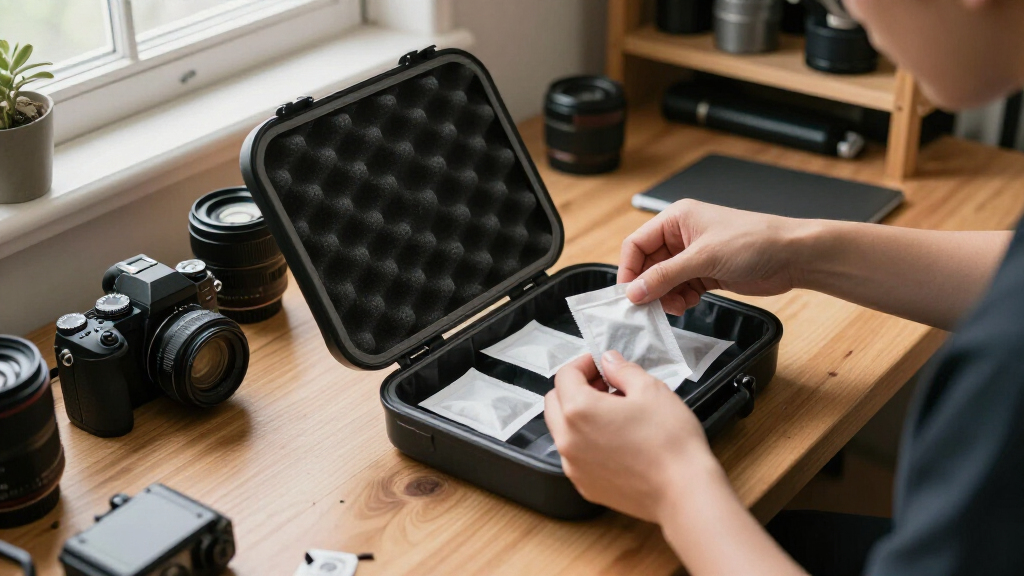
I ranked these desiccant packs for gear storage by how well their format matches common storage jobs: protecting a camera case, tool bin, electronics box, or a collection of smaller containers. Capacity and pack size matter because one large pack and several small packets distribute differently, even when both are labeled for moisture absorption. I also weighed whether packs are described as reusable or rechargeable, whether they provide a visible moisture indicator, and how easy the stated pack count is to allocate across gear.
The top positions favor versatile formats that can serve a typical storage setup without forcing buyers into either a large bulk assortment or a collection of tiny sachets. Indicator-equipped and higher-count options rank well when their extra convenience has a clear purpose; compact and single-use formats remain useful for specific placements but rank lower as general-purpose choices. Product names and supplied specifications do not establish performance in every container, so I avoid treating capacity, food-related labeling, or recharge claims as a substitute for following each manufacturer’s instructions.
Factors to Consider When Choosing Desiccant Packs For Gear Storage
Choosing desiccant for stored gear is less about finding the biggest number on a packet and more about matching the format to your container, inspection habits, and maintenance routine. These broader checks can help prevent buying too few packs, using a format that cannot be monitored, or expecting desiccant to solve a leak or damp-storage problem.
Match pack size to the container, not just the gear
A padded camera case, a sealed electronics box, and a large equipment bin have different air volumes and different places to position packs. Small packets can be placed near individual items or tucked into narrow gaps, but using several sachets does not automatically make them equal to a larger pack for a roomy container. Check the manufacturer’s guidance for the intended volume and storage conditions rather than estimating from the number of objects inside. If you store gear in several separate containers, a larger assortment of smaller packs may be easier to allocate than a few heavy packs. Avoid blocking vents or placing packets where they can rub against delicate surfaces. For mixed storage, a few larger packs for bins plus small packets for accessory cases can be more practical than relying on one format.
Treat rechargeability as a maintenance commitment
Reusable packs can reduce the need to replace disposable sachets, but they only help if you have a workable way to recharge them. Read the product’s instructions before buying; heating methods, temperature limits, and timing can differ, and a pack’s outer fabric may not be suitable for every heat source. A busy storage room with many containers may make scheduled recharging worthwhile, while occasional users may prefer simple packets that do not need a separate maintenance step. Do not assume that a reusable label means the pack is ready to use indefinitely without checking its condition. Keep recharged packs dry until they go into storage, or they may absorb moisture from the room first. Factor in the time and safe recharging setup alongside the number of packs in the box.
Decide whether you need a visible indicator
A color-indicating pack can make inspection easier because it offers a visual cue about moisture exposure. That cue is useful when packs sit in opaque bins or when you prefer a scheduled check over guessing whether a pack needs attention. An indicator does not measure the moisture level around every item, and it cannot confirm that a container is sealed. Check what color change the manufacturer specifies and how the pack is restored or replaced. If you routinely open a transparent case, a non-indicating pack may be enough, leaving you to prioritize fit and quantity instead. For gear kept out of sight for long stretches, the added visibility can justify choosing an indicating option.
Choose materials for the storage conditions
Silica gel is the dominant material across this roundup, while Micro-Pak Dri Clay is a clay-based alternative. Material alone does not tell you how much moisture a pack can manage or how it should be handled; use the product’s stated capacity and instructions. Think about whether packs could contact food, fabric, finished surfaces, or sensitive equipment, and keep them contained as directed. A food-related label on a product does not automatically mean the packet should touch stored gear or be used outside the maker’s specified conditions. If dust, leakage, or direct contact would be a concern, inspect the packet construction and choose a placement that keeps it separate from the item. For valuable equipment, a sound dry storage location and a closed container matter alongside the desiccant material.
Plan for the storage environment, not just the packet
Desiccant packs help manage moisture inside a reasonably closed space; they are not a fix for a leaking case, wet equipment, or a persistently damp room. Dry gear before sealing it away, and inspect container seals if moisture returns quickly. Frequent opening lets humid air back in, which can shorten the interval before packs need attention. In a large or leaky bin, adding more packets may not address the underlying source of moisture. Consider how often you access the gear, how tightly the container closes, and whether the storage area experiences seasonal humidity changes. Those factors can determine how many packs you need and how often you should inspect them better than the pack count alone.
Avoid buying by total packet count alone
A high count can be useful when you have many small cases, but it can be inconvenient if each packet is too small for the storage spaces you actually use. Compare both the weight per pack and the number of packs, then map them to your containers before choosing. A few large units reduce the number of individual packets to manage; many smaller ones offer more placement flexibility. Also distinguish one-time packets from rechargeable packs, since the ongoing routine is different even when their listed weights look similar. If you are new to desiccant storage, start with a format that suits one representative container and follow its instructions before buying for every bin. This avoids accumulating packs that are awkward to place or maintain.
Frequently Asked Questions
How many desiccant packs should I put in a gear-storage bin?
There is no reliable count based on bin size alone because pack capacity and manufacturer guidance vary. Start with the product’s stated coverage or instructions, then account for how well the bin seals and how often you open it. A few large packs may be easier to position in a roomy container, while small packets can spread around multiple compartments. Inspect the packs on a regular schedule, especially after opening the bin or during humid weather. If moisture returns quickly, check the seal and the condition of the gear rather than adding packets without finding the source.
Are rechargeable packs a better choice than disposable packets for equipment I store all year?
Rechargeable packs can suit year-round storage if you are prepared to monitor and restore them according to the maker’s directions. They reduce the need to keep replacing individual sachets, but they add a maintenance task and may require a suitable, safe recharging setup. Disposable packets are simpler when access is infrequent or when you want to place small units in many separate cases. The right choice depends on how many containers you manage and whether you will check them regularly. Do not assume a pack is still active just because it remains in the bin.
Do I need color-indicating desiccant for stored gear?
An indicator is most useful when packs are out of sight or you want a quick visual reminder to inspect them. It does not show the exact moisture level throughout a container, and it cannot detect water entering through a poor seal. If your storage case is easy to open and inspect, a non-indicating option may meet your needs. Check the product instructions for what the color change means and how to respond. Indicator packs are a monitoring aid, not a replacement for dry gear and sound storage.
Can I put desiccant packs directly against cameras, tools, or electronics?
Follow the product’s handling directions and avoid letting a packet rub against or snag delicate surfaces. Keep sachets intact and positioned so they cannot press on screens, lenses, connectors, or moving parts. A small packet may fit inside an accessory case, while a larger pack may be better placed beside the gear rather than on it. If the outer material or contents are unclear, keep the pack separated from the equipment. Drying the gear before storage and using a closed container remain necessary steps.
Can desiccant packs protect gear in a damp room or a container that leaks?
Desiccant packs are intended to absorb moisture within a storage space, not to compensate for ongoing water entry or very damp surroundings. A leaking lid or wet item can overwhelm packs and make repeated replacement or recharging ineffective. First dry the equipment and improve the container seal; move valuable gear away from persistent dampness when possible. Packs can then help manage residual moisture in the enclosed space. Check them more often if the container is opened frequently or the room’s humidity changes with the seasons.
Conclusion
For most buyers, I would start with DryTote’s five 100g rechargeable packs as the best overall balance of pack size and reuse for bins or cases. For best value in a multi-container setup, compare the larger assortments such as FURWEY’s 12-pack and TUXIYA’s 24-pack against how many containers you actually have; a larger count is only useful if you can place and maintain the packs. My best premium-style pick for easy visual checks is Vbeijll’s 120g color-indicating pack format, while best for beginners is a straightforward small-packet option such as Romeda’s 20g packs, which is easy to allocate without committing to recharging. For tight spaces or individual items, Vbeijll’s 5g packets or Micro-Pak Dri Clay offer smaller formats. Choose based on your container size, access to the gear, and willingness to recharge or replace packs—not packet count alone.
Halloween Picks
halloween
As an affiliate, we earn on qualifying purchases.