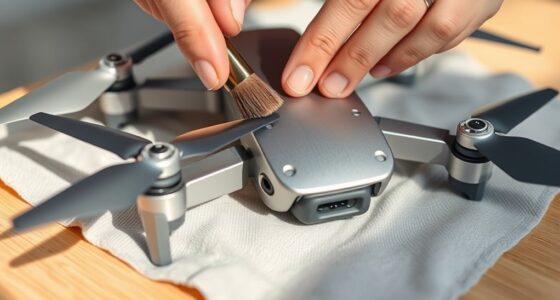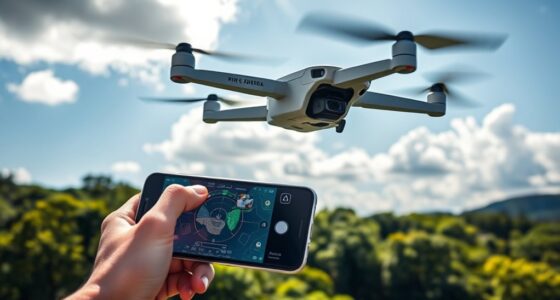
To guarantee your drone’s obstacle sensors are accurate, start by checking their alignment and physically adjusting their angles for maximum coverage. Regular calibration involves testing them in controlled environments with known obstacle positions to spot discrepancies, then fine-tuning as needed. Keep sensors clean and free from obstructions, and verify calibration under different environmental conditions. Properly aligned and calibrated sensors prevent blind spots and false detections, helping your drone navigate safely—continue on to learn more about maintaining peak sensor performance.

Get the latest gadgets delivered free with Prime
- Fast, free delivery on millions of items
- Prime Video, Amazon Music and more included
- Member-only deals all year
Key Takeaways
- Regularly verify sensor readings against known obstacle positions to identify calibration drift.
- Keep sensors clean and free from dust, dirt, or moisture that can impair detection accuracy.
- Adjust sensor angles and mounting for optimal field of view overlap and proper alignment.
- Use calibration tools or controlled environment tests to fine-tune sensor sensitivity and distance measurements.
- Recalibrate sensors periodically, especially after environmental changes or hardware adjustments, to maintain reliable obstacle detection.
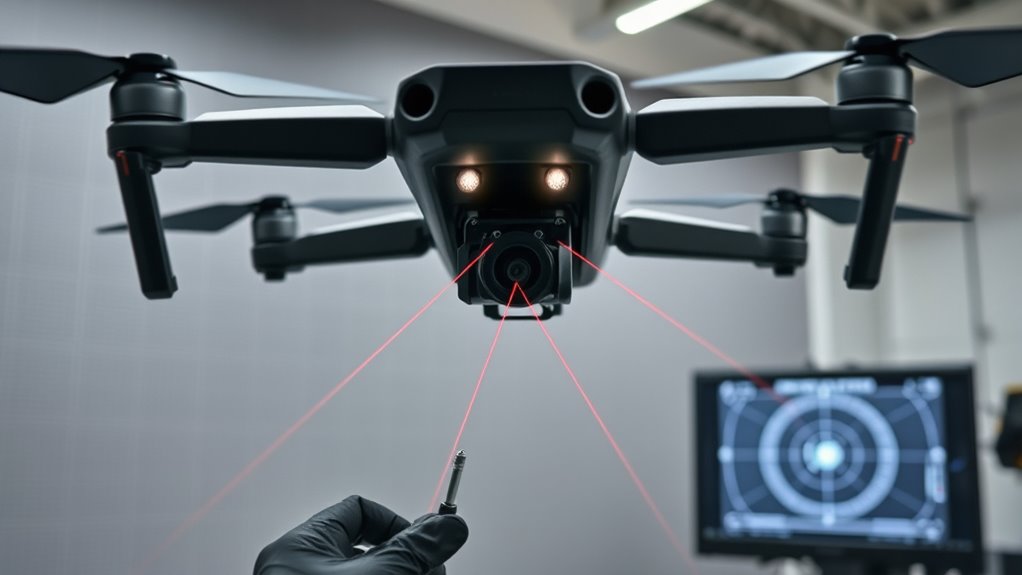
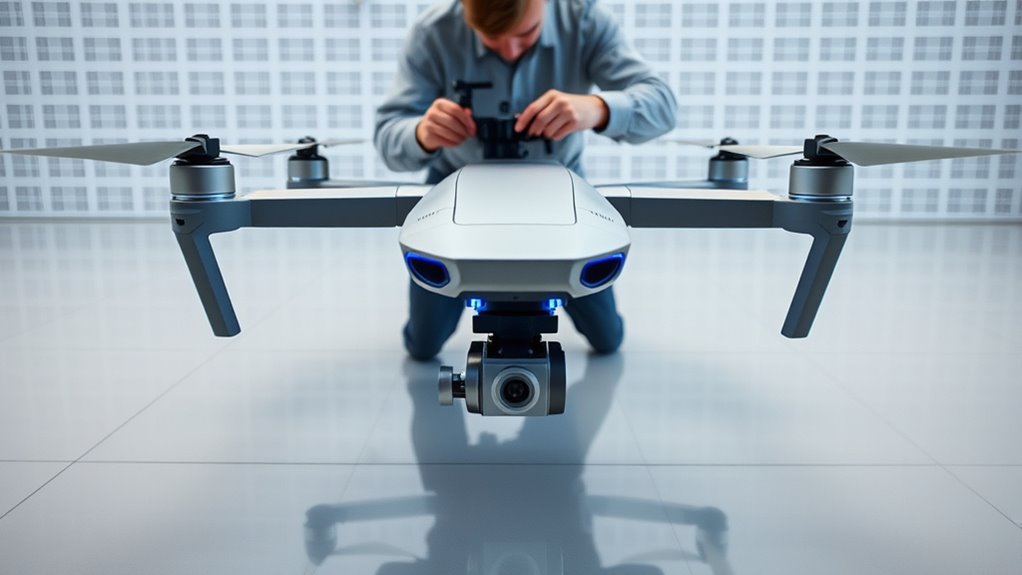
Calibrating obstacle sensors is a crucial step to guarantee your autonomous system detects objects accurately and operates safely. Proper sensor alignment ensures that all sensors are correctly positioned and oriented, which directly impacts obstacle detection accuracy. When sensors are misaligned, they might overlook obstacles or generate false positives, compromising the drone’s ability to navigate reliably. To achieve ideal sensor alignment, you need to carefully adjust each sensor so that their fields of view overlap correctly and cover the intended detection zones. This process involves physically repositioning sensors or fine-tuning their mounting angles, often using calibration tools or reference objects to verify their alignment. By ensuring sensors are precisely aligned, you minimize blind spots and enhance the system’s ability to perceive its environment correctly.
Next, focus on calibration routines that verify and fine-tune the obstacle detection accuracy of your sensors. This involves testing the sensors in controlled environments with known obstacle positions to see how well they detect and interpret objects. During these tests, you’ll identify any discrepancies between expected and actual sensor readings, which may indicate issues with sensor calibration. If you notice that sensors are consistently detecting obstacles at incorrect distances or missing objects altogether, it’s time to recalibrate. Many sensors come with calibration procedures or software tools that guide you through this process, helping you adjust sensitivity settings or recalibrate distance measurements. Regularly performing these routines ensures your sensors maintain high obstacle detection precision over time, especially after impacts, temperature changes, or hardware adjustments. Additionally, understanding how high refresh rates influence detection performance can help you select sensors that respond quickly and accurately to dynamic environments.
Additionally, pay attention to environmental factors that can affect sensor calibration. Dust, dirt, or moisture on sensor surfaces can impair their ability to detect obstacles accurately. Keep sensors clean and free from obstructions, and recalibrate if you notice a decline in detection performance. Temperature fluctuations can also cause sensor drift, so it’s wise to periodically verify calibration in different conditions. Use calibration targets that mimic real-world obstacles to test your sensors’ responsiveness and accuracy. If you find inconsistencies, revisit the alignment and calibration steps, making adjustments as necessary.
Products Worth Considering

DJI Osmo Mobile 7P with Mic Mini TX (Infinity Black) Gimbal Stabilizer

Jackery Solar Generator 1000 V2 with 200W Solar Panel

Apple iPad Air (4th Generation, 10.9-inch, Wi-Fi, 256GB) – Space Gray
As an affiliate, we earn on qualifying purchases.
Frequently Asked Questions
How Often Should Obstacle Sensors Be Recalibrated?
You should recalibrate your obstacle sensors every few months or whenever you notice sensor drift, which can affect their accuracy. Regular calibration frequency helps maintain reliable obstacle detection, especially after crashes, sensor impacts, or firmware updates. Keep an eye on sensor performance during flights; if you see inconsistent readings, it’s time to recalibrate. Staying proactive ensures your drone’s obstacle sensors stay precise and your flights remain safe.
What Are Common Signs of Sensor Miscalibration?
You’ll notice sensor miscalibration through signs like inconsistent obstacle detection, sudden sensor drift, or false alarms. If your drone’s sensors sometimes fail to detect objects or react unpredictably, it’s a clear sign they need recalibration. Regularly check and adjust calibration frequency to prevent drift and keep your drone’s obstacle sensors accurate. Pay attention to these signs, and recalibrate promptly to guarantee safe and reliable flight performance.
Can Calibration Fix All Obstacle Detection Errors?
Calibration can critically reduce obstacle detection errors, but it won’t fix all issues caused by sensor drift or false positives. You might think calibration alone solves everything, but environmental factors or hardware problems can still cause inaccuracies. Regular calibration helps maintain sensor accuracy, yet staying vigilant for persistent errors or unexpected behavior is vital. Combining calibration with software updates and maintenance ensures your drone’s obstacle detection stays dependable.
Are There Specific Environmental Conditions That Affect Calibration?
Yes, environmental interference and weather effects can impact calibration. You should be aware that electromagnetic interference from nearby devices or power lines can cause sensor inaccuracies. Additionally, weather conditions like rain, fog, or extreme temperatures can affect sensor performance and calibration stability. To maintain accuracy, regularly calibrate your drone in different conditions and avoid flying in environments with high interference or adverse weather to guarantee reliable obstacle detection.
What Tools Are Needed for Sensor Calibration?
You’ll need calibration tools like a calibration target or a flat surface to guarantee proper sensor alignment. Use a screwdriver or Allen wrench for adjusting mounting brackets if needed. A smartphone app or a computer with compatible software can help fine-tune sensor settings. These tools help you verify that obstacle sensors are accurately calibrated, maintaining your drone’s obstacle detection and safe operation. Always follow the manufacturer’s calibration procedures for best results.
Conclusion
By taking the time to calibrate your obstacle sensors, you’re gently guiding your drone to see the world more clearly. This small act of care guarantees smoother flights and safer adventures, like giving your drone a gentle nod of trust. When your sensors are properly tuned, you’re not just avoiding mishaps—you’re fostering a silent partnership built on confidence and precision. With each calibration, you’re softly nurturing your drone’s ability to navigate life’s unexpected turns.