
📊 Full opportunity report: Estate And Inheritance Facilitator Marketplace on IdeaNavigator AI — validation score, market gap, and execution plan.

Get the latest gadgets delivered free — and shop member deals
- Fast, free delivery on millions of items
- Access to Prime Big Deal Days deals on October 6–7
- Prime Video, Amazon Music and more included
TL;DR
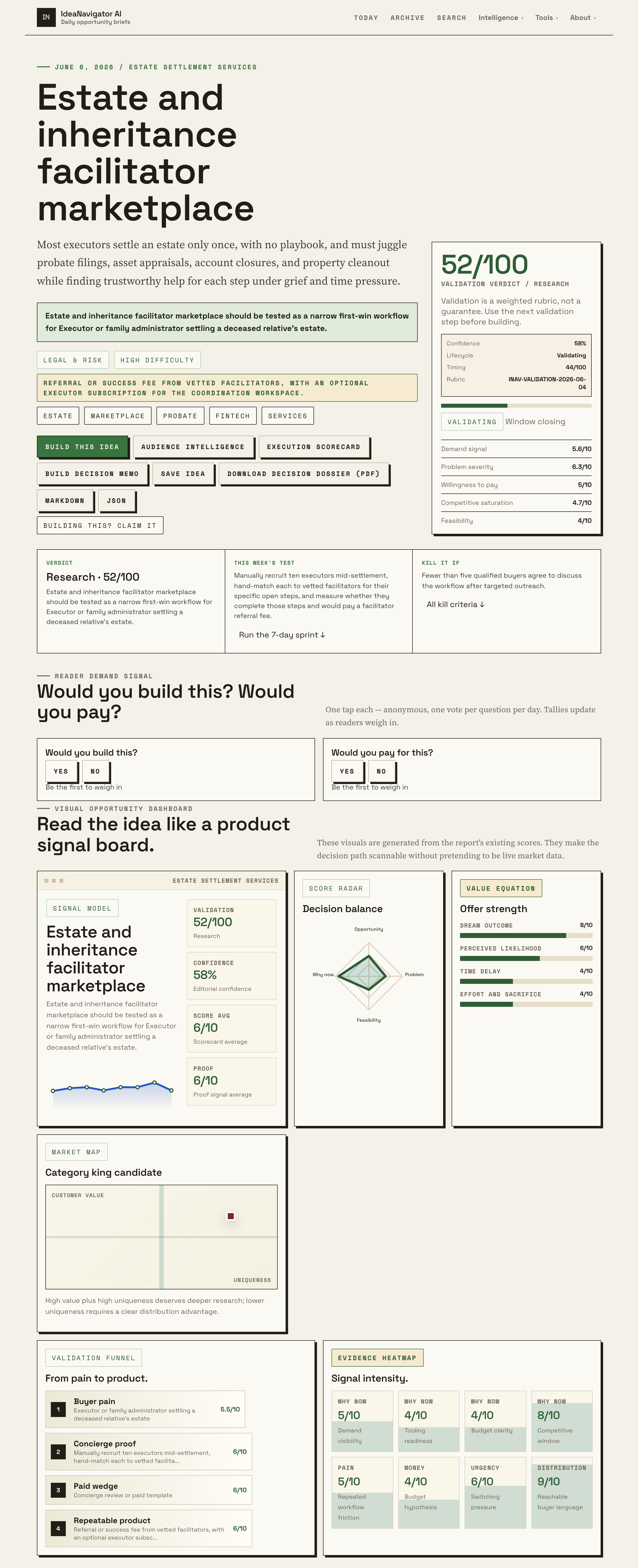
A marketplace prototype is in early testing to help executors and family administrators settle estates more efficiently. It diagnoses estate needs and matches users with vetted facilitators, aiming to improve the complex settlement process amid rising estate transfers.
A new estate and inheritance facilitator marketplace is in the early testing stage, designed to help executors and family administrators manage estate settlements more effectively. The platform aims to diagnose specific settlement steps and connect users with vetted facilitators, addressing a complex process that often involves multiple steps and service providers. This development comes amid the largest generational wealth transfer in history, increasing the demand for streamlined estate management solutions.
The proposed marketplace is focusing initially on a narrow workflow, specifically assisting executors during the estate settlement process. It will offer a guided intake that assesses the specific tasks an estate requires, such as probate filings, asset appraisals, or property cleanouts. Once diagnosed, the platform will hand-match each step to vetted facilitators and track their completion, functioning as a concierge-style service before expanding into a broader self-serve marketplace.
According to sources involved in the project, the MVP (minimum viable product) will involve manually recruiting ten executors mid-settlement, then matching them with facilitators for their open steps. The success of this pilot will be measured by whether the executors complete their tasks and if they are willing to pay a referral or success fee to the facilitators. The platform may also offer optional subscription services to facilitate ongoing coordination.
This initiative is driven by the increasing complexity of estate settlements, especially as more estates span multiple states and digital accounts. The scattered nature of existing facilitator services and lack of coordination contribute to the difficulty faced by executors under grief and time pressure, creating an opportunity for a more organized, technology-enabled solution.
Potential Impact on Estate Settlement Processes
This marketplace could significantly reduce the time and stress faced by executors by providing a guided, coordinated approach to estate settlement. It aims to fill a critical gap in the current market where scattered, uncoordinated facilitator services make estate management cumbersome. If successful, the platform could become a standard tool for estate professionals and families, especially during the ongoing large-scale transfer of wealth across generations.
Furthermore, by vetting facilitators and tracking completion, the platform promises greater transparency and trustworthiness, addressing common concerns about service quality in estate management. Its success could lead to broader adoption and potentially reshape how estate settlement services are delivered and coordinated in the future.
As an affiliate, we earn on qualifying purchases.
Growing Need for Coordinated Estate Settlement Tools
The estate settlement industry is experiencing increased pressure due to the largest generational wealth transfer in history, with an estimated $68 trillion expected to change hands over the next few decades. Many estates now involve multiple states, digital accounts, and complex assets, complicating the settlement process.
Currently, most executors settle estates only once and lack a dedicated playbook or centralized resource. They must independently find trustworthy professionals for each step, often relying on scattered directories and informal networks. This fragmentation leads to delays, increased costs, and emotional strain, highlighting the need for more integrated solutions.
While some digital platforms offer estate services, few provide a guided, step-by-step coordination that ensures all tasks are completed efficiently. The new marketplace aims to address this gap through a focused pilot, testing whether a guided diagnosis and facilitator matching approach can improve outcomes for executors and their families.
“The complexity of estate settlements is only increasing, and current solutions are often fragmented and inefficient.”
— an anonymous researcher
As an affiliate, we earn on qualifying purchases.
Unclear Scope and Long-term Adoption Potential
It is not yet clear how well the initial pilot will perform at scale, including whether executors will consistently find value in the guided diagnosis and facilitator matching model. The platform’s ability to attract and vet facilitators effectively, and whether users are willing to pay for these services, remains to be seen. Additionally, broader market acceptance and integration into existing estate management workflows are still uncertain.
As an affiliate, we earn on qualifying purchases.
Next Steps in Pilot Testing and Expansion Plans
The immediate next step is to complete the pilot with the recruited executors, monitor task completion rates, and gather user feedback. If the results are positive, the platform plans to refine its matching algorithms, expand the facilitator network, and prepare for a broader rollout. Further testing will also explore additional features such as digital asset management and multi-state coordination, aiming to develop a comprehensive estate settlement platform.
As an affiliate, we earn on qualifying purchases.
Key Questions
How does the marketplace diagnose estate settlement needs?
The platform will use a guided intake process to assess the specific steps an estate requires, such as probate filings, asset appraisals, or property cleanouts, based on user input.
What makes this platform different from existing estate services?
It offers a coordinated, step-by-step approach that diagnoses specific needs and hand-matches them with vetted facilitators, providing tracking and transparency throughout the process.
Will users have to pay for facilitator services?
The pilot will test a referral or success fee model, with optional subscription services for ongoing coordination, but the exact pricing structure is still being finalized.
Is this platform intended for all types of estates?
Initially, the focus is on estates requiring a narrow set of settlement steps, but the long-term goal is to expand to more complex and multi-state estates.
When will the platform be available to the general public?
The current testing phase is ongoing, with broader availability contingent on pilot success, likely within the next year or two.
Source: IdeaNavigator AI
Halloween Picks
halloween
As an affiliate, we earn on qualifying purchases.