For most drone pilots, I’d start with the Jackery Explorer 240D: its 256Wh capacity and 200W DC output suit field charging without the bulk of a large station. The DJI Power 1000 V2 is the standout for long trips or charging several devices, while the 89.6Wh two-way fast-charging station favors a lighter, compact kit. The main tradeoff is between capacity and portability: more watt-hours can support more charging, but they add weight, while small stations may run short during a full day of flying. I compared all 15 options for drone-relevant output, usable capacity, charging flexibility, and practical carry size. Read on for the full breakdown and guidance on matching a station to your aircraft and battery routine.

Get the latest gadgets delivered free with Prime
- Fast, free delivery on millions of items
- Prime Video, Amazon Music and more included
- Member-only deals all year
Complete the kit


Key Takeaways
The Jackery Explorer 240D is the most balanced pick in this lineup: its 256Wh capacity and 200W DC output put it ahead of sub-100Wh models for multi-battery field days without moving into the bulk of the 1024Wh DJI station.
The DJI Power 1000 V2 is the capacity leader, making it the clearest fit for extended trips and multiple devices; its size is harder to justify if you only need to top up one drone battery.
Compact stations cluster around 89.6–100Wh, including the Daran 89.6Wh, the two-way fast-charging model, and LKTOP’s 100Wh charger. They suit light kits, but limited capacity makes battery-count planning more important.
Several 192–300W-class stations offer a middle ground: the ALLWEI 256Wh and EnginStar 296Wh have more capacity than pocket-size options, while the 192Wh LiFePO4 models trade some runtime for a smaller battery pack.
Port selection matters as much as headline wattage. The Jackery’s 200W DC output, LKTOP’s drone-focused positioning, and the two-way fast-charging option serve different charging setups, so check the drone charger’s input requirements before choosing by capacity alone.




| portable power stations for drone charging | Dimensions | Weight | Battery capacity | Battery type |
|---|---|---|---|---|
| MARBERO Portable Power Station | 6.5 x 4.6 x 3.1 inches | 1.04 kg | 24,000mAh | — |
| Portable Power Station 89.6Wh | 6.5 x 3.3 x 4.0 inches | 2.5 lb | 89.6Wh | — |
| ALLWEI Portable Power Station | 9.25 x 5 x 6.81 inches | 6.4 lb | — | LiFePO4 |
| EnginStar Portable Power Stati | 9.1 x 5 x 7 inches | — | — | — |
| LKTOP Drone Portable Charger 1 | — | — | 27,000mAh | — |
| Portable Power Station 300W | 8.7 × 5.1 × 7.2 inches | 5.5 lbs | 192Wh | LiFePO4 |
| Daran 300W Portable Power Stat | 8.4 × 5.3 × 7.4 inches | 5.84 lbs | 192Wh | — |
| Jackery Explorer 240D Power St | 4.19 × 4.73 × 6.69 inches | 4.85 lbs | 256Wh | LiFePO4 |
| Daran Portable Power Station 8 | 6.5 × 3.3 × 4 inches | 2.54 lbs | 89.6Wh | LiFePO4 |
| HOWERASY Portable Power Statio | 6.6 × 4 × 3 inches | 2.3 lbs | 98Wh | Rechargeable lithium-ion |
| VTOMAN FlashSpeed 300 Portable | 10.24 x 4.72 x 7.87 inches | 4.44 kg | — | LiFePO4 |
| DJI Power 1000 V2 Portable Pow | 19.2 x 8.85 x 9.05 inches | 15 kg | 1024Wh | LFP |
| HOWEASY Portable Power Station | 6.6 x 3 x 4 inches | 2.3 pounds | 88Wh | — |
| BLUETTI Elite 10 Mini Portable | 7.8 x 5.7 x 4.3 inches | 4 pounds | — | LiFePO4 |
| Portable Power Station 120W | 5.7 x 4.4 x 4.1 inches | 2.2 pounds | 97.6Wh | — |
More Details on Our Top Picks
MARBERO Portable Power Station 88Wh, 120W Surge, Solar Generator 24,000mAh
The MARBERO’s main advantage is its low carry burden: at 1.04 kg, it suits drone pilots who want a small backup for a day trip rather than a base-camp battery. Its 88Wh capacity and 80W output are best matched to charging a controller, phone, or compatible drone battery charger with modest power needs; they leave little room for repeated charging sessions. Compared with the ALLWEI 300W, it is much easier to pack but gives up substantial capacity and output headroom. Eight output ports help accommodate several small devices, while the flashlight adds utility away from the charging setup. The listed two-hour charge time reaches only 80%, and the product data does not specify which drone chargers it supports, so check charger input requirements before relying on it.
Pros:- Light 1.04 kg body is easy to carry with a compact drone kit.
- Eight output ports provide flexibility for small accessories and personal devices.
- Solar compatibility offers an alternative recharge method when suitable panels are available.
- Built-in flashlight can be useful at a launch site or during an outage.
Cons:- 88Wh capacity is restrictive for repeated drone-battery charging.
- 80W output may not suit drone chargers with higher input demands.
- The stated two-hour charge time is for reaching 80%, not a full recharge.
Best for: Day-trip drone pilots who prioritize a very light backup for a phone, controller, and limited charging of compatible low-power gear.
Not ideal for: Pilots planning multiple drone-battery recharges or using a charger that needs more than 80W of continuous output; its 88Wh capacity leaves little reserve.
- Capacity:88Wh
- Output power:80W
- Surge power:120W
- Battery capacity:24,000mAh
- Weight:1.04 kg
- Dimensions:6.5 x 4.6 x 3.1 inches
- Output ports:8
- Input charging time:2 hours from 0 to 80%
Our verdict“Choose the MARBERO when low weight matters more than charging several drone batteries or powering a higher-wattage charger.”
Portable Power Station 89.6Wh with Two-Way Fast Charging and 100W AC Outlets
Fast turnaround is the reason to pick this compact station. Its listed AC/PD recharge time is 1.3 hours, making it easier to top up between flights or during a short stop than the larger ALLWEI 300W, which carries more energy but is a bulkier option. At 89.6Wh, it remains a one-battery-or-accessories class of backup rather than a multi-day drone power source. The 200W output rating gives it more stated headroom than the MARBERO’s 80W output, though buyers should still match the station’s outlet and output limits to their specific drone charger. Dual USB-C and two AC outlet types add flexibility; solar charging is supported, but the panel is not included. Its small capacity means quick recharging cannot compensate for limited stored energy.
Pros:- 89.6Wh capacity and 2.5 lb weight keep the unit relatively portable.
- Listed 1.3-hour AC/PD charging time supports quick turnarounds.
- Dual USB-C, USB-A, and AC outlet options cover varied charging setups.
- LiFePO4 battery and 12-layer safety monitoring are specified.
Cons:- Limited stored energy restricts repeated drone-battery charging.
- Solar panels must be supplied separately.
- The provided port details do not establish how many devices can be charged at full output simultaneously.
Best for: Pilots who carry a compact kit and can recharge the station between short flying sessions, especially those needing both USB-C and AC outputs.
Not ideal for: Field crews needing several full drone-battery charges without access to a wall outlet, car socket, or compatible solar panel.
- Battery capacity:89.6Wh
- Battery cell type:Lithium-phosphate (LiFePO4)
- Output wattage:200W, 400W peak
- Weight:2.5 lb
- Dimensions:6.5 x 3.3 x 4.0 inches
- Ports:2-prong AC, 3-prong AC, USB-A, USB-C
- AC/PD input:100W
- AC/PD recharge time:1.3 hours
Our verdict“Pick this model over the MARBERO if quicker recharging and 200W output matter more than minimizing weight or gaining extra capacity.”
ALLWEI Portable Power Station 300W, 256Wh Solar Generator LiFePO4 Battery
The ALLWEI brings the most useful capacity jump in this group for pilots who expect to recharge more than a small accessory or make repeated trips through a drone battery. Its 256Wh capacity and 300W continuous output offer much more operating room than the 88–89.6Wh MARBERO and compact 89.6Wh station, while the 6.4 lb weight remains manageable for a car-based launch site. Multiple output types, including USB-C, AC, DC5521, and a car outlet, make it easier to match different charging equipment. The tradeoff is a larger, heavier pack that is less appealing for long hikes, and the supplied data gives no recharge-time figure. Solar input is supported, but slow solar replenishment can limit how quickly it is ready for another session.
Pros:- 256Wh capacity offers substantially more reserve than the compact 88–89.6Wh options.
- 300W continuous output supports a wider range of charger requirements than the MARBERO.
- LiFePO4 battery is specified with 3,000 charge cycles.
- AC, car, solar, and dual AC-plus-solar recharge methods provide setup flexibility.
Cons:- At 6.4 lb, it is heavier than the small-capacity travel options.
- Solar charging may take a long time, and no specific recharge duration is provided.
- 300W continuous output still rules out higher-draw equipment.
Best for: Drone photographers working from a vehicle or base camp who want more reserve for repeated charging and can carry a 6.4 lb station.
Not ideal for: Hikers seeking the lightest possible kit, or pilots whose chargers exceed 300W continuous output.
- Capacity:256Wh
- Continuous output:300W
- Peak surge:600W
- Battery type:LiFePO4
- Listed charge cycles:3,000
- Weight:6.4 lb
- Dimensions:9.25 x 5 x 6.81 inches
- Recharging methods:AC wall, 12V car, solar, AC plus solar
Our verdict“Choose the ALLWEI over the compact stations when extra drone-charging reserve matters more than a light pack.”
EnginStar Portable Power Station 300W 296Wh Solar Generator
The EnginStar is the AC-focused choice for pilots using a compatible mains-powered drone charger. Its pure sine wave inverter is a useful distinction from the lineup’s compact stations, while 296Wh capacity gives it more reserve than the MARBERO and the 89.6Wh fast-recharging model. Its 300W output is on par with the ALLWEI, but the ALLWEI lists a LiFePO4 battery and a broader range of named output connections; the EnginStar’s data instead highlights two power outlets and a 110V output. That makes checking the exact port layout especially relevant before buying. The station supports wall, car, and solar charging, though its panel is sold separately. At 296Wh it suits a fixed outdoor setup better than a lightweight hiking load, and its 300W ceiling limits high-draw chargers.
Pros:- 296Wh capacity provides more reserve than the compact MARBERO and 89.6Wh station.
- Pure sine wave inverter is suited to compatible sensitive electronics.
- Wall, car, and solar recharging options support varied field setups.
- Digital display, flashlight, and overload protection add practical utility.
Cons:- 300W output limits compatibility with higher-draw charging equipment.
- Solar panel is not included.
- The listed specifications give less port detail than the ALLWEI, so buyers should confirm connection needs.
Best for: Pilots who use an AC-powered drone charger and want a pure sine wave inverter with more capacity than a compact travel station.
Not ideal for: Buyers who need a light hiking power source, extensive listed DC or USB port options, or output above 300W.
- Capacity:296Wh
- Output wattage:300W
- Output voltage:110V
- Inverter:Pure sine wave
- Power outlets:2
- Dimensions:9.1 x 5 x 7 inches
- Frequency:60Hz
- Recharge methods:Wall outlet, car socket, solar
Our verdict“Choose the EnginStar if a pure sine wave AC outlet is central to your charging setup and its 300W limit fits your charger.”
LKTOP Drone Portable Charger 100WH Power Station for DJI and Camera Accessories
LKTOP is the most directly drone-oriented option here. Its stated compatibility covers DJI Mavic, Air, and Mini series, along with camera gear, so it gives drone owners a clearer starting point than general-purpose stations such as the ALLWEI 300W. The 27,000mAh battery, five ports, LCD screen, and AC outlet are aimed at keeping a compact photo kit powered and making remaining charge easier to monitor. However, the listing specifies only 100W AC output, well below the ALLWEI and EnginStar’s 300W ratings, and does not provide a watt-hour capacity figure despite the 100WH wording in the product name. That limits a precise comparison of stored energy. Treat its compatibility claims as a cue to verify your exact charger and travel rules before relying on it.
Pros:- Compatibility is stated for DJI Mavic, Air, and Mini series, plus select camera devices.
- Five ports and USB-C support charging a small mix of drone and camera gear.
- LCD screen displays battery and output status.
- Compact design and built-in LED light suit portable outdoor use.
Cons:- 100W AC output is lower than the 300W ALLWEI and EnginStar.
- The supplied specifications do not confirm a watt-hour capacity despite the 100WH product title.
- Airplane-safe wording does not replace checking current airline and battery-carriage rules.
Best for: DJI Mavic, Air, or Mini owners who want a compact, drone-oriented station for compatible chargers and camera accessories.
Not ideal for: Pilots with chargers requiring more than 100W AC output, or buyers who need a clearly stated watt-hour capacity for planning several recharges.
- Battery capacity:27,000mAh
- AC output:100W
- Number of ports:5
- Connector type:USB-C
- Compatible devices:DJI Mavic, Air, and Mini series; Insta360 Pro; Lovskoo Mini
- Input voltage:110V AC
- Output voltage:100V AC
- Additional features:LCD screen, LED light
Our verdict“Choose LKTOP for its drone-specific compatibility and monitoring features, but verify capacity and charger wattage before building a flight plan around it.”
Portable Power Station 300W (600W Surge), 192Wh LiFePO4 Battery Solar Generator with Carry Bag & Multiple Ports
For drone pilots who want a portable station that can run a charger from AC or top up gear through USB-C, this model balances 192Wh capacity with a 300W continuous output. Its 5.5-pound weight and included backpack make it easier to carry to a launch spot than the larger-capacity EnginStar 300W 296Wh Solar Generator, though that model offers more stored energy. Two AC outlets give flexibility for charging batteries and another small device at once, while solar and car charging help when wall power is unavailable. The tradeoff is that 192Wh is a modest reserve: repeated drone-battery charging will use it quickly, and a 300W ceiling rules out higher-draw gear. I’d choose it for a balance of portability and useful output, not extended off-grid sessions.
Pros:- 5.5-pound weight and included backpack simplify carrying a charging setup to remote launch areas.
- 192Wh LiFePO4 battery provides more reserve than the sub-100Wh compact options in this group.
- Two AC outlets, USB-C, USB-A, and DC5521 support a mix of chargers and accessories.
- Solar and car charging offer alternatives when a wall outlet is unavailable.
Cons:- 192Wh can run short during repeated drone-battery charging.
- 300W continuous output excludes higher-wattage equipment.
- No app connectivity for remote monitoring or control.
Best for: Drone pilots who carry their kit on foot and need AC and USB-C charging for a short outing.
Not ideal for: Pilots planning several full drone-battery charges or powering equipment above 300W; the capacity and output are limited for longer or heavier-duty sessions.
- Battery capacity:192Wh
- Battery type:LiFePO4
- Continuous / surge output:300W / 600W
- Weight:5.5 lbs
- Dimensions:8.7 × 5.1 × 7.2 inches
- Ports:2 AC, 1 DC5521, 1 USB-C, 2 USB-A
- Recharge time:3 hours to 80%
- Recharge options:Solar and car charging supported
Our verdict“Choose this for portable, mixed-port drone charging on shorter outings; pick a higher-capacity station for multiple days or repeated battery cycles.”
Daran 300W Portable Power Station (600W Surge) | 192Wh LiFePO4 Solar Generator for Camping, RV & Emergency
The Daran’s strongest case for drone trips is its eight-port layout: two AC outlets, two Type-C ports, USB-A, a car outlet, and two DC5521 ports let a pilot charge several kinds of gear without swapping connections. Its 192Wh battery and 300W continuous output match the first 300W model in this batch, but this Daran adds a built-in LED with SOS and strobe modes and a second Type-C port. That makes it a more versatile camp companion, although the extra ports do not add battery capacity. At 5.84 pounds, it is slightly heavier than the backpack-equipped Portable Power Station 300W, and its listed runtime at a 300W load is only about three hours. I’d favor it when port variety and emergency lighting matter more than minimizing carry weight.
Pros:- Eight output ports accommodate a broad mix of drone chargers and personal electronics.
- Two Type-C ports allow USB-C devices to charge without occupying an AC outlet.
- LiFePO4 battery is specified for over 3,500 charge cycles.
- Multi-mode LED includes SOS and strobe functions for low-light situations.
Cons:- 192Wh capacity limits repeated drone-battery charging between recharges.
- At 5.84 pounds, it is heavier than the similarly rated Portable Power Station 300W with carry bag.
- 300W continuous output is not suited to higher-wattage equipment.
Best for: Drone operators who charge a drone battery alongside phones, controllers, or other USB-C and DC accessories at camp.
Not ideal for: Travelers focused on the lightest carry or pilots needing long charging sessions; it weighs more than the first 300W pick and has the same 192Wh capacity.
- Battery capacity:192Wh
- Battery chemistry:LiFePO4
- Continuous / surge output:300W / 600W
- Weight:5.84 lbs
- Dimensions:8.4 × 5.3 × 7.4 inches
- Output ports:2 AC, 2 Type-C, 1 USB-A, 1 car, 2 DC5521
- Recharging modes:AC, solar, car socket
- LED modes:50%, 100%, strobe, SOS
Our verdict“Pick the Daran when charging several device types and having an emergency light are priorities, but skip it if low weight or extra battery reserve matters more.”
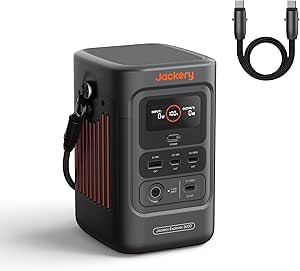
Jackery Explorer 240D Power Station, 256Wh, 200W DC
At 4.85 pounds, the Explorer 240D is the lightest option here with more than 200Wh of stated capacity, making it appealing when a drone setup needs to stay compact. Its 256Wh battery exceeds the 192Wh units from Portable Power Station 300W and Daran, but the listed 200W output is lower than their 300W limits. That distinction matters if a drone charger draws more than 200W or if you want to run other AC equipment; check the charger’s input requirements before choosing it. The product name emphasizes 200W DC, and the supplied information does not specify an AC outlet, so I would treat it as a DC-first choice rather than assume compatibility with an AC charger. Solar, car, and USB-C charging add flexibility, but this is not the pick for high-draw gear.
Pros:- 4.85-pound weight keeps a 256Wh station relatively easy to carry.
- More stated battery capacity than the 192Wh Portable Power Station 300W and Daran models.
- LiFePO4 battery is described as having a 10-year lifespan.
- USB-C, solar, car, and AC-DC dual-input charging options support several recharge routes.
Cons:- 200W output is lower than the 300W models in this batch.
- The supplied product details do not identify an AC output, limiting certainty for AC-powered drone chargers.
- Listed runtime is approximately one hour at full load.
Best for: Pilots with a compatible DC or USB-C drone-charging setup who value a lighter carry and more capacity than the sub-200Wh models.
Not ideal for: Drone owners whose charger requires AC or draws above 200W, and pilots who need clearly specified AC outlet support.
- Battery capacity:256Wh
- Battery type:LiFePO4
- Output power:200W
- Weight:4.85 lbs
- Dimensions:4.19 × 4.73 × 6.69 inches
- Charging inputs:USB-C, solar, car, AC-DC dual input
- Stated runtime:Approximately 1 hour
- Battery lifespan:10-year lifespan stated in product description
Our verdict“Choose the Explorer 240D for a compact, higher-capacity DC charging setup, but confirm your drone charger’s connection and wattage needs first.”
Daran Portable Power Station 89.6Wh LiFePO4 Battery with 100W Output and Fast Charging
For a pilot who wants a backup for one small charging setup rather than a full field power hub, this Daran keeps the load light at 2.54 pounds and offers AC, USB-C, USB-A, and DC outputs. Its 89.6Wh capacity is less than half that of the 192Wh Portable Power Station 300W, so it is better suited to topping up a compatible drone battery or keeping a controller and phone going than repeated charging cycles. The 100W maximum output also narrows which AC chargers it can run; check the charger label before relying on it. Compared with the 98Wh HOWERASY, it uses LiFePO4 chemistry and provides a stated 3,500-plus cycle life, but HOWERASY lists a higher 135W output. I’d choose this Daran for compactness and cycle-life emphasis, not extra headroom.
Pros:- 2.54-pound weight and compact dimensions make it easy to pack with drone gear.
- LiFePO4 chemistry and a stated 3,500-plus cycle life suit frequent use.
- AC, two USB-C, two USB-A, and DC5521 outputs cover several small devices.
- AC, USB-C PD, car, and solar charging provide multiple recharge methods.
Cons:- 89.6Wh capacity provides limited reserve for repeated drone-battery charging.
- 100W maximum output is below the HOWERASY’s listed 135W output.
- Solar panel is not included.
Best for: Drone pilots who need a small backup station for a compatible charger, controller, and phone on a short outing.
Not ideal for: Pilots running chargers above 100W or expecting multiple full drone-battery charges before recharging.
- Battery capacity:89.6Wh
- Battery type:LiFePO4
- Maximum output:100W
- Weight:2.54 lbs
- Dimensions:6.5 × 3.3 × 4 inches
- Output ports:2 AC, 2 USB-C, 2 USB-A, 1 DC5521
- Charging methods:AC wall socket, USB-C PD, car, solar
- Cycle life:3,500+ cycles
Our verdict“Choose this Daran when minimum carry weight and a compact backup matter more than charging capacity or higher output.”
HOWERASY Portable Power Station 98Wh, 135W (270W Peak) Solar Generator
The HOWERASY stands out among the sub-100Wh options by pairing a 98Wh battery with a listed 135W output. That gives it more output headroom than the 100W Daran, which may help with a compatible drone charger that sits near that lower model’s limit. Its 2.3-pound weight is also the lightest in this batch, and the metal body plus built-in flashlight suit a compact outdoor kit. Capacity remains the constraint: 98Wh is for short sessions or topping up, not repeated drone-battery charging. Unlike the Daran, this model uses rechargeable lithium-ion rather than LiFePO4, and the provided details do not give a cycle-life figure. I’d pick it for its low weight and extra output over the smallest Daran, while choosing a 192Wh station for more charging reserve.
Pros:- At 2.3 pounds, it is the lightest model in this batch.
- 135W output offers more headroom than the 100W Daran compact station.
- Ports include AC, PD, QC3.0, DC, and USB connections for varied small devices.
- Built-in LED flashlight and metal construction suit outdoor carry.
Cons:- 98Wh capacity is limited for repeated drone-battery charging.
- Rechargeable lithium-ion chemistry is specified, but no cycle-life figure is provided.
- The 135W output still falls well below the 300W stations in this group.
Best for: Pilots seeking the lightest station here for a compatible charger under 135W and occasional accessory charging.
Not ideal for: Operators planning multiple drone-battery charges or seeking LiFePO4 chemistry and a stated long cycle life.
- Battery capacity:98Wh
- Battery type:Rechargeable lithium-ion
- Output / peak power:135W / 270W
- Weight:2.3 lbs
- Dimensions:6.6 × 4 × 3 inches
- Output ports:2 AC, 1 PD, 1 QC3.0, 2 DC, 1 USB
- Input charging:65W PD, solar panels (15V–24V), 12V car, wall adapter
- Warranty:24 months
Our verdict“Pick the HOWERASY for a very light kit and more output than a 100W compact station, but choose a larger-capacity model for a full day of drone work.”
VTOMAN FlashSpeed 300 Portable Power Station, 300W 230Wh LiFePO4 Battery
I’d choose the VTOMAN FlashSpeed 300 when a drone pilot wants more reserve than pocket-sized units can offer without hauling a large station. Its 230Wh LiFePO4 battery and 300W output provide room to charge a drone battery setup alongside a phone or controller, while 100W USB-C PD input can speed up recharging between outings. Compared with the DJI Power 1000 V2, it is far easier to carry, but its capacity and output are nowhere near as suited to a full day of repeated charging. The seven outlets are useful for a small kit, though the 300W ceiling rules out more demanding gear. I’d skip it for long remote shoots where there’s no chance to recharge; its compact size comes with limited energy on hand.
Pros:- 230Wh capacity offers more reserve than the 88–128Wh compact options in this group
- 100W USB-C PD input supports faster recharging
- LiFePO4 battery is specified for over 3,000 cycles
- Seven outlets allow several small devices to connect at once
Cons:- 300W output limits compatibility with higher-wattage equipment
- 230Wh may run short during extended drone shoots
- Solar panel is not included
Best for: Drone pilots who want a carryable station for a few battery top-ups plus phones or controllers, and can recharge between sessions.
Not ideal for: Crews filming all day far from outlets who need repeated drone-battery charging or power for high-wattage equipment.
- Capacity:230Wh
- Power output:300W
- Battery type:LiFePO4
- Weight:4.44 kg
- Dimensions:10.24 x 4.72 x 7.87 inches
- Number of outlets:7
- Charging inputs:AC, solar, car, USB-C PD
- Additional features:Digital display, LED light, overload protection
Our verdict“Choose the VTOMAN for a portable, mid-capacity charging base, but pick the DJI Power 1000 V2 for longer shoots that demand much more energy.”
DJI Power 1000 V2 Portable Power Station, 1024Wh LFP Battery
For a remote shoot with multiple batteries to replenish, I’d put the DJI Power 1000 V2 ahead of the smaller stations here. Its 1024Wh LFP battery gives a crew substantially more stored energy than the VTOMAN FlashSpeed 300’s 230Wh, and the listed 1000W output leaves more room for compatible charging gear. Fast recharging and quiet operation also suit a base camp where the station may need to recover between sessions without adding much noise. The tradeoff is a 15kg carry weight: this is better transported in a vehicle than carried far across a field. It also has four outlets, fewer than the VTOMAN’s seven, and solar and car charging modules require separate adapters. I’d pass if a light pack matters more than extended power.
Pros:- 1024Wh LFP capacity provides much more reserve than the smaller stations in this group
- 1000W output suits a wider range of compatible charging equipment
- Fast recharge reaches 80% in 37 minutes, according to the supplied product details
- Quiet operation is specified as low as 26 dB
Cons:- 15kg weight makes it awkward for long walks to a launch site
- Solar and car charging modules are not built in and need separate adapters
- Four outlets offer fewer connection points than the VTOMAN FlashSpeed 300
Best for: Drone crews working from a vehicle or base camp who need substantial stored energy for repeated battery charging and other gear.
Not ideal for: Solo pilots hiking to a launch site, or buyers who need built-in solar and car charging without separate adapters.
- Battery capacity:1024Wh
- Output wattage:1000W
- Maximum engine power:2600W
- Battery type:LFP
- Weight:15 kg
- Dimensions:19.2 x 8.85 x 9.05 inches
- Power outlets:4
- Voltage:110V
- Warranty:5 years
Our verdict“Pick the DJI Power 1000 V2 for vehicle-supported shoots and repeated charging, not for a lightweight hiking kit.”
HOWEASY Portable Power Station, 120W (240W Peak) Solar Generator
The HOWEASY 120W is the lightest pick in this batch at just 2.3 pounds, so I’d treat it as a backup for a compact drone kit rather than a primary charging hub. Its 88Wh capacity and 120W continuous output may suit small devices and compatible low-draw charging equipment, but they leave little room for repeated drone-battery charging. That makes it a different choice from the VTOMAN FlashSpeed 300, which weighs more but supplies 230Wh and 300W output. Eight ports and AC, solar, and car recharging options give the HOWEASY flexibility for phones, controllers, and other accessories. The limitation is energy: the listed four-hour runtime is not a promise of four hours for every device, and full-load use can drain it quickly. I’d skip it if drone batteries are the main load.
Pros:- At 2.3 pounds, it is easier to carry than every other option in this batch
- Eight output ports support a variety of small devices
- Can recharge from AC, solar, or a car socket
- 240W peak output provides brief headroom above its 120W continuous rating
Cons:- 88Wh capacity is limited for charging several drone batteries
- 120W continuous output excludes higher-draw charging equipment
- Solar panel is not included
Best for: Hikers and casual pilots who want a very light backup for phones, controllers, and other low-draw accessories.
Not ideal for: Drone operators relying on the station for repeated aircraft-battery charging or any equipment that needs more than 120W continuously.
- Battery capacity:88Wh
- Continuous output:120W
- Peak output:240W
- Output ports:8
- USB-C output:18W
- Recharging options:Solar, AC, car socket
- Weight:2.3 pounds
- Dimensions:6.6 x 3 x 4 inches
- Cycle life:More than 1,500 cycles
Our verdict“Choose the HOWEASY when low weight matters most and your drone batteries are not the station’s main charging job.”
BLUETTI Elite 10 Mini Portable Power Station, 128Wh, 200W Solar Generator
I’d shortlist the BLUETTI Elite 10 Mini for pilots who want a compact station that can also serve as a small backup-power unit at home. Its 128Wh LiFePO4 battery and 200W output give it a modest step up from the HOWEASY’s 88Wh and 120W, though neither is a strong choice for extended drone-battery charging. The built-in UPS adds value beyond field use by providing backup power for compatible equipment during an outage. At four pounds, it stays easy to pack, but the single AC outlet can be a pinch point if you need to connect several AC chargers at once. Compared with the VTOMAN FlashSpeed 300, it is smaller and lighter, but carries less than two-thirds the capacity. I’d choose it for mixed travel and backup duty, not as a field crew’s main power supply.
Pros:- Four-pound design is easy to pack for travel
- 128Wh capacity and 200W output exceed the HOWEASY’s listed 88Wh and 120W
- LiFePO4 battery chemistry
- Built-in UPS offers a backup role beyond outdoor charging
Cons:- 128Wh capacity is limited for repeated drone-battery charging
- Only one AC outlet restricts simultaneous AC charger connections
- Listed runtime is two hours, with actual runtime depending on the connected load
Best for: Traveling drone owners who want a small station for occasional charging and UPS backup for compatible home or work equipment.
Not ideal for: Pilots charging several drone batteries in the field, or anyone who needs multiple AC outlets or a large energy reserve.
- Capacity:128Wh
- Output wattage:200W
- Battery type:LiFePO4
- Weight:4 pounds
- Dimensions:7.8 x 5.7 x 4.3 inches
- AC outlets:1
- Charging inputs:AC, solar, car
- Listed runtime:2 hours
- Additional feature:Built-in UPS
Our verdict“Pick the Elite 10 Mini for compact travel and UPS flexibility, but choose a higher-capacity station for a full day of drone charging.”
Portable Power Station 120W, 110V Power Bank with DC and AC Outlets
This 120W portable station makes the most sense as a simple power bank for a drone pilot’s smaller accessories, rather than a dependable source for multiple aircraft batteries. Its 97.6Wh capacity and six output ports can support a mix of phones, tablets, and compatible low-draw devices, while the 2.2-pound weight is manageable in a field bag. Compared with the HOWEASY 120W, it has slightly more listed capacity and a stated five-hour runtime, but the supplied details do not specify the conditions behind that runtime. Neither unit offers the output headroom or stored energy of the VTOMAN FlashSpeed 300. The 120W limit is the main constraint: check the power needs of your drone charger before relying on it. I’d skip this model for longer shoots where recharging the station is not practical.
Pros:- Six ports include AC, DC, USB, and USB-C connections
- 2.2-pound weight is practical for a field bag
- 97.6Wh capacity is slightly higher than the HOWEASY’s 88Wh
- Display and safety protections help monitor operation
Cons:- 120W output rules out higher-wattage equipment
- 97.6Wh capacity may not cover extended outdoor charging
- Solar panel is not included
Best for: Casual drone pilots who need a light station for phones, controllers, and other compatible devices under 120W.
Not ideal for: Pilots planning repeated drone-battery charging, using equipment above 120W, or spending long periods away from a recharge source.
- Battery capacity:97.6Wh
- Output wattage:120W
- Voltage:120V
- Output ports:6
- Weight:2.2 pounds
- Dimensions:5.7 x 4.4 x 4.1 inches
- Frequency:60Hz
- Listed runtime:5 hours
- Material:ABS
Our verdict“Choose it for lightweight charging of drone accessories, but move up to the VTOMAN or DJI station if aircraft batteries are your priority.”

How We Picked
I ranked these portable power stations for drone charging by how well their listed capacity, output, and ports fit realistic field use. I gave more weight to stations that can support a drone charging setup without forcing pilots to carry much more power than they need. Models with clearly stated capacities and useful output details were easier to compare; product names alone do not establish compatibility, charging speed, or the number of drone batteries a station can replenish.
The ranking also reflects portability, charging flexibility, and use-case fit. Compact 89.6–100Wh options make sense for short outings, mid-capacity models better suit pilots carrying more than one battery, and the 1024Wh DJI Power 1000 V2 earns its place for extended power needs rather than everyday light carry. I separated products with similar output ratings by their stated capacity and distinct charging focus, while treating missing or ambiguous specifications as a reason to verify details before purchase.
| portable power stations for drone charging | Battery type |
|---|---|
| MARBERO Portable Power Station | — |
| Portable Power Station 89.6Wh | — |
| ALLWEI Portable Power Station | LiFePO4 |
| EnginStar Portable Power Stati | — |
| LKTOP Drone Portable Charger 1 | — |
| Portable Power Station 300W | LiFePO4 |
| Daran 300W Portable Power Stat | — |
| Jackery Explorer 240D Power St | LiFePO4 |
| Daran Portable Power Station 8 | LiFePO4 |
| HOWERASY Portable Power Statio | Rechargeable lithium-ion |
| VTOMAN FlashSpeed 300 Portable | LiFePO4 |
| DJI Power 1000 V2 Portable Pow | LFP |
| HOWEASY Portable Power Station | — |
| BLUETTI Elite 10 Mini Portable | LiFePO4 |
| Portable Power Station 120W | — |
Factors to Consider When Choosing Portable Power Stations For Drone Charging
Choosing a station for drone charging starts with your batteries and charging routine, not the biggest wattage number on the box. I’d work out how many batteries you expect to recharge, how you’ll connect the drone charger, and how far you’re willing to carry the station. These broader checks can prevent a mismatch that a product comparison alone cannot resolve.
Estimate Energy From Your Actual Drone Batteries
Battery capacity is usually listed in watt-hours or as voltage and amp-hours; when only the latter appear, multiply volts by amp-hours to estimate watt-hours. Add the energy for the number of recharges you want, then allow extra for conversion losses and other devices. A station’s rated capacity is not the same as energy available at every output, especially when using AC power. Avoid assuming that a 256Wh unit will deliver exactly 256Wh to drone batteries. If your flight day includes several battery swaps, plan around the total battery energy rather than the size of one battery.
Match the Output to Your Charging Method
Find out whether your drone charger accepts AC, USB-C, or a particular DC input, and check the station’s corresponding output rating. An AC outlet can make a standard wall charger convenient, but it may add conversion losses compared with a suitable direct DC connection. A high surge figure is not a substitute for continuous output; the sustained wattage must support the charger while it runs. Some drone-specific chargers have their own input limits, so a powerful station cannot make them charge faster than they are designed to. Confirm connector, voltage, and charging protocol compatibility before buying.
Choose Capacity for the Length of the Trip
For a short outing with one or two planned recharges, a compact station may be easier to carry than a large reserve. Longer trips, multiple aircraft, or charging a controller and phone alongside drone batteries call for more usable capacity. Think through how often you can recharge the station between flights or overnight, since that can change the capacity you need. Buying far more capacity than your routine uses adds weight without improving the charging experience. On the other hand, choosing a station that only covers a best-case estimate can leave little reserve for cold conditions or extra devices.
Treat Weight and Packability as Part of Capacity
Capacity matters less if the station is too heavy or awkward for the route to your flying location. Compare dimensions and weight, not just watt-hours, and decide whether the station will ride in a vehicle or be carried on foot. A compact unit can be the better field choice even when it needs more frequent recharging. For remote locations, a larger station may earn its bulk by covering several batteries and accessories in one load. Include cables, chargers, and any carry bag in your packing plan, since they add to the kit’s real footprint.
Check Recharge Options and Time Between Sessions
A station is only useful for repeated trips if you can replenish it on your schedule. Check its stated wall, vehicle, and solar input support, then compare those options with where you’ll be charging. Solar input can help during a long stay outdoors, but panel compatibility, sunlight, and charging time determine whether it will keep up with demand. Two-way charging may be useful when the station itself needs a quick refill, though the feature does not tell you how quickly a drone battery will charge. For vehicle-based pilots, a practical car-charging option may matter more than solar capability.
Prioritize Battery Chemistry and Clear Specifications
Battery chemistry can affect a station’s cycle life, weight, and long-term value, but chemistry alone does not settle which model is best for your use. Several products here identify LiFePO4 or LFP batteries, while others make capacity and output the more visible comparison points. Check the manufacturer’s cycle-life and warranty terms rather than assuming all batteries with the same chemistry perform alike. Read the output specifications carefully when a listing gives only a peak wattage or leaves out port details. If a key number is missing, verify it with the maker before relying on that unit for a remote flying day.
Frequently Asked Questions
How many drone batteries can a 256Wh power station charge?
There is no fixed battery count because drone batteries vary in capacity and charging loses some energy along the way. Compare the station’s usable output with the watt-hours of each battery, then leave a reserve for conversion losses and accessories. The Jackery Explorer 240D’s 256Wh rating makes it a stronger starting point for a multi-battery outing than the 89.6Wh or 100Wh options, but it does not guarantee a specific number of full charges. Check your drone battery and charger specifications before estimating. If you need a dependable full-day plan, test the math against your actual battery set rather than relying on the station’s headline capacity.
Should I charge my drone from an AC outlet or a DC port?
Use the method your drone charger supports and the station can provide at the right voltage and power. AC is often straightforward because many pilots already own a wall charger, but it can involve extra conversion losses. A compatible DC connection may be more direct, yet connector shape alone does not confirm voltage or charging-protocol compatibility. This matters in the lineup because the Jackery highlights 200W DC output, while several compact stations emphasize AC outlets or general-purpose ports. Check the charger manual and station output specifications before connecting them.
Is a station under 100Wh enough for a day of drone flying?
It can work for a short session or a light setup, particularly if you only need a limited number of recharges and can start with fully charged drone batteries. The compact 89.6–100Wh choices here are easier to carry, but they leave less reserve for multiple batteries, a controller, and a phone. Estimate the energy needed for your planned flights and account for charging losses before deciding. If you fly for several hours or carry spare batteries, a mid-capacity model such as the 256Wh Jackery may be a more practical balance. A small station is a poor fit when you expect it to replace a full charging setup for a long field day.
When does it make sense to choose the 1024Wh DJI Power 1000 V2?
The DJI Power 1000 V2 makes the most sense when you need substantial reserve for extended trips, multiple charging sessions, or several devices beyond the drone. Its 1024Wh capacity sets it apart from the compact stations and the 192–296Wh middle group, but that extra power comes with a less portable format. For a short outing with one drone, the capacity may be more than your routine needs. Consider where you will store and carry it, and whether you can recharge it between trips. Choose it for sustained power needs, not just because the largest capacity sounds reassuring.
What should I verify before taking a power station on a flight?
Check current airline rules for portable batteries and power stations before packing one, since limits can depend on watt-hours and airline approval. Do not assume that a unit suitable for a car trip is permitted in checked baggage or carry-on luggage. Confirm the watt-hour marking on the station and ask the airline about its specific policy for that battery size. Also protect ports and pack the unit according to the carrier’s instructions. For air travel, a compact model may be easier to manage, but airline approval still needs to be confirmed before departure.
Conclusion
For the broadest balance of capacity and field practicality, I’d choose the Jackery Explorer 240D as best overall. The 89.6Wh two-way fast-charging station is my best value-style pick for a light kit and short outings, while the DJI Power 1000 V2 is the best premium choice for extended power needs and multiple devices. Beginners with a simple charging routine can start with the MARBERO 88Wh or another compact option after confirming charger compatibility and expected battery count. For a drone-focused charging setup, consider the LKTOP 100Wh; for extra mid-range capacity, compare the ALLWEI 256Wh and EnginStar 296Wh. Choose by your real battery load and how far you’ll carry the station, rather than by output or capacity alone.
Halloween Picks
halloween
As an affiliate, we earn on qualifying purchases.