If you’re choosing between FPV frequency bands, 5.8GHz offers sharp video quality and low latency but struggles with obstacles and range, especially in cluttered areas. 2.4GHz provides better penetration and stability over longer distances but can face interference from Wi-Fi and Bluetooth. 900MHz gives the longest range and best obstacle avoidance, ideal for extended flights, but requires specialized gear. To improve your setup, understanding these differences can make a big difference.
Play games included with Prime
Start a Prime free trial and play with Amazon Luna on your devices.
As an affiliate, we earn on qualifying purchases.
Key Takeaways
- 5.8 GHz offers high-quality, low-latency video ideal for urban environments but has limited range and obstacle sensitivity.
- 2.4 GHz balances range and penetration, with moderate interference risk from Wi-Fi and Bluetooth devices.
- 900 MHz provides the longest range and best obstacle penetration, suitable for long-distance flights over challenging terrains.
- Proper antenna polarization (circular or linear) is crucial across all bands to ensure signal stability and reduce multipath interference.
- Choice of frequency depends on environment, range needs, and interference considerations, with higher frequencies favoring urban clarity and lower frequencies for extended reach.
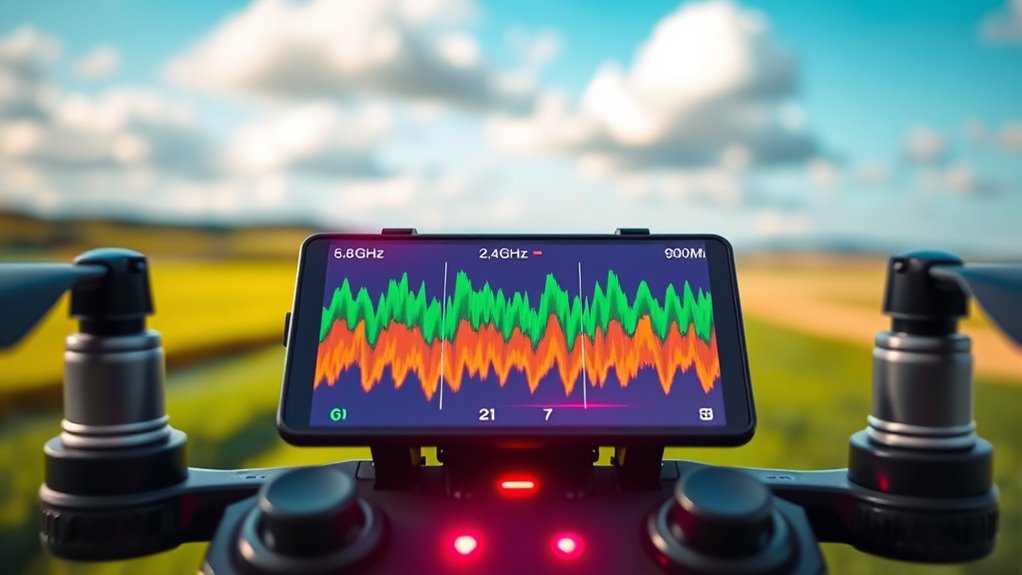
FPV (First Person View) drone pilots need to understand the various frequency bands they can utilize to transmit video signals effectively. Choosing the right band impacts your flight experience, especially in terms of signal clarity, range, and interference resistance. Among the options, 5.8 GHz, 2.4 GHz, and 900 MHz are the most common. Each band has its unique strengths and challenges, and understanding how to optimize antenna polarization and interference mitigation helps you get the best performance.
Starting with 5.8 GHz, this band is popular for its high-quality video transmission and minimal interference, especially in urban environments where other devices operate on similar frequencies. The high frequency allows for sharper images and lower latency, making it ideal for racing and precise control. However, 5.8 GHz signals are more susceptible to obstacles and can have reduced range compared to lower frequencies. To counter this, you should focus on proper antenna polarization—using circular or right-hand polarized antennas often improves signal stability. Circular polarization helps mitigate multipath interference, where signals bounce off objects, causing signal degradation. Ensuring your antennas are correctly polarized reduces interference and enhances video clarity, especially when flying through cluttered environments.
5.8 GHz offers high-quality video with minimal interference, but proper antenna polarization like circular or right-hand polarization enhances stability and clarity.
Moving to 2.4 GHz, this band is widely used for both control signals and video transmission, offering a good balance of range and penetration. It’s less affected by obstacles than 5.8 GHz but can experience more interference from Wi-Fi networks, Bluetooth devices, and other common gadgets. To optimize your setup, you should employ interference mitigation techniques, such as using frequency hopping or spread spectrum technology. Proper antenna polarization, like linear polarization aligned with your transmitter and receiver, helps maintain a stable connection, especially during fast maneuvers. While 2.4 GHz provides longer range, it’s also more crowded, so scanning for clear channels before your flight can considerably improve your signal quality.
Lastly, the 900 MHz band offers the longest range and best penetration through obstacles, making it suitable for long-distance FPV flights over challenging terrain. However, this band often requires specialized equipment and is less common in consumer-grade setups. Because of its lower frequency, interference mitigation is less of a concern, but antenna polarization still matters. Using appropriately polarized antennas ensures maximum signal strength and stability over extended distances. Additionally, with fewer devices operating at 900 MHz, interference issues are minimized, but you should always verify local regulations before using this band.
FPV drone 5.8GHz video transmitter
As an affiliate, we earn on qualifying purchases.
As an affiliate, we earn on qualifying purchases.
Frequently Asked Questions
How Do Weather Conditions Affect Each Frequency Band’s Performance?
Weather conditions impact each frequency band’s performance through antenna polarization and signal attenuation. 5.8GHz signals are more susceptible to rain, causing higher attenuation, reducing your range and clarity. 2.4GHz fares better but still experiences some attenuation during heavy rain or humidity. 900MHz signals are least affected, maintaining better performance in adverse weather. You should adjust antenna polarization and consider weather effects to optimize your FPV experience across all bands.
Are Certain Frequencies More Legal or Restricted in Specific Countries?
Think of frequency bands as the legal playgrounds for your FPV adventures. Some bands, like 5.8GHz, often fly under strict regulatory restrictions and might require license approval in certain countries. Others, like 2.4GHz, are more freely accessible but still subject to local rules. Always check your country’s frequency licensing laws before you take off, so you stay within the legal skies and avoid unwanted turbulence.
How Do Antenna Types Influence Signal Quality Across Bands?
You’ll notice antenna types greatly impact signal quality across bands. Antenna polarization, like circular or linear, affects how well signals transmit and receive, especially in different environments. Higher antenna gain focuses energy for longer range but can diminish coverage. Choosing the right antenna polarization and gain ensures clearer video and better control, regardless of whether you’re on 2.4GHz, 5.8GHz, or 900MHz bands.
What Are the Best Practices for Minimizing Interference?
To minimize interference, you should optimize antenna polarization by matching transmitter and receiver orientations, ensuring clearer signals. Use frequency hopping spread spectrum (FHSS) technology to switch channels rapidly, reducing the chance of interference from other devices. Also, keep your antennas properly aligned and maintain physical separation from other electronic equipment. Regularly scan for signal interference and adjust channels accordingly to maintain stable, high-quality FPV feeds.
Can Switching Bands Improve Drone Flight Safety?
They say “a stitch in time saves nine,” and that applies here. Switching bands can definitely improve drone flight safety by reducing interference, which enhances interference mitigation. Opt for a band with less congestion, like 900MHz for longer range or 5.8GHz for clearer signals, depending on your environment. Smart band selection minimizes signal disruptions, keeping your drone more reliable and safe during flight.
FPV drone antenna polarization circular
As an affiliate, we earn on qualifying purchases.
As an affiliate, we earn on qualifying purchases.
Conclusion
Understanding FPV frequency bands helps you choose the right setup for your flying style. Did you know that the 5.8GHz band offers higher resolution but shorter range, while 900MHz provides longer distances but lower image quality? By selecting the appropriate frequency, you can maximize your flying experience. Whether you’re chasing speed or scenic views, knowing these stats ensures you stay connected and confident in every flight. Happy flying!
As an affiliate, we earn on qualifying purchases.
FPV drone interference mitigation tools
As an affiliate, we earn on qualifying purchases.
As an affiliate, we earn on qualifying purchases.
Fall yard work Picks
leaf blowers
As an affiliate, we earn on qualifying purchases.