🔍 Read the full analysis: 2026'S Essential 11 AI Software For Productivity Boosts on ThorstenMeyerAI.com
Prime for Young Adults — start your free trial
Fast free delivery, streaming and member deals for eligible 18–24 year olds.
Try it freeAs an affiliate, we earn on qualifying purchases.
TL;DR
In 2026, eleven AI productivity software solutions stand out for their ability to automate tasks, enhance collaboration, and optimize workflows. These tools vary in complexity, cost, and specialization, with Microsoft Copilot leading overall. This roundup offers a detailed look at each, helping users choose the best fit for their needs.
Eleven AI productivity tools have emerged as the most effective options for boosting work efficiency in 2026, with Microsoft Copilot maintaining its top position due to its broad integration and versatility. These solutions are transforming workflows by automating tasks, improving collaboration, and offering advanced customization, making them essential for professionals and organizations aiming to stay competitive.
The list includes a mix of comprehensive platforms and niche solutions, each excelling in specific areas such as prompt engineering, workflow automation, or niche support like ADHD management. Microsoft Copilot remains the overall leader because of its seamless integration with Microsoft 365, extensive automation capabilities, and user-friendly interface. Meanwhile, Claude AI offers powerful prompt engineering features tailored for professionals seeking deep customization.
Pricing varies significantly, with some tools offering free tiers suitable for individuals and small teams, while enterprise solutions can cost thousands annually. Support and learning resources are critical, with most top tools providing extensive tutorials, community forums, and developer support to facilitate onboarding and troubleshooting. The selection process considered ease of use, integration, feature depth, and value for different user profiles, from beginners to advanced power users.
The 11 picks
- 1
 Claude AI for Microsoft 365 for Beginners: Practical Guide to Mastering Produ…View on Amazon →
 - 2
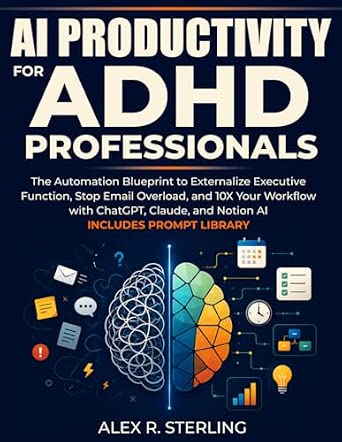 AI Productivity for ADHD Professionals: Automation Blueprint to Externalize E…View on Amazon →
 - 3
 Mastering Claude AI: The Complete Practical Guide to Prompt Engineering, Proj…View on Amazon →
 - 4
 AI Prompts for Productivity and Time Management: 500 Powerful Prompts to Work…View on Amazon →
 - 5
 Master AI for Beginners: Develop Artificial Intelligence Basics, Understand M…View on Amazon →
 - 6
 AI Tools for Everyone: Your Guide to Artificial IntelligenceView on Amazon →
 - 7
 AI-Powered Productivity & Prompt Engineering: A Practical System to Work Smar…View on Amazon →
 - 8
 Microsoft Copilot: A Practical Guide to Using AI in Word, Excel, PowerPoint,…View on Amazon →
 - 9
 AI Productivity Made Simple: How to Use ChatGPT, Automation Tools, Prompts, a…View on Amazon →
 - 10
 AI Tools for Productivity: Microsoft Copilot at Work for BeginnersView on Amazon →
 - 11
 How To Master Generative AI: Master AI Tools, Write Better Prompts, Boost Pro…View on Amazon →
Why These AI Tools Will Define 2026 Productivity
The adoption of these eleven AI solutions signifies a major shift in how work is approached, emphasizing automation, intelligent assistance, and seamless integration. For organizations, leveraging these tools can lead to significant time savings, improved accuracy, and enhanced collaboration. For individual users, they offer tailored support for managing workload, reducing cognitive load, and enabling focus on strategic tasks. As AI continues to evolve, these solutions are setting the standard for productivity in the coming years, influencing workplace expectations and workflows worldwide.
The Evolution of AI Productivity Tools Leading to 2026
Over the past few years, AI-driven productivity software has transitioned from experimental features to essential workplace tools. Early solutions focused on basic automation, but recent advancements have introduced sophisticated prompt engineering, deep integrations with major productivity suites, and niche applications for specific needs like ADHD management. Microsoft’s integration of Copilot into its Office suite in 2023 marked a turning point, establishing a new standard for seamless AI assistance within familiar environments. By 2026, the market is saturated with options that cater to diverse user requirements, from simple automation for individuals to complex enterprise workflows.
Remaining Questions About AI Productivity Software in 2026
While the top tools are well-established, it remains unclear how rapidly AI capabilities will evolve beyond current features, especially regarding privacy, data security, and ethical considerations. The long-term stability of these platforms and their adaptability to future technological shifts are also uncertain. Additionally, the impact of these tools on employment patterns and workplace dynamics continues to be a topic of debate among experts.
Future Developments in AI Productivity Tools Post-2026
Expect ongoing enhancements in AI automation, deeper integrations with enterprise systems, and more personalized productivity solutions tailored to individual workflows. Developers are likely to focus on improving transparency, security, and user control over AI-generated outputs. Meanwhile, new niche applications may emerge, addressing specialized needs like mental health support or industry-specific automation. Monitoring these trends will be essential for users and organizations aiming to stay ahead.
Key Questions
How do I choose the best AI productivity tool for my needs?
Consider your work environment, technical comfort, and specific goals. Prioritize tools with strong integration into your existing platforms, ease of use, and features that match your workflow complexity. For beginners, user-friendly interfaces and basic automation are ideal, while advanced users may seek deeper customization and automation capabilities.
Are free AI productivity tools enough for professional use?
Many free options handle basic automation effectively, but professional environments often require advanced features, support, and reliability offered by paid plans. Investing in premium solutions can provide higher limits, better integration, and dedicated support, which are crucial for demanding workflows.
Will AI tools replace human workers entirely?
Current AI solutions are designed to augment human work rather than replace it. They automate repetitive tasks and enhance decision-making, allowing humans to focus on strategic, creative, or complex problem-solving activities. The future may see more collaboration between AI and humans rather than outright replacement.
What are the privacy concerns with AI productivity software?
Many AI tools process sensitive data to deliver personalized assistance, raising privacy and security questions. Users should evaluate each platform’s data policies, encryption standards, and compliance with regulations like GDPR. Choosing solutions with transparent privacy practices is essential to mitigate risks.
How soon will these AI tools become standard in workplaces?
Adoption varies by industry and organization size, but given their proven benefits, widespread integration is expected to accelerate over the next few years. Large enterprises are already heavily investing, while smaller firms are gradually adopting these solutions as costs decrease and usability improves.
Source: ThorstenMeyerAI.com
Fall yard work Picks
leaf blowers
As an affiliate, we earn on qualifying purchases.