
Inside your DIY racing quad, the frame holds everything securely while keeping it lightweight. The flight controller acts as the brain, managing stability, while ESCs control motor speed. Motors and propellers work together to give your drone speed and agility, with the right size and pitch for peak performance. The FPV camera and video transmitter send live footage to your goggles or monitor. Keep exploring to understand how each part maximizes your drone’s flying potential.
Key Takeaways
- The frame is the drone’s skeleton, typically made from lightweight, durable carbon fiber, and influences aerodynamics and handling.
- The flight controller acts as the drone’s brain, managing stability and maneuvers based on sensor inputs.
- Motors’ size and KV rating determine speed, torque, and responsiveness, while propellers affect lift and thrust.
- The FPV camera provides live first-person view, and the video transmission system (VTX and antennas) ensures signal quality and range.
- Proper assembly, balancing, calibration, and firmware updates optimize performance, responsiveness, and flight safety.
Frame and Structure

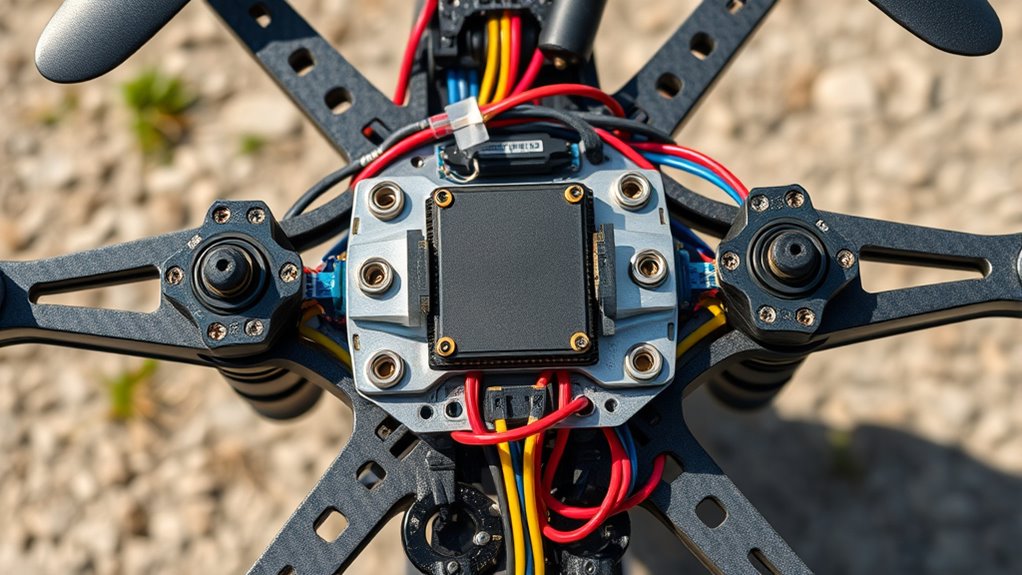
The frame is the foundation of your FPV drone, providing the essential structure that holds all components together. It acts as the skeleton, giving your drone strength and stability while keeping weight low. Most frames are made from carbon fiber, balancing durability with lightweight design, which is vital for speed and agility. They come in various sizes and mounting options, so you can choose one that fits your flight controller and ESCs perfectly. The design impacts aerodynamics and handling—racing frames focus on minimal drag, while freestyle frames prioritize durability. Some frames feature centralized mounting, like tilted FC/ESC stacks, to improve balance and crash resilience. Picking the right frame sets the stage for a responsive, durable FPV drone tailored to your flying style. Modern European cloud innovation also emphasizes the importance of lightweight, durable materials for system reliability and performance. Additionally, considering material selection can further enhance the overall durability and weight savings of your drone. Incorporating advanced manufacturing techniques can lead to improvements in both strength and weight reduction, further optimizing your drone’s capabilities. Using innovative design methods can help create frames that better withstand impacts and reduce vibrations, enhancing flight quality and longevity. Ensuring proper compatibility with your components can further optimize flight performance and longevity.
Flight Controller and Electronic Speed Controllers
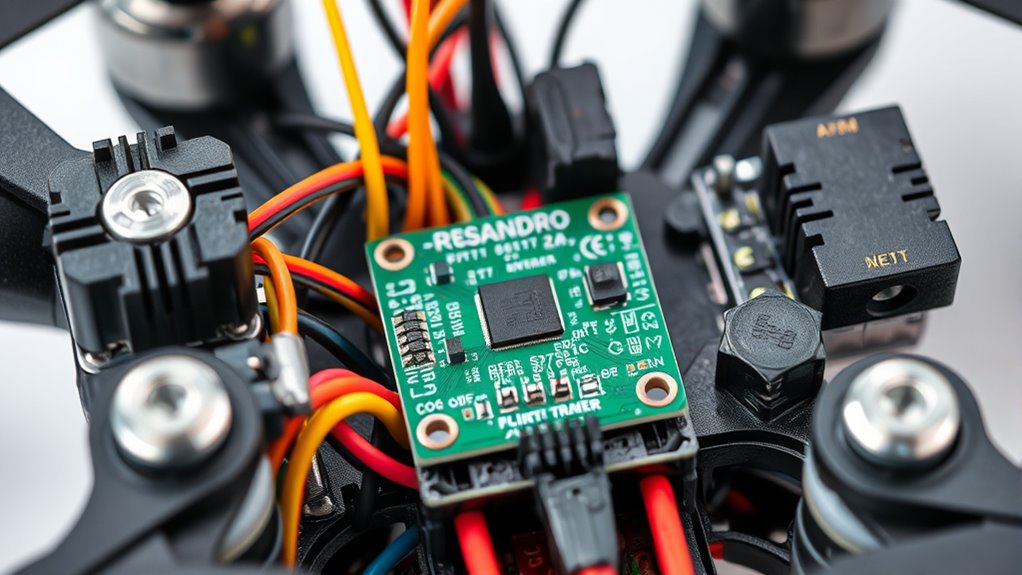
Ever wondered how your drone processes commands and controls its motors? That’s the job of the flight controller (FC) and electronic speed controllers (ESCs). The FC acts as the brain, interpreting your inputs and sensor data to manage flight stability and maneuvers. It sends signals to the ESCs, which regulate power delivery to each motor, controlling speed and torque. Your choice of FC and ESCs impacts responsiveness, smoothness, and reliability. Attention to detail is crucial when selecting and installing these components to ensure optimal performance. Understanding the materials and craftsmanship involved in these components can also help in appreciating their quality and durability. Carefully considering these component specifications can lead to better longevity and consistent flight behavior. Additionally, high-quality components often feature precise manufacturing standards that enhance overall drone performance.
Motors and Propellers
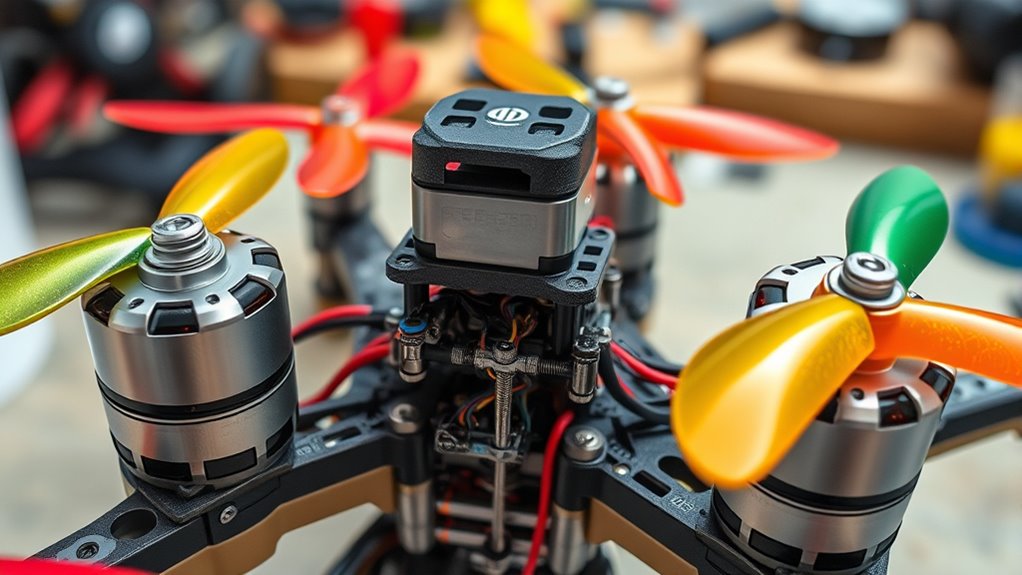
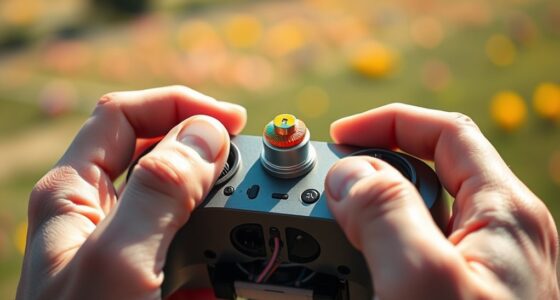
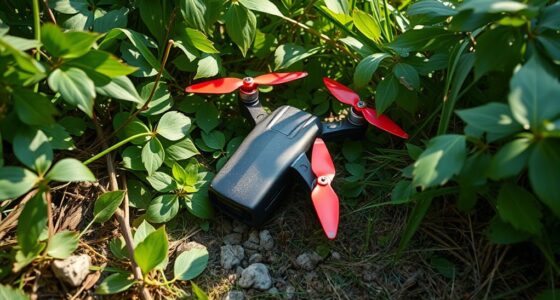
Motors and propellers directly determine your drone’s speed, agility, and overall flight performance. Your motor’s size and KV rating influence how fast it spins and how much torque it produces, affecting acceleration and responsiveness. Higher KV motors spin faster but generate less torque, ideal for speed, while lower KV motors offer more power for heavier loads and stability. Propellers work with motors to generate lift and thrust; their length and pitch control how quickly your drone accelerates and reaches top speed. Fewer blades are more efficient and faster, while more blades provide more thrust at the cost of efficiency. Choosing the right combination ensures you get a balanced mix of speed, control, and durability suited to your flying style. Proper setup is crucial for best flight, and understanding motor specifications helps optimize your drone’s performance. Additionally, selecting components with compatible power ratings ensures optimal efficiency and minimizes motor strain. Considering motor and propeller compatibility is also essential to prevent damage and ensure smooth operation.
FPV Camera and Video Transmission System

Your drone’s FPV camera and video transmission system are key to steering and capturing footage during flight. The camera provides a live feed that helps you navigate tight turns and avoid obstacles, while the video transmitter (VTX) wirelessly sends this feed to your goggles or monitor. Choosing the right VTX output power balances range and interference; higher power offers better distance but may cause more signal issues. The antenna type—directional or omnidirectional—significantly impacts signal quality and range, depending on your flying style. Ensuring your camera and VTX are lightweight helps maintain drone agility, and matching antenna types to your flying environment optimizes signal performance. Consider analog for low latency or HD for improved image clarity. Additionally, understanding the signal quality and how different components interact can greatly enhance your overall flight experience. Selecting components that prioritize connectivity can lead to more reliable and enjoyable flights. Proper component compatibility also minimizes potential issues and ensures seamless operation during your flights. For optimal performance, regularly testing your video transmission range helps identify potential weak spots before flight sessions. Incorporating proper antenna placement can further improve signal strength and stability during operation.
Assembly Tips and Optimization Strategies

To guarantee your FPV drone performs reliably and efficiently, proper assembly and fine-tuning are essential. Start by carefully mounting components, ensuring all screws are tight without over-tightening, which could crack parts. Use quality cables and secure wiring with zip ties to prevent loose connections and reduce vibrations. Balance your propellers for smooth flight and minimal vibrations, which improves sensor readings and flight stability. Calibrate your flight controller’s sensors—gyros and accelerometers—for accurate responsiveness. Check motor spin directions and propeller orientation before flying. Keep firmware updated for maximum performance and compatibility. Additionally, proper wiring practices help prevent electrical issues and ensure safe operation. Performing routine maintenance and pre-flight checks further contribute to consistent drone performance. Conduct thorough pre-flight inspections to identify potential issues before takeoff. Regularly inspecting electrical connections and using reliable cables can greatly reduce connection failures during flight. Perform test flights in open areas, adjusting PID settings and throttle curves to optimize handling, responsiveness, and flight time. Proper assembly and calibration lay the foundation for a high-performance FPV drone.
Frequently Asked Questions
How Do I Choose the Right Frame Size for My Racing Drone?
You should choose the right frame size based on your racing style and motor setup. Smaller frames, like 5-inch, are more agile and faster, perfect for tight courses. Larger frames, like 6-inch, provide more stability and power for longer flights. Match the frame size with your motor and propeller combo, considering your skill level and racing environment. Make certain the frame fits your components and offers good durability for crashes.
What Firmware Options Are Compatible With Specific Flight Controllers?
You can choose firmware options like Betaflight, INAV, or RaceFlight, depending on your flight controller. Betaflight is the most popular for racing drones, offering incredible customization and performance. Make sure your flight controller supports the firmware by checking compatibility lists on their official sites. Keep in mind, some firmware updates can transform your drone into a flying masterpiece, so always match your firmware to your controller’s specifications for peak flying.
How Can I Optimize Motor and Propeller Pairing for Maximum Speed?
To optimize your motor and propeller pairing for maximum speed, start by choosing a high KV motor suited for fast RPMs. Match it with lightweight, appropriately sized props—usually smaller and with a higher pitch for speed. Guarantee the motor’s current rating matches your ESC and battery capacity. Test different combinations, monitor performance, and adjust size or pitch until you find the best balance of speed, efficiency, and control for your racing needs.
What Factors Influence FPV Video Latency and Quality?
Did you know that even a tiny delay of 10 milliseconds in your FPV feed can cause noticeable lag? Latency and quality are mainly affected by your video transmitter power, antenna type, and the signal interference in your flying environment. High-quality antennas and lower transmitter power reduce latency, while digital HD systems offer clearer images but may add more delay. Keep your hardware optimized to enjoy smooth, real-time FPV flying!
How Do I Troubleshoot Common Connectivity Issues Between Components?
To troubleshoot connectivity issues, first check all wiring and connectors for loose or damaged parts. Make certain your components are compatible and properly powered. Update firmware if needed, and verify settings in your flight controller software. Test each component individually if possible, and swap out suspect parts to identify faults. Finally, confirm antenna placement and signal strength, especially for your FPV system, to improve video and control signals.
Conclusion
Now that you understand each component’s role, you’re better equipped to build or upgrade your racing quad. Remember, selecting quality parts and fine-tuning your setup can make all the difference in performance. Are you ready to push your drone to its limits and see how far your skills can take you? With the right knowledge and dedication, you’ll be soaring faster and more confidently than ever before. The sky’s the limit—literally.