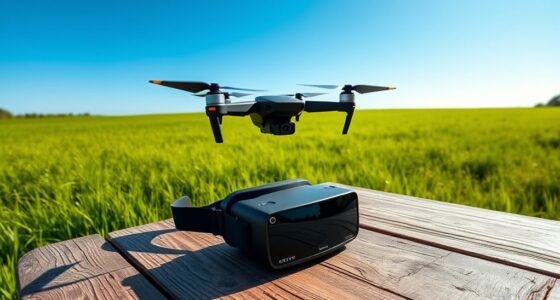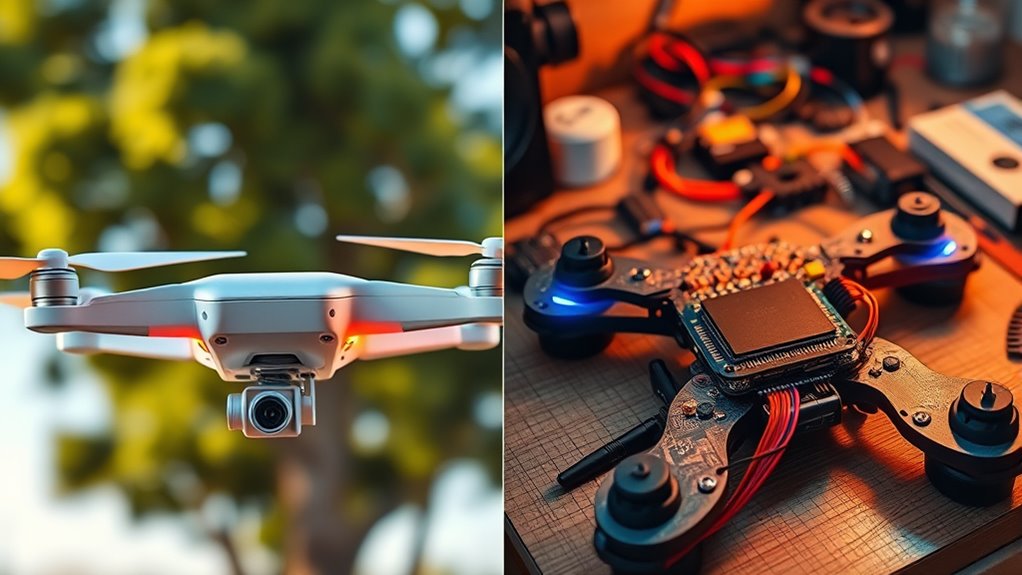
If you’re choosing your first FPV drone, consider your budget, skills, and goals. RTF models are ideal if you want a hassle-free experience with minimal setup, perfect for beginners. DIY builds suit those wanting to customize performance and learn more about drone mechanics, but require technical skills. Think about whether you prioritize ease or customization and what you aim to achieve. Keep exploring, and you’ll find the best option to start your FPV journey.
Key Takeaways
- Assess your technical skills and willingness to learn; RTF is easier for beginners, while DIY offers customization.
- Define your budget and consider long-term upgradeability; DIY builds can be more cost-effective over time.
- Determine your flying goals, such as racing or freestyle, to choose the right performance features.
- Consider support options; RTF drones come with warranties and customer service, DIY relies on community and manuals.
- Match the drone type to your experience level and desired complexity for a satisfying first FPV experience.
Understanding the Basics of FPV Drones
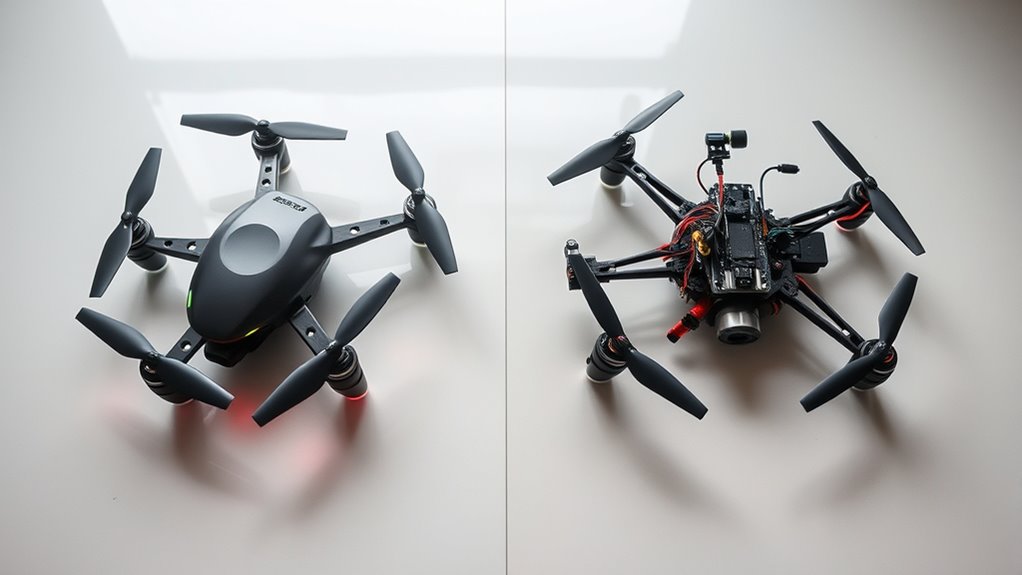
Have you ever wondered what makes FPV drones different from regular flying drones? FPV, or First-Person View, drones let you see from the drone’s perspective through a headset or screen in real-time. This immersive experience is what sets them apart. Unlike typical drones, which are mainly used for photography or simple flying, FPV drones are built for agility, speed, and precise control. They’re often smaller, lighter, and designed to perform quick maneuvers. The core components include a camera, video transmitter (VTX), flight controller, and a pilot’s goggles or monitor. Flying an FPV drone requires learning how to interpret the live video feed, control the drone smoothly, and understand the basics of aerodynamics. It’s an exciting, hands-on way to experience drone flying at a whole new level. Additionally, understanding the innovations in European cloud servers can provide insights into the technological advancements supporting these high-performance drones. Recognizing the importance of high-performance technology can help enthusiasts appreciate the sophisticated hardware that enables real-time video transmission and precise control.
Evaluating Your Budget and Cost Factors

Your budget plays a key role in choosing the right FPV drone, with options ranging from affordable DIY builds to premium RTF kits. Consider not only the initial cost but also expenses for components, upgrades, and accessories over time. Being clear about your budget helps you find a drone that balances performance, features, and affordability. Additionally, understanding investment risks and costs can help you better evaluate the true long-term expenses associated with different drone types. Furthermore, understanding personality assessment tools can help you identify your preferences and strengths, guiding you toward the most suitable drone type for your personal style. Recognizing the cost implications of upgrades and maintenance can also influence your overall budgeting strategy. Consulting financial planning resources can support more informed decisions when allocating funds for your FPV drone hobby. Incorporating knowledge about water-related activities and maintenance, such as protecting your drone from water damage or choosing waterproof components, can be beneficial if you plan to fly in wet conditions or near water bodies.
Budget Range and Expenses
When evaluating the budget for your first FPV drone, it’s important to contemplate both initial costs and future expenses. Your upfront investment varies considerably based on your choice. RTF kits typically cost between $500 and $1,200, including essentials like batteries and chargers. DIY builds can start around $300 but may go over $800 for high-end parts. Additional costs include tools, spare parts, and upgrades over time. RTF drones often have higher resale value, which can offset initial spending. DIY builds save money long-term through easier upgrades and repairs. Considering the concept of Free Floating in drone design can also influence your budget, as it emphasizes lightweight and flexible setups that may reduce costs and improve performance. Exploring component compatibility can help ensure your build remains cost-effective and adaptable as your skills grow. Additionally, understanding the importance of reliability can guide you toward selecting parts that offer better durability and performance. When selecting components, researching market options can help you find the best balance between quality and price to maximize your investment. Evaluating cost-effectiveness is essential to ensure that your spending aligns with your skill level and long-term ambitions. Assess what fits your financial situation and long-term goals. Remember, a higher initial investment can result in better reliability and performance, but budget-friendly options are available for beginners.
Component and Upgrade Costs
Evaluating the costs of components and potential upgrades helps you understand how your initial investment can grow over time. With RTF drones, the upfront cost includes everything—drone, controller, goggles—usually between $500 and $1,200. These kits often include batteries and chargers, but upgrading parts can be costly since proprietary components limit customization. DIY builds start cheaper, with basic setups around $300, but premium parts can push costs over $800. Upgrades like motors, batteries, or flight controllers are more affordable and flexible in DIY builds, allowing you to customize performance and extend your drone’s lifespan. Keep in mind, DIY upgrades require research and technical skills, while RTF components tend to be more expensive but easier to replace or upgrade through official channels. Additionally, considering the regular maintenance routines involved in maintaining your drone can help prolong its performance and safety over time, especially when proper care practices are followed diligently. Regular maintenance is essential for ensuring safe flying and maximizing your investment.
Assessing Your Technical Skills and Experience
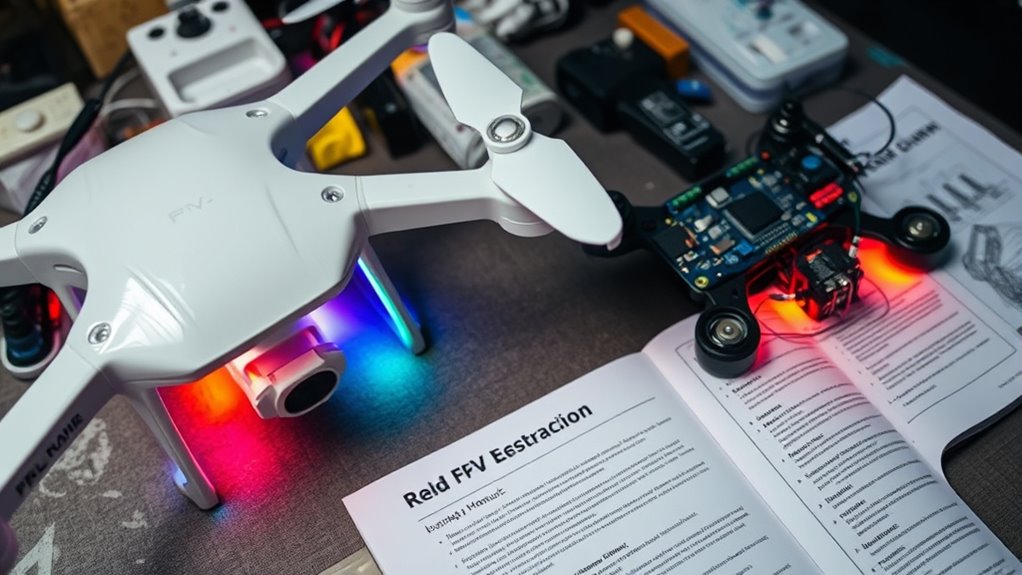
You need to honestly evaluate your technical knowledge and building experience before choosing a drone. If you’re comfortable with electronics and assembling components, a DIY build could be a rewarding challenge. But if you prefer a straightforward setup, an RTF drone might be a better fit to get you flying quickly.
Technical Knowledge Required
Evaluating your technical skills is crucial when choosing a first FPV drone, as it determines whether a ready-to-fly setup or a DIY build suits you best. If you opt for a DIY build, you’ll need a solid understanding of electronics, soldering, and firmware setup. Consider these skills:
- Soldering wires and components accurately
- Configuring flight controllers and firmware
- Troubleshooting hardware and software issues
- Assembling and wiring electronic parts
- Upgrading and replacing individual components
Without these skills, you risk damaging parts or creating a drone that’s unsafe or unreliable. Ready-to-fly options minimize these requirements, letting you focus on flying. If you’re new to electronics, starting with an RTF drone offers a smoother entry, while DIY appeals to those enthusiastic to learn and customize.
Prior Building Experience
Having prior building experience can considerably influence your choice between an RTF drone and a DIY build. If you’re comfortable with electronics, soldering, and firmware setup, a DIY build might suit you better, offering customization and potentially lower costs. You’ll enjoy selecting individual components, tuning performance, and troubleshooting issues as they arise. Additionally, understanding affiliate disclosures and privacy policies can help you navigate third-party parts and software suppliers more confidently. Moreover, familiarity with auditory processing concepts can enhance your troubleshooting skills during building and tuning. Developing a solid understanding of technical skills can also facilitate more effective troubleshooting and optimization of your drone. However, if your experience is limited or you prefer a straightforward, plug-and-play solution, an RTF drone is a smarter option. It minimizes technical challenges, allowing you to focus on flying rather than assembly. Assess your skills honestly—if you’ve built or repaired electronics before, the DIY route can be rewarding. Otherwise, starting with an RTF drone helps you learn the basics without feeling overwhelmed.
Considering Performance and Customization Options
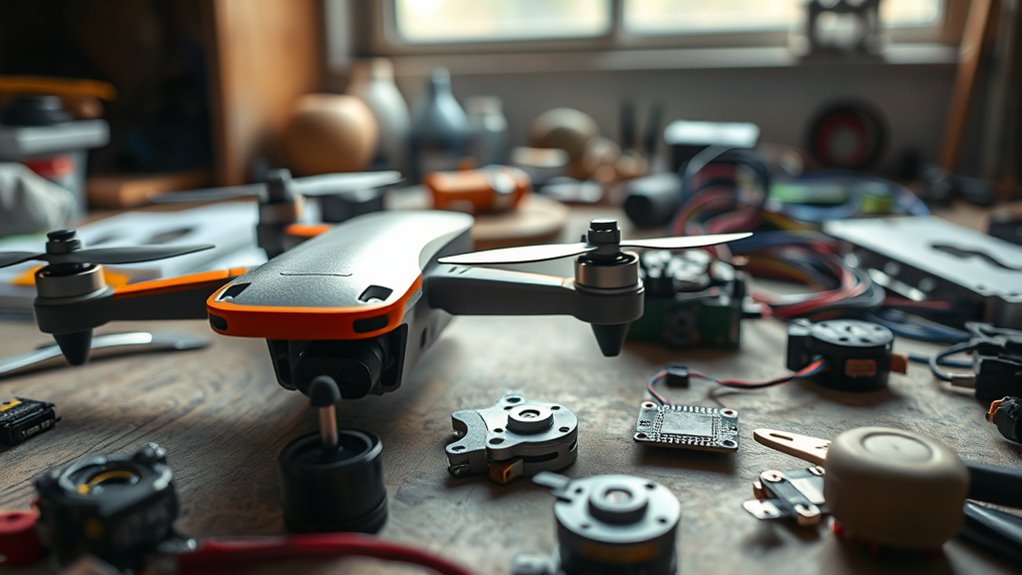
When choosing between an RTF drone and a DIY build, considering performance and customization options is essential. RTF drones deliver consistent, ready-to-fly performance but limit upgrades. DIY builds, on the other hand, let you tailor every aspect to your preferences. You can:
RTF drones offer reliable flight with limited upgrades, while DIY builds provide full customization options.
- Optimize speed, agility, or endurance
- Swap out components for better performance
- Adjust firmware for custom flight characteristics
- Change aesthetics with different frames and skins
- Incorporate specific features like enhanced cameras or batteries
This flexibility means your drone can evolve with your skills and goals. RTF models focus on simplicity and reliability, while DIY builds offer endless room for experimentation and fine-tuning. Your choice depends on how much you want to customize versus ease of use. Additionally, understanding connected technology can help you integrate modern features for a smarter flying experience.
Analyzing Safety, Reliability, and Support
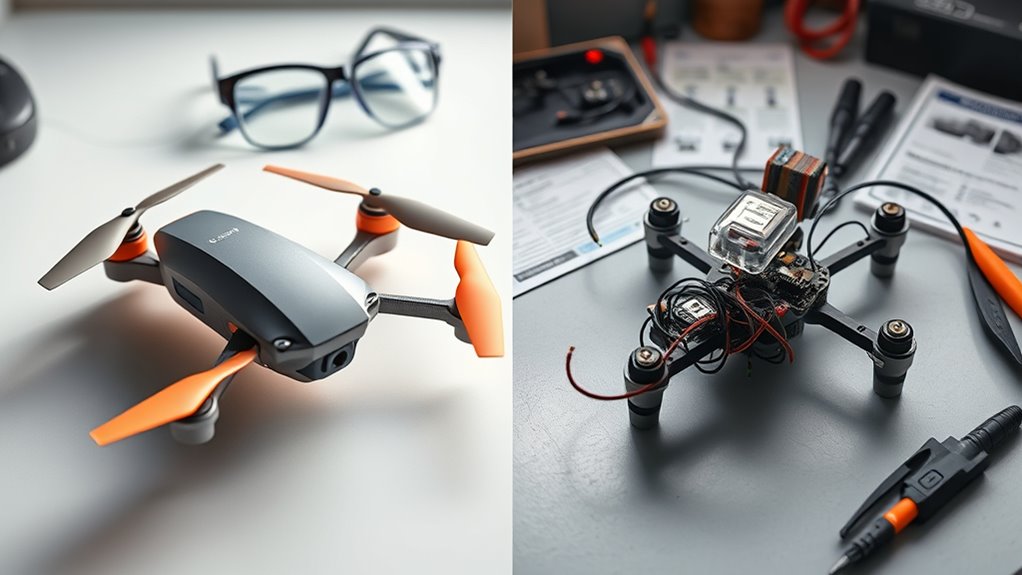
Choosing between an RTF drone and a DIY build considerably impacts safety, reliability, and support. RTF drones are factory tested, so they typically operate safely right out of the box, with built-in safety features like GPS, failsafes, and obstacle avoidance. They often come with warranties and customer support, making troubleshooting straightforward if issues arise. DIY builds, on the other hand, depend heavily on your skills during assembly and configuration. While you can customize for performance, ensuring safety requires careful wiring, software setup, and thorough testing. Support mostly comes from online communities and manuals, which can be helpful but less immediate. Ultimately, RTF drones offer more peace of mind for beginners, while DIY builds demand greater technical competence but can be more reliable once properly assembled.
Determining Your Long-Term Goals and Upgrades
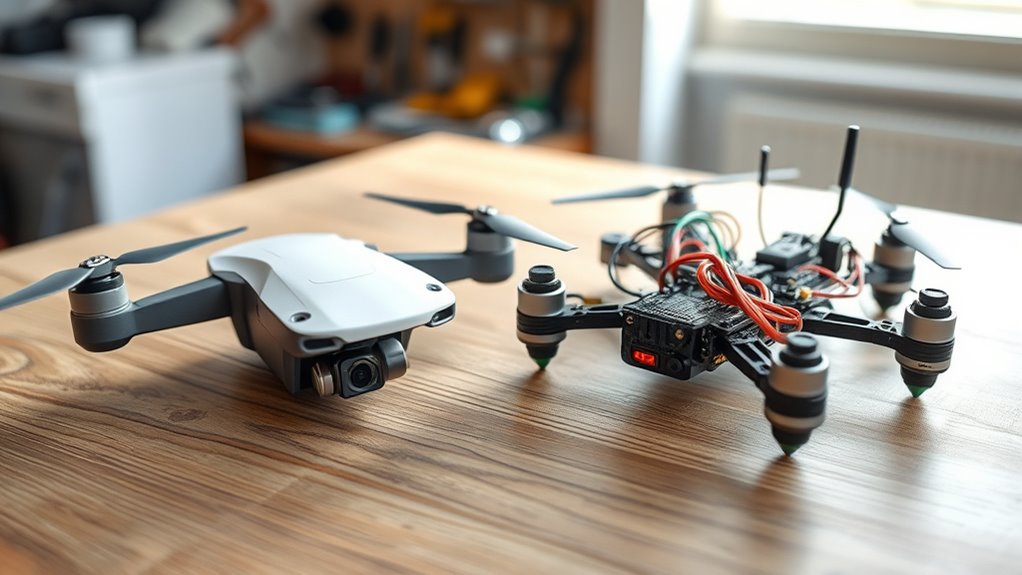
Understanding your long-term goals and plans for upgrades is essential when selecting your first FPV drone, as it guides your choices in hardware, performance features, and investment level. If you aim to improve flying skills, you might prioritize durability and ease of repair. For future customization, consider whether you want a drone compatible with aftermarket parts and firmware tweaks. Think about upgrade paths like better batteries, motors, or flight controllers. Your goals could include racing, freestyle flying, or cinematic footage. Keep in mind:
Identify your long-term goals to choose an FPV drone that fits your upgrade plans and desired flying style.
- Desired performance improvements
- Compatibility with future upgrades
- Budget constraints
- Ease of maintenance and repairs
- Long-term support and community resources
Clarifying these factors helps you pick a drone aligned with your ambitions and growth trajectory.
Making the Best Choice for Your First Drone
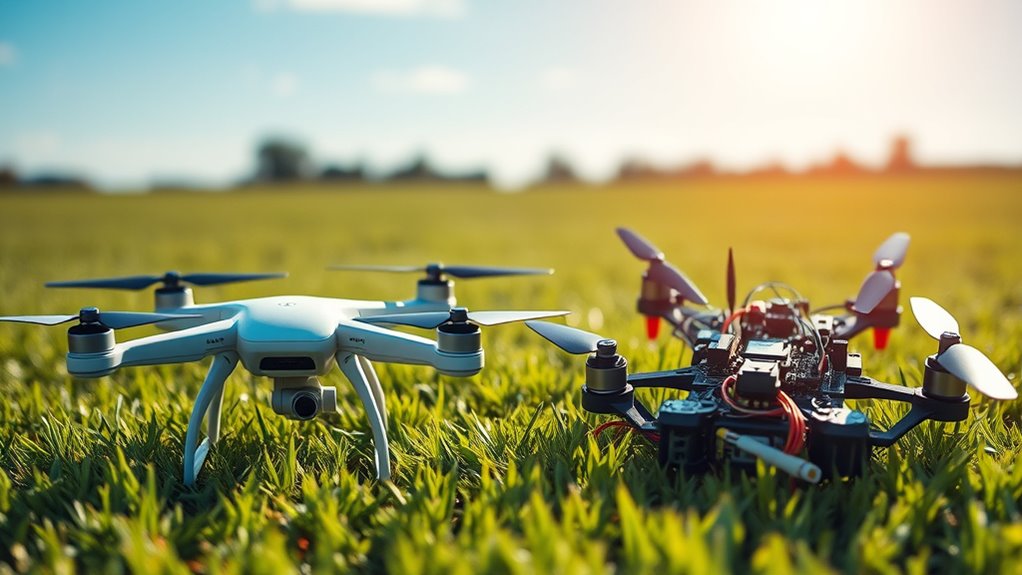
Selecting the right first FPV drone depends on your experience level, goals, and willingness to learn. If you’re new to drones or prefer a hassle-free start, a Ready-To-Fly (RTF) drone makes sense. It’s fully assembled, easy to operate, and offers a smooth entry point. You can focus on flying without worrying about setup or troubleshooting. Conversely, if you’re technically inclined or enthusiastic to customize, a DIY build might be better. Building your drone from scratch gives you full control over performance, upgrades, and repairs. It also deepens your understanding of drone mechanics. Consider your budget, technical skills, and what you hope to achieve. Ultimately, choose the option that aligns with your current skills and long-term interests in FPV flying.
Frequently Asked Questions
Can I Upgrade or Modify My RTF Drone Later?
Yes, you can upgrade or modify your RTF drone later, but your options might be limited. Many RTF drones use proprietary parts, so swapping out components or customizing performance can be challenging. However, you can often add accessories like better batteries or camera upgrades. For more extensive modifications, consider switching to a DIY build, which offers greater flexibility and customization to match your evolving flying skills and preferences.
How Difficult Is It to Repair a DIY FPV Drone?
Repairing a DIY FPV drone is like fixing a complex puzzle—you need patience and technical skill. You’ll often replace or troubleshoot individual parts like motors, ESCs, or wiring, which requires understanding of electronics and soldering. While it’s more challenging than fixing an RTF drone, your knowledge grows with each repair. If you’re comfortable with tools and electronics, you’ll find DIY repairs rewarding, but expect some trial and error.
What Are the Best FPV Drones for Beginners?
For beginners, the best FPV drones are ready-to-fly models like the BetaFPV Beta85X or DJI Mini 2. These drones are easy to set up, user-friendly, and come with safety features, making your first flights smoother. They don’t require technical skills for assembly or troubleshooting, so you can focus on flying and improving your skills without frustration. As you gain experience, you can explore more advanced DIY options.
Are There Warranty Options for DIY Builds?
Yes, DIY builds often offer warranty options, but they vary considerably. You typically get limited warranty coverage through individual component manufacturers, which means you’re responsible for repairs if something fails. It’s wise to research each part’s warranty and be prepared for potential troubleshooting. While DIY builds may lack extensive warranties like RTF drones, proper care, quality parts, and community support can help keep your FPV flying smoothly.
How Does Battery Life Compare Between RTF and DIY Drones?
You’ll find that battery life varies more with your choices than the drone type itself. RTF drones often come with batteries optimized for their design, giving you reliable flight times. With DIY builds, you can select batteries that maximize duration, but it requires knowledge to balance weight, capacity, and power. Overall, DIY setups can potentially offer longer flight times if you choose high-capacity batteries, but proper setup is essential.
Conclusion
Choosing between a ready-to-fly or DIY FPV drone ultimately depends on your skills, goals, and budget. Are you willing to learn and customize, or do you prefer instant flying fun? Remember, your first drone sets the foundation for your flying journey. Whichever path you choose, make sure it aligns with what excites you most. After all, isn’t the ultimate goal to enjoy and grow in your FPV experience?