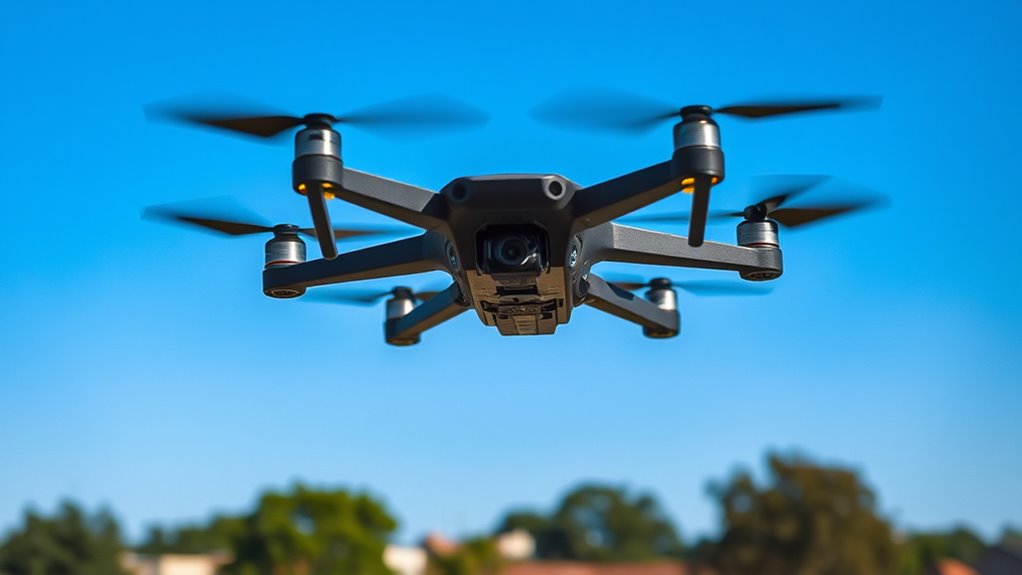

Drones use motors and propellers to generate lift and move through the air, while flight controllers keep stability by adjusting motor speeds based on sensor data from gyroscopes, accelerometers, and GPS. Sensors act as the drone’s eyes and ears, providing real-time information for obstacle avoidance and navigation. Power comes from advanced batteries, and communication systems guarantee smooth control. The software and algorithms behind all this allow for autonomous flight. Exploring more reveals how these systems work together seamlessly.
Key Takeaways
- Quadcopters use four motors and propellers, with speed adjustments for lift, stability, and maneuverability.
- Flight controllers process sensor data (gyroscopes, accelerometers) to maintain balance and respond to environmental changes.
- Sensors like GPS, cameras, and lidar provide real-time environmental data for navigation and obstacle avoidance.
- Wireless radio signals transmit commands and telemetry between the drone and operator or autonomous systems.
- Advanced algorithms enable autonomous flight, obstacle detection, and dynamic path planning for safe, stable operation.
The Role of Motors and Propellers

Have you ever wondered how drones stay airborne and move so precisely? It all comes down to the motors and propellers working together. The motors power the propellers, which generate aerodynamic lift by pushing air downward. This lift counteracts gravity, keeping your drone afloat. The design and size of the propellers are vital for maximizing propulsion efficiency, ensuring the drone uses less energy while maintaining strong lift. Faster motor spins increase thrust, allowing quick maneuvers, while efficient motors conserve battery life. The balance between motor power and propeller size directly impacts flight stability and control. When everything works in harmony, your drone can hover, turn, and accelerate smoothly, demonstrating how essential these components are for precise, efficient flight. Additionally, understanding Free Floating concepts helps optimize drone stability and performance in various environments. Proper weight distribution also enhances flight responsiveness and reduces strain on the motors, with innovative European cloud servers supporting data processing for advanced drone navigation systems. Moreover, motor control algorithms play a crucial role in adjusting the motor speeds in real-time for better stability and maneuverability. Considering energy efficiency principles can further improve flight duration and overall performance.
How Flight Controllers Maintain Stability

Your flight controller constantly gathers data from sensors to understand the drone’s position and movement. It then adjusts motor speeds to keep the drone stable and on course. This real-time integration of sensor data and motor control guarantees smooth, balanced flight. Additionally, precision and automation are key features that enable drones to respond quickly to changing conditions and maintain stability. By leveraging sensor fusion techniques, the flight controller can create a comprehensive understanding of the drone’s environment, further enhancing stability and responsiveness. Incorporating robust communication links ensures continuous data flow between the drone’s components, which is essential for maintaining reliable flight stability. The use of advanced algorithms allows for faster processing and adaptation to environmental changes, further improving flight performance. Moreover, feedback control systems are fundamental in continuously adjusting the drone’s behavior to sustain stability during flight.
Sensor Data Integration
To maintain stability during flight, flight controllers continuously gather data from various sensors, such as gyroscopes, accelerometers, and magnetometers. This sensor data is combined through data fusion techniques, which create a precise understanding of your drone’s position and orientation. Visual sensor integration also plays a vital role, helping the drone interpret its surroundings for better stability. By merging data from multiple sources, the flight controller can quickly correct any deviations and keep your drone steady. Additionally, understanding heat distribution within electronic components can help improve the durability and reliability of flight controllers. Recognizing thermal management principles is essential for preventing overheating and ensuring consistent performance during operation. Proper component cooling strategies further support stable flight by maintaining optimal operating temperatures, and staying aware of thermal conductivity helps optimize cooling solutions for electronic parts. Implementing effective heat dissipation methods is crucial for maintaining overall system stability during extended flights.
Motor Speed Adjustments
Flight controllers adjust motor speeds in real-time to keep the drone stable. When you’re capturing aerial photography, maintaining steady flight is vital for clear images. The flight controller constantly monitors sensor data to detect any tilts or shifts, then tweaks motor speeds accordingly. If the drone tilts or drifts, it increases or decreases power to specific motors to correct its orientation. This precise control also helps manage payload weight, ensuring that added equipment doesn’t compromise stability. By swiftly adjusting motor speeds, the drone stays balanced even in windy conditions or when carrying heavier payloads. This dynamic response keeps your drone steady, making it easier to capture high-quality footage and perform complex maneuvers without sacrificing stability or control. Additionally, understanding how sensor feedback features can improve overall flight stability highlights the importance of balanced design and payload considerations. Incorporating automatic stabilization systems further enhances this capability, allowing for smoother and more reliable flight performance. For example, real-time data processing enables the flight controller to react swiftly to changing conditions, further improving stability and control.
Sensors: Eyes and Ears of the Drone

Sensors act as the eyes and ears of a drone, allowing it to perceive and interpret its environment. These devices enable precise movements, obstacle avoidance, and enhanced aerial photography. You’ll find cameras, ultrasonic sensors, infrared sensors, and GPS systems working together to gather real-time data. This data helps the drone navigate complex environments and capture stunning images without collisions. Understanding drone sensors is key to appreciating how these devices work together seamlessly. Additionally, advancements in sensor technology continue to improve drone capabilities and safety features. The integration of real-time data processing further enhances responsiveness and operational accuracy.
Power Sources and Battery Technology

Power sources and battery technology are at the heart of a drone’s performance, determining how long it can stay airborne and how effectively it operates. You rely on batteries, typically lithium-polymer (LiPo), which offer high energy density and lightweight design. Battery longevity is vital for extended flight times, so advances focus on maximizing charge cycles and minimizing weight. Efficient power management is essential; it guarantees your drone uses energy wisely, balancing power draw with flight demands. Good power management reduces battery drain and prevents overheating, extending overall battery life. As technology advances, you’ll see batteries that last longer and charge faster, giving you more flight time and reliability. These improvements directly impact your drone’s endurance and operational efficiency.
Communication Systems and Remote Control

Have you ever wondered how your drone stays connected and responds to your commands mid-air? It all comes down to its communication system, which uses specialized antenna design and frequency bands. The remote control transmits signals via radio waves, which are received by the drone’s antenna. The choice of frequency bands, like 2.4 GHz or 5.8 GHz, impacts range and interference resistance. Here’s a quick look:
| Aspect | Details |
|---|---|
| Antenna Design | Optimized for signal strength and clarity |
| Frequency Bands | 2.4 GHz for longer range, 5.8 GHz for better stability |
| Signal Transmission | Radio waves carry commands and telemetry |
| Response Time | Near-instant communication ensures smooth control |
| Interference Handling | Filters and design reduce signal disruptions |
This system keeps you in control, ensuring safe, responsive flights.
Software and Algorithms Driving Autonomous Flight

You rely on flight control algorithms to keep the drone stable and on course. These algorithms interpret sensor data to make real-time adjustments during flight. Understanding how software processes this information reveals the core of autonomous drone operation.
Flight Control Algorithms
Ever wondered how drones navigate complex environments with precision and stability? Flight control algorithms are the brain behind smooth, autonomous flight. They process data from onboard systems to keep your drone steady during aerial photography or obstacle detection. These algorithms constantly adjust motor speeds to maintain altitude, direction, and balance. Imagine:
- Real-time calculations balancing wind and movement
- Dynamic adjustments for sudden obstacles
- Stabilization routines for clear images
- Path planning to avoid collisions
- Continuous feedback loops ensuring smooth flight
With these sophisticated algorithms, your drone can hover steadily, follow intricate routes, and avoid obstacles seamlessly. They’re essential for safe, reliable, and precise autonomous flight—making sure you capture stunning aerial shots without a hitch.
Sensor Data Processing
Sensor data processing forms the foundation of autonomous drone navigation by interpreting information collected from various onboard sensors. You rely on this data to accurately understand your surroundings, whether capturing stunning aerial photography or delivering payloads. Algorithms analyze inputs from cameras, lidar, GPS, and inertial measurement units to create real-time maps and obstacle detection. This processing helps you adjust flight paths, avoid hazards, and maintain stability without human control. Efficient software filters out noise and combines sensor inputs to produce reliable navigation cues. For payload delivery, precise sensor data ensures you approach targets accurately. In aerial photography, it helps stabilize your camera for clear shots. Overall, sensor data processing enables your drone to operate safely and effectively in complex environments.
Challenges and Innovations in Quadcopter Technology

Despite rapid advancements, quadcopter technology still faces significant challenges that hinder widespread adoption and performance. One major hurdle is enhancing obstacle avoidance, especially in complex environments, to prevent crashes during aerial photography missions. Battery life remains a concern, limiting flight time and operational efficiency. Controlling drones in windy conditions tests stability and precision, impacting photo quality. Additionally, developing lightweight yet durable materials helps improve flight endurance. Lastly, integrating smarter AI systems for real-time decision-making guarantees safer navigation. Imagine navigating through narrow corridors, capturing stunning shots, or flying in unpredictable weather—all while avoiding obstacles effortlessly. Innovations like advanced sensors, machine learning algorithms, and improved power sources are pushing boundaries, making quadcopters more reliable, safer, and capable of performing complex tasks with ease.
Frequently Asked Questions
How Do Weather Conditions Affect Drone Flight Stability?
Weather conditions substantially impact your drone’s flight stability. Wind turbulence can cause unpredictable movements, making it harder to control your drone precisely. Temperature effects also matter; extreme cold can reduce battery life and affect motor performance, while heat can cause overheating issues. Always check the weather forecast, avoid flying in strong winds or turbulent conditions, and be mindful of temperature extremes to guarantee safe, stable flights.
What Safety Features Are Integrated Into Modern Quadcopters?
Modern quadcopters come equipped with essential safety features like collision avoidance and GPS stabilization. You can trust these features to prevent crashes and maintain steady flight, even in challenging conditions. Collision avoidance uses sensors to detect obstacles and steer clear automatically, while GPS stabilization keeps your drone steady and on course. These safety measures guarantee you fly confidently, reducing risks and enhancing your overall experience.
How Do Drones Handle High-Speed Maneuvers?
You handle high-speed maneuvers with your drone through advanced flight control systems that enhance aerial agility. These systems adjust motor speeds rapidly, allowing precise maneuvering techniques like sharp turns and quick accelerations. The drone’s sensors constantly monitor position and orientation, helping maintain stability during fast movements. This combination of robust hardware and smart software guarantees your drone responds accurately, giving you confident control even during rapid, complex aerial maneuvers.
Can Drones Learn and Adapt During Flight?
Yes, drones can learn and adapt during flight. They use machine learning algorithms and adaptive control systems to analyze real-time data, allowing them to adjust their behavior automatically. This means your drone can improve stability, avoid obstacles, and optimize flight paths on the fly. With ongoing advancements, these intelligent features enable drones to handle complex environments and tasks more effectively, making them more autonomous and reliable.
What Are Future Trends in Drone Technology Development?
Future drone tech combines cutting-edge autonomous navigation with seamless payload integration, making drones smarter and more versatile. You’ll see advancements like improved obstacle detection and smarter decision-making, allowing drones to operate independently in complex environments. These trends will enable drones to handle heavier payloads, perform precision tasks, and expand into new industries. Embracing these innovations, you’ll find drones becoming more autonomous, efficient, and essential for various applications.
Conclusion
Now that you understand how drones work, it’s clear they’re more than just flying gadgets—they’re marvels of modern technology. From powerful motors to smart sensors, each component plays a crucial role in flight. Remember, “the sky’s the limit,” but innovation keeps pushing it higher. As you see drones in action, appreciate the intricate tech behind their flight and imagine the endless possibilities ahead. The future of drone technology is truly boundless.