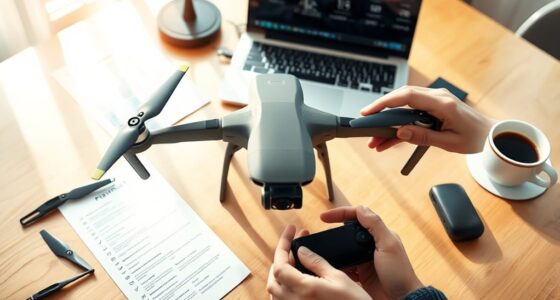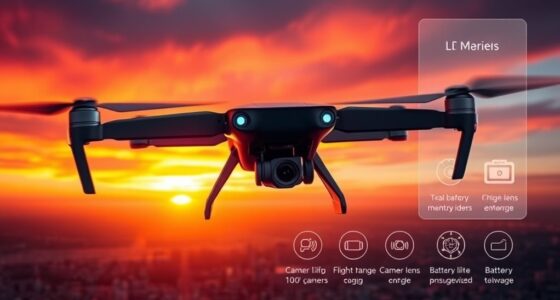
For beginners, GPS drones are generally the better choice because they offer improved stability, automatic features like return-to-home, and easier control, making flying less frustrating. Non-GPS drones are more affordable and simple but require more manual skill and have fewer safety features, increasing the risk of crashes. To make an informed decision and enhance your flying experience, explore the key differences and helpful tips that follow.

Get the latest gadgets delivered free — and shop member deals
- Fast, free delivery on millions of items
- Access to Prime Big Deal Days deals on October 6–7
- Prime Video, Amazon Music and more included
Key Takeaways
- GPS drones offer automatic features like return-to-home and precise navigation, easing beginner learning and increasing safety.
- Non-GPS drones are more affordable and simpler, ideal for practicing basic flying skills without relying on advanced tech.
- GPS drones provide greater stability and smoother footage, beneficial for beginners aiming for quality results.
- Non-GPS drones require manual control, helping beginners develop fundamental flying skills with lower complexity.
- For versatile, safer, and more forgiving flying experiences, GPS drones are generally better choices for beginners.
As an affiliate, we earn on qualifying purchases.
Understanding the Core Differences Between GPS and Non-GPS Drones

GPS and non-GPS drones differ primarily in how they navigate and maintain their positions. With GPS-enabled drones, you benefit from precise positioning, which often results in longer flight times since they optimize battery use more efficiently. This means you can enjoy longer flights and more stable footage. When it comes to camera quality, GPS drones often support advanced stabilization features, providing clearer, smoother images. Non-GPS drones rely on sensors like barometers or optical flow, which might lead to shorter battery life and less stable footage. If you’re looking for extended flights and better camera stability, GPS drones give you an edge. Additionally, GPS technology plays a crucial role in navigation accuracy and positioning, making GPS drones more reliable for complex flight paths. Understanding these core differences helps you choose a drone that matches your needs, especially if camera quality and battery life are priorities. The availability of advanced features like waypoint flight and automatic return further enhances the appeal of GPS drones for beginners who seek reliability and ease of use.
As an affiliate, we earn on qualifying purchases.
Key Features and Benefits of GPS-Enabled Drones

GPS-enabled drones offer precise positioning and navigation, making it easier for you to follow planned routes and reach specific locations. They also provide enhanced flight stability, reducing the risk of drifting or crashes. These features help you complete tasks more accurately and confidently. Additionally, GPS functionality can facilitate easy waypoint setting, allowing for more complex and automated flight paths. Moreover, the reliable positioning data provided by GPS can be crucial in challenging environments or low-visibility conditions.
Accurate Positioning and Navigation
Thanks to advanced satellite communication, GPS-enabled drones can pinpoint their exact location with remarkable accuracy, even in complex environments. This precision makes navigation smoother and allows you to fly confidently, especially when using remote control. You’ll find it easier to follow planned routes and avoid obstacles, helping conserve battery life by reducing unnecessary maneuvers. GPS also enables features like automatic return-to-home, ensuring you don’t lose your drone. Additionally, accurate positioning improves overall flight stability, giving you a more enjoyable experience. Here’s a quick comparison:
| Feature | Non-GPS Drones | GPS Drones | Benefit |
|---|---|---|---|
| Positioning Accuracy | Less precise | Highly accurate | Better navigation and safety |
| Remote control | Manual adjustments needed | Assisted navigation | Easier control, fewer errors |
| Battery life | Drains faster due to corrections | Optimized power usage | Longer flight times |
Enhanced Flight Stability
Enhanced flight stability is one of the key advantages of using GPS technology in drones. With GPS, your drone’s flight control system can precisely maintain position, even in windy conditions or minor turbulence. This stability enhancement helps prevent drifting, making your flights smoother and more controlled. GPS-enabled drones automatically correct their position, allowing you to focus on capturing footage or exploring without constantly adjusting the controls. The improved stability also simplifies hovering, auto-landing, and return-to-home features, ensuring safer, more reliable flights. As a beginner, this means fewer crashes and more confidence in your flying skills. Overall, GPS technology substantially boosts your drone’s stability, making it easier to operate and more forgiving during your learning process. Additionally, understanding the importance of field‑of‑view and imaging‑scale can help you better plan your shots and maximize your drone’s capabilities.
As an affiliate, we earn on qualifying purchases.
Advantages and Limitations of Non-GPS Drones for Beginners

Non-GPS drones can be be a great choice for beginners because they often require less complex technology and are simpler to operate in straightforward environments. Without GPS, these drones rely on basic sensors, which means you get to learn manual flight skills like altitude control more directly. Additionally, sensor-based navigation allows for a more hands-on experience but requires careful handling. However, they have limitations, especially in obstacle avoidance. Without GPS, the drone can’t precisely navigate around objects, increasing the risk of crashes in cluttered areas. This makes them suitable for open spaces but less ideal for complex environments. While they may lack some advanced features, they offer a good way to build foundational flying skills. The absence of GPS also means that automatic return features are typically unavailable, requiring pilots to be more vigilant. Keep in mind, their simplicity can be both an advantage and a limitation, depending on where and how you want to fly.
As an affiliate, we earn on qualifying purchases.
Factors to Consider When Choosing Your First Drone

Choosing your first drone involves balancing your goals, budget, and experience level. Think about how long you want to fly — longer battery life means more flight time. If capturing photos or videos matters, prioritize camera quality. To visualize, consider this table:
| Feature | Importance | Your Priority |
|---|---|---|
| Battery Life | Extends flight sessions | Choose ≥20 minutes for beginners |
| Camera Quality | Enhances photo/video clarity | Look for 1080p or higher cameras |
| Ease of Use | Simplifies flying experience | Select beginner-friendly models |
| Price | Fits your budget | Balance features with affordability |
Focus on these factors, and you’ll find a drone that matches your needs without overwhelm.
Practical Tips for Flying and Learning With Different Drone Types

When starting out with different drone types, understanding how to fly and learn effectively can make a big difference in your progress. Focus on controlling the drone smoothly, especially when practicing with non-GPS models, which don’t have position hold. Pay attention to camera quality if capturing photos or videos is your goal; higher-quality cameras often require steadier flight and more careful handling. Keep an eye on battery life to avoid unexpected power loss during flights, especially since different drone types may have varying durations. Practice in open areas to minimize crashes and build confidence. As you gain experience, experiment with different flight modes and camera angles. This approach helps you learn faster, improve your skills, and get the most out of each drone type. Additionally, understanding the Luggage & Bags guidelines for travel can be helpful if you plan to take your drone on trips, ensuring it’s packed safely and within airline regulations. Proper maintenance routines are also essential to keep your drone in optimal condition and extend its lifespan. For beginners, exploring free floating techniques can be useful for mastering basic flight controls before moving on to more advanced maneuvers. Remember that flight simulation apps can be valuable tools for practicing skills indoors without risking damage to your drone.
Making the Best Choice for Your Aerial Learning Journey

Selecting the right drone for your aerial learning journey depends on your goals, experience level, and budget. If you want longer flights, prioritize models with better battery life to avoid frequent recharges. For capturing stunning photos and videos, consider camera quality; higher resolution cameras will give you clearer images and more detailed footage. Beginners should look for drones that balance ease of use with essential features, like stable flight and reliable controls. Non-GPS drones often offer affordability and simplicity, ideal for learning basic skills, while GPS-enabled drones provide advanced stability and navigation, helpful as you progress. Additionally, understanding drone technology can help you make more informed decisions about features and capabilities, ensuring your drone supports your growth without overwhelming you. Knowing about flight stabilization systems can further enhance your ability to operate drones confidently and safely as you develop your skills.
Furthermore, familiarizing yourself with battery management techniques can extend your flying time and improve overall safety during your flights.
Frequently Asked Questions
How Do GPS and Non-Gps Drones Perform in Extreme Weather Conditions?
You’ll find that GPS drones generally perform better in extreme weather conditions because of their weather resilience and signal stability. They can navigate accurately even in strong winds or rain, maintaining steady flight. Non-GPS drones, however, struggle more with unstable signals and reduced control in harsh weather. If you’re flying in challenging conditions, GPS drones give you more reliable performance and peace of mind.
What Are the Safety Concerns Unique to Each Drone Type?
You should be aware that GPS drones face collision risks if signal interference disrupts their navigation, leading to crashes or loss of control. Non-GPS drones rely on manual control, increasing your chances of mishandling or collisions, especially for beginners. Both types are vulnerable to signal interference, which can cause loss of control. Always maintain clear signals and practice in safe environments to minimize these unique safety concerns.
Can GPS Drones Be Hacked or Jammed During Flight?
Did you know that over 60% of drone hacking risks involve GPS signal interference? Yes, GPS drones can be hacked or jammed during flight if someone exploits vulnerabilities in the GPS signal. This can cause loss of control or misdirection. To stay safe, always fly in secure areas, update your firmware, and avoid known jamming zones. Being aware helps you minimize drone hacking risks and keep your drone secure.
Are Non-Gps Drones Suitable for Professional Photography or Videography?
Non-GPS drones aren’t ideal for professional photography or videography because they struggle with camera stability and flight precision. You’ll notice more shaky footage and difficulty maintaining steady shots, especially in challenging environments or windy conditions. If you want high-quality, stable footage, a GPS-enabled drone provides better control, precise positioning, and reliable camera stability, making it the smarter choice for professional work.
How Does Battery Life Differ Between GPS and Non-Gps Drones?
You’ll notice that GPS drones generally have better battery efficiency because their navigation systems optimize power consumption, extending flight time. Non-GPS drones often consume more power due to manual control and less efficient flight paths, resulting in shorter battery life. If you want longer flights and reliable positioning, GPS drones are the better choice. Keep in mind, battery life can also vary based on usage and environmental factors.
Conclusion
Choosing between GPS and non-GPS drones depends on your flying style and learning goals. Did you know that over 60% of beginner pilots start with GPS drones because of their stability and ease? Whether you prioritize navigation or enjoy manual control, understanding each type helps you make an informed choice. Remember, your first drone should inspire confidence and fun—so pick what feels right and start exploring the skies today!
Fall Picks
fall essentials
As an affiliate, we earn on qualifying purchases.