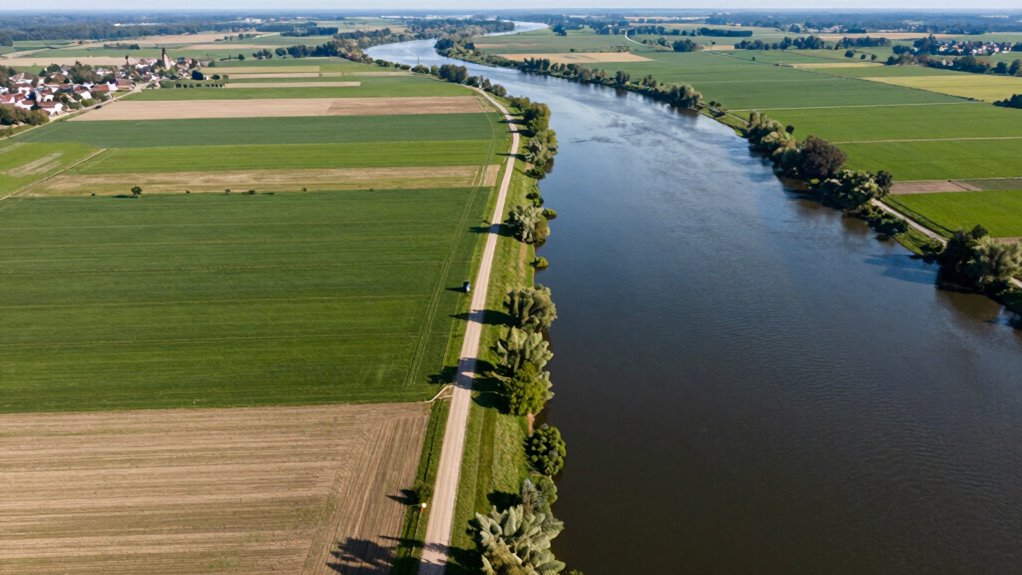

To notice leading lines in aerial scenes faster, train your eye to spot natural pathways like winding rivers, roads, or terrain patterns that draw attention. Focus on the environment’s natural flow and visual cues that guide the viewer’s eye toward the main subject. Practice quickly evaluating scenes and visualize how lines will add depth and movement to your shot. Keep refining your skills, and you’ll soon spot these lines effortlessly, uncovering more tips along the way.

Get the latest gadgets delivered free — and shop member deals
- Fast, free delivery on millions of items
- Access to Prime Big Deal Days deals on October 6–7
- Prime Video, Amazon Music and more included
Key Takeaways
- Scan the entire scene quickly to identify natural pathways like rivers, roads, or trails that guide the viewer’s eye.
- Focus on recognizing curved or diagonal lines that create a sense of movement and direction.
- Mentally visualize how these lines lead toward the main subject before capturing the shot.
- Practice scene assessment regularly to improve speed and instinct in spotting effective leading lines.
- Use environmental features such as fences or terrain patterns as visual anchors to identify strong lines faster.
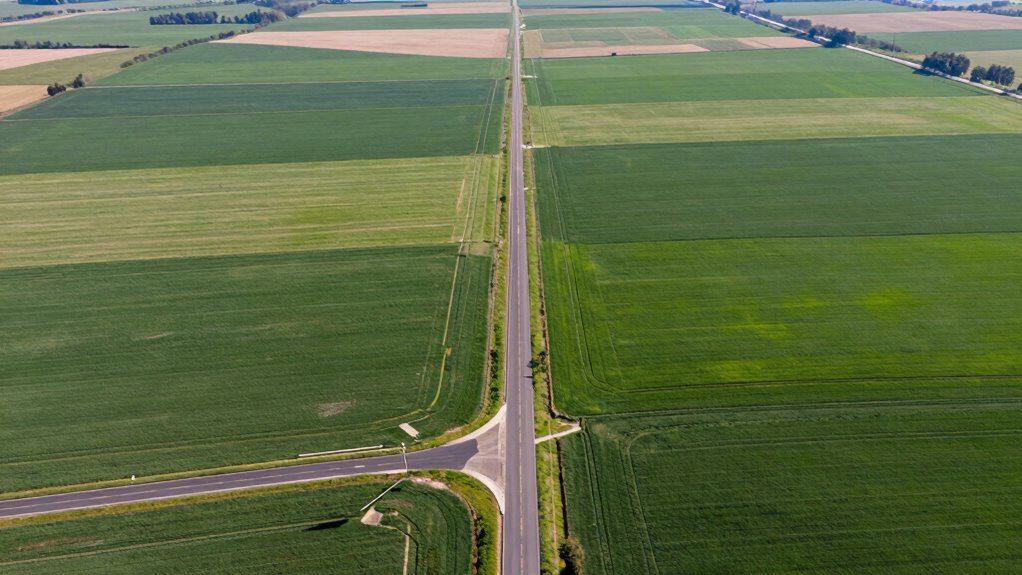
Recognizing leading lines in aerial scenes can dramatically enhance your photography, but it often takes practice to notice them quickly. When you’re flying high, you have a unique bird’s eye perspective that reveals patterns and pathways invisible from the ground. Your goal is to develop an eye for these natural pathways—curved rivers, roads, fences, or even rows of trees—that draw the viewer’s eye through the frame. The more you practice, the faster you’ll spot these lines, which can add depth and guide the viewer’s gaze intentionally.
Start by training yourself to scan the scene systematically. As you look at an aerial shot, don’t just focus on the main subject; instead, take a moment to analyze the entire scene for lines that lead into or through it. Look for natural pathways—these are often the strongest leading lines because they’re formed by the environment’s natural flow. A winding river or a meandering trail naturally draws attention, creating a visual journey that pulls the viewer into your shot. Recognizing these pathways early allows you to frame your shot around them, emphasizing their role in guiding the eye.
Analyze the entire scene for natural pathways that guide the viewer’s eye through your shot.
To speed up the process, familiarize yourself with common shapes and patterns that tend to serve as effective leading lines. Curves and diagonals often work better than horizontal or vertical lines because they add a sense of movement and direction. From your aerial vantage point, keep an eye out for elements that stand out against the landscape—such as a distinct road cutting across fields or a river that snakes through the terrain. These features become your visual anchors, helping you quickly identify the best compositions.
Practice also involves mentally visualizing how these lines will look in the final image. Before you press the shutter, ask yourself: Does this pathway lead the viewer’s eye toward the main subject? Will this natural pathway add depth or create a sense of movement? Over time, you’ll develop an instinct for recognizing these cues faster, making your aerial photography more dynamic and compelling. Developing an understanding of visual patterns can help you quickly identify strong leading lines in various scenes.
Finally, don’t forget to experiment. Sometimes, the most interesting leading lines are subtle or unexpected. Keep practicing your observation skills, and over time, you’ll find it easier to notice natural pathways and bird’s eye perspectives that can transform ordinary scenes into extraordinary compositions. The key is consistent practice and staying attentive to the environment’s natural flow.
aerial photography drone with GPS
As an affiliate, we earn on qualifying purchases.
As an affiliate, we earn on qualifying purchases.
Frequently Asked Questions
What Are the Common Mistakes When Identifying Leading Lines?
You often mistake urban patterns or natural formations for leading lines when they’re not, causing confusion. A common mistake is ignoring subtle lines or edges, focusing only on obvious ones, which leads to missing key compositional cues. Also, you might overlook the perspective distortion from aerial views, making some lines appear less prominent. To avoid these errors, study various scenes carefully, and train your eye to distinguish genuine leading lines from background clutter.
How Do Lighting Conditions Affect Spotting Leading Lines?
Imagine you’re in a 21st-century drone, and lighting variation dramatically influences your ability to spot leading lines. Bright sunlight creates sharp shadow effects that enhance the lines’ visibility, while overcast skies soften shadows, making lines less distinct. To notice leading lines faster, observe how changing light and shadows interact with terrain and structures, as these variations can either highlight or obscure the natural pathways guiding your eye through the scene.
Can Leading Lines Be Found in Night Aerial Scenes?
Yes, you can find leading lines in night aerial scenes. Urban landscapes often feature illuminated roads, bridges, and building outlines that create strong, guiding lines. Natural formations like rivers or coastlines may also produce visible leading lines through reflections or moonlit contours. To notice them faster, look for contrasts and light patterns that draw your eye along certain paths, helping you identify these guiding elements even in low-light conditions.
Are There Software Tools to Assist in Recognizing Leading Lines?
Yes, software tools with advanced algorithms can help you recognize leading lines quickly. These tools use visual recognition technology to analyze aerial images, highlighting prominent lines and guiding your eyes through the scene. By automating detection, they save you time and improve accuracy, especially in complex scenes. You can experiment with image analysis platforms or specialized editing software that integrates AI-powered algorithms to enhance your ability to spot leading lines efficiently.
How Does Altitude Impact the Visibility of Leading Lines?
Altitude variation profoundly impacts the visibility of leading lines by affecting visual clarity. When you’re at a lower altitude, leading lines appear sharper and more defined, making them easier to spot. Conversely, higher altitudes can cause lines to blur or become less distinct, reducing their effectiveness. To notice leading lines faster, adjust your altitude to optimize visual clarity, balancing proximity and overall scene context for the clearest, most impactful composition.
wide angle camera lens for landscape
As an affiliate, we earn on qualifying purchases.
As an affiliate, we earn on qualifying purchases.
Conclusion
By sharpening your eye for leading lines, you’ll navigate aerial scenes like a skilled captain steering through a labyrinth of visual pathways. These lines are the threads weaving the story of the landscape, guiding your gaze effortlessly across the horizon. With practice, spotting them becomes second nature, painting your photos with the elegance of a well-told tale. Embrace the dance of lines and let your perspective soar, transforming every shot into a visual symphony.
As an affiliate, we earn on qualifying purchases.
As an affiliate, we earn on qualifying purchases.
Halloween Picks
halloween
As an affiliate, we earn on qualifying purchases.