Drones are increasingly replacing helicopters for aerial filming because they’re cheaper, quieter, and more agile. You’ll find they’re easy to deploy and can access tight spots or challenging terrain, giving you greater creative control. While helicopters still have their place for large-scale projects, drones are becoming the go-to option for budget-friendly, wildlife-friendly, and high-quality shots. Want to discover how these advancements can boost your productions? Keep exploring to find out more.
Play games included with Prime
Start a Prime free trial and play with Amazon Luna on your devices.
As an affiliate, we earn on qualifying purchases.
Key Takeaways
- Drones are more cost-effective and easier to deploy than helicopters for most aerial filming projects.
- They operate quietly, minimizing noise interference and disturbance, ideal for sensitive environments.
- Drones offer greater maneuverability and quick adjustments, enhancing creative shot options in tight or challenging spaces.
- While suitable for many projects, helicopters still excel in large-scale, long-distance aerial filming.
- Advances in drone technology are narrowing quality gaps, making UAVs a practical alternative for many professional uses.
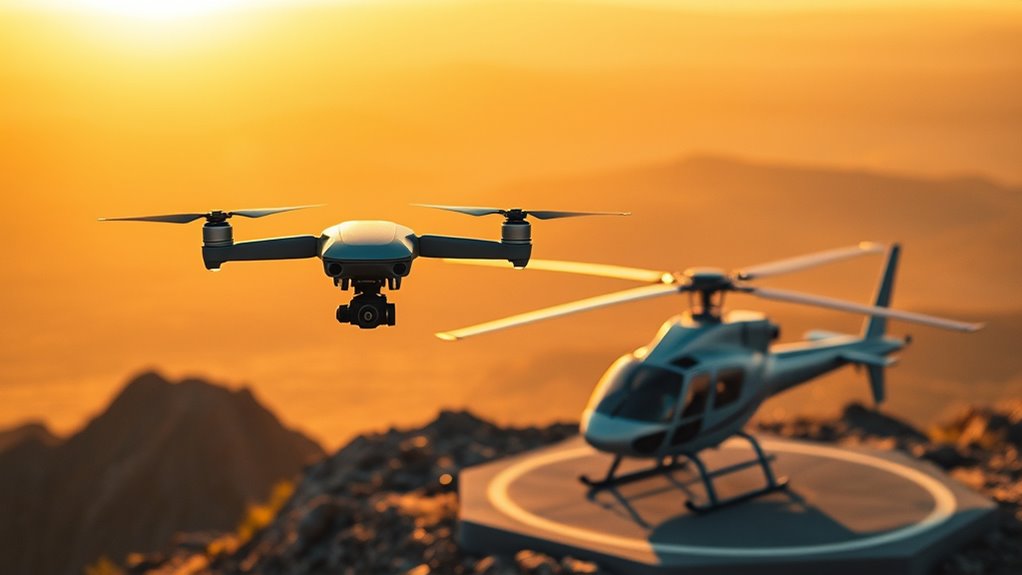
When comparing drones and helicopters, it’s important to understand how each serves different needs and operates in unique ways. Drones have gained popularity for their affordability and flexibility, especially in aerial filming. They typically offer better cost efficiency because they require less financial investment in equipment, fuel, and maintenance. You can rent or buy a drone for a fraction of what a helicopter costs to operate. This makes drones an attractive option for filmmakers, photographers, and videographers who need high-quality footage without breaking the bank. Additionally, drones produce considerably lower noise levels compared to helicopters. While helicopters generate loud, disruptive rotor noise that can interfere with sound recordings and disturb wildlife or people nearby, drones operate quietly, enabling you to capture footage in sensitive environments without causing a disturbance. This low noise profile is particularly advantageous for filming in urban or natural settings where minimizing noise is essential.
As you consider which option to use, think about how these factors impact your project. The lower operational costs of drones mean you can allocate your budget toward multiple shoots or advanced equipment, increasing your production value without escalating expenses. Furthermore, the quiet operation allows for more natural sound capture, which is essential for scenarios like wildlife documentaries or interviews where background noise could compromise audio quality. Drones are also easier to deploy and can quickly adapt to various shooting angles and perspectives, providing a level of agility that helicopters can’t match. You can control a drone remotely, maneuvering it into tight spaces or over difficult terrain with relative ease. This agility translates into more creative shot options and a faster setup process, ultimately saving you time and effort on set. Moreover, the advancement of high-refresh-rate drone cameras enhances the smoothness and clarity of fast-moving footage, making them even more suitable for dynamic filming situations.
While helicopters still have their place—especially for large-scale, long-distance aerial work—their higher costs and noise levels often limit their use for smaller or more delicate projects. For most aerial filming needs, drones present a compelling alternative thanks to their cost efficiency and quiet operation. They allow you to get high-quality footage without the logistical complications and expenses associated with helicopters. As technology continues to advance, drones are becoming even more capable, further narrowing the gap in quality and expanding their role in professional aerial cinematography. So, when weighing your options, remember that for many applications, drones can deliver impressive results with less investment and less noise, making them a practical choice in today’s evolving aerial filming landscape.
professional drone for aerial filming
As an affiliate, we earn on qualifying purchases.
As an affiliate, we earn on qualifying purchases.
Frequently Asked Questions
How Do Drone Costs Compare to Helicopter Rental Fees?
Drone costs are considerably lower than helicopter rental fees, making them a budget-friendly choice for aerial filming. While helicopter rental costs can range from thousands to tens of thousands per hour, drones offer affordable options with prices starting at a few hundred dollars. Keep in mind, drone battery life impacts how long you can film, so plan accordingly. Drones are cost-effective, easy to operate, and perfect for many filming needs.
What Are Drone Flight Time Limitations?
Your drone’s flight time is primarily limited by its battery life, typically ranging from 20 to 30 minutes. Endurance limits vary depending on the drone model, payload weight, and environmental conditions. To maximize flight time, you might need to carry extra batteries or plan for quick swaps. Keep in mind that pushing beyond the battery’s capacity can lead to reduced performance or unsuccessful landings, so always plan your shoots accordingly.
Can Drones Operate in All Weather Conditions?
Think of weather challenges as nature’s tests; unfortunately, drones can’t pass all of them. You’ll find that weather conditions like rain, snow, and strong winds markedly impact drone durability and operation. While some models are built for light rain or wind, most drones are limited in extreme weather. So, you should always check your drone’s specifications and exercise caution, because operating in harsh weather can compromise safety and equipment longevity.
Are Drones Suitable for Professional Cinematic Productions?
Drones are suitable for professional cinematic productions, but you need to consider drone noise, which can affect audio quality and scene authenticity. Ensuring your drone pilot has proper certification is vital for safety and legal compliance. Advanced models offer high-quality footage and stability, making them a valuable tool in filmmaking. However, for complex shots or large-scale projects, helicopters might still be preferable due to their range and capacity.
What Safety Regulations Govern Drone and Helicopter Use?
You must follow safety regulations governing drone and helicopter use, including airspace restrictions that limit where you can fly. You’ll also need pilot licensing to operate larger aircraft legally and safely. Always check local rules before your flight, obtain necessary permits, and stay within designated airspace. These regulations help prevent accidents, protect privacy, and guarantee everyone’s safety during aerial operations.
As an affiliate, we earn on qualifying purchases.
Conclusion
As you weigh drones against helicopters, remember, sometimes a smaller tool can do a bigger job—like the saying goes, “The best things come in small packages.” Drones offer affordability, flexibility, and ease of use, making them a strong choice for aerial filming. While helicopters still have their place for large-scale or complex shots, for most tasks, drones prove that size isn’t everything. Embrace the revolution; sometimes, less really is more.
quiet drone for wildlife filming
As an affiliate, we earn on qualifying purchases.
As an affiliate, we earn on qualifying purchases.
compact drone for cinematography
As an affiliate, we earn on qualifying purchases.
As an affiliate, we earn on qualifying purchases.
NFL season / tailgating Picks
team gear
As an affiliate, we earn on qualifying purchases.