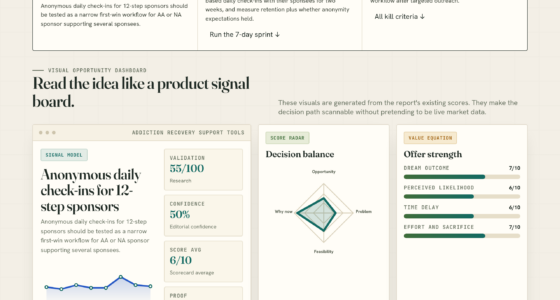
📊 Full opportunity report: One Model, a Whole Portfolio: What Ten Days on Fable Mean for a Business Building on Frontier AI on ThorstenMeyerAI.com — validation score, market gap, and execution plan.
Listen free for 30 days with Audible
Thousands of audiobooks and originals — cancel anytime.
Start your free trialAs an affiliate, we earn on qualifying purchases.
TL;DR
Over ten days, one AI model managed an entire business portfolio, including content, software, and analytics systems. The experiment showed new operational possibilities but also revealed security vulnerabilities and control issues.
Thorsten Meyer conducted a ten-day experiment where a single AI model, Claude Fable 5, managed nearly his entire product portfolio, including content systems, consumer apps, and analytics platforms. The test demonstrated increased productivity and operational efficiency, but ended due to a government shutdown over security concerns. This development has potential implications for how businesses might utilize advanced AI in operational workflows.
During the ten-day run, Meyer used the model to handle diverse systems—ranging from a self-hosted knowledge workspace to consumer applications—without switching models or tools. The model was responsible for architecture, design, and planning, with a secondary, less costly model executing the work under review. The process resulted in approximately thirty systems, with several reaching initial shipping stages, totaling about 850 commits and over half a million lines of code. The approach shifted focus from code generation speed to architecture, verification, and safe delegation, emphasizing design and review as key strengths of the AI-driven workflow.
However, the experiment was terminated by a government order, citing security concerns that remain contested. The shutdown affected all of Meyer’s clients and systems, despite the majority of work being completed and operational. This incident highlights ongoing discussions about dependency on AI models with centralized control mechanisms and the associated security considerations in AI-enabled business operations.
One Model, a Whole Portfolio
● 30+ systemsFor ten days one frontier model coordinated almost an entire product portfolio — it architected and reviewed; a cheaper model executed. The result was the most productive stretch I’ve had. The catch: the model was switched off on its third day by government order.
Aggregated across the portfolio, rounded conservatively. The line count is not the point — that one model coordinated this much, in parallel, is.
The heaviest output landed inside the model’s brief public life. After the suspension, the work continued on the tier beneath — because nothing was hard-wired to the capability that vanished.
The bottleneck has moved. Generation is commoditized; what gates a project is architecture, decomposition, and verification — and that is where the premium model earned its price.
Vendor claims are marketing. This is from a skeptic: a deliberately hard, defense-relevant evaluation I maintain. After a fairness fix to the grader, the model’s score roughly tripled and it took the top spot.
The evaluation is intentionally brutal and every model on it is overconfident, so a modest absolute score is the expected outcome. The result that matters: on a hard, independent harness I built to be unkind, this model ranked first.
Described by function, not by name. Several of these went from an empty start to a shipped product inside the window.
- Fleet control + plain-English intelligence across several hundred sites.
- A seasonal revenue campaign of ~880 placements — zero failures, all compliant.
- Market- and news-intelligence systems made self-updating, not point-in-time.
- A self-hosted team knowledge-and-database workspace — empty start to v1.
- A local-first document & proposal generator grounded in a company’s own data.
- A media editor that edits video by editing the transcript, on-device.
- A customer-acquisition platform — first click to paid deal, AI-optimized.
- A defense-grade analytics platform given a cross-industry backbone.
- Sensor and signal processing added under the intelligence layer.
- Multi-asset forecasting research expanded — strictly paper-only.
- The independent benchmark above — built, hardened, and run.
- Original games taken to playable, all-original assets.
- One real-time simulation shipped to web, a spatial headset, and a console from one core.
- A privacy-first mobile app with a scalable content architecture.
Asked the same question across the portfolio — what is the highest-value next thing — the model rarely answered with another feature. It answered with structure: a way to connect the data, a shared backbone, a layer that turns a single-purpose tool into a platform. For a business, that is the bias that matters: durable advantage and pricing power come from connected systems and the moats they create, not from isolated tools.
- The bottleneck moved — buy the premium model as architect & reviewer, not as a faster typist.
- One model coordinates a portfolio — changing what a small team or solo operator can ship.
- It reorganizes problems — toward connected platforms that compound.
- Capability is real — first place on a hard evaluation I built myself.
- It’s expensive — two premium seats, a weekly limit gone in a day. Token appetite is a line item.
- It leans on a second model — a strength when both are available, a fragility when either isn’t.
- Access can be revoked in hours — by forces you don’t control, on rationale you can’t see.
- It’s a procurement risk — controls can turn on nationality, residency, and jurisdiction.
Independent commentary, produced with AI assistance under human editorial oversight; the views are the author’s own and may change. This is analysis, not investment, financial, legal, or technical advice, and it touches an actively developing situation. Development figures are drawn from automated reports generated from the underlying projects in June 2026, are approximate where aggregated, and reflect each project’s state at generation time; specific products, internal details, and implementation specifics are withheld by choice. Two of the underlying reports describe sprints that predate the model and are not attributed to it. Benchmark results are from the author’s own internal evaluation harness and are not an independent or peer-reviewed comparison. References to models, companies, and government actions are factual and analytical, not partisan, and imply no affiliation or endorsement.
Implications of Single-Model Business Management
This experiment demonstrates a potential operational model where a single AI system manages multiple aspects of a business, potentially reducing development time and streamlining integration. It indicates a shift in focus from code generation to high-level design, architecture, and verification tasks. Nonetheless, reliance on a single AI system susceptible to external shutdowns raises concerns about control, security, and resilience, prompting further discussion on governance and safety protocols for AI in critical business functions.
Domain-Specific Small Language Models: Efficient AI for local deployment
As an affiliate, we earn on qualifying purchases.
As an affiliate, we earn on qualifying purchases.
Background on AI in Business Operations
Over the past two years, AI’s application in software development has primarily aimed at accelerating code generation, with models capable of producing functional code efficiently. However, designing system architectures, dividing work into safe modules, and verifying correctness remain complex tasks requiring high-level oversight. Meyer’s experiment with Claude Fable 5 explores the potential for AI to oversee comprehensive management of business systems, handling both high-level design and execution through delegation to secondary models. This approach aligns with broader industry trends toward automation and AI-driven orchestration, while also raising new questions regarding security and control.
“The constraint in building software has moved. Architecture, decomposition, and verification are now the bottlenecks, and AI can handle these at a scale and speed previously impossible.”
— Thorsten Meyer
ENTERPRISE COHERENCE in the Age of AI
As an affiliate, we earn on qualifying purchases.
As an affiliate, we earn on qualifying purchases.
Unresolved Security and Control Concerns
The extent and enforceability of the security vulnerabilities identified during the shutdown are still under evaluation, and it remains uncertain whether similar risks could impact other AI-driven business operations. The government’s order was based on security concerns that have not been fully disclosed, and discussions about the long-term safety and control of AI-managed business portfolios continue within the industry and regulatory bodies.

GNCC Security Camera Indoor with 2K Night WiFi Cameras for Home Security
- Resolution: 2K Ultra HD for clear video
- Night Vision: 10-meter infrared night vision
- WiFi Compatibility: Dual-band 2.4G/5GHz WiFi
As an affiliate, we earn on qualifying purchases.
As an affiliate, we earn on qualifying purchases.
Future of AI-Managed Business Portfolios
Experts anticipate increased regulatory scrutiny of AI’s role in critical business functions, along with efforts to develop improved safety and control measures. Organizations may explore hybrid models combining AI oversight with human governance, and policymakers are likely to establish clearer guidelines for AI security and dependency. Meyer’s experiment provides insights into the potential and challenges of centralized AI management, emphasizing the need for careful consideration of risks and safeguards.
Beyond Code: Build Reliable AI-Assisted Software with Context Engineering, Mechanical Gates, and AI Agent Control
As an affiliate, we earn on qualifying purchases.
As an affiliate, we earn on qualifying purchases.
Key Questions
What is Claude Fable 5?
Claude Fable 5 is Anthropic’s advanced AI model designed for high-level tasks such as architecture, planning, and review, capable of managing multiple systems simultaneously.
Why was the AI model shut down?
The government ordered the shutdown citing security concerns related to potential vulnerabilities in the AI-managed systems, though details remain undisclosed.
What are the risks of using a single AI model for an entire business?
Potential risks include reliance on a single point of failure, security vulnerabilities, loss of control, and the possibility of regulatory or governmental shutdowns affecting operations.
Could this approach be adopted widely?
While technically feasible, widespread adoption would require addressing security, control, and regulatory challenges, which are still under evaluation.
What happens next for AI-driven business management?
Increased regulation, development of safety protocols, and exploration of hybrid oversight models are expected as the industry assesses this approach’s viability and associated risks.
Source: ThorstenMeyerAI.com
Baby shower & registry season Picks
baby registry must-haves
As an affiliate, we earn on qualifying purchases.