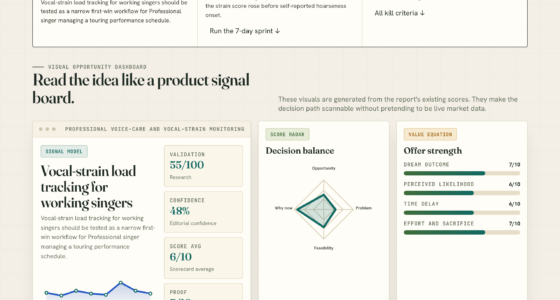

📊 Full opportunity report: Can Artificial Intelligence Improve Weather Forecast Accuracy In China? on ThorstenMeyerAI.com — validation score, market gap, and execution plan.

Get the latest gadgets delivered free with Prime
- Fast, free delivery on millions of items
- Prime Video, Amazon Music and more included
- Member-only deals all year
TL;DR
Huawei Pangu has announced AI initiatives related to weather forecasting in China. However, there is no confirmed evidence of operational systems or accuracy improvements. The development is still at an early, unverified stage.
Huawei Pangu has publicly highlighted efforts to incorporate artificial intelligence into China’s weather-forecasting sector, but there is no verified information on whether these AI systems are operational or improving forecast accuracy.
The reports from August 2026 indicate that Huawei Pangu is involved in AI-related work aimed at transforming weather prediction in China. However, the available information does not specify any deployed system, technical specifications, or performance metrics. For more details, see the original analysis on weather forecasting in China.
There are no details on whether the AI models are being used by official weather agencies or in real-time forecasting operations. The reports describe the work as “transforming,” but this characterization is unverified and based solely on promotional claims. For a detailed overview, see the original analysis.
Potential Impact of AI on China’s Weather Forecasting
If validated and operational, AI-driven weather forecasting could significantly enhance predictive accuracy, lead times, and regional specificity in China, which faces diverse weather challenges across its vast territory. Improved forecasts could aid in disaster preparedness, agriculture, transportation, and energy management.
However, without concrete evidence of system performance, the actual impact remains uncertain. Reliable AI integration could transform public safety and infrastructure planning, but premature claims risk misleading stakeholders about current capabilities.
As an affiliate, we earn on qualifying purchases.
China’s Growing Interest in AI for Weather Prediction
China has been investing heavily in artificial intelligence research, including applications in weather forecasting. Huawei Pangu’s involvement signals a push toward leveraging AI to complement traditional physical models and observational data.
Previous efforts in weather prediction relied heavily on physical models and human expertise, with AI seen as a promising supplement. As of 2026, no publicly confirmed operational AI-based forecasting system has been disclosed by Chinese meteorological agencies, and testing remains in experimental or developmental stages.
“The claim that AI is transforming weather forecasting in China is premature without independent validation or operational deployment data.”
— an anonymous researcher
advanced weather prediction devices
As an affiliate, we earn on qualifying purchases.
As an affiliate, we earn on qualifying purchases.
Unverified Claims and Lack of Deployment Evidence
It remains unclear whether the AI systems promoted by Huawei Pangu are being used operationally by Chinese weather agencies or are still in research phases. No deployment sites, start dates, or performance metrics have been disclosed, and no peer-reviewed validation exists yet.
Further, it is unknown if these AI models have demonstrated measurable improvements over existing forecasting methods or if they are integrated into official warning systems.
As an affiliate, we earn on qualifying purchases.
Next Steps: Validation and Independent Testing Needed
Key developments will include the release of technical documentation, independent validation studies, and confirmation of deployment by official agencies. Future research papers or benchmarks comparing AI forecasts with current standards are expected to clarify the system’s effectiveness.
Monitoring announcements from Chinese meteorological authorities and Huawei Pangu’s official disclosures will be crucial to assess whether AI-based forecasting is transitioning from experimental to operational use.
professional weather forecasting equipment
As an affiliate, we earn on qualifying purchases.
As an affiliate, we earn on qualifying purchases.
Key Questions
Is Huawei Pangu’s AI system already used in weather forecasting?
There is no confirmed evidence that Huawei Pangu’s AI systems are currently operational or used by official weather agencies in China. The reports are promotional and lack verification.
Has AI improved weather forecast accuracy in China?
No, there are no published benchmarks, performance data, or independent evaluations to confirm that AI has improved forecast accuracy or lead times.
When will AI-based weather forecasting become operational in China?
It is not yet clear when or if AI systems will be deployed operationally. Future announcements from Chinese authorities or Huawei are needed to confirm deployment dates.
Are there peer-reviewed studies supporting these AI claims?
No peer-reviewed studies or independent evaluations have been published to substantiate the reported claims of AI transforming weather forecasting.
What are the potential benefits if AI proves effective in weather prediction?
Effective AI integration could enhance forecast precision, improve disaster preparedness, and optimize resource management across sectors like agriculture, transportation, and energy.
Source: ThorstenMeyerAI.com
Columbus Day / Indigenous Peoples' Day Picks
long weekend sales
As an affiliate, we earn on qualifying purchases.