📊 Full opportunity report: GLP-1 Pricing By Pharmacy: See Cash-Pay Costs And Stock on IdeaNavigator AI — validation score, market gap, and execution plan.

Get the latest gadgets delivered free — and shop member deals
- Fast, free delivery on millions of items
- Access to Prime Big Deal Days deals on October 6–7
- Prime Video, Amazon Music and more included
TL;DR
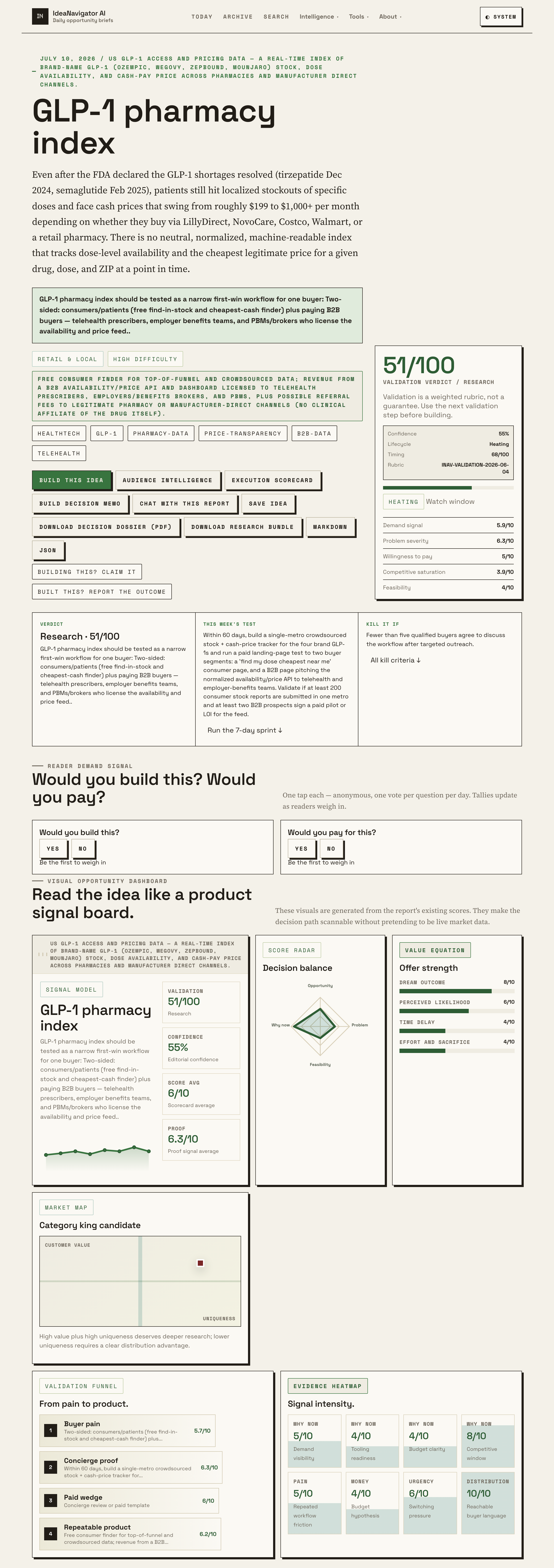
A market analysis from IdeaNavigator AI proposes building a free consumer tool that finds the cheapest legitimate cash price and in-stock doses of brand GLP-1 drugs by ZIP code, monetized through a B2B price-and-availability feed. The proposal responds to fragmented pricing — roughly $199 to over $1,000 per month — and localized stockouts persisting after the FDA declared shortages resolved.
A newly published proposal from IdeaNavigator AI calls for building a GLP-1 pharmacy index — a free consumer tool that shows where specific doses of Ozempic, Wegovy, Zepbound and Mounjaro are in stock and at the lowest legitimate cash price, paired with a paid B2B data feed for telehealth prescribers, employer benefits teams and PBMs. The proposal responds to a market that has shifted from a shortage problem to a fragmentation problem, with monthly cash prices ranging from roughly $199 to more than $1,000 depending on the channel.
According to the analysis, even after the FDA declared GLP-1 shortages resolved — tirzepatide in December 2024 and semaglutide in February 2025 — patients still encounter localized stockouts of specific doses. At the same time, cash prices vary widely depending on whether a purchase is made through LillyDirect, NovoCare, Costco, Walmart or a traditional retail pharmacy. The proposal identifies a gap: no neutral, normalized, machine-readable index currently tracks dose-level availability and the cheapest legitimate price for a given drug, dose and ZIP code at a point in time.
The proposed minimum viable product would launch a free consumer web tool covering the four brand GLP-1s, searchable by drug, dose and ZIP code. It would be seeded with crowdsourced stock reports plus normalized public price data drawn from manufacturer direct sites, Costco and Walmart cash programs, and a GoodRx-style price layer. Dose-level availability alerts would sit on top of the finder.
Revenue would come from the B2B side: a licensed availability and price API and dashboard sold to telehealth prescribers, employers and benefits brokers, and PBMs, with possible referral fees to legitimate pharmacy or manufacturer-direct channels. The consumer finder would remain free to generate top-of-funnel traffic and crowdsourced data.
Why Employers and Telehealth Need This Data
The proposal argues the timing is driven by a structural shift in the market. Brand GLP-1s came off the FDA shortage list in 2024 and 2025, compounding deadlines pushed compounders out of the market, and manufacturers simultaneously launched competing direct cash-pay channels — including LillyDirect, NovoCare, the Costco and Walmart programs, and the TrumpRx portal launched in February 2026. The result is a sprawl of prices and dose-level supply gaps that no single source normalizes.
The analysis cites reports that GLP-1s now account for roughly 20% of employer pharmacy spend, creating demand among benefits teams for cost-steering data. For patients, the index would address a practical problem: finding a specific dose that is actually in stock nearby at a price that can differ by hundreds of dollars per month between channels. For prescribers, particularly telehealth operations, a normalized feed could reduce failed prescriptions caused by pharmacy stockouts.
From Shortage Crisis to Channel Sprawl
The GLP-1 supply landscape has changed quickly. During the shortage period, the FDA’s shortage-list status permitted compounded versions of semaglutide and tirzepatide, which sold at far lower cash prices. When the FDA determined the shortages were resolved — tirzepatide in December 2024 and semaglutide in February 2025 — compounders faced enforcement deadlines to exit the market. Eli Lilly and Novo Nordisk responded by expanding their own direct-to-consumer cash-pay channels, LillyDirect and NovoCare, while mass retailers introduced competing cash programs. The February 2026 launch of the TrumpRx portal added a government-linked pricing channel. Each channel publishes its own prices and manages its own inventory, which is what created the fragmentation the proposed index targets.
What Is Claimed Versus Confirmed
This is a product proposal, not a launched service. No consumer tool, B2B API or design-partner agreements have been announced as existing. The 20%-of-pharmacy-spend figure is presented in the analysis as something employers report, but no specific survey, employer or dataset is cited, and it should be treated as a claimed figure rather than a verified statistic. The $199-to-$1,000+ price range is described as approximate and dependent on channel, drug and dose; it is not a normalized dataset.
It is also unclear how accurate crowdsourced stock reports would be at dose level, whether manufacturer direct channels would permit their prices to be republished in a normalized feed, and whether referral-fee arrangements with pharmacies or manufacturer channels would be permitted under existing agreements. The proposal does not address regulatory or data-licensing constraints in detail.
The 60-Day Validation Test
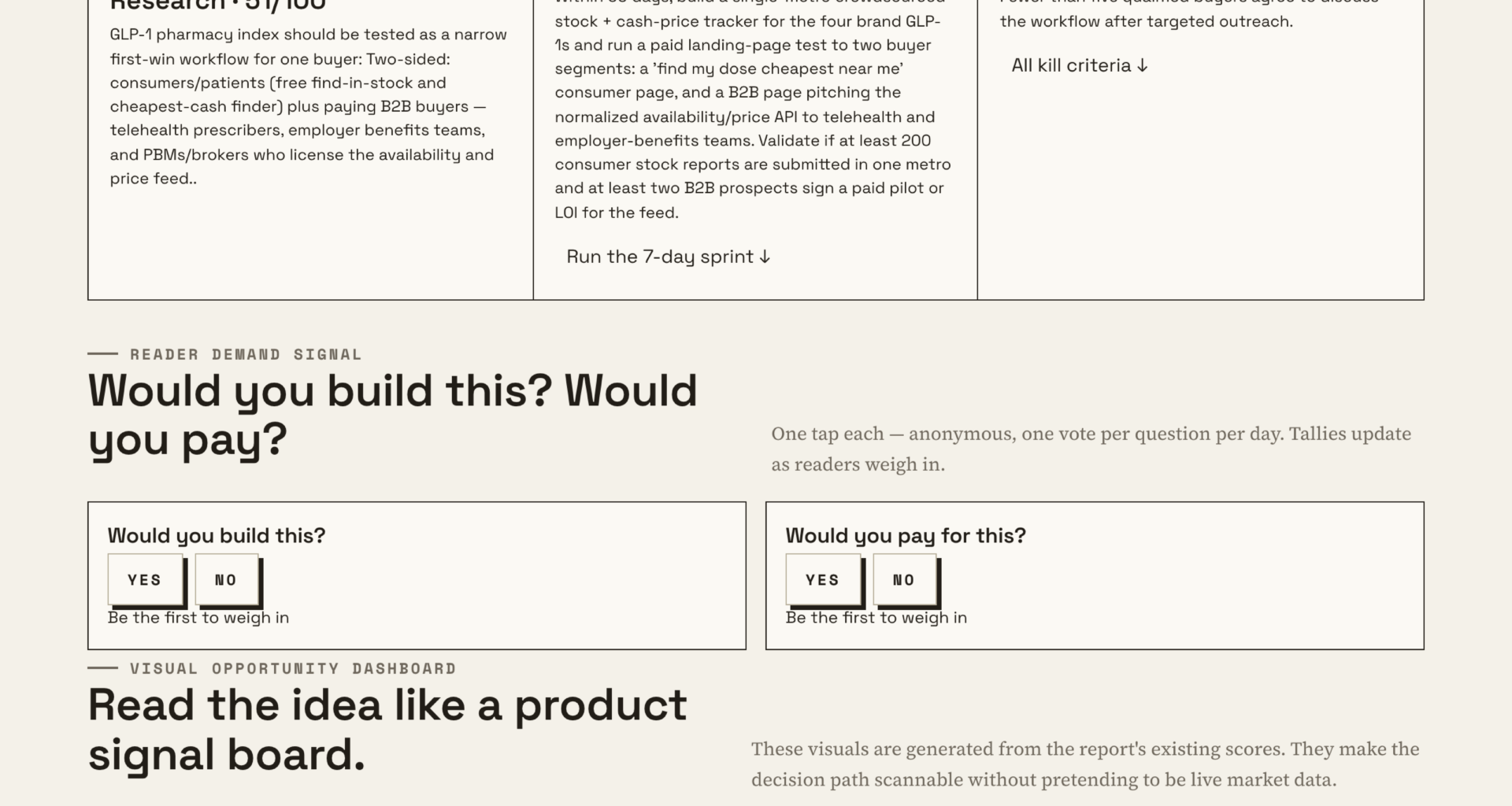
The proposal sets out a specific validation plan: within 60 days, build a single-metro crowdsourced stock and cash-price tracker for the four brand GLP-1s and run a paid landing-page test aimed at two segments — a consumer page pitched as “find my dose cheapest near me,” and a B2B page pitching the availability and price API to telehealth and employer-benefits teams.
The stated success thresholds are concrete: at least 200 consumer stock reports submitted in one metro, and at least two B2B prospects signing a paid pilot or letter of intent for the feed. If those thresholds are met, the next step would be expanding the consumer finder beyond the pilot metro and formalizing B2B data licenses. Whether any of this proceeds, and who would build it, remains open.
Key Questions
What would the GLP-1 pharmacy index actually do?
It would let consumers search by drug, dose and ZIP code to see which pharmacies or manufacturer channels have a dose in stock and what the cheapest legitimate cash price is. Businesses could license the same underlying availability and price data as an API.
Does this tool exist today?
No. This is a published proposal from IdeaNavigator AI with a 60-day validation plan. No consumer tool or B2B feed has been launched, and no design partners have been announced.
Why do GLP-1 prices vary so much between pharmacies?
According to the analysis, prices differ across channels — LillyDirect, NovoCare, Costco, Walmart, retail pharmacies and the TrumpRx portal — each publishing its own cash prices. Monthly cash prices are described as ranging from roughly $199 to over $1,000 depending on the channel, drug and dose.
Are GLP-1 shortages still happening?
The FDA declared the shortages of tirzepatide resolved in December 2024 and semaglutide in February 2025. However, the proposal states that patients still encounter localized stockouts of specific doses, which is a different problem from a national shortage.
How would the index make money if the consumer tool is free?
Revenue would come from licensing a normalized availability-and-price API and dashboard to telehealth prescribers, employer benefits teams, brokers and PBMs, plus possible referral fees to legitimate pharmacy or manufacturer-direct channels.
Source: IdeaNavigator AI
Fall Picks
fall essentials
As an affiliate, we earn on qualifying purchases.