
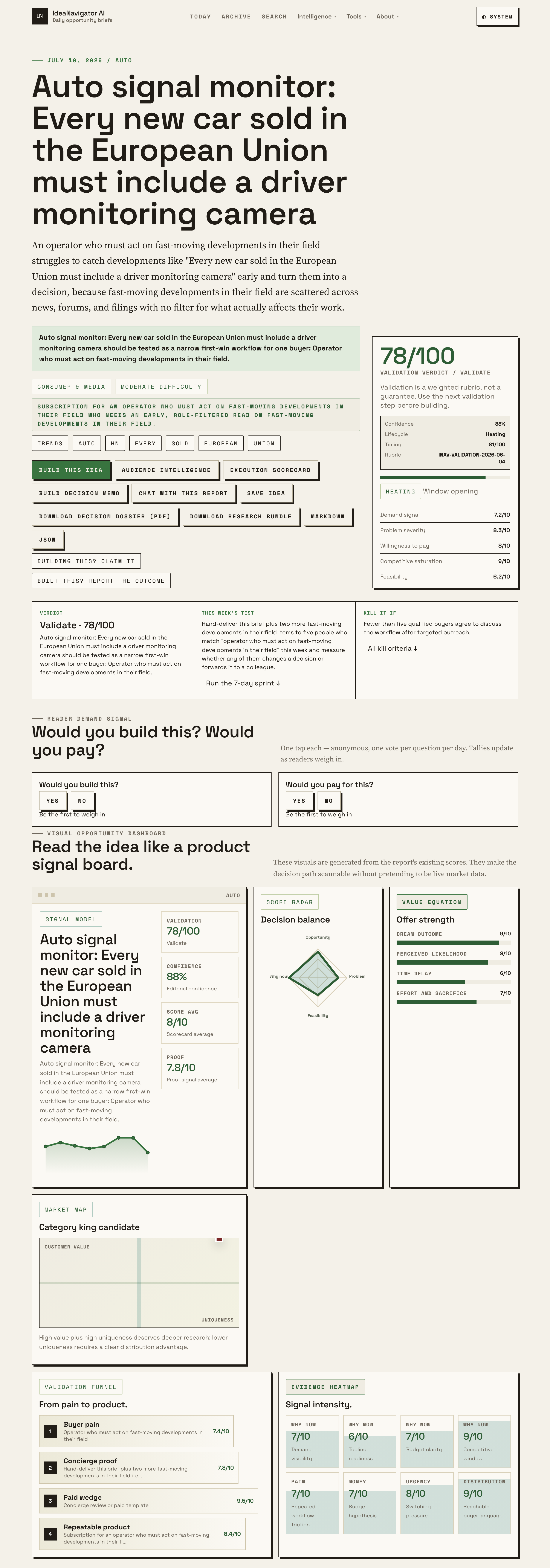
📊 Full opportunity report: Driver Monitoring Cameras For Every New Car: The EU's Latest Auto Rule on IdeaNavigator AI — validation score, market gap, and execution plan.

Get the latest gadgets delivered free — and shop member deals
- Fast, free delivery on millions of items
- Access to Prime Big Deal Days deals on October 6–7
- Prime Video, Amazon Music and more included
TL;DR
Under the EU’s General Safety Regulation, all new cars sold in the European Union must be fitted with driver drowsiness and attention warning systems, which manufacturers overwhelmingly implement using in-cabin cameras. The requirement applies to all new vehicle registrations from July 2024, following the July 2022 deadline for new type approvals.
Every new car sold in the European Union must now carry a driver drowsiness and attention warning system, a requirement under the EU’s General Safety Regulation that has applied to all new vehicle registrations since July 2024. Carmakers have overwhelmingly chosen in-cabin cameras that watch the driver’s face and eyes as the way to meet the rule, making the technology a standard feature on European forecourts. The development, which surfaced on Hacker News as a high-signal item tracked by IdeaNavigator AI, marks one of the most visible changes to new-car interiors in years.
The legal basis is Regulation (EU) 2019/2144, adopted in 2019, which mandated a package of safety technologies across new vehicles. The driver monitoring requirement was implemented in two steps: from 7 July 2022 for all new types of vehicles (new models gaining approval), and from 7 July 2024 for all new vehicles registered in the EU, regardless of when the model was first approved. That second deadline has now passed, meaning no new car can legally be registered in the bloc without a compliant system.
The regulation sets a performance requirement rather than prescribing a specific technology: the system must detect driver drowsiness and declining attention — for example through steering-pattern degradation, eyelid closure, or gaze direction — and issue a warning. In practice, most major manufacturers, including those supplying camera systems such as Bosch, Continental and Smart Eye’s automotive partners, have settled on driver-facing cameras as the most reliable route to compliance, because camera systems can detect eye closure and head pose directly rather than inferring fatigue from steering behaviour alone.
The camera-based systems typically work by tracking eyelid closure duration, blink rate, head position and gaze direction. When the system calculates that the driver is drowsy or distracted, it triggers escalating alerts — first visual and audible warnings in the instrument cluster, and in some implementations seat vibrations or brief braking pulses. According to safety researchers, drowsiness and distraction are contributing factors in a substantial share of serious road crashes, which is the core rationale EU regulators cited for mandating detection.
What Mandatory Monitoring Means for Drivers
For buyers of new cars in the EU, the most immediate effect is that a camera pointed at the driver’s face is now a standard feature rather than an optional extra bundled with premium driver-assistance packages. Drivers will notice the system in operation through warnings when they appear tired or when their gaze drifts from the road for too long — for instance while reading a phone screen, which the systems are designed to detect.
The rule also matters commercially. Suppliers of in-cabin sensing technology have gained a guaranteed market across the EU, and the requirement is accelerating a broader shift toward camera-based occupant monitoring that the industry is also deploying to enable hands-free driving features. Safety regulators in other regions, including US crash investigators who have recommended similar mandates, are watching the European rollout closely. At the same time, the always-on camera raises data privacy questions that consumer groups have flagged, since the systems process continuous video of the driver’s face.
How the EU Requirement Came Into Force
The General Safety Regulation was adopted in December 2019 as part of the EU’s response to persistent road fatalities. It mandated a broad package of measures alongside driver monitoring, including intelligent speed assistance, lane-keeping assistance, emergency lane-keeping, event data recorders and reversed direct visibility requirements for trucks and vans. The driver drowsiness warning provisions were then specified in detail through implementing regulations, with the two-stage phase-in dates of July 2022 for new type approvals and July 2024 for all new registrations.
Driver monitoring itself is not new: some premium brands, among them Mercedes-Benz and BMW, had offered attention-assist or camera-based systems for years before the mandate. The regulation’s effect was to make the technology universal across price segments, including the smallest and cheapest models sold in Europe. Similar requirements are being introduced in other markets — China has moved toward mandating drowsiness detection, and Euro NCAP, the independent crash-test body, has said camera-based monitoring will factor into its star ratings, adding pressure beyond the legal minimum.
Privacy Limits and Enforcement Questions
The regulation mandates the capability, not a specific sensor, so it is not strictly accurate to say EU law names a “camera” — the camera is the industry’s dominant compliance path, and some entry-level models may still use steering-based detection. How strictly national authorities enforce the requirement on systems that perform poorly in real-world conditions remains unclear, as does how the rule will interact with the EU’s upcoming AI Act and updated type-approval framework.
Data handling is the largest open question. The regulation states that data recorded by these systems should not be available to anyone other than the vehicle owner or user, but the practical boundaries — whether footage can be accessed after a crash, shared with insurers, or processed by manufacturers for system improvement — are still being worked out through GDPR enforcement and manufacturer privacy policies. The systems’ real-world effectiveness in preventing fatigue-related crashes has also not yet been established with comprehensive independent data.
Euro NCAP Ratings and Stricter Rules Ahead
Euro NCAP has signalled that camera-based driver monitoring will carry increasing weight in its safety ratings in coming protocols, which typically pushes manufacturers to exceed legal minimums. The European Commission is expected to revisit the General Safety Regulation as part of a broader update addressing automated driving, and driver monitoring is likely to feature in rules for hands-off assisted driving systems, where confirming that the driver is ready to retake control is a prerequisite. For consumers, the practical next step is simply encountering the systems in showrooms — and, for privacy-conscious buyers, asking manufacturers how the camera footage is stored and processed.
Key Questions
Does EU law literally require a camera in every new car?
The law requires a driver drowsiness and attention warning system; it does not name a specific technology. However, most manufacturers meet the requirement with a driver-facing camera, so in practice the vast majority of new EU cars ship with one.
Since when does the requirement apply?
Since 7 July 2022 for new vehicle types gaining approval, and since 7 July 2024 for every new car registered in the EU. Cars already on the road are not affected.
What does the system actually do?
It tracks indicators such as eyelid closure, blink rate, head pose and gaze direction. If it detects drowsiness or distraction, it issues escalating warnings — visual and audible alerts, and in some cars seat vibrations or brief braking pulses.
Who can see the camera footage?
The regulation says data from these systems should not be available to anyone other than the vehicle owner or user. Exactly how manufacturers handle storage, crash-related access and processing under GDPR is still being clarified, so policies vary by brand.
Does this apply outside the EU?
The mandate covers vehicles registered in the EU. Other regions are moving in similar directions — China has moved toward drowsiness-detection requirements, and US safety investigators have recommended broader driver monitoring — but there is no equivalent blanket US rule as of now.
Source: IdeaNavigator AI
Fall Picks
fall essentials
As an affiliate, we earn on qualifying purchases.