
📊 Full opportunity report: How To Turn A Workflow Audit Into An Automation Roadmap on IdeaNavigator AI — validation score, market gap, and execution plan.

Get the latest gadgets delivered free with Prime
- Fast, free delivery on millions of items
- Prime Video, Amazon Music and more included
- Member-only deals all year
TL;DR
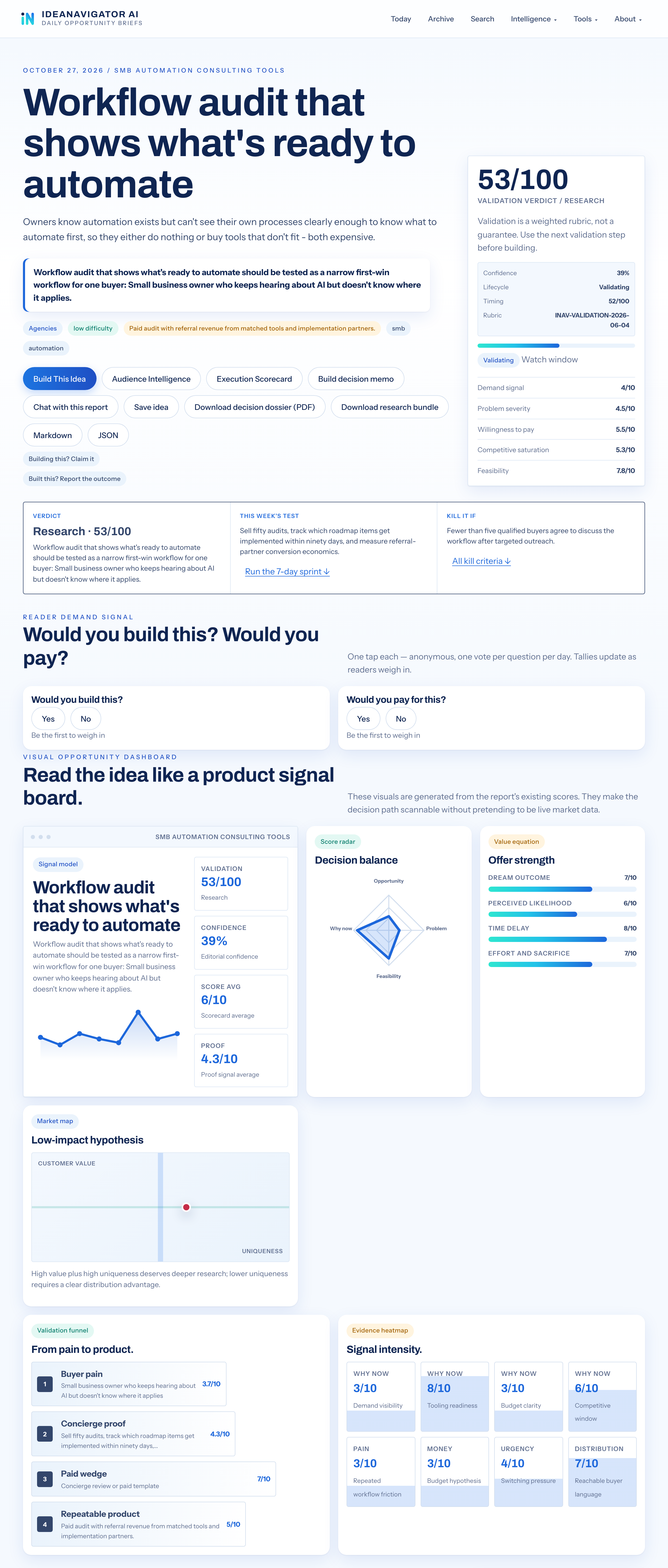
IdeaNavigator AI describes a proposed workflow-audit product for small-business owners who are unsure which processes to automate. The concept would produce a scored process map, a sequenced 90-day roadmap and tool suggestions, but there are no reported results showing whether customers will implement its recommendations or whether the business model works.
IdeaNavigator AI’s description of a proposed workflow-audit service says it would interview small-business owners about their operations, map their processes and recommend which tasks may be ready for automation. The concept targets owners who hear about AI tools but cannot identify where those tools fit; the product and its expected results have not been validated in the information provided.
According to IdeaNavigator AI’s proposal, the minimum viable product would guide an owner through questions about day-to-day work and turn the answers into a process map, similar to approaches used in preparing for AI workflow automation. Each process would be scored for automation readiness, potential return on investment and implementation difficulty, then arranged into a 90-day roadmap, much like the planning involved in selecting AI workflow automation tools. The plan would also suggest AI workflow automation tools for individual steps.
The proposal says the business model would combine revenue from a paid audit with referral income from recommended software providers and implementation partners. That means the recommendations could have commercial ties. The proposal does not specify how those ties would be disclosed, how tools would be selected or how the audit would keep advice independent.
For validation, IdeaNavigator AI proposes selling 50 audits, then tracking which roadmap recommendations customers implement within 90 days and measuring conversions to referral partners. Those figures describe a suggested test, not completed sales or results. The proposal reports no pricing, customer interviews, implementation rates or referral economics.
How to Turn a Workflow Audit Into an Automation Roadmap
IdeaNavigator AI proposes a guided audit that maps business processes, scores automation opportunities and sequences them into a 90-day plan. The concept and its expected results have not yet been validated.
From tool overload to a work plan
The service aims to help owners decide where automation fits before they choose software or attempt several changes at once.
Guided interview
Questions about day-to-day operations would capture tasks, current processes and the owner’s pain points.
Process map
Answers would be turned into a structured view of work, making repetitive steps and dependencies easier to inspect.
Ranked roadmap
Suggested projects and matched tools would be arranged into a sequence spanning the next 90 days.
A connected path from operations to action
A useful roadmap depends on specific business details. Scores remain estimates until the method is explained and checked against real implementations.
Describe work
Owner answers questions about recurring operations and existing systems.
Map processes
Activities are organized into steps, handoffs, exceptions and dependencies.
Score candidates
Readiness, potential return and implementation effort are assessed.
Sequence changes
Projects and tool suggestions become a trackable 90-day plan.
What the 50-audit test needs to show
IdeaNavigator AI proposes selling 50 audits, then observing customer actions and referral conversions. These are planned measures, not results.
Purchase demand
How many owners buy, and at what price? The proposal reports no pricing or customer interview evidence.
Implementation
Track which roadmap items customers implement within 90 days. No target rate or results are provided.
Referral economics
Measure partner conversions and whether referral income can support the service without distorting advice.
Trust, evidence and incentives
The value of the service rests on dependable recommendations and clear rules for how those recommendations are made.
Scores could be misleading without reliable information about work volumes, costs, exceptions and existing systems. The proposal does not explain its scoring formulas, accuracy checks or comparison with human consulting.
Owners may also need to share sensitive business information. The concept does not specify data handling, how it distinguishes routine tasks from work requiring human judgment, or how it accounts for integration costs and staff training.
Referral revenue could lower the cost of an assessment, while also creating an incentive to favor partner products. Tool-selection rules, disclosure practices and non-partner alternatives are not described.
Are recommendations independent?
Disclose referral relationships and explain how tools are selected, ranked and compared.
Are the estimates grounded?
Show the data and assumptions behind readiness, ROI and difficulty scores.
Can customers act on the plan?
Clarify implementation support, ownership, timeline and likely change costs.
Is the service available?
No launch date or confirmation that audits can be purchased is reported.
Separate the proposal from proof
The concept is positioned in small-business automation consulting, but the information provided describes a rationale and test plan rather than demonstrated performance.
Will owners pay?
Pricing, purchase rates and customer interview findings are not reported.
Do scores predict?
No evidence shows the scores match real effort, value or implementation outcomes.
Do incentives hold?
Referral economics and safeguards for independent recommendations remain unspecified.
From Tool Overload to a Work Plan
The proposal addresses a practical gap between knowing that automation tools exist and deciding whether a particular task is a good candidate. A business owner may face repetitive administrative work, but choosing software before mapping the process can lead to a poor fit. A guided audit aims to make that decision more concrete by connecting specific tasks to readiness, effort and expected value.
If it works as intended, a sequenced roadmap could help owners avoid attempting several changes at once and give them a way to compare potential projects. A 90-day horizon also makes implementation trackable. But the proposed scores would be estimates unless backed by reliable information about a business’s volumes, costs, exceptions and existing systems. IdeaNavigator AI’s description does not show how it would calculate or verify those estimates.
The commercial structure also matters to customers. Referral revenue can help pay for a low-cost assessment, but recommendations tied to commissions may favor partner products. Owners would need clear explanations of how suggestions are ranked and whether alternatives are considered. Trust and measurable outcomes, not simply a list of AI tools, will shape whether the service is useful.
Products Worth Considering

Sony WH-1000XM4C Wireless Noise-Cancelling Headphones, Black

LG UltraGear 27-Inch QHD OLED Gaming Monitor, 240Hz, 0.03ms, G-SYNC Compatible, FreeSync Premium Pro, HDMI 2.1

Bose SoundLink Flex Bluetooth Speaker (2nd Gen), Portable Waterproof Speaker, Black
As an affiliate, we earn on qualifying purchases.
The Proposed Audit and Its Test
IdeaNavigator AI positions the proposal in the small-business automation consulting market. Its stated problem is that owners may either postpone automation because they cannot see where it applies or buy tools that do not fit their processes. The concept presents a guided interview as a way to make process-mapping easier to deliver.
IdeaNavigator AI also links the idea’s timing to the expansion of AI tools, which it says has contributed to decision paralysis, and to the possibility of using large language models to structure interviews and process maps. That is the proposal’s rationale, rather than evidence that an automated interview can consistently capture operational details or produce sound recommendations. The description provides no technical design, accuracy testing or comparison with human consulting.
The proposed test is deliberately narrow: sell 50 audits, observe implementation of roadmap items during the following 90 days, and measure referral-partner conversion economics. Those measures could indicate whether owners act on the advice and whether referrals generate revenue. The outline does not set a target implementation rate, define a successful conversion or say how it would account for customers who choose not to implement for reasons unrelated to the audit.
Demand, Scores and Incentives
IdeaNavigator AI’s proposal reports no customer demand or performance data. It is unclear whether small-business owners would pay for an audit, how much they might pay, or whether a guided interview would capture enough detail to make recommendations specific and dependable. The proposal also gives no evidence that the readiness, ROI and difficulty scores have been tested against real implementations.
Other open questions include how the service would handle sensitive business information, distinguish tasks that require human judgment from routine work, and account for integration costs or staff training. The proposal does not say whether tool suggestions would include non-partner options or how referral relationships would be disclosed. It identifies no launch schedule, product owner, partner list or results from the proposed 50-audit experiment.
Evidence Needed From 50 Audits
IdeaNavigator AI identifies a 50-audit validation test as the next stated step. If conducted, the most informative results would include how many owners purchase the assessment, which roadmap items are implemented within 90 days, and whether referral revenue supports the service without distorting recommendations.
Readers should treat the roadmap and scoring system as proposed features until those results are available. Further details about pricing, data handling, score methodology, tool-selection rules and implementation support would help assess whether the audit is a practical service or remains a product concept.
Source: IdeaNavigator AI
Key Questions
What would the workflow audit do?
According to IdeaNavigator AI’s proposal, it would interview a small-business owner about operations, create a process map, score tasks for automation readiness, ROI and difficulty, and suggest a 90-day implementation sequence with matched tools.
Is the audit available now?
IdeaNavigator AI describes a proposed product and a validation plan. Its information does not provide a launch date or confirm that the audit is available for purchase.
How would the proposed service make money?
IdeaNavigator AI’s proposed model combines payment for the audit with referral revenue from recommended tools and implementation partners. The outline does not explain pricing or how recommendations would be kept independent of referral incentives.
How would the idea be tested?
IdeaNavigator AI proposes selling 50 audits, tracking which recommendations customers implement within 90 days and measuring referral-partner conversions. The source reports no test results.
Source: IdeaNavigator AI