
If you want to elevate your Milky Way shots, I recommend trying the AstrHori 6mm F2.8 fisheye for an ultra-wide, dramatic perspective, the VILTROX 75mm f/1.2 for superb low-light performance and sharp stars, and the Sony E 16mm F2.8 for a compact, versatile wide-angle option. Each lens offers great focus control and portability, making outdoor shooting easier. Keep exploring, and you’ll discover how to maximize their potential for stunning night sky images.
Key Takeaways
- Choose lenses with large apertures (f/1.4 or f/2.8) to maximize light intake and reduce exposure times for sharp star images.
- Opt for wide focal lengths (14mm to 24mm) to capture expansive night sky scenes and the Milky Way effectively.
- Prioritize manual focus capability with smooth rings and focus peaking features for precise focusing in dark conditions.
- Select lightweight, portable lenses for ease of outdoor setup and quick repositioning during night shoots.
- Ensure high-quality coatings and minimal optical aberrations to enhance contrast, reduce flare, and produce clearer star images.
AstrHori 6mm F2.8 Circular Fisheye Lens for Nikon Z Mount
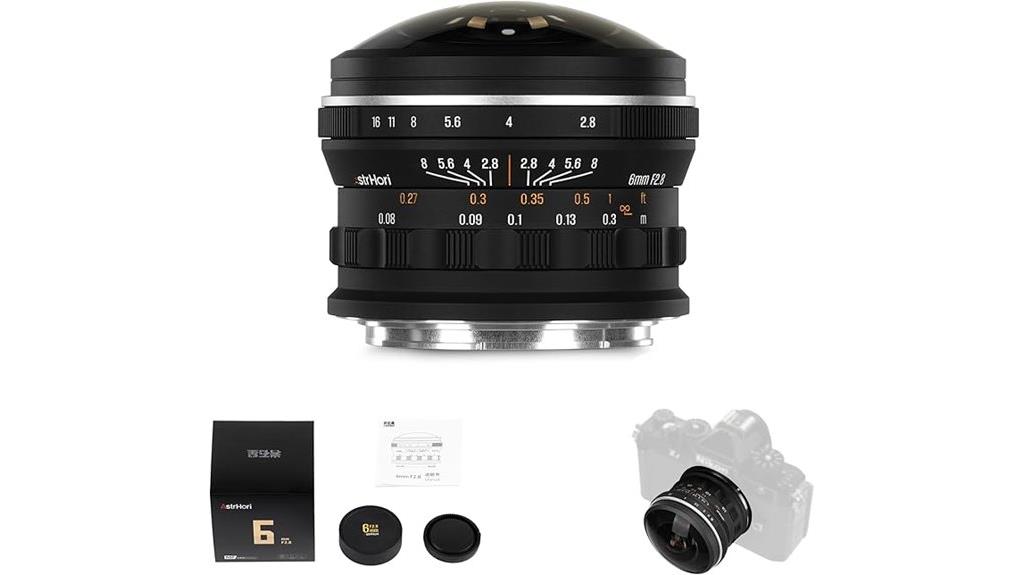
If you’re looking to capture the Milky Way with a truly immersive and artistic twist, the AstrHori 6mm F2.8 Circular Fisheye Lens for Nikon Z Mount is an excellent choice. Its 220° ultra-wide field of view creates striking, circular images that envelop the viewer in the night sky. The F2.8 aperture handles low-light conditions well, making it perfect for astrophotography. The compact, all-metal build ensures durability during outdoor shoots. Manual focus gives you precise control, while the spherical distortion adds dramatic flair to your shots. Whether for creative landscapes, VR content, or unique starry scenes, this lens transforms ordinary night sky captures into bold, artistic statements.
Best For: astrophotographers, creatives, and outdoor enthusiasts seeking a unique, immersive fisheye perspective for night sky, landscape, and artistic projects.
Pros:
- Offers an expansive 220° ultra-wide circular fisheye view for dramatic, spherical images.
- Excellent low-light performance with a bright F2.8 aperture ideal for astrophotography.
- Compact, durable all-metal build makes it portable and suitable for outdoor and travel use.
Cons:
- Manual focus operation requires precise adjustment and setup.
- Compatibility limited to Nikon Z mount full-frame mirrorless cameras, requiring manual focus setup.
- Creates strong edge distortion, which may not be suitable for traditional photographic styles.
VILTROX 75mm f/1.2 EF Lens for Sony E-Mount

The VILTROX 75mm f/1.2 EF Lens for Sony E-mount is an excellent choice for astrophotographers seeking sharp, detailed images of the Milky Way, thanks to its bright f/1.2 aperture. Its large aperture allows more light, making it ideal for low-light conditions and capturing the galaxy’s intricate details. With 16 elements in 11 groups, including high-refractive index lenses, it delivers crisp, vivid images even at wide apertures. The fast STM autofocus ensures quick, accurate focusing, while manual controls offer flexibility. Compatible with Sony’s mirrorless cameras, this lens is perfect for both astrophotography and videography, elevating your night sky shots effortlessly.
Best For: astrophotographers and videographers seeking a high-performance lens with excellent low-light capabilities and sharp image quality for Sony E-mount cameras.
Pros:
- Bright f/1.2 aperture ideal for low-light and astrophotography
- Fast, precise STM autofocus with manual focus switch for versatile shooting
- High-quality 16-element design with high-refractive index lenses for sharp, vivid images
Cons:
- Relatively large and heavy, which may affect portability
- Prime lens with fixed focal length limits framing flexibility
- Compatibility limited to Sony E-mount mirrorless cameras, requiring adapters for other systems
Sony E 16mm F2.8 Wide-Angle Prime Lens (SEL16F28)

For photographers seeking a lightweight, versatile lens to capture the Milky Way, the Sony E 16mm F2.8 (SEL16F28) stands out as an excellent choice. Its ultra-compact pancake design weighs just 67 grams, making it perfect for travel and outdoor shoots. With a 24mm equivalent focal length and bright F2.8 aperture, it handles low-light conditions well and creates beautiful background blur. The lens incorporates aspherical elements to minimize distortion and enhance sharpness. Its smooth autofocus and short minimum focus distance of 0.24 meters make it ideal for capturing wide-angle night shots, all while remaining portable and easy to carry.
Best For: photographers who need a lightweight, versatile wide-angle lens for travel, landscape, street, and night photography, especially in low-light conditions.
Pros:
- Ultra-compact and lightweight design (67g) ideal for portability and travel.
- Bright F2.8 aperture enhances low-light performance and artistic background blur.
- Incorporates aspherical elements to reduce distortion and improve image sharpness across the frame.
Cons:
- Customer reviews indicate mixed feedback, with a 3-star average rating.
- Fixed focal length limits versatility compared to zoom lenses.
- Limited to APS-C E-mount cameras, reducing compatibility with other camera systems.
Factors to Consider When Choosing Wide-Field Lenses for Milky Way Photography
When choosing a wide-field lens for Milky Way photography, I focus on several key factors that can make or break my shots. Things like aperture size, field of view, and low-light performance directly impact image quality, while size and focus adjustment ease influence convenience. Understanding these points helps me pick the best lens for capturing stunning night skies.
Aperture Size Importance
Choosing a wide-field lens with a large aperture is essential for capturing the stunning details of the Milky Way. A lens with an aperture like f/1.4 or f/2.8 lets in more light, which is vital in dark skies where faint stars and the galaxy itself are hard to see. This increased light gathering enables faster shutter speeds, helping to reduce star trails caused by Earth’s rotation. Plus, a bigger aperture improves low-light performance, meaning you can use lower ISO settings and avoid noisy images. It also creates a shallower depth of field, making it easier to isolate the Milky Way from foreground objects for dramatic shots. While these lenses often come at a higher cost and may have optical aberrations, the benefits for astrophotography are significant.
Field of View Range
Have you ever wondered how much of the night sky a wide-field lens can capture in a single shot? The field of view determines how much of the Milky Way and stars you include in your image. Ultra-wide lenses with a 180° or more field of view create a striking fisheye effect, perfect for dramatic shots. Typically, lenses designed for Milky Way photography range between 100° and 220°, balancing wide coverage with manageable distortion. A larger field of view means fewer shots to create panoramic images, but it can also introduce more distortion and vignetting. Choosing a lens with an ideal field of view helps you maximize sky coverage while keeping your images sharp and free of unwanted artifacts.
Low-Light Performance
A wide-field lens with a large maximum aperture, such as f/1.2 or f/2.8, substantially boosts low-light performance by allowing more light to reach the sensor. This enables me to shoot with faster shutter speeds, which helps prevent star trails caused by Earth’s rotation. Better light intake also means I can lower the ISO setting, reducing noise and grain in my images. Manual focus lenses with smooth focus rings are essential for precisely adjusting focus in dark conditions, ensuring sharp star and Milky Way captures. Additionally, high-quality lens coatings that minimize internal reflections and flare improve contrast and clarity when shooting in dark, high-contrast scenes. Overall, a fast, well-coated lens with a wide aperture is vital for capturing stunning night sky shots.
Portability and Size
When photographing the Milky Way outdoors, portability and size become important considerations. A compact, lightweight lens makes outdoor shoots much easier, allowing me to carry everything comfortably and set up quickly. Smaller lenses fit more easily into my camera bag, which is essential when traveling or moving between locations. This convenience means I can adapt swiftly to changing conditions and capture fleeting moments in the night sky without cumbersome gear slowing me down. Additionally, durable materials in smaller lenses withstand outdoor elements, ensuring longevity during rugged shoots. Reduced size and weight also help prevent camera shake, leading to sharper images during long exposures. Overall, choosing a portable lens enhances my flexibility, allowing me to focus more on capturing stunning Milky Way shots rather than managing bulky equipment.
Focus Adjustment Ease
Choosing a wide-field lens for Milky Way photography means paying close attention to how easily I can adjust focus in low-light conditions. Manual focus lenses are often preferred because they allow for precise control, which is essential when capturing distant stars. A focus ring with a large diameter and smooth rotation makes manual focusing more accurate and comfortable in the dark. Autofocus systems tend to struggle or become unreliable at night, so I rely on focus peaking or live view magnification to ensure sharp images. Consistent, responsive focus mechanisms are also crucial for stacking images or multiple exposures. Overall, lenses with tactile feedback and easy adjustability help me achieve perfect focus, even when visibility is limited.
Frequently Asked Questions
How Do Lens Focal Lengths Affect Milky Way Composition?
Focal length directly impacts my Milky Way compositions by controlling the field of view. A wider lens, like 14mm, captures more sky, revealing the galaxy’s vastness and creating dramatic, expansive shots. Conversely, a longer focal length, say 24mm or 35mm, narrows the view, allowing me to focus on specific details or interesting sky features. Choosing the right focal length helps me craft the perfect scene, whether broad or detailed.
What Are the Best Aperture Settings for Night Sky Clarity?
Imagine I’m a time traveler from the 1800s, here to share a secret: for clear night sky shots, I set my aperture between f/2.8 and f/4.0. This wide opening captures enough light without introducing too much noise. I always shoot wide open or close to it, especially with fast lenses, to maximize star detail. Remember, a balance helps prevent star trails, so don’t go too wide with your settings.
Are Manual Focus Lenses Preferable for Astrophotography?
I prefer manual focus lenses for astrophotography because they give me precise control over focusing, especially in low light conditions. Autofocus can struggle in the dark, leading to missed sharpness. With manual focus, I can fine-tune for pinpoint stars and clear Milky Way shots. It’s more reliable and satisfying, allowing me to capture those stunning night sky details without fuss.
How Does Lens Distortion Impact Astrophotography Images?
Did you know lens distortion can reduce image sharpness by up to 30%? In astrophotography, it causes curved stars and warped celestial shapes, making your night sky shots less accurate and more challenging to process. I’ve noticed that minimizing distortion with quality lenses or post-processing helps keep stars pinpoint sharp and your images true to the universe’s beauty. It’s essential for capturing clear, stunning Milky Way shots.
What Accessories Enhance Wide-Field Milky Way Photography?
You’ll want a sturdy tripod to keep your camera stable during long exposures, preventing motion blur. A remote shutter release or intervalometer helps avoid camera shake when pressing the shutter. A wide-angle lens with a large aperture captures more light, making your images brighter. Additionally, a headlamp or flashlight with red light preserves night vision, and a star tracker can help you achieve sharper, longer exposures of the Milky Way.
Conclusion
Choosing the right wide-field lens can truly transform your Milky Way shots. Think of it like finding the perfect brush for your masterpiece—each lens offers unique magic. Remember, the right tool makes all the difference, so don’t settle for less. As the saying goes, “A good craftsman never blames his tools,” but with these lenses, you’ll find yourself capturing the night sky’s beauty like never before. Happy stargazing!