
If you’re looking for the best flux and solder for electronics, I’ve got you covered. I recommend using no-clean flux pastes, rosin-based formulas, and desoldering wick for reliable, clean joints. Choosing the right alloy and application method makes a big difference in durability and safety. To get the most out of your soldering projects, explore the options below—more expert tips come with the next steps.
Key Takeaways
- Discover various flux formulations (no-clean, rosin-based, halogen-free) suitable for different electronic soldering needs and environments.
- Learn about application methods and tools like flux paste, solder wick, and solder wire for precise, clean joints.
- Understand the pros and cons of different flux types, ideal for hobbyists, technicians, and professional electronics repair.
- Explore safety standards, environmental compliance, and long-term reliability features of top flux and solder options.
- Find tips for optimal soldering performance, residue management, and ensuring durable, corrosion-resistant connections.
Liquid Solder Flux Dropper (30 ml/1 Oz.)
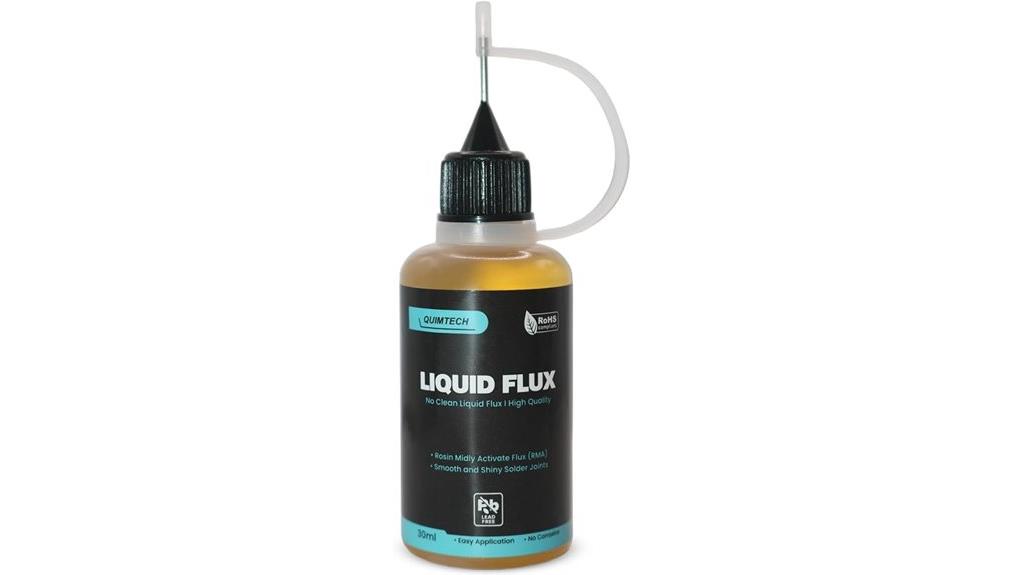
If you’re looking for a reliable flux for electronics soldering, the Liquid Solder Flux Dropper (30 ml/1 Oz.) is an excellent choice. I’ve used it on various projects, and it consistently delivers strong, clean joints. Its no-clean, rosin-based formula effectively removes oxides and improves wettability across lead-free, tin-lead, gold, silver, and copper alloys. The advanced RMA formulation is environmentally friendly, non-corrosive, and safe for long-term use. Plus, the dropper bottle makes application precise and easy. Whether you’re reworking a circuit or soldering new components, this flux ensures high-quality results without residue or corrosion.
Best For: electronics hobbyists, technicians, and professionals seeking a reliable, environmentally friendly flux for precise soldering and rework tasks.
Pros:
- Ensures strong, clean, and shiny solder joints with high wettability
- No-clean, rosin-based formula that is environmentally friendly and non-corrosive
- Easy to apply with the dropper bottle for accurate and controlled usage
Cons:
- Limited to 30 ml, which may require reordering for extensive projects
- Requires careful handling to avoid spills or over-application
- May not be suitable for applications requiring flux with specific activator levels beyond RMA standards
SRA Solder 135 Rosin Paste Soldering Flux for Electronics
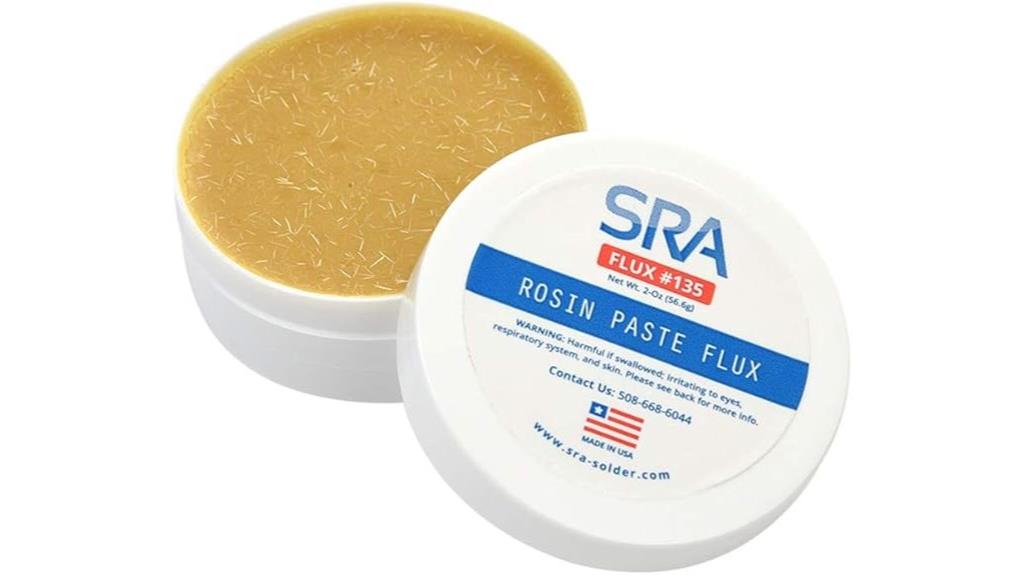
Looking for a reliable flux that offers precise control and leaves no harmful residues? SRA Solder 135 Rosin Paste is exactly what you need. Its semi-solid wax consistency makes application easy—just dip wires or brush onto PCBs for smooth, accurate soldering. Suitable for both leaded and lead-free solder, it performs well on circuit boards, copper wires, and DIY projects like drones and Arduino. It’s impurity-free, safe, and leaves no goopy mess or harmful residues. With superior wetting and an active temperature range of 93–315°C, this USA-made flux guarantees clean, high-quality joints every time.
Best For: DIY electronics enthusiasts, hobbyists, and professionals seeking precise, safe, and clean soldering flux for circuit boards, wires, and delicate electronic components.
Pros:
- Impurity-free and leaves no harmful residues for safe, clean joints
- Semi-solid wax consistency allows easy, controlled application
- Suitable for both leaded and lead-free soldering across various electronic projects
Cons:
- May require careful handling to avoid over-application due to its semi-solid nature
- Limited to small-scale or hobbyist use; not ideal for heavy-duty industrial soldering
- Necessitates proper storage to maintain its consistency and effectiveness
2 Jar Solder Flux for Electronics Soldering
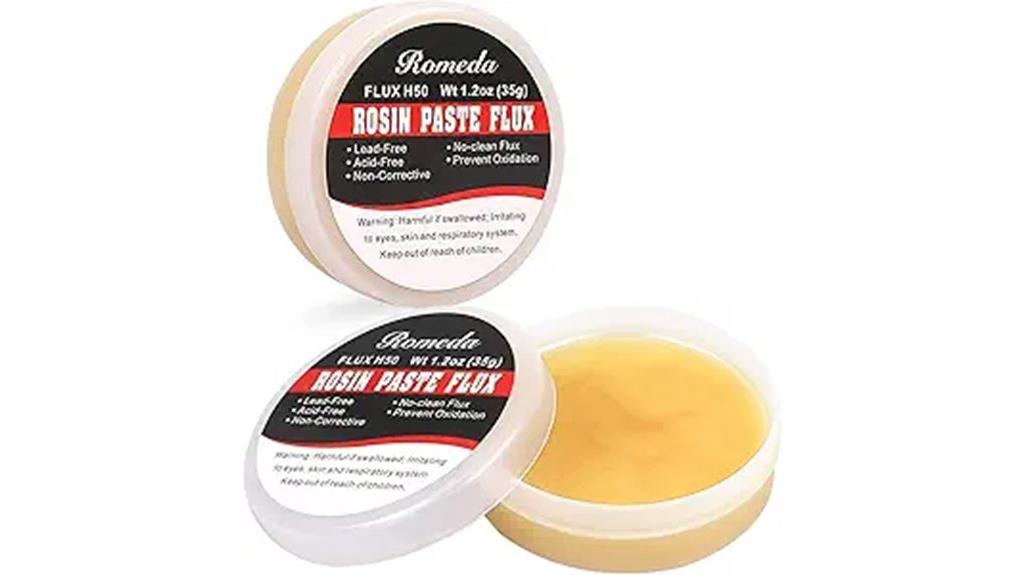
For anyone engaged in electronic soldering projects, the Jar Solder Flux for Electronics Soldering offers a reliable solution that guarantees clean, secure connections. It comes with two 35g jars, providing enough flux for multiple tasks. Made from rosin, it’s non-conductive when dry and safe for use on circuit boards, ensuring no corrosion. Its semi-solid consistency prevents spills, making application easier and cleaner. It’s compatible with metals like gold, copper, tin, and iron, ideal for repairs, rework, and general soldering. Plus, with 24/7 customer support, I feel confident using it for various projects, knowing I have help if needed.
Best For: electronics hobbyists, technicians, and professionals engaged in soldering, repair, or rework projects seeking a safe, effective flux.
Pros:
- Non-conductive and non-corrosive, ensuring safe use on circuit boards and metals
- Semi-solid consistency reduces spills and mess during application
- Includes enough quantity (70g total) for multiple projects with reliable oxidation resistance
Cons:
- May require proper storage to prevent drying out over time
- Not suitable for applications involving high-temperature or specialized soldering conditions
- Limited to the included two jars, which might necessitate additional supplies for extensive projects
No Clean Soldering Flux Paste (4 Pack)
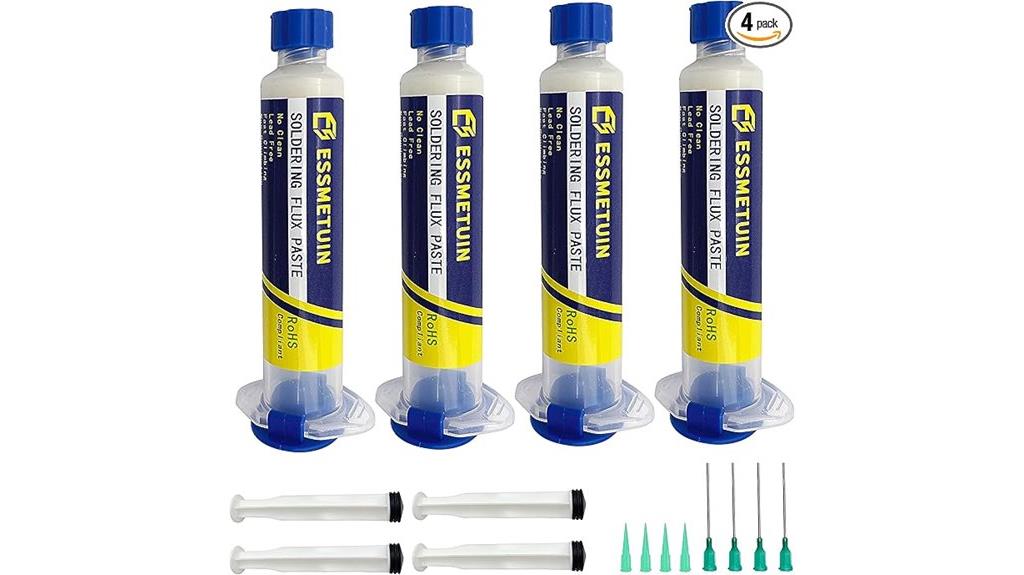
When precision and cleanliness matter most in electronics soldering, the No Clean Soldering Flux Paste (4 Pack) stands out as an ideal choice. Its lead-free, halogen-free, high-purity rosin formulation guarantees safe, environmentally friendly soldering with minimal residue. The pushing-type design allows for smooth flow, reducing wastage and improving efficiency. It effectively removes oxides, promoting better adhesion and stronger joints on circuit boards, wires, and various electronic components. Perfect for both professional and DIY projects, this flux paste enhances soldering quality while keeping cleanup effortless, making it a versatile tool for achieving reliable, clean connections every time.
Best For: DIY electronics enthusiasts, professional technicians, and hobbyists seeking a clean, reliable soldering solution for circuit boards, wires, and electronic repairs.
Pros:
- Lead-free and halogen-free, ensuring safety and environmental friendliness
- High activity rosin effectively removes oxides for better solder joints
- Pushing-type design provides smooth flow and reduces waste during application
Cons:
- May require careful handling to avoid excess application in tight spaces
- Not suitable for high-temperature or extremely specialized soldering needs
- The paste consistency might need adjustment for specific applications or preferences
Desoldering Wick and Soldering Flux Paste Kit
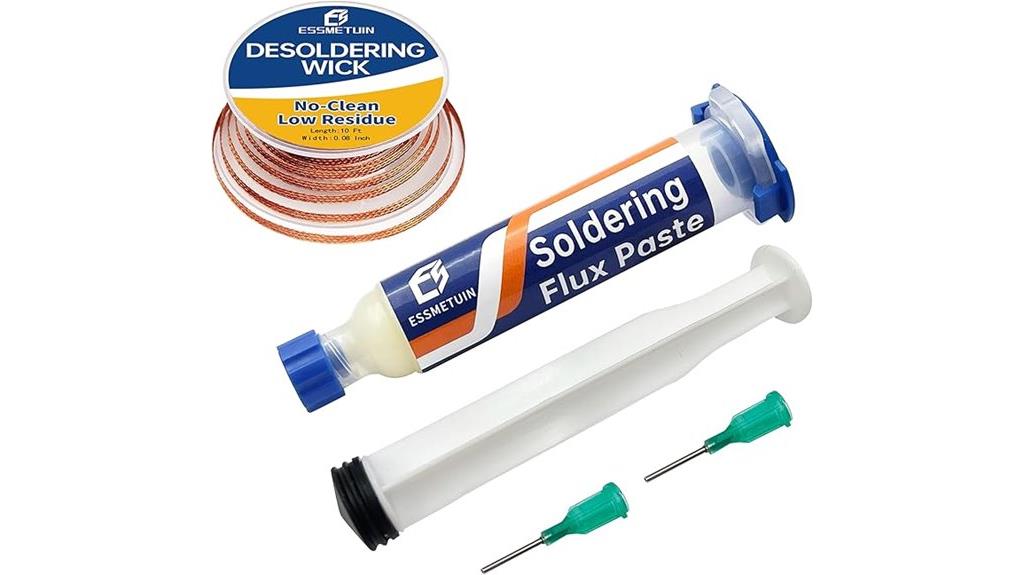
This desoldering wick and flux paste kit is ideal for electronics enthusiasts and professionals who need a reliable, all-in-one solution for soldering and desoldering tasks. It includes a 10CC no-clean flux paste and desoldering wick, making it versatile and easy to use. The high-activity rosin flux helps remove oxide layers quickly, ensuring efficient solder removal without damaging components. The no-clean flux leaves minimal residue, reducing cleaning time. Its compact design makes it perfect for repairs on various electronic devices. Trusted by technicians, this kit offers consistent, reliable performance, streamlining your soldering and desoldering projects with convenience and precision.
Best For: electronics technicians, hobbyists, and repair professionals seeking a reliable all-in-one soldering and desoldering solution.
Pros:
- Efficient removal of solder without damaging components due to high activity rosin flux.
- Minimal residue left after use, reducing cleaning time and effort.
- Compact and versatile kit suitable for various electronic device repairs.
Cons:
- Limited to small-scale or precision soldering and desoldering tasks.
- May require additional tools for heavy-duty or large-component repairs.
- The 10CC flux paste might need reapplication for extensive projects.
Solder Flux Paste and Wick Braid for Electronics Repair
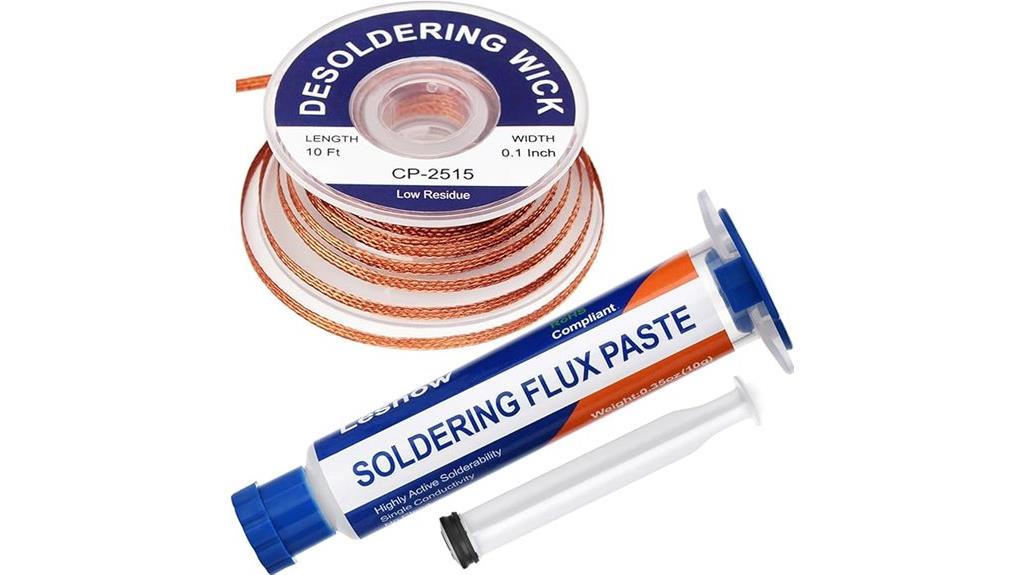
Solder flux paste and wick braid stand out as essential tools for anyone performing detailed electronics repairs, especially in small-scale or delicate work. The flux paste helps clean solder residues safely, preventing damage to sensitive components, while the copper wick braid efficiently absorbs excess solder for quick, clean desoldering. Both tools are versatile, ideal for fixing small PCBs, reworking mechanical keyboards, removing wires, or disassembling devices like motherboards. Made from high-quality materials, they make certain of reliable performance and ease of use. Whether you’re a professional or a DIY enthusiast, these tools streamline error correction and component removal, making your repairs more precise and efficient.
Best For: DIY electronics enthusiasts, professional repair technicians, and hobbyists performing precise soldering and desoldering tasks on small PCBs and electronic components.
Pros:
- High-quality copper braid with excellent capillary action for efficient solder absorption
- Halogen-free, non-corrosive flux paste that safely cleans solder residues without damaging delicate parts
- Versatile tools suitable for a wide range of electronics repair tasks, from reworking keyboards to disassembling motherboards
Cons:
- Limited quantity (10cc paste and 10ft wick) may require frequent replacement for heavy use
- Requires careful handling to avoid accidental damage or excess flux application
- May not be suitable for large-scale manufacturing or repairs involving extensive soldering work
Solder Wick and Soldering Flux for Electronics Repair

If you’re looking for a reliable solution to remove solder efficiently without risking damage to delicate components, a solder wick paired with no-clean flux paste is an ideal choice. The desoldering wick effectively absorbs excess solder quickly, while the high-activity rosin flux helps break down oxide layers for easier removal. This combo ensures a clean, damage-free process with minimal residue. The compact kit is portable and easy to use, making it perfect for various repair scenarios. Trusted by technicians, it offers consistent performance and quick turnaround, helping you achieve professional-quality results with less effort and cleaning.
Best For: electronics technicians and hobbyists seeking efficient, damage-free solder removal and surface preparation in repair tasks.
Pros:
- Effectively removes solder without damaging delicate components
- Leaves minimal residue, reducing cleaning time
- Compact and portable for convenience in various repair scenarios
Cons:
- May require practice to master precise application
- Limited to small-scale repair projects, not suitable for large jobs
- No additional tools or accessories included beyond wick and flux paste
63-37 Tin Lead Rosin Core Solder Wire for Electrical Soldering (0.8mm 50g)
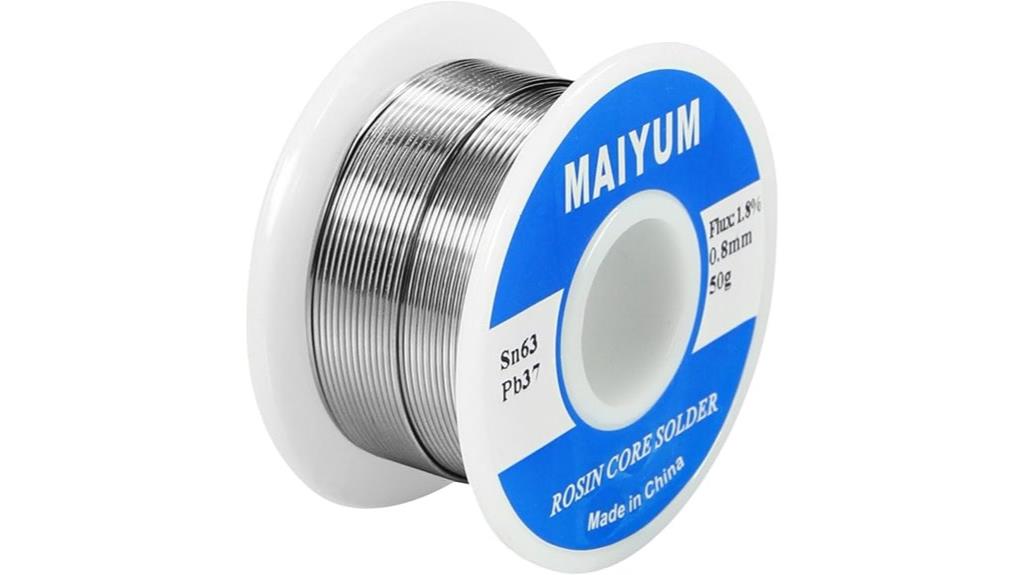
For electronics enthusiasts and professionals seeking reliable, high-quality solder wire, the 63-37 Tin Lead Rosin Core Solder with a 0.8mm diameter and 50g weight stands out as an excellent choice. Its composition of 63% tin and 37% lead guarantees smooth, strong, and fast solder joints, making it ideal for circuit boards, DIY projects, and repairs. The rosin core contains 1.8% flux, promoting easy flow and clean connections. With a melting point of 361°F (183°C), it’s easy to work with and efficient. Compact and portable, this solder wire offers both convenience and performance for a wide range of electrical soldering tasks.
Best For: electronics enthusiasts, professionals, and DIYers seeking reliable solder wire for circuit board assembly and repairs.
Pros:
- Easy to solder with smooth flow and strong joints
- Low melting point for efficient soldering
- Compact and portable for convenient use
Cons:
- Contains lead, which poses health and environmental risks
- Requires careful handling and safety precautions
- Not suitable for applications requiring lead-free solder
4-in-1 Welding Tool Set: Soldering Iron Tips, Solder Wire, Rosin Flux, No-Clean Solder Core
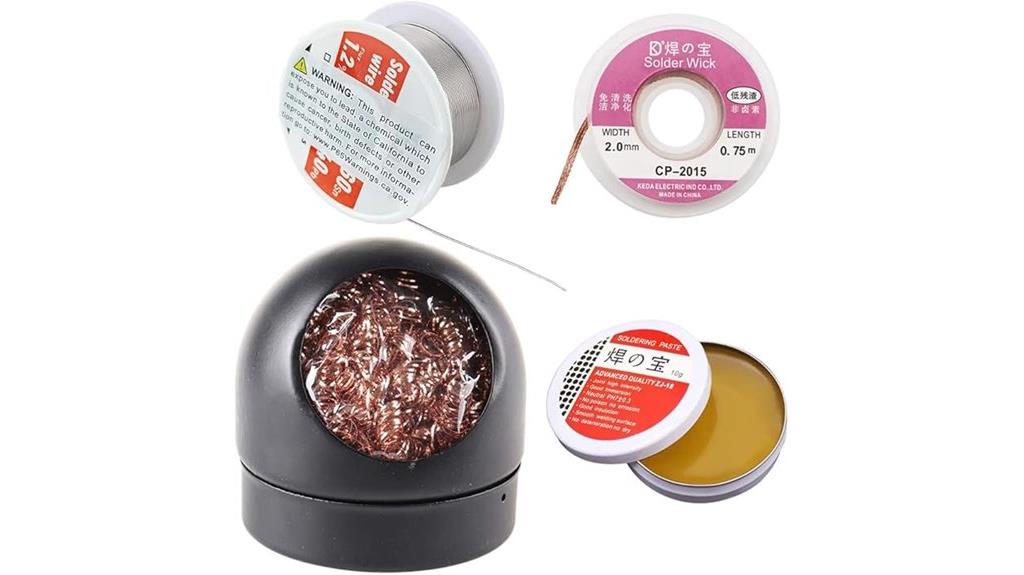
This 4-in-1 welding tool set is ideal for electronics enthusiasts and professionals seeking an all-inclusive solution for soldering and desoldering tasks. It includes soldering iron tips, a brass wire cleaner that maintains tip temperature without water, and a no-clean soldering core that reduces residue. The set features 0.6mm solder wire for smooth flow, rosin flux paste to improve solder joints, and a no-clean flux core for cleaner results. Designed for efficiency, it helps produce strong, reliable connections while minimizing cleaning time. Whether repairing PCBs or building electronics, this set offers everything needed for precise, professional-quality soldering.
Best For: electronics enthusiasts and professionals seeking an all-in-one, efficient solution for soldering and desoldering tasks on PCB repairs and electronics projects.
Pros:
- Includes comprehensive 4-in-1 set with soldering iron tip cleaner, solder wire, flux paste, and no-clean soldering core for versatile use.
- Brass wire cleaner maintains tip temperature without water, providing safer and cleaner cleaning.
- Produces strong, reliable solder joints with minimal residue, reducing cleaning time and improving overall welding quality.
Cons:
- Limited solder wire diameter (0.6mm) may not suit larger soldering projects.
- The set’s size and components might be excessive for very simple or occasional repairs.
- Requires proper handling and storage to prevent corrosion or damage to the flux paste and solder core.
TOWOT 63-37 High Purity Tin Lead Rosin Core Solder Wire
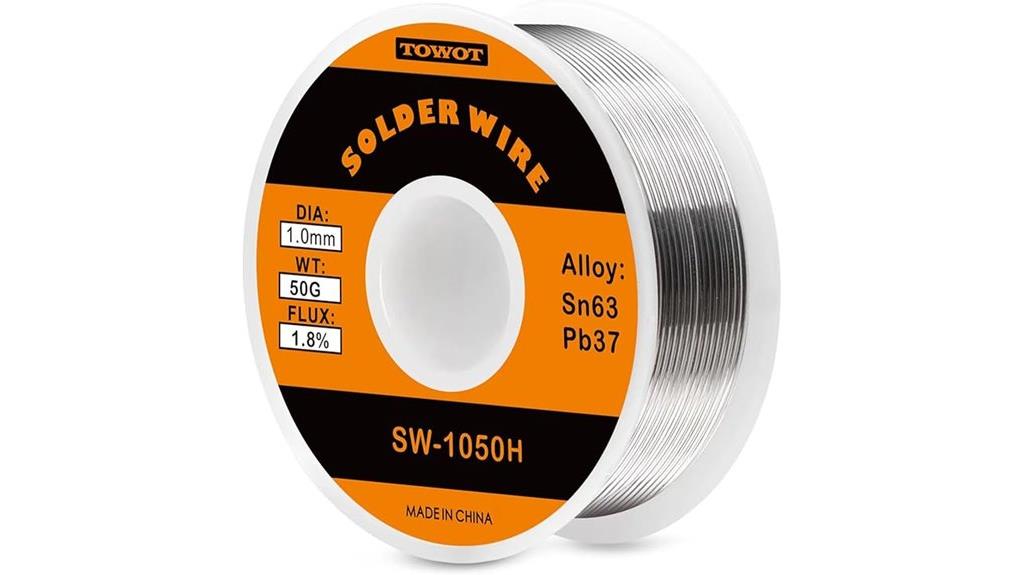
The TOWOT 63-37 High Purity Tin Lead Rosin Core Solder Wire stands out as an ideal choice for electronics enthusiasts and professionals seeking reliable, high-quality soldering. Its alloy, containing 63% tin and 37% lead, offers excellent electrical conductivity and strength. With a 1.8% flux content, it ensures smooth, fast flow and strong joints, making soldering efficient and dependable. The 1.0mm diameter is perfect for various projects, from circuit board repairs to DIY electronics. Plus, its low melting point minimizes heat stress on components. Overall, this solder wire delivers consistent performance and durability, assuring your connections are solid and long-lasting.
Best For: electronics enthusiasts and professionals seeking reliable, high-quality soldering solutions for circuit board repairs, DIY projects, and electronic assembly.
Pros:
- High purity alloy for excellent electrical conductivity and strong joints
- Low melting point reduces heat stress on components
- Smooth flow and fast soldering speed enhance efficiency and reliability
Cons:
- Limited to applications compatible with 1.0mm diameter solder wire
- Contains lead, which requires careful handling and proper disposal
- Flux content may not be suitable for highly sensitive or specialized electronic components
Soldering Iron Kit 80W with LCD Temperature Control (13 in 1)
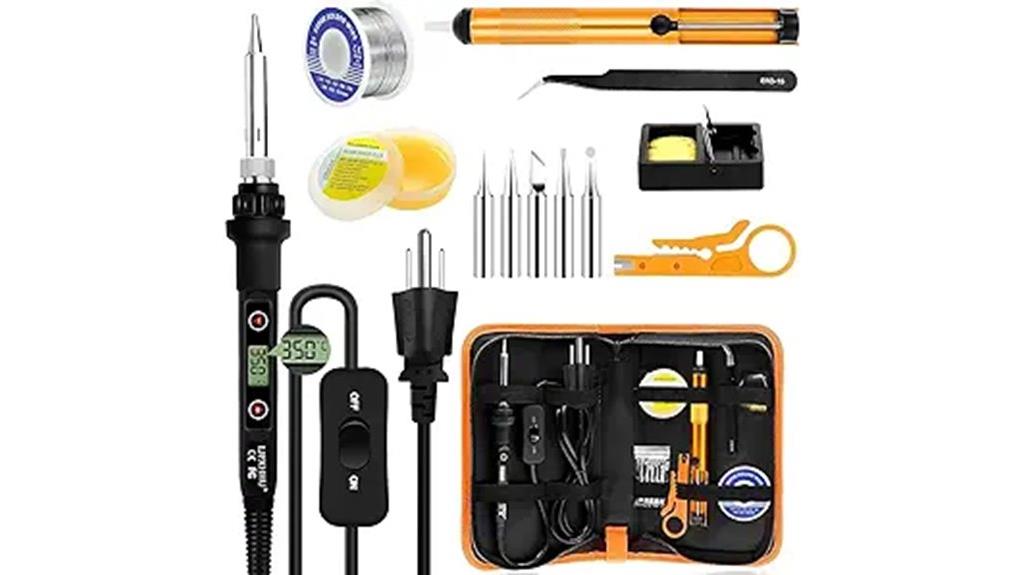
If you need precise temperature control for delicate electronic work, the Soldering Iron Kit 80W with LCD Temperature Control (13 in 1) is an excellent choice. It heats up in just 15 seconds thanks to its ceramic core, providing rapid readiness. The high-definition LCD screen allows me to adjust the temperature between 180℃ and 520℃ with 5℃ accuracy, ensuring safe, accurate soldering. Its safety features include an ON/OFF switch and heat-resistant components. The kit comes complete with five interchangeable tips, flux, solder, and essential tools, making it versatile for various projects. Compact and portable, it’s perfect for both hobbyists and professionals.
Best For: hobbyists, DIY enthusiasts, and professionals needing precise, versatile soldering tools for electronics and small projects.
Pros:
- Rapid 15-second heat-up with high power 80W ceramic core for efficient work
- Precise temperature control from 180℃ to 520℃ with 5℃ increments and LCD display
- Complete 13-in-1 kit includes multiple tips, flux, solder, and essential tools for diverse applications
Cons:
- May be heavier or bulkier for extended handheld use compared to smaller soldering irons
- Requires a power source, limiting portability in some outdoor or remote settings
- The LCD display and electronic components may be susceptible to damage if not handled carefully
No-Clean Flux Paste, Solder Wick & Pickup Kit
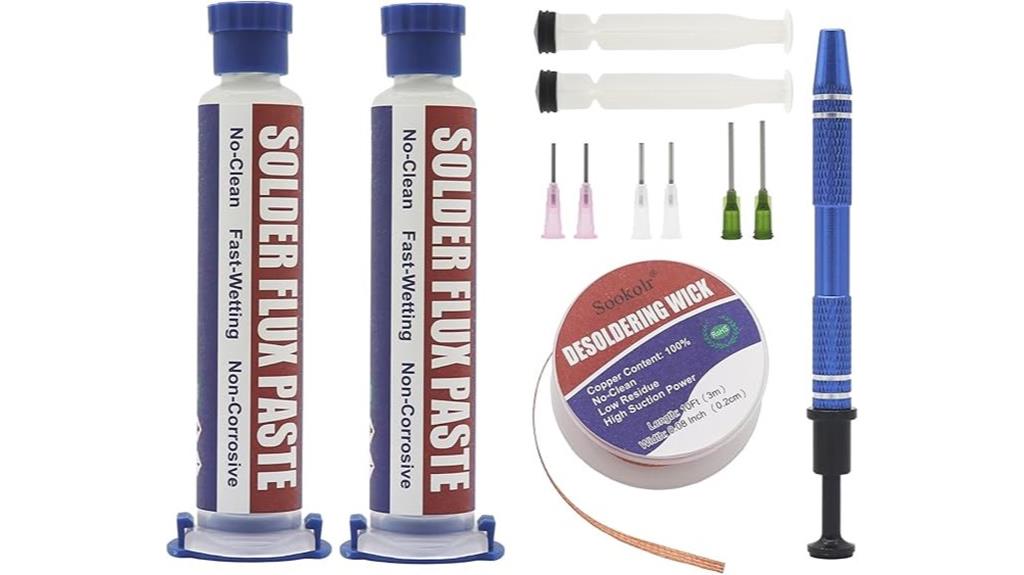
For electronic repair professionals and hobbyists alike, the No-Clean Flux Paste, Solder Wick, and Pickup Kit offers an all-in-one solution that streamlines soldering and desoldering tasks. The kit includes a 10 cc bottle of no-clean flux paste, which promotes smooth solder flow and clean joints without residue cleanup. The 10-foot copper desoldering wick efficiently absorbs excess solder, protecting delicate components. The IC pickup tool makes handling small parts safer and more precise. This all-encompassing set enhances efficiency, reduces damage risk, and simplifies intricate work, making it an essential addition to any electronics toolkit. It truly helps achieve perfect, reliable connections every time.
Best For: electronic repair professionals and hobbyists seeking an all-in-one kit for soldering, desoldering, and small parts handling.
Pros:
- Includes essential tools like flux paste, desoldering wick, and pickup tool for comprehensive electronic work
- Promotes clean, reliable solder joints without residue cleanup thanks to no-clean flux
- Efficiently absorbs excess solder, minimizing risk of damage to delicate components
Cons:
- May require some experience to use effectively, especially for beginners
- Limited quantity of flux paste (10cc) might need replenishing for extensive projects
- The kit’s small parts pickup tool might not be suitable for larger or heavy components
10g Solder Flux for Electronics and Repairs

A 10g solder flux paste is an excellent choice for anyone working on delicate electronics repairs, thanks to its no-clean formula and minimal residue. Its yellow color makes it easy to see where you’ve applied it, ensuring precise coverage. Designed for electronics, mobile phones, and computer motherboards, it offers excellent wetting, weldability, and insulation. The easy application methods—squeezing, brushing, or dipping—make repairs straightforward. After soldering, it leaves little residue, produces minimal smoke, and has no irritating odor. This compact, metal-tin package is perfect for small-scale projects, making reliable, professional results accessible for both hobbyists and technicians.
Best For: hobbyists and professional technicians performing delicate electronics repairs on mobile phones, computer motherboards, and home appliances.
Pros:
- Easy to apply via squeezing, brushing, or dipping for precise coverage
- Leaves minimal residue with little smoke and no irritating odor
- Provides excellent wetting, weldability, and insulation for reliable solder joints
Cons:
- Small 10g size may require frequent reapplication for larger projects
- Requires surface cleaning before application for optimal results
- Not suitable for high-volume industrial soldering tasks
Solder Flux for Electronics Soldering (10CC)
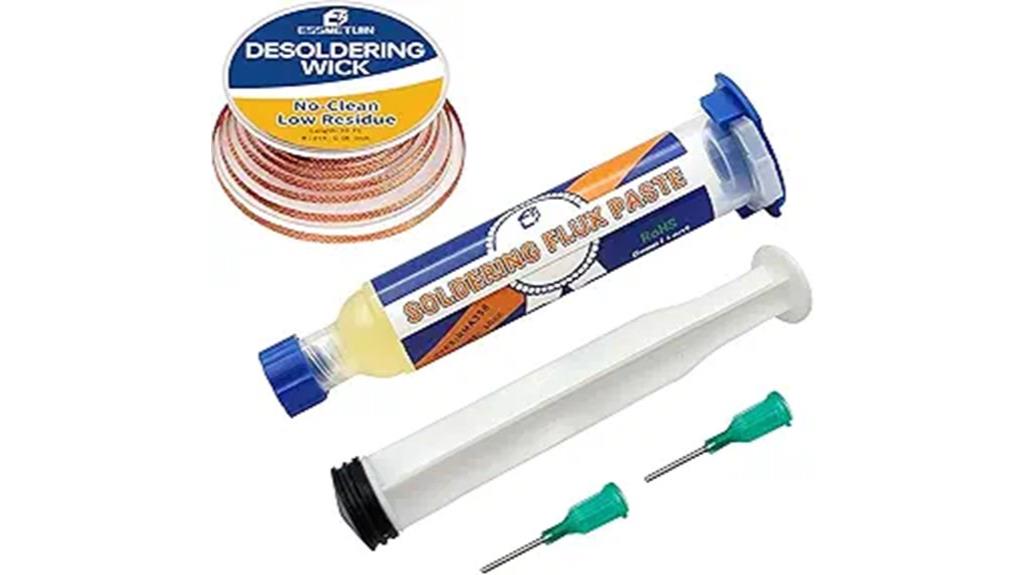
Looking for a reliable flux that simplifies your electronics soldering and desoldering tasks? The Solder Flux for Electronics Soldering (10CC) kit is exactly what you need. It includes a no-clean soldering flux paste and desoldering wick, making repairs straightforward and efficient. The high-activity rosin in the flux helps remove oxide layers easily, ensuring strong, clean connections. Plus, the minimal residue from the no-clean wick means less cleaning time afterward. Trusted by professionals, this compact kit offers a dependable solution for quick soldering and desoldering, whether you’re fixing circuit boards or performing detailed electronic repairs.
Best For: DIY electronics enthusiasts, technicians, and professional repair specialists seeking a reliable, all-in-one soldering and desoldering solution for circuit board repairs and detailed electronic work.
Pros:
- Facilitates quick and clean solder removal without damaging components
- Contains high-activity rosin to easily remove oxide layers, ensuring strong connections
- Minimal residue from the no-clean wick reduces cleaning time and effort
Cons:
- May require additional cleaning for certain sensitive components despite minimal residue
- Limited to small-scale or hobbyist repairs due to the 10CC size
- The kit may not include all tools needed for extensive or industrial repair projects
Factors to Consider When Choosing Flux and Solder for Electronics
When selecting flux and solder for electronics, I focus on factors like solder type compatibility and the flux’s activation level to guarantee solid joints. Environmental compliance and ease of application also matter, making the process safer and more efficient. Plus, I consider how easily residues can be removed to keep the work clean and reliable.
Solder Type Compatibility
Choosing the right solder and flux combination is essential for guaranteeing strong, reliable joints in electronics assembly. First, I check that the solder type matches the materials and application—whether leaded or lead-free—to optimize joint strength. I also verify flux compatibility with the solder alloy, since some fluxes are formulated specifically for certain solders to improve wetting and oxide removal. It’s important to confirm the flux’s activity level suits the components and substrates; higher activity fluxes are better for oxidized surfaces. Additionally, I consider whether the flux leaves minimal residues, especially if a no-clean process is desired. Finally, I ensure the temperature requirements match the melting points of both the solder and flux, preventing incomplete melting or damage during the process.
Flux Activation Level
Have you ever wondered how the activation level of flux impacts the quality of your solder joints? The activation level determines how effectively the flux removes oxides and prepares surfaces for soldering. RA (Rosin Activated) flux is common in electronics; it offers moderate activation, making it easy to work with and requiring little cleaning afterward. WA (Water Soluble) flux provides high activation and simplifies cleaning because it dissolves in water, but you must rinse thoroughly to prevent corrosion. OA (Organic Acid) flux has high activity and is suitable for challenging surfaces, but it can be corrosive if not cleaned properly. Choosing the right activation level depends on your materials, cleanliness requirements, and whether post-solder cleaning is feasible or desirable.
Environmental Compliance
Ever wondered how environmental regulations influence your choice of flux and solder in electronics assembly? These standards, like RoHS, REACH, and WEEE, guide us to select materials that minimize hazardous substances. I always opt for lead-free solder and fluxes that are free from toxic heavy metals such as lead, cadmium, or mercury. It’s also essential to verify that flux formulations don’t contain harmful chemicals like halogens, zinc chloride, or ammonium chloride. I prefer organic, biodegradable fluxes and solder alloys because they reduce ecological impact and make waste disposal easier. Additionally, I look for products with clear environmental certifications and labels. Prioritizing compliance makes sure we’re not only creating reliable connections but also supporting responsible manufacturing practices and protecting our environment.
Ease of Application
When selecting flux and solder for electronics, ease of application is crucial to achieving reliable and precise results. Choosing products with the right viscosity ensures smooth, controlled application, especially on small or delicate components. Semi-solid or paste fluxes allow for precise placement and help prevent spillage or excess residue. Fluxes with dropper or brush applicators offer better control, making intricate soldering tasks more manageable. It’s also important to pick formulations that spread evenly across surfaces, ensuring uniform solder joints. Additionally, opt for flux and solder that produce minimal fumes and residue, simplifying cleanup and making handling safer. Prioritizing ease of application helps improve soldering accuracy, reduces errors, and enhances overall work quality.
Residue Removal Ease
Choosing flux and solder that leave minimal or no residue makes post-solder cleaning easier and helps prevent corrosion. No-clean fluxes and pastes designed for low residues are ideal, as they produce non-conductive, easy-to-remove remnants. High-activity fluxes effectively eliminate oxides and contaminants, reducing the need for aggressive cleaning. Compatibility with your cleaning process is essential—whether you prefer rinsing, wiping, or no cleaning at all. Keep in mind that rosin-based fluxes typically leave more residues compared to organic or synthetic options, which can complicate cleaning. Selecting products formulated to leave minimal residue simplifies maintenance and enhances long-term reliability. By prioritizing low-residue flux and solder combinations, you streamline your workflow and protect your electronics from potential corrosion issues down the line.
Joint Strength & Durability
Selecting the right flux and solder is crucial for ensuring strong, durable joints that can withstand environmental stresses. I focus on fluxes that promote excellent wetting and oxide removal, which improves mechanical stability and bond strength. Durability depends on choosing materials resistant to corrosion, moisture, and temperature swings, preventing joint degradation over time. Proper flux guarantees consistent flow and bonding, reducing weak or brittle spots. High-quality solder with suitable alloy composition contributes to long-lasting connections with minimal risk of failure. Compatibility between flux, solder, and materials is essential to avoid issues like cracking or joint deterioration. By carefully considering these factors, I can create solder joints that are not only strong initially but maintain their integrity in harsh conditions, ensuring reliable performance over the lifespan of the electronics.
Safety & Toxicity
Ever wondered if the flux and solder you use are safe? It’s vital to choose products labeled as non-toxic and compliant with safety standards like RoHS to avoid hazardous fumes and residues. Opt for lead-free solder to reduce health risks, especially for hobbyists or household projects. Make sure the flux is free from harmful chemicals such as zinc chloride and ammonium chloride, which can produce toxic fumes during soldering. Using flux and solder with low volatile emissions also helps minimize inhalation of harmful vapors. Additionally, prioritize organic or environmentally friendly formulations; they’re safer to handle and dispose of. Taking these precautions guarantees your soldering process remains safe, protecting both your health and the environment without compromising quality.
Frequently Asked Questions
How Do I Store Flux and Solder to Prevent Deterioration?
I store flux and solder in a cool, dry place to prevent deterioration. I keep the flux in airtight containers, tightly sealed after use, and avoid exposing it to moisture or extreme temperatures. For solder, I use resealable bags or containers, ensuring they’re sealed tightly. Regularly checking for corrosion or signs of spoilage helps me maintain their quality, ensuring reliable electrical connections every time.
Are There Eco-Friendly Flux and Solder Options Available?
Yes, eco-friendly flux and solder options are available. I prefer lead-free solder made from recycled metals because it’s safer for the environment and health. For flux, I choose water-based, biodegradable formulas that work just as well but cause less pollution. These options help me create reliable connections while reducing my ecological footprint. If you want to be more sustainable, look for products labeled as environmentally friendly or eco-conscious.
What Safety Precautions Should I Follow When Using Flux and Solder?
When using flux and solder, I always wear safety goggles and gloves to protect my eyes and skin from splashes and fumes. I work in a well-ventilated area to avoid inhaling harmful vapors. I keep a fire extinguisher nearby and avoid eating or drinking while soldering. Properly disposing of waste materials is also essential. Following these precautions keeps me safe and guarantees a successful, accident-free soldering experience.
How Do Different Flux Types Affect Solder Joint Quality?
Different flux types substantially impact solder joint quality by improving wetting and preventing oxidation. I find that rosin flux enhances electrical connections, while water-soluble flux offers easier cleaning but may be more corrosive. No-clean flux provides reliable results with minimal residue, reducing cleanup time. Choosing the right flux depends on your project’s needs, but using the appropriate type ensures stronger, more durable, and reliable solder joints.
Can I Reuse Solder and Flux From Previous Projects?
Reusing solder and flux is like recycling old stories; it’s tempting but not always reliable. I wouldn’t recommend it, as re-melting solder can cause oxidation and contamination, leading to weak joints. Flux can also lose effectiveness after use, risking poor connections. Instead, I prefer fresh materials to guarantee quality and durability. Think of it as giving your project a fresh start—better safe than sorry!
Conclusion
So, after all this talk about flux and solder, you’d think I’d have it all figured out, right? Turns out, the perfect connection isn’t about fancy brands or tiny details. It’s about patience, a steady hand, and maybe a little luck. Because in the end, even the best flux can’t save us from a sneaky mistake or two. But hey, that’s the charm of electronics—always a little unpredictable, always worth the effort.