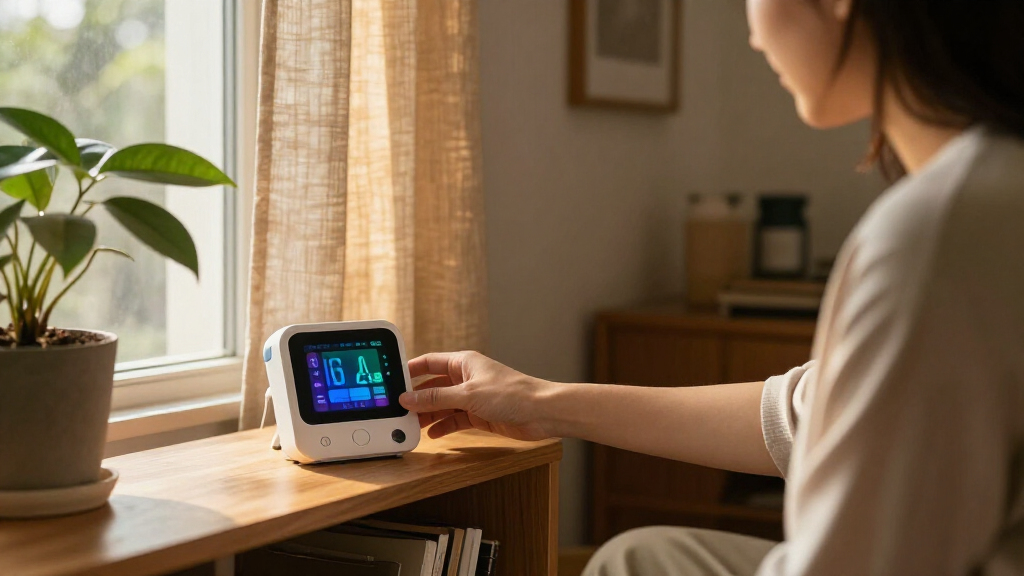

The best smart home air quality monitor for most homes is the Airthings View Plus, which stands out for tracking radon alongside several other indoor air indicators. For focused CO₂ monitoring, the Aranet4 is a strong alternative, while the Amazon Smart Air Quality Monitor offers a simpler path into Alexa-based alerts. The main tradeoffs are sensor coverage versus simplicity, and detailed readings versus easy-to-act-on alerts. Some monitors focus on one risk, while others track several measurements but may require more setup or app interpretation. Read on for the full comparison of all 15 options and a guide to choosing the right monitor for your home.

Get the latest gadgets delivered free with Prime
- Fast, free delivery on millions of items
- Prime Video, Amazon Music and more included
- Member-only deals all year
Complete the kit



Key Takeaways
- Airthings View Plus is the broad-coverage pick: its radon monitoring sets it apart from models focused mainly on CO₂, particles, or general air indicators.
- Aranet4 makes the most sense for CO₂-first buyers: it keeps the focus on ventilation and carbon dioxide rather than trying to cover every indoor-air concern.
- Amazon’s monitor favors convenience over breadth: Alexa integration and straightforward alerts suit an existing Amazon smart home, while the two-pack is useful for comparing rooms.
- Multifunction display models trade simplicity for visible data: the Lecoolife AK22B and other 10-in-1 or 16-in-1 devices can show many readings at once, but buyers should check which measurements matter and how clearly they are explained.
- Safety alarms and air-quality monitors are not interchangeable: the Kidde and Ring products include specific hazard monitoring, but a general air monitor should not replace dedicated, properly installed life-safety alarms.
| Kidde COPDLQW Smart Carbon Monoxide Detector with Indoor Air Quality Monitoring |  | Best for CO Safety Plus Basic Air Monitoring | Monitored measures: Carbon monoxide, temperature, relative humidity, and TVOCs | Power: 120V plug-in with two AA backup batteries | Connectivity: 2.4 GHz Wi-Fi | VIEW LATEST PRICE | See Our Full Breakdown |
| Amazon Smart Air Quality Monitor (2-Pack) |  | Best for Alexa-Based Whole-Home Coverage | Pack size: 2 monitors | Monitored factors: PM2.5, VOCs, carbon monoxide, humidity, and temperature | Connectivity: Alexa | VIEW LATEST PRICE | See Our Full Breakdown |
| Lecoolife AK22B 16-in-1 Indoor Air Quality Monitor with 7-Inch Display |  | Best for Readable, On-Device Air Data | Model: AK22B | Monitoring parameters: CO₂, PM1.0, PM2.5, PM10, HCHO, TVOC, temperature, humidity, AQI, and more | Display: 7-inch display with adjustable brightness | VIEW LATEST PRICE | See Our Full Breakdown |
| GoveeLife H5140 Smart CO₂ Air Quality Monitor with Display and Alarm |  | Best for CO₂ Trends and Connected Alerts | Measurements: CO₂, temperature, and humidity | CO₂ sensor: SCD4x photoacoustic NDIR | CO₂ accuracy: ±(40 ppm + 5%) | VIEW LATEST PRICE | See Our Full Breakdown |
| Airthings View Plus Battery-Powered Radon and Indoor Air Quality Monitor |  | Best Premium Pick for Broad, Cable-Free Monitoring | Model: 2960 | Sensors: Radon, PM2.5, CO₂, VOCs, humidity, temperature, and air pressure | Connectivity: Wi-Fi | VIEW LATEST PRICE | See Our Full Breakdown |
| Aranet4 Indoor Air Quality Monitor with Wireless CO2 Detector |  | Best for Long-Term CO2 Monitoring | Measurements: CO2, temperature, relative humidity, atmospheric pressure | Sensor technology: NDIR | Display: E-ink | VIEW LATEST PRICE | See Our Full Breakdown |
| Amazon Smart Air Quality Monitor | | Best for Alexa Automation | Measurements: PM2.5, VOCs, carbon monoxide, humidity, temperature | Connectivity: 2.4 GHz Wi-Fi and BLE 4.2 | Power: 5V, 1A (5W) | VIEW LATEST PRICE | See Our Full Breakdown |
| Sacnahe WiFi Indoor Air Quality Monitor with App Control |  | Best for Broad Readings on a Color Screen | Measurements: AQI, CO2, PM1.0, PM2.5, PM10, TVOC, HCHO, temperature, humidity | Connectivity: 2.4 GHz Wi-Fi | Compatible apps: Smart Life, Tuya Smart | VIEW LATEST PRICE | See Our Full Breakdown |
| Ring Air Quality Monitor with CO and PM2.5 Monitoring |  | Best for Ring Households | Measurements: Carbon monoxide, PM2.5, temperature, humidity | Connectivity: Amazon Sidewalk | Power: 100–240 VAC, 50/60 Hz | VIEW LATEST PRICE | See Our Full Breakdown |
| 16-in-1 Indoor Air Quality Monitor with HD Color Display | 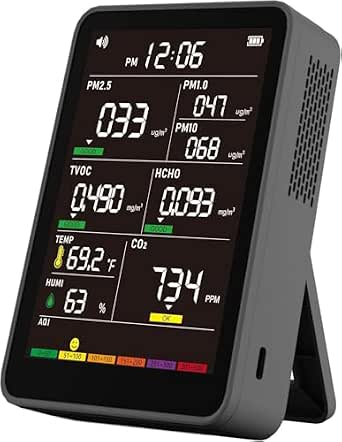 | Best for Portable On-Device Readings | Measurements: PM1.0, PM2.5, PM10, CO2, TVOC, HCHO, temperature, humidity | Sampling interval: 1.5 seconds | Display: HD color screen with color-coded readings | VIEW LATEST PRICE | See Our Full Breakdown |
| SONOFF AirGuard CO2 Smart Indoor Air Quality Monitor | 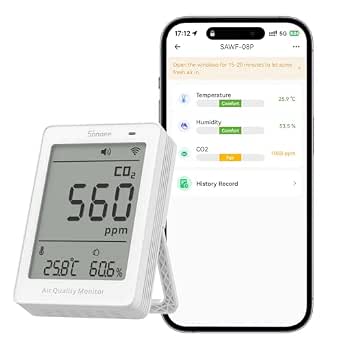 | Best for Matter Smart-Home Integration | Model: SAWF-08P | Measurements: CO2, temperature, humidity | CO2 range: 400–5000 ppm | VIEW LATEST PRICE | See Our Full Breakdown |
| AprilAire ZAWTHCPV Smart Wi-Fi Indoor Air Quality Monitor |  | Best for AprilAire System Owners | Model: ZAWTHCPV | Measurements: PM2.5, VOCs/TVOC, CO2, humidity, temperature | Connectivity: Wi-Fi | VIEW LATEST PRICE | See Our Full Breakdown |
| Lwyinp MT13S 10-in-1 Indoor Air Quality Monitor |  | Best for Portable, Screen-First Monitoring | Model: MT13S | Measurements: CO2, HCHO, TVOC, AQI, PM2.5, PM1.0, PM10, temperature, humidity, clock | Display: High-definition color screen with three-color air-quality visualization | VIEW LATEST PRICE | See Our Full Breakdown |
| BREATHE Airmonitor Plus Gen 2 Indoor Air Quality Monitor |  | Best for Broad Pollutant Tracking and Data History | Model: Airmonitor Plus Gen 2 (BTL40001) | Measurements: CO2, PM1, PM2.5, PM10, TVOC, formaldehyde (HCHO), temperature, humidity | CO2 sensor: NDIR | VIEW LATEST PRICE | See Our Full Breakdown |
| GoveeLife H5106 Smart Air Quality Monitor with LED Display |  | Best for Fast PM2.5 Updates and GoveeLife Automation | Model: H5106 | Measurements: PM2.5, temperature, humidity | PM2.5 accuracy: ±15 µg/m³ from 0–100 µg/m³; ±15% from 100–1000 µg/m³ | VIEW LATEST PRICE | See Our Full Breakdown |
| smart home air quality monitor | Connectivity | Measurements | Power |
|---|---|---|---|
| Kidde COPDLQW Smart Carbon Mon | 2.4 GHz Wi-Fi | — | 120V plug-in with two AA backup batteries |
| Amazon Smart Air Quality Monit | Alexa | — | — |
| Lecoolife AK22B 16-in-1 Indoor | — | — | — |
| GoveeLife H5140 Smart CO₂ Air | — | CO₂, temperature, and humidity | AC power via Type-C cable |
| Airthings View Plus Battery-Po | Wi-Fi | — | Battery-powered |
| Aranet4 Indoor Air Quality Mon | — | CO2, temperature, relative humidity, atmospheric pressure | Two included AA batteries |
| Amazon Smart Air Quality Monit | 2.4 GHz Wi-Fi and BLE 4.2 | PM2.5, VOCs, carbon monoxide, humidity, temperature | 5V, 1A (5W) |
| Sacnahe WiFi Indoor Air Qualit | 2.4 GHz Wi-Fi | AQI, CO2, PM1.0, PM2.5, PM10, TVOC, HCHO, temperature, humidity | — |
| Ring Air Quality Monitor with | Amazon Sidewalk | Carbon monoxide, PM2.5, temperature, humidity | 100–240 VAC, 50/60 Hz |
| 16-in-1 Indoor Air Quality Mon | — | PM1.0, PM2.5, PM10, CO2, TVOC, HCHO, temperature, humidity | — |
| SONOFF AirGuard CO2 Smart Indo | 2.4 GHz Wi-Fi; Matter compatible | CO2, temperature, humidity | — |
| AprilAire ZAWTHCPV Smart Wi-Fi | Wi-Fi | PM2.5, VOCs/TVOC, CO2, humidity, temperature | — |
| Lwyinp MT13S 10-in-1 Indoor Ai | Bluetooth for time calibration | CO2, HCHO, TVOC, AQI, PM2.5, PM1.0, PM10, temperature, humidity, clock | — |
| BREATHE Airmonitor Plus Gen 2 | 2.4 GHz Wi-Fi | CO2, PM1, PM2.5, PM10, TVOC, formaldehyde (HCHO), temperature, humidity | USB-C or battery |
| GoveeLife H5106 Smart Air Qual | Bluetooth and 2.4 GHz Wi-Fi | PM2.5, temperature, humidity | Type-C cable; no built-in battery |
More Details on Our Top Picks
Kidde COPDLQW Smart Carbon Monoxide Detector with Indoor Air Quality Monitoring
The Kidde COPDLQW is the strongest fit here for households that want carbon monoxide protection first, with indoor air readings as a useful addition. It monitors CO alongside temperature, humidity, and TVOCs, and its low-level CO alerts can flag readings below the stated 70 ppm alarm level. App notifications and Alexa and Google Home compatibility add smart-home access, while the AA battery backup helps maintain coverage during an outage.
Compared with the Amazon Smart Air Quality Monitor, Kidde puts more emphasis on dedicated CO detection and a loud 85 dB alarm, rather than broader air-quality routines. The tradeoff is its outlet-bound placement and need for 2.4 GHz Wi-Fi for smart alerts. Expanded air-quality insights also require an optional subscription, so it is less suited to buyers seeking a cable-free, all-in-one sensor.
Pros:- Combines CO detection with temperature, humidity, and TVOC monitoring.
- Low-level CO alerts and an 85 dB alarm prioritize safety.
- AA battery backup helps preserve protection during power outages.
- Rotating plug can fit vertical or horizontal outlets.
Cons:- Smart notifications require a 2.4 GHz Wi-Fi connection.
- Expanded air-quality insights require an optional paid subscription.
- Placement is limited to a standard 120V outlet.
Best for: Households that want a plug-in CO alarm with app alerts and a few additional indoor air readings.
Not ideal for: Buyers who need portable placement, broad particulate monitoring, or expanded air-quality insights without an optional subscription.
- Monitored measures:Carbon monoxide, temperature, relative humidity, and TVOCs
- Power:120V plug-in with two AA backup batteries
- Connectivity:2.4 GHz Wi-Fi
- Low-level CO alert range:30–70 ppm
- CO alarm level:70 ppm
- Alarm volume:85 dB
- Smart home compatibility:Amazon Alexa-enabled devices and Google Home
- Standards:UL 2034, 5th Edition; ETL Listed
- Warranty:10-year limited warranty
Our verdict“Choose the Kidde if CO safety and backup power matter more than portable placement or extensive air-quality measurements.”
Amazon Smart Air Quality Monitor (2-Pack)
This two-pack makes the most sense for Alexa households that want air readings in more than one room and a path from alerts to automatic action. Each monitor tracks PM2.5, VOCs, carbon monoxide, humidity, and temperature; Alexa can send notifications or announcements and run routines with compatible purifiers, fans, and dehumidifiers. That link between sensing and device control gives it a more active smart-home role than the Kidde COPDLQW, which is centered on CO alarms and outlet-based operation.
The tradeoff is a closed Alexa-centered experience: setup and detailed readings depend on the Alexa app, while routines only work with compatible devices. Compared with the Airthings View Plus, this pair lacks radon and air-pressure monitoring, but it offers two placements in the box and simpler plug-in setup. It suits buyers who want practical room-to-room alerts, not a platform-neutral or highly specialized monitoring system.
Pros:- Two monitors support coverage in separate rooms.
- Tracks PM2.5, VOCs, carbon monoxide, humidity, and temperature.
- Color-coded LED and Alexa app provide at-a-glance and detailed readings.
- Alexa Routines can link readings to compatible fans, purifiers, and dehumidifiers.
Cons:- Setup and detailed air-quality information require the Alexa app.
- Automation is limited to compatible Alexa devices.
- Does not monitor radon or air pressure like the Airthings View Plus.
Best for: Alexa users who want to monitor two rooms and trigger compatible air-treatment devices when readings worsen.
Not ideal for: Buyers who avoid Alexa, want radon monitoring, or need automations across a broad mix of smart-home platforms.
- Pack size:2 monitors
- Monitored factors:PM2.5, VOCs, carbon monoxide, humidity, and temperature
- Connectivity:Alexa
- Alerts:Phone notifications or announcements on Echo devices
- Automation:Alexa Routines for compatible devices
- Setup:Plug in and connect through the Alexa app
Our verdict“Pick this two-pack if Alexa routines and monitoring two rooms matter more than broad platform compatibility or radon detection.”
Lecoolife AK22B 16-in-1 Indoor Air Quality Monitor with 7-Inch Display
The Lecoolife AK22B stands out for people who want a large display with readings visible in the room, rather than relying on an app for everyday checks. Its 7-inch screen presents a broad set of measurements, including CO₂, PM1.0, PM2.5, PM10, HCHO, TVOC, temperature, humidity, and AQI. Adjustable brightness makes the display easier to live with across day and night, while threshold alerts and a mute function let buyers tailor audible warnings.
Compared with the GoveeLife H5140, Lecoolife covers more types of pollutants, while Govee offers app and email alerts, Alexa and Google Assistant support, and data export. The AK22B is a better match for local visual monitoring than connected automation. Its readings may be affected by perfumes or strong odors, and calibration can require manual adjustment, so it is less appealing to buyers who want minimal upkeep or dependable remote notifications.
Pros:- Large 7-inch display shows a wide range of readings in one place.
- Monitors CO₂, multiple particle sizes, HCHO, TVOC, temperature, and humidity.
- Adjustable brightness and a buzzer mute function suit different rooms and schedules.
- Built-in calibration support and adjustable alert thresholds provide user control.
Cons:- Perfumes and other strong odors may affect sensor readings.
- Manual calibration adjustments may be needed.
- The listed feature set does not include app alerts or smart-home integration.
Best for: People who want a large, always-visible screen for checking several air-quality readings in a room.
Not ideal for: Smart-home buyers who need app notifications, voice-assistant control, or a low-maintenance calibration routine.
- Model:AK22B
- Monitoring parameters:CO₂, PM1.0, PM2.5, PM10, HCHO, TVOC, temperature, humidity, AQI, and more
- Display:7-inch display with adjustable brightness
- Alerts:Buzzer with adjustable thresholds and mute function
- Calibration:Built-in calibration support
- Temperature units:°F and °C
- Time format:12-hour and 24-hour
- Item weight:1.5 pounds
Our verdict“Choose the Lecoolife if broad readings on a large local display matter more than app-based tracking and automation.”
GoveeLife H5140 Smart CO₂ Air Quality Monitor with Display and Alarm
The GoveeLife H5140 is a focused pick for buyers whose main question is whether indoor CO₂ is climbing. It tracks CO₂, temperature, and humidity, refreshes readings every five seconds, and pairs a display with buzzer, app, and email alerts. Its history can extend up to two years, with CSV export for people who want to compare trends rather than react only to the current reading. Alexa and Google Assistant support, plus linkage with select Govee devices, give it a stronger connected-monitoring role than the Lecoolife AK22B.
That focus also means less pollutant coverage: unlike the Airthings View Plus, the H5140 does not list radon, PM2.5, or VOC monitoring. It needs AC power, and its clock depends on an app connection. Outdoor calibration may be needed, so buyers seeking cable-free placement and a broader household air survey may prefer Airthings despite its app and account requirements.
Pros:- Tracks CO₂, temperature, and humidity with a five-second refresh rate.
- Offers buzzer, app, and email alerts with customizable thresholds.
- Stores up to two years of data and supports CSV export.
- Works with Alexa and Google Assistant and can link with select humidifiers and tower fans.
Cons:- Requires AC power for continuous operation.
- Monitors fewer pollutant types than the Airthings View Plus.
- Clock display requires an app connection, and outdoor calibration may be needed.
Best for: People who want frequent CO₂ updates, customizable remote alerts, and exportable history for a room or home office.
Not ideal for: Buyers who need battery-powered placement or measurements for radon, particulate matter, and VOCs in one monitor.
- Measurements:CO₂, temperature, and humidity
- CO₂ sensor:SCD4x photoacoustic NDIR
- CO₂ accuracy:±(40 ppm + 5%)
- Refresh rate:5 seconds
- Display:CO₂, temperature, humidity, and clock; clock requires app connection
- Alerts:Built-in buzzer, app notifications, and email reports
- Data history and export:Up to 2 years; CSV export
- Smart home compatibility:Alexa and Google Assistant; humidifier and tower fan linkage
- Power:AC power via Type-C cable
Our verdict“Pick the H5140 if CO₂ trends and connected alerts are your priority and you can place it near AC power.”
Airthings View Plus Battery-Powered Radon and Indoor Air Quality Monitor
The Airthings View Plus earns its place for buyers who want radon included in a broad indoor air picture. It continuously monitors radon, PM2.5, CO₂, VOCs, humidity, temperature, and air pressure, with an eInk display for at-a-glance readings and app access to trends and notifications. Battery power allows placement away from an outlet, while the option to connect with other Airthings monitors can help build a multi-room setup.
Compared with the two-pack Amazon Smart Air Quality Monitor, View Plus adds radon and air pressure, and its cable-free placement is more flexible. The tradeoff is reliance on the Airthings app, an account, and internet access; buyers who want Alexa-centered routines may find Amazon’s approach more direct. The product data also lists an extended five-year warranty only with registration within 30 days, so this is a better fit for committed, app-connected monitoring than for a fully offline setup.
Pros:- Monitors radon, PM2.5, CO₂, VOCs, humidity, temperature, and air pressure.
- Battery-powered design allows placement without an AC cable.
- Customizable eInk display and app provide readings, trends, and notifications.
- Can connect with other Airthings monitors for multi-room monitoring.
Cons:- Requires the Airthings app, an account, and internet access.
- Does not offer the Alexa Routine workflow described for the Amazon Smart Air Quality Monitor.
- The optional five-year extended warranty requires registration within 30 days.
Best for: Homeowners who want radon alongside common air-quality readings and need flexible placement without a power cable.
Not ideal for: Buyers who want offline monitoring, Alexa-based routines, or a simple plug-in device with no account requirement.
- Model:2960
- Sensors:Radon, PM2.5, CO₂, VOCs, humidity, temperature, and air pressure
- Connectivity:Wi-Fi
- Power:Battery-powered
- Display:Customizable eInk
- Radon detection method:Passive diffusion chamber sampling with alpha spectrometry
- Operating temperature:4–40°C (39–104°F)
- App requirement:Airthings app, account, and internet access required
- Extended warranty:Optional five-year extension; registration required within 30 days
Our verdict“Choose the View Plus if radon coverage and cable-free placement outweigh the need for offline access or Alexa routines.”
Aranet4 Indoor Air Quality Monitor with Wireless CO2 Detector
Aranet4 is the clearest fit for buyers focused on CO2 trends rather than the widest possible list of pollutants. Its NDIR sensor tracks CO2 alongside temperature, humidity, and atmospheric pressure, while the e-ink display and color-coded alerts make it easy to check conditions without opening an app. The optional buzzer adds an audible prompt when CO2 climbs. Compared with the Amazon Smart Air Quality Monitor, it concentrates on CO2 instead of adding particulate and carbon monoxide readings, but its battery operation and up-to-90-day app history suit people who want portable, ongoing tracking. Two AA batteries are included, with stated battery life of up to four years. The tradeoff is a narrower pollutant picture, and app history is capped at 90 days.
Pros:- NDIR sensor measures CO2 alongside temperature, humidity, and atmospheric pressure.
- E-ink screen and wireless operation support easy placement without a power cable.
- Color-coded alerts and optional buzzer flag elevated CO2.
- App offers graphs and up to 90 days of historical readings.
Cons:- Does not measure particulate matter, VOCs, or carbon monoxide.
- App history is limited to 90 days.
- Uses two AA batteries, which will eventually need replacement.
Best for: People monitoring CO2 in bedrooms, classrooms, or home offices who want a cable-free device and long battery life.
Not ideal for: Buyers seeking PM2.5, VOC, or carbon monoxide readings in one monitor, or a long-term archive beyond 90 days.
- Measurements:CO2, temperature, relative humidity, atmospheric pressure
- Sensor technology:NDIR
- Display:E-ink
- Alerts:Color-coded display and optional buzzer
- App history:Up to 90 days
- Power:Two included AA batteries
- Stated battery life:Up to four years
- Dimensions:2.76 x 2.76 x 0.94 inches
Our verdict“Choose Aranet4 if dependable, portable CO2 tracking matters more to you than measuring a broad mix of indoor pollutants.”
Amazon Smart Air Quality Monitor
This is the most automation-oriented pick in this group: it tracks PM2.5, VOCs, carbon monoxide, humidity, and temperature, then connects those readings to Alexa notifications and routines. That makes it a practical choice for households that want an air purifier or thermostat to respond to changing conditions, rather than just display numbers. Compared with the Aranet4, it covers more types of pollutants and offers deeper Alexa integration, but it is less suited to cable-free placement because it needs 5V power. Its color-coded LED gives a quick status check, while auto-calibration and self-cleaning features reduce some routine upkeep. The main tradeoff is ecosystem dependence: full functionality requires a compatible Alexa app and Echo setup. Humidity accuracy is also specified with a relatively wide ±10% margin.
Pros:- Tracks PM2.5, VOCs, carbon monoxide, humidity, and temperature.
- Alexa notifications and routines can connect readings to compatible home devices.
- Color-coded LED provides a quick at-a-glance status.
- Auto-calibration and self-cleaning capabilities are included.
Cons:- Requires 5V power, limiting placement compared with battery-powered Aranet4.
- Full functionality depends on a compatible Alexa app and Echo ecosystem.
- Humidity accuracy has a stated margin of ±10%.
Best for: Alexa households that want air readings to trigger purifier, thermostat, or other compatible-device routines.
Not ideal for: People who need a battery-powered monitor, prefer a platform-neutral setup, or require tighter humidity accuracy.
- Measurements:PM2.5, VOCs, carbon monoxide, humidity, temperature
- Connectivity:2.4 GHz Wi-Fi and BLE 4.2
- Power:5V, 1A (5W)
- Status indicator:Color-coded LED
- Compatibility:Echo Family Devices and Alexa App 2021.16 or later
- Dimensions:65 x 65 x 45 mm
- Weight:120 g
- Warranty:One-year limited
Our verdict“Pick this monitor if Alexa routines are central to how you want your home to respond to indoor air readings.”
Sacnahe WiFi Indoor Air Quality Monitor with App Control
Sacnahe gives buyers one of the broadest stated measurement lists here, spanning AQI, CO2, PM1.0, PM2.5, PM10, TVOC, HCHO, temperature, and humidity. Its color-coded LCD makes the readings easier to scan than a phone-only setup, and Smart Life or Tuya Smart adds remote monitoring and historical data. Compared with the 16-in-1 Indoor Air Quality Monitor, Sacnahe has Wi-Fi app access and a wall-mount option, while the other monitor emphasizes frequent on-device updates and audio prompts. Sacnahe can run from its rechargeable battery for portable checks, but its stated seven-to-15-hour runtime is not suited to continuous logging; the product recommends keeping it plugged in for long-term recording. It also requires 2.4 GHz Wi-Fi, and only one phone can connect at a time.
Pros:- Measures AQI, CO2, three particle sizes, TVOC, HCHO, temperature, and humidity.
- Color-coded LCD makes readings visible directly on the device.
- Smart Life and Tuya Smart provide remote monitoring and historical data.
- Rechargeable, portable design includes a wall-mount bracket.
Cons:- Battery runtime is approximately seven to 15 hours; continuous recording is recommended while plugged in.
- Requires 2.4 GHz Wi-Fi, and some newer routers may need compatibility mode.
- Only one phone can be connected at a time.
Best for: Buyers who want a wall-mountable monitor with a wide range of readings and remote access through Smart Life or Tuya Smart.
Not ideal for: Households needing uninterrupted battery-powered monitoring, multiple simultaneous app users, or a setup that avoids 2.4 GHz Wi-Fi.
- Measurements:AQI, CO2, PM1.0, PM2.5, PM10, TVOC, HCHO, temperature, humidity
- Connectivity:2.4 GHz Wi-Fi
- Compatible apps:Smart Life, Tuya Smart
- Display:High-definition LCD with color-coded air quality bars
- Battery capacity:3000 mAh
- Stated battery runtime:Approximately 7–15 hours
- Charging:USB-C
- Installation:Wall-mounted or portable
Our verdict“Choose Sacnahe if a broad set of readings, a built-in color display, and app access matter more than long cordless runtime.”
Ring Air Quality Monitor with CO and PM2.5 Monitoring
Ring’s monitor is a focused add-on for homes already using Ring devices, tracking carbon monoxide, PM2.5, temperature, and humidity and offering suggestions when conditions change. Amazon Sidewalk can help it stay connected in areas with weak coverage, though availability depends on local Sidewalk reach. That makes it a different proposition from the Amazon Smart Air Quality Monitor: Ring covers CO and particulates but does not list VOCs, and its connectivity is tied to Sidewalk rather than the other monitor’s Wi-Fi and Alexa routines. The device plugs into household power, so it is not a portable, battery-operated sensor. Buyers also need to treat its CO reading as supplemental: it is not a certified carbon monoxide alarm, and it does not measure CO2 or radon.
Pros:- Tracks carbon monoxide, PM2.5, temperature, and humidity.
- Provides suggestions when monitored air conditions change.
- Amazon Sidewalk may help maintain connectivity in hard-to-reach areas.
- Can pair with compatible Ring environmental sensors and alarm listeners.
Cons:- Not a certified carbon monoxide alarm or detector.
- Does not measure CO2 or radon.
- Sidewalk connectivity depends on coverage in the home’s location.
Best for: Ring households that want supplemental CO and PM2.5 monitoring and already have compatible Ring environmental devices.
Not ideal for: Anyone relying on this as a life-safety CO alarm, or buyers who need CO2, radon, or a portable battery-powered monitor.
- Measurements:Carbon monoxide, PM2.5, temperature, humidity
- Connectivity:Amazon Sidewalk
- Power:100–240 VAC, 50/60 Hz
- PM2.5 range:0–500 µg/m³
- CO range:0–70 ppm
- Operating conditions:32°F to 120°F (0°C to 49°C)
- Dimensions:1.83 x 2.56 x 2.56 inches
- Warranty:One-year limited
Our verdict“Choose Ring as a supplemental monitor for a compatible Ring setup, never as a replacement for a certified CO alarm.”
16-in-1 Indoor Air Quality Monitor with HD Color Display
This monitor suits buyers who want a quick, broad air snapshot on the device itself, with readings for PM1.0, PM2.5, PM10, CO2, TVOC, HCHO, temperature, and humidity refreshed every 1.5 seconds. Its color-coded HD screen and adjustable audio prompts make it easy to check conditions without relying on an app. Compared with the Sacnahe PV33, this model highlights faster stated sampling and audio prompts, while Sacnahe adds Wi-Fi remote monitoring and historical data. Portability is useful for checking different rooms, but the rechargeable battery lasts only four to five hours, so extended monitoring means staying near a power source. The description also gives no measurement accuracy or operating ranges, making it harder to judge how precise its readings are than the more specifically documented Aranet4.
Pros:- Tracks particulate sizes, CO2, TVOC, HCHO, temperature, and humidity.
- Color-coded HD display presents readings on the device.
- Stated 1.5-second sampling interval gives frequent updates.
- Includes USB Type-C cable and AC adapter for charging or powered use.
Cons:- Continuous battery use is limited to four to five hours per charge.
- Product details do not specify measurement accuracy or operating ranges.
- No app connectivity or remote history is listed.
Best for: People who want to carry a monitor between rooms and read multiple pollutant indicators directly from a color display.
Not ideal for: Buyers needing all-day cordless operation, app-based remote history, or published accuracy and measurement ranges.
- Measurements:PM1.0, PM2.5, PM10, CO2, TVOC, HCHO, temperature, humidity
- Sampling interval:1.5 seconds
- Display:HD color screen with color-coded readings
- Audio prompts:Adjustable; toggle by double-tapping
- Battery life:Four to five hours of continuous sampling
- Charging:USB Type-C; AC adapter included
- Item weight:14.4 ounces
- Warranty support:12 months
Our verdict“Pick this model for portable, on-screen readings across several air indicators, but skip it if you need long battery runtime or published accuracy details.”
SONOFF AirGuard CO2 Smart Indoor Air Quality Monitor
The SONOFF AirGuard is a strong fit for buyers who want CO2 readings to trigger or inform a connected-home routine, rather than just appear on a screen. Its Matter compatibility supports Apple Home, Alexa, Google Home, SmartThings, and Home Assistant, giving it broader stated platform reach than the app-focused AprilAire ZAWTHCPV. The NDIR sensor refreshes CO2 readings every five seconds, and the display combines CO2, temperature, and humidity so a stuffy room is easier to distinguish from one that is simply warm or damp.
The tradeoff is a narrower measurement set: unlike the BREATHE Airmonitor Plus Gen 2, it does not monitor particulate matter, VOCs, or formaldehyde. It also needs continuous power and uses 2.4 GHz Wi-Fi. Choose it for smart-home coordination and CO2 awareness, not broad pollutant coverage or portable monitoring.
Pros:- Matter compatibility supports several major smart-home platforms.
- NDIR CO2 readings refresh every five seconds.
- Shows CO2, temperature, and humidity together.
- App offers customizable alerts and up to 12 months of history.
Cons:- Does not measure PM2.5, VOCs, or formaldehyde, unlike the BREATHE Airmonitor Plus Gen 2.
- Requires continuous power and is limited to 2.4 GHz Wi-Fi.
Best for: Smart-home owners who want CO2, temperature, and humidity readings connected to Matter-compatible platforms and alerts.
Not ideal for: Buyers who need particle, VOC, or formaldehyde monitoring, or who want a battery-powered monitor they can move freely.
- Model:SAWF-08P
- Measurements:CO2, temperature, humidity
- CO2 range:400–5000 ppm
- CO2 accuracy:±(50 ppm + 5%)
- Response time:5 seconds
- Connectivity:2.4 GHz Wi-Fi; Matter compatible
- Mounting and display:Wall mount; real-time display with multicolor LED indicator
- App features:Customizable notifications; up to 12 months of historical data with charts and export
Our verdict“Pick the SONOFF AirGuard if Matter-based smart-home integration and frequent CO2 updates matter more than tracking a wider range of pollutants.”
AprilAire ZAWTHCPV Smart Wi-Fi Indoor Air Quality Monitor
The AprilAire ZAWTHCPV earns its place for buyers who want several pollutant and comfort readings paired with plain-language guidance. It tracks PM2.5, VOCs, CO2, humidity, and temperature, while the Healthy Air app adds alerts and measurement trends. That makes it a broader monitor than the CO2-and-comfort-focused SONOFF AirGuard, and more guidance-oriented than the GoveeLife H5106, which centers on PM2.5, temperature, and humidity.
Its strongest case is in a home already using compatible AprilAire equipment: integration with certain thermostats or air-quality systems can connect readings to a larger setup. But that link requires separately purchased compatible hardware, and the app is required for operation. Buyers without AprilAire equipment still get broad measurements, but should not expect the monitor alone to control filtration or ventilation. The adjustable indicator lights are useful if a bright status display would bother you.
Pros:- Tracks PM2.5, VOCs, CO2, humidity, and temperature in one device.
- App provides alerts, trends, explanations, and suggested responses.
- Indicator lights can be set to default, always on, or always off.
- Offers a three-year warranty.
Cons:- Requires the AprilAire Healthy Air app to function.
- System integration needs a compatible thermostat and separately sold equipment.
- Unlike the SONOFF AirGuard, the listed connectivity does not specify Matter or broad smart-home platform support.
Best for: Households using compatible AprilAire thermostats or air-quality systems that want broad readings and app-based guidance.
Not ideal for: Buyers seeking a standalone monitor with broad platform integration or who do not want to rely on a required brand-specific app.
- Model:ZAWTHCPV
- Measurements:PM2.5, VOCs/TVOC, CO2, humidity, temperature
- Connectivity:Wi-Fi
- App:AprilAire Healthy Air app required
- Indicator light settings:Default, always on, or always off
- System integration:Requires AprilAire Wi-Fi Thermostat Model S86WMUPR or 8920W
- Warranty:3 years
- Included items:Healthy Air Monitor and power supply
Our verdict“Choose the AprilAire if you want pollutant breadth and already use, or plan to add, compatible AprilAire equipment.”
Lwyinp MT13S 10-in-1 Indoor Air Quality Monitor
The Lwyinp MT13S suits buyers who want a wide spread of readings visible on the device, without making app connectivity the center of the experience. Its color screen presents CO2, formaldehyde, TVOC, PM1.0, PM2.5, PM10, temperature, humidity, AQI, and a clock. That is a broader listed set than the GoveeLife H5106, which focuses on PM2.5 and comfort readings, and the MT13S is intended for use in homes, offices, and vehicles.
Its portability and on-screen access come with a meaningful data-quality caveat: the product information does not give measurement ranges or accuracy figures. Bluetooth is listed for clock calibration, not remote monitoring or smart-home routines, so it is less connected than the SONOFF AirGuard or BREATHE Airmonitor Plus Gen 2. This is a better match for people who want a locally readable snapshot than for buyers who need verified precision, long-term app history, or automation.
Pros:- Lists measurements for gases, particulate matter, and comfort conditions.
- Color display shows live readings with three-color air-quality visualization.
- Portable design is intended for homes, vehicles, offices, and other indoor spaces.
- Offers Celsius/Fahrenheit selection and sound and screen controls.
Cons:- Measurement ranges and accuracy figures are not specified.
- Bluetooth is listed for clock calibration, not app-based remote monitoring.
- Unlike the BREATHE Airmonitor Plus Gen 2, no long-term history, alerts, or data export are listed.
Best for: People who want a portable, screen-based overview of several air indicators across rooms, offices, or vehicles.
Not ideal for: Buyers who need published accuracy and measurement ranges, remote monitoring, or smart-home automations.
- Model:MT13S
- Measurements:CO2, HCHO, TVOC, AQI, PM2.5, PM1.0, PM10, temperature, humidity, clock
- Display:High-definition color screen with three-color air-quality visualization
- Connectivity:Bluetooth for time calibration
- Temperature units:Celsius and Fahrenheit
- Controls:Sound, screen sleep, and calibration controls
- Color:Black
- Included items:Air quality monitor, charging cable, user manual
Our verdict“Choose the MT13S for a portable, on-device snapshot across many readings, but skip it if documented accuracy or connected-home features are priorities.”
BREATHE Airmonitor Plus Gen 2 Indoor Air Quality Monitor
The BREATHE Airmonitor Plus Gen 2 is the most data-oriented pick in this group for buyers who want to review changes over time. It measures eight categories, including NDIR CO2, PM1, PM2.5, PM10, TVOC, formaldehyde, temperature, and humidity, then pairs readings with custom alerts, trend graphs, 90-day history, and CSV export. Compared with the SONOFF AirGuard, it covers more pollutant types; unlike the AprilAire ZAWTHCPV, the listed app tools include CSV export.
USB-C power and up to six hours unplugged allow brief repositioning, though that is not the same as an always-ready battery monitor. Wi-Fi is limited to 2.4 GHz, and the safety distinction matters: it measures CO2, not carbon monoxide, gas leaks, or smoke. It is designed for indoor use and does not replace dedicated CO or smoke alarms. Choose it for pollutant breadth and reviewable records, not life-safety detection.
Pros:- Tracks eight air-quality and environmental measurements, including particulate matter and formaldehyde.
- Uses an NDIR sensor for CO2 measurement.
- App offers custom CO2 and PM2.5 alerts, trend graphs, 90-day history, and CSV export.
- USB-C powered with up to six hours of unplugged runtime.
Cons:- Wi-Fi is limited to 2.4 GHz.
- Does not detect carbon monoxide, gas leaks, or smoke and cannot replace dedicated alarms.
- Unplugged runtime is limited to up to six hours, unlike a monitor designed for extended battery use.
Best for: Homeowners who want several pollutant readings, custom alerts, and exportable history for tracking indoor changes.
Not ideal for: Buyers seeking a true long-term battery monitor, outdoor readings, or carbon monoxide, gas-leak, or smoke detection.
- Model:Airmonitor Plus Gen 2 (BTL40001)
- Measurements:CO2, PM1, PM2.5, PM10, TVOC, formaldehyde (HCHO), temperature, humidity
- CO2 sensor:NDIR
- Connectivity:2.4 GHz Wi-Fi
- App features:Remote readings, custom CO2 and PM2.5 alerts, trend graphs, 90-day history, CSV export
- Power:USB-C or battery
- Unplugged runtime:Up to 6 hours
- Warranty:2 years
Our verdict“Pick the BREATHE if broad pollutant coverage and exportable trend data outweigh the need for extended battery operation or safety alarms.”
GoveeLife H5106 Smart Air Quality Monitor with LED Display
The GoveeLife H5106 is a focused choice for households more concerned with particulate changes than with CO2 or gas readings. It measures PM2.5, temperature, and humidity, refreshes data every two seconds, and can trigger compatible GoveeLife devices based on air-quality settings. That makes it more useful for a GoveeLife automation setup than the screen-first Lwyinp MT13S, while the BREATHE Airmonitor Plus Gen 2 is the stronger alternative if you also want CO2, VOC, and formaldehyde monitoring.
Bluetooth and 2.4 GHz Wi-Fi support remote readings, graphs, and exports, but it needs a Type-C power connection and has no built-in battery. Its PM2.5 accuracy is specified as ±15 µg/m³ up to 100 µg/m³ and ±15% above that, so buyers should weigh the stated tolerance when interpreting readings. This is a practical connected particle monitor, not a whole-spectrum air-quality instrument.
Pros:- Refreshes PM2.5, temperature, and humidity readings every two seconds.
- Supports Bluetooth and 2.4 GHz Wi-Fi for remote monitoring.
- Offers data graphs and export options.
- Can trigger compatible GoveeLife devices based on air-quality settings.
Cons:- Requires continuous Type-C power and has no built-in battery.
- Does not measure CO2 or VOCs, unlike the BREATHE Airmonitor Plus Gen 2.
- PM2.5 accuracy is specified as ±15% at concentrations from 100 to 1000 µg/m³.
Best for: GoveeLife users who want quick PM2.5 updates, comfort readings, and automations for compatible appliances.
Not ideal for: Buyers who need CO2, VOC, or formaldehyde measurements, or who want a battery-powered monitor they can place anywhere.
- Model:H5106
- Measurements:PM2.5, temperature, humidity
- PM2.5 accuracy:±15 µg/m³ from 0–100 µg/m³; ±15% from 100–1000 µg/m³
- Temperature accuracy:±0.54°F
- Humidity accuracy:±3% RH
- Response time:2 seconds
- Connectivity:Bluetooth and 2.4 GHz Wi-Fi
- Power:Type-C cable; no built-in battery
- Data storage:13-day graphs; export data from the past 2 years
Our verdict“Choose the H5106 if PM2.5 monitoring and GoveeLife device automation are your priorities, not broad pollutant coverage or portability.”
How We Picked
I ranked these smart home air quality monitors by how well their sensing, alerts, and connected features serve a distinct household need. I gave more weight to clearly defined monitoring goals—such as radon, CO₂, or particulate matter—than to a large sensor count alone. I also considered whether the display and app make readings understandable, how the device fits into a smart-home setup, and whether its power and placement needs suit everyday use.
The order reflects practical usefulness, not a claim that every model measures the same things or has been independently tested here. Models with clearly differentiated monitoring roles rank ahead of devices whose broad feature counts may require buyers to verify sensor coverage and app details. I also accounted for tradeoffs: a specialist can be easier to interpret but miss other pollutants, while a multi-sensor unit may provide more readings with added setup or explanation demands. Life-safety functions are treated as a separate benefit, not a substitute for dedicated alarms.
Factors to Consider When Choosing Smart Home Air Quality Monitors
Before choosing a monitor, match its measurements to the concern you actually want to track. I would start with the room, pollutant, and response you care about, then check how the device presents changes over time and fits into your household routine.
Choose Measurements Based on the Problem
“Air quality” can mean very different things: CO₂ can help flag stale air and ventilation needs, particulate matter can be relevant to smoke or dust, and radon calls for a dedicated measurement approach. A monitor that lists many readings is not automatically the right choice if it omits the one you need or makes its results hard to interpret. Start by identifying a specific concern, such as a basement radon question or a bedroom that feels stuffy overnight. Then confirm the exact sensor types and what the manufacturer says each reading represents. Avoid treating a general air score as a diagnosis or as a substitute for a targeted test when the concern calls for one.
Separate Monitoring From Life-Safety Alarms
Air-quality devices and dedicated smoke or carbon monoxide alarms serve different jobs, even when a product combines monitoring features. A smart notification can be useful when you are away, but it depends on power, connectivity, app settings, and notification permissions. For fire or carbon monoxide protection, follow local requirements and the alarm maker’s placement and maintenance instructions. Do not remove or replace a required alarm because another device reports a related reading. If you are buying a combined unit, check exactly what it detects and whether it is certified for the safety function you expect.
Think About Where Readings Will Be Useful
One monitor cannot represent every room, because ventilation, cooking, heating, and occupancy can create different conditions across a home. A single device is a sensible start when you have one clear priority room; a multi-room setup can help reveal whether a concern is localized or widespread. Placement matters too: follow the maker’s instructions and avoid assuming that a reading beside a window, vent, or appliance reflects the whole room. Multi-packs can simplify room-to-room comparisons, but only if the devices measure comparable indicators and their apps present the readings in a useful way. Decide whether you need a portable unit, a fixed location, or several monitors before choosing a format.
Check How the App Turns Data Into Action
A stream of numbers is useful only when you can tell what changed and what to do next. Check whether alerts are adjustable, whether readings are available away from home, and whether the app keeps a history rather than showing only current conditions. Smart-home compatibility can add value if you already use that ecosystem, but a device that depends on an unfamiliar platform may create more friction than convenience. Also review whether key features require an account, cloud access, or a particular hub. For a less technical household, clear labels and simple notifications may matter more than extra charts.
Balance Display Convenience Against Detail
A built-in screen lets you check conditions without opening an app, which can make a monitor more useful in a shared space. Larger displays and multi-sensor dashboards can expose more information at a glance, but crowded screens may leave new users unsure which reading deserves attention. App-first models can offer history and remote alerts while keeping the device compact, though they require a phone for routine checks. Consider who will read the monitor and where it will sit: a wall or desk display can suit a family room, while a smaller unit may be easier to move. Choose the interface you are likely to use consistently, rather than the one with the longest feature list.
Account for Power, Upkeep, and Calibration
Power choices affect where a monitor can go and how often someone must maintain it. Battery-powered units can be easier to place away from outlets, while plugged-in models may suit a fixed location but need accessible power. Before buying, check the manufacturer’s guidance on sensor calibration, maintenance, software support, and any parts that need replacement. These details matter especially for a device intended to run continuously or monitor a specific long-term concern. A lower-maintenance model may be the better household fit even if another unit offers more measurements or a larger display.
Frequently Asked Questions
Should I choose a monitor that measures many pollutants or one focused on CO₂?
Choose based on the question you want the device to answer. A CO₂-focused monitor can make ventilation patterns easier to follow, while a broader unit may cover other concerns such as radon or particulate matter. A high sensor count does not prove that every measurement is relevant to your home or equally clear in the app. Check the listed sensor types, the manufacturer’s explanations, and whether the readings support the action you plan to take. If you have a specific health or building concern, a targeted test or qualified professional may be more appropriate than relying on a general-purpose monitor alone.
Can a smart air quality monitor replace my carbon monoxide alarm?
No general-purpose air monitor should be assumed to replace a dedicated carbon monoxide alarm. Even when a product includes CO monitoring, verify that it is designed and certified for the alarm function required where you live. Follow local codes and the manufacturer’s instructions for installation, placement, and maintenance. Smart alerts can add a useful layer of awareness, but they rely on the device and connected services working as intended. Keep required life-safety alarms in place unless local authorities or the manufacturer provide clear guidance that a specific product meets that role.
Do I need more than one monitor for my home?
It depends on whether your rooms have different conditions and whether you need a whole-home picture or a focused reading. Kitchens, basements, bedrooms, and rooms with different ventilation can behave differently, so one device may not capture every pattern. A multi-room setup is most useful when the units track comparable measurements and you will use the results to investigate differences. If you are uncertain, start in the room tied to your main concern and observe whether that answers your question. Add another monitor only when a specific room or comparison would provide useful information.
How much should I rely on a monitor’s air-quality score?
Use a combined score as a quick signal, not as a replacement for understanding the underlying readings. Different devices may calculate scores from different sensors or scales, so scores may not be directly comparable across brands. Look at which measurement changed, whether the device provides a trend history, and whether the change corresponds with an event such as cooking or opening a window. Follow the manufacturer’s guidance for interpreting readings rather than assuming a single score captures every risk. If the result relates to a serious or persistent concern, confirm it through an appropriate test or professional assessment.
What should I check before buying a monitor for Alexa or another smart-home system?
Confirm the exact platform support for the model you are considering, rather than assuming that every product from a brand works with every ecosystem. Check whether voice assistants can show readings, deliver alerts, or only trigger basic routines; those capabilities are not always the same. Find out whether the monitor needs a hub, a stable Wi-Fi connection, an account, or cloud access for its main functions. Consider what happens if the internet is down, especially if you expect local readings or alarms to remain available. Pick the ecosystem fit that makes routine checks easier without relying on connected features for essential safety protection.
Conclusion
For the best overall coverage, I would start with the Airthings View Plus, particularly if radon monitoring is part of the goal. The best value-style choice for an Alexa household is the Amazon Smart Air Quality Monitor, while its two-pack makes more sense when comparing rooms. For a premium, CO₂-first setup, the Aranet4 is the focused alternative; for beginners, Amazon’s simpler smart-home path is easier to approach than a dense multi-reading display. Choose the Kidde or Ring option only when its specific safety-monitoring role fits your needs, and keep required dedicated alarms in place. If you want a large number of readings on-device, compare the Lecoolife AK22B and other multi-sensor displays by verified sensor coverage and clarity—not by the number of measurements alone.
Fall Picks

DJI Osmo Action 4 Essential Combo Waterproof 4K Action Camera
As an affiliate, we earn on qualifying purchases.