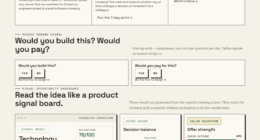

📊 Full opportunity report: Why SAP’s AI Focus Is On System Ownership, Not Brain Leasing on ThorstenMeyerAI.com — validation score, market gap, and execution plan.
TL;DR
SAP’s AI approach centers on controlling enterprise data and infrastructure, not on leasing AI models. This strategy leverages its existing data dominance and architecture to maintain a competitive edge in enterprise AI.
SAP’s AI strategy in 2026 is focused on owning and controlling enterprise data and infrastructure rather than leasing or building AI models. This approach aims to leverage SAP’s dominant position in global business transactions, ensuring that its AI tools operate over permissioned, structured data rather than open internet models. SAP’s recent deployment of Joule across multiple solutions exemplifies this shift, emphasizing system integration and data ownership as the foundation for enterprise AI.
As of mid-2026, SAP’s Joule AI layer is active across more than 35 enterprise solutions, including S/4HANA Cloud, SuccessFactors, and Ariba. SAP reports that Joule has over 30 specialized agents and 2,500 skills, with plans to expand to 50 agents and 200 skills by Q3 2026. The company has also committed €100 million to a partner fund aimed at developing custom agents via Joule Studio, its low-code agent builder. These developments are accompanied by concrete customer success stories, such as a retailer reducing HR cycle times by up to 60% and an airport operator cutting costs significantly.
Strategically, SAP’s architecture hinges on the Knowledge Graph, which allows Joule to access structured, permissioned enterprise data directly from its Business Technology Platform. This enables context-rich, accurate AI responses tailored to specific business workflows, setting SAP apart from frontier labs that rely on open internet models. Additionally, SAP’s model-agnostic approach involves consuming third-party foundation models, orchestrated through Joule, to maintain flexibility and avoid dependence on any single model provider.
Own the system of record.
Rent nobody’s brain.
SAP’s AI bet is the incumbent’s inversion of the frontier race: don’t build the smartest model — own the data smart models are useless without, and meter access through Joule, an orchestration layer indifferent to which model wins.
The stack — where SAP chose to stand
You can switch AI vendors in an afternoon. You cannot switch your general ledger.
Honest bull / bear
Bull
- Best data-layer position of any incumbent — the one place hyperscalers can’t reach
- Knowledge Graph is context no model scale substitutes for
- Model-agnostic: owns the layer above commoditizing models
- Named, operational customer outcomes (40–60% HR cycle time, 90% admin cut)
Bear
- Consumption pricing is hard for CFOs to forecast — adoption stalls
- “Activated” ≠ “adopted”: the €100M fund admits demand needs subsidizing
- Depends on frontier models it doesn’t control
- Innovation tax: everything must work across a regulated installed base

The Enterprise Data Catalog: Improve Data Discovery, Ensure Data Governance, and Enable Innovation
As an affiliate, we earn on qualifying purchases.
As an affiliate, we earn on qualifying purchases.
Implications of SAP’s Data-Centric AI Approach
This strategy allows SAP to maintain a competitive advantage in enterprise AI by controlling the data and infrastructure that underpin AI models. It reduces reliance on external models, mitigates risks related to data governance, and aligns AI deployment with existing mission-critical systems. However, it also introduces challenges, such as variable AI costs and dependence on third-party models, which could impact adoption and scalability if not managed effectively.

AI for Small Business: From Marketing and Sales to HR and Operations, How to Employ the Power of Artificial Intelligence for Small Business Success (AI Advantage)
As an affiliate, we earn on qualifying purchases.
As an affiliate, we earn on qualifying purchases.
SAP’s Enterprise AI Evolution and Strategic Positioning
Historically, SAP has dominated enterprise transaction data, including purchase orders, invoices, payroll, and supply chain data, especially within large corporations like Fortune 500 companies and German Mittelstand firms. Its move into AI reflects a shift from building large, general-purpose models to leveraging its data moat. The company’s focus on structured, permissioned data and its Knowledge Graph infrastructure are core to this evolution, enabling AI that is trustworthy, auditable, and tailored to enterprise needs.
Recent years have seen SAP invest heavily in AI infrastructure, including the acquisition of Prior Labs and the launch of Joule. The company’s architecture aims to be model-agnostic, orchestrating third-party foundation models while maintaining control over enterprise data. This approach contrasts with frontier labs’ focus on training and scaling large models, positioning SAP as a provider of enterprise-specific AI services rooted in existing data assets.
“Joule is designed to read business metadata directly from our platform, ensuring AI responses are contextually accurate and trustworthy.”
— SAP spokesperson

AI Agent Builders: The Complete Guide to Building, Training, Deploying & Launching Your Own AI Agent
As an affiliate, we earn on qualifying purchases.
As an affiliate, we earn on qualifying purchases.
Uncertainties Around Adoption and Cost Management
It remains unclear how effectively SAP can drive widespread adoption of Joule given the variable costs associated with AI usage and the need for organizations to reduce custom code. The impact of reliance on third-party models and potential shifts in model pricing or capabilities also pose risks to SAP’s strategy. Additionally, the pace at which customers operationalize AI solutions and realize measurable ROI is still uncertain.

The Big Book of Tools for Collaborative Teams in a PLC at Work® (An explicitly structured guide for team learning and implementing collaborative PLC strategies)
As an affiliate, we earn on qualifying purchases.
As an affiliate, we earn on qualifying purchases.
Next Steps for SAP’s Enterprise AI Strategy
SAP is likely to continue expanding Joule’s capabilities and integrations, with a focus on increasing agent count and customer success stories. Monitoring how organizations adopt and operationalize these AI tools, as well as managing costs and dependencies on third-party models, will be critical. The company may also refine its pricing models and partner ecosystem to facilitate broader deployment and ROI realization.
Key Questions
Why does SAP focus on system ownership rather than building models?
SAP’s strategy is rooted in controlling the enterprise data and infrastructure that AI depends on, which offers a defensible moat and reduces dependency on external models and open internet data sources.
What is Joule and how does it differ from other AI solutions?
Joule is an AI layer integrated into SAP’s enterprise solutions, designed to read structured, permissioned business data via the Knowledge Graph, providing contextually accurate, trustworthy responses rather than generic internet-based answers.
What are the main risks associated with SAP’s AI approach?
Risks include variable AI costs tied to usage, dependence on third-party foundation models, and slow adoption or operationalization by customers, which could limit ROI and scalability.
How does SAP plan to expand Joule’s capabilities?
SAP intends to increase the number of agents and skills, develop custom solutions via its partner fund, and deepen integration across its enterprise solutions to enhance AI-driven workflows.
Why is SAP’s data moat considered a competitive advantage?
Because SAP owns and controls vast amounts of permissioned, structured enterprise data, it can deliver AI solutions that are more accurate, trustworthy, and compliant than models relying on open internet data.
Source: ThorstenMeyerAI.com