


In the world of wide-area motion imagery (WAMI), accurately tracking multiple objects across large scenes is a complex challenge. These systems must maintain consistent identities for moving targets, a task that becomes increasingly difficult as the scene density and environmental conditions worsen. CORVUS ISR, a leading WAMI exploitation platform, has recently published a public tracker benchmark showcasing its latest advancements in multi-object tracking (MOT).
The benchmark pits two models against each other: the baseline v1 ‘greedy nearest-neighbour’, which uses a simple two-pass association with fixed velocity prediction, and the newer v2 ‘confirmed-track auction’, which introduces a sophisticated three-tier auction-based association paired with velocity consistency gating and noise-scaled reservation pricing. The results demonstrate a significant reduction in identity switches, a key metric in evaluating tracking quality, especially in high-density scenes.
Specifically, in a test scenario with 150 movers at 2 frames per second, the v2 model reduced identity switches from 2,042 to 1,183 per minute—an impressive 42.1% improvement. When scaled to denser scenes with 400 movers, the switch count dropped from 14,032 to 8,040, a 42.7% decrease. This metric, which counts every change in the track identity assigned to a ground-truth object, is intentionally strict, capturing even re-acquisitions and fragmentations.
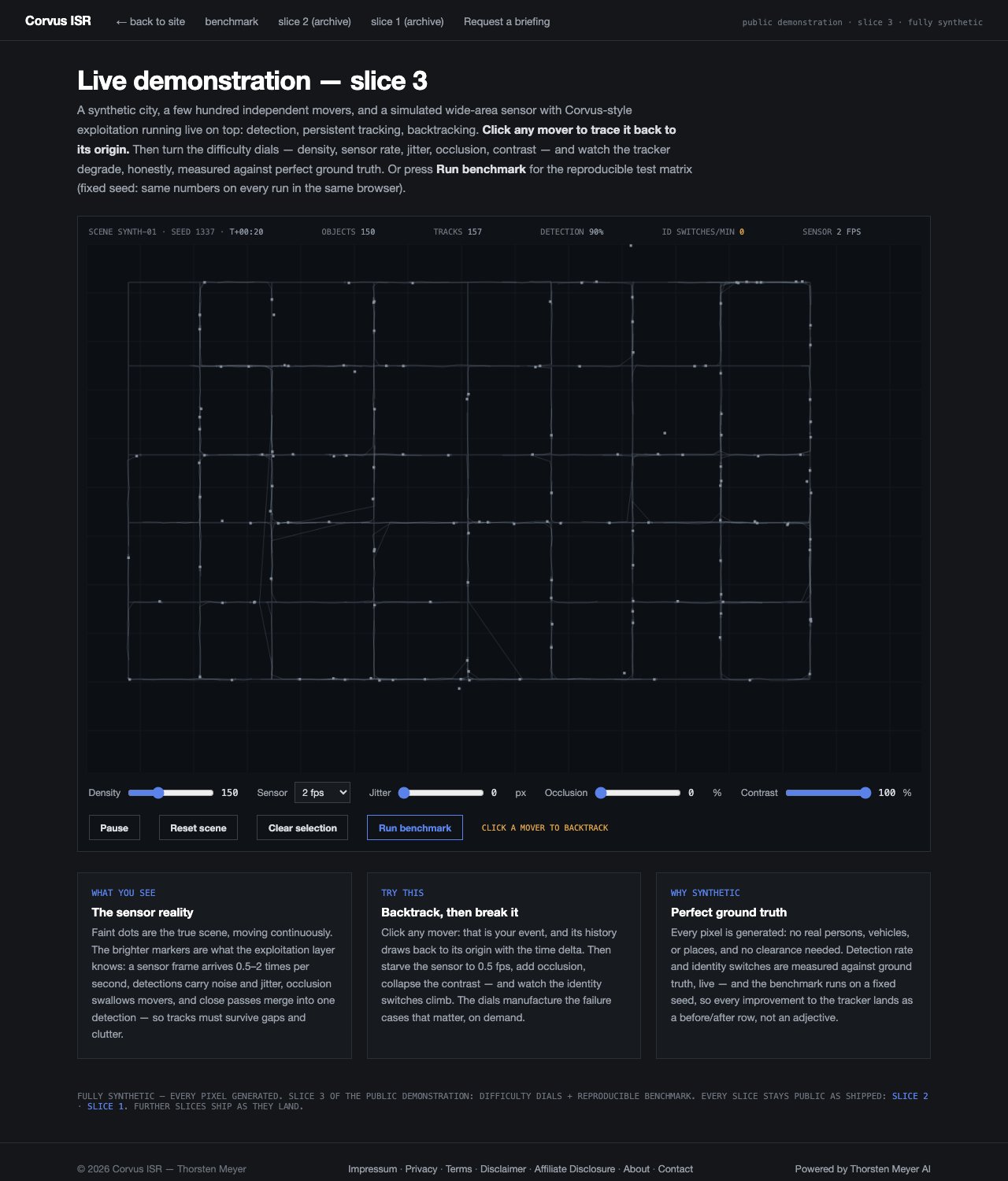
Interestingly, the benchmark also reveals how environmental factors influence tracking performance. Under frame-starved conditions (0.5 fps), the switch rate increased by only 16.6%, while occlusion and degraded image quality caused drops of about 18%. Despite these challenges, the v2 tracker maintains a real-time average of approximately 1.2 milliseconds per sensor tick at a density of 400 objects, comfortably fitting within a 10ms processing budget — all in the browser, with no special hardware or signup needed.
It’s worth noting that both models still commit thousands of identity errors per minute under stress, even with perfect ground truth scenes. These failure numbers are shared openly to promote transparency. As the benchmark uses synthetic scenes, the data is purely measurement-based, underscoring the importance of publicly available metrics over marketing claims.
For tech enthusiasts interested in reproducing the results, the live demo offers a straightforward way to run the benchmark directly in your browser. Open the demo, click ‘Run benchmark,’ and see firsthand how the auction-based tracker outperforms the baseline. Experiment yourself and witness the power of AI-driven multi-object tracking in action.

Data Association for Multi-Object Visual Tracking (Synthesis Lectures on Computer Vision)
As an affiliate, we earn on qualifying purchases.
As an affiliate, we earn on qualifying purchases.

JetBot AI Kit Based on Jetson Nano to Build Smart AI-Based Robot JetBot with Front Camera Eye and ROS Nodes Code Dual Mode Wireless WiFi Bluetooth Facial Recognition Object Tracking etc @XYGStudy
Part Number: JetBot AI Kit Acce
As an affiliate, we earn on qualifying purchases.
As an affiliate, we earn on qualifying purchases.
wide-area motion imagery system
As an affiliate, we earn on qualifying purchases.
As an affiliate, we earn on qualifying purchases.

Accelerated Image Processing in Hardware: Detection and Tracking of Binary Large Objects in Realtime
As an affiliate, we earn on qualifying purchases.
As an affiliate, we earn on qualifying purchases.