
📊 Full opportunity report: Apple Silicon’s Quiet Memory Advantage on ThorstenMeyerAI.com — validation score, market gap, and execution plan.
Listen free for 30 days with Audible
Thousands of audiobooks and originals — cancel anytime.
Start your free trialAs an affiliate, we earn on qualifying purchases.
TL;DR
Apple Silicon’s unified memory architecture allows running larger AI models locally without multi-GPU setups, providing capacity advantages at the expense of raw speed. This makes Macs a compelling choice for large-model inference in 2026.
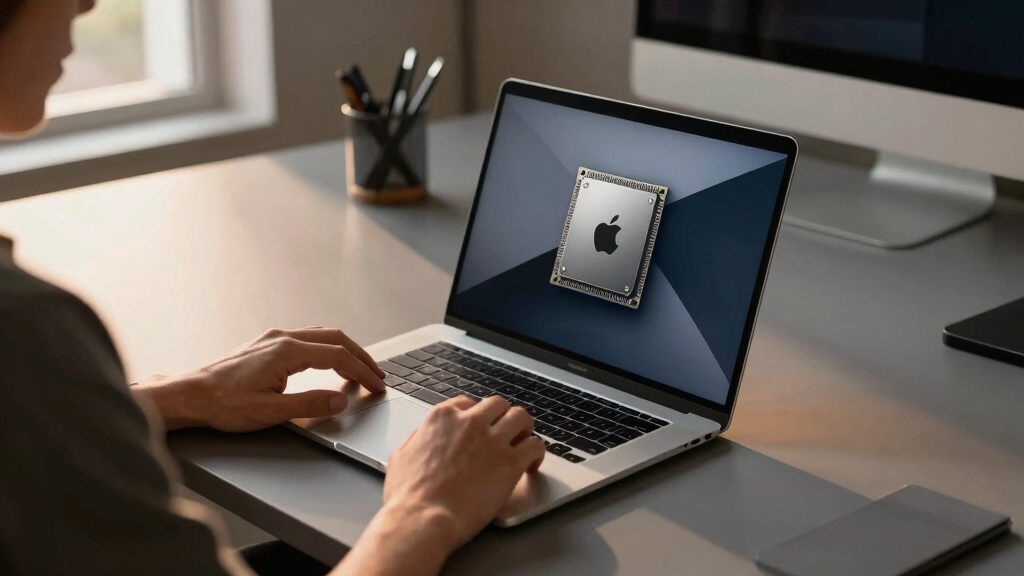
Apple Silicon’s unified memory architecture enables Macs to run large AI models more efficiently than discrete GPUs by leveraging shared memory, offering a capacity advantage that is especially relevant in 2026’s memory shortage.
In 2026, the industry faces a severe memory shortage, making large AI model inference challenging on traditional discrete GPUs. Unlike NVIDIA’s architecture, where system RAM and VRAM are separate, Apple Silicon shares a single pool of memory between CPU and GPU, allowing models to utilize the full capacity of the installed RAM.
This design means a Mac with 64GB of RAM can run models exceeding 70 billion parameters without the need for multi-GPU setups, which are costly and complex. For instance, a Mac Studio with 256GB of RAM can handle models around 200 billion parameters at near-lossless quality, surpassing what any single consumer GPU can support.
However, this capacity advantage comes with a trade-off: lower memory bandwidth. Apple Silicon’s bandwidth is approximately 600–800 GB/s, compared to NVIDIA’s RTX 4090 at over 1,000 GB/s. As a result, inference speeds are slower—an Apple Silicon-based Mac with 128GB of RAM achieves roughly 12–18 tokens per second on a 70B model, versus 40–50 tokens on an RTX 5090.
Apple Silicon’s quiet memory advantage
While the discrete-GPU world fought over 24GB of brutally expensive VRAM, a Mac quietly offered to run the big model on one silent, low-watt box. Not magic — but the rare place an architecture beats the squeeze.
Mac Studio 256GB holds a 70B at near-lossless Q8, or 200B+ at Q4 — no single GPU reaches that at any price. Win zone: 32–200B models at 10–30 tok/s for personal/dev use.
M5 Max ~614 GB/s vs RTX 4090’s 1,008. A 70B runs ~12–18 tok/s on M5 Max vs 40–50 on a 5090. You buy capacity, not raw throughput. Bandwidth & capacity matter — not FLOPs.
Apple turned a laptop-efficiency design — one shared memory pool — into the most elegant answer to the part of the squeeze that hurts most: capacity. Bonus: 25–90W vs a GPU rig’s 600–1,200, ~$35–55/yr to run 24/7 vs $300–400, and silent. Right for large models, privacy, low-power always-on; wrong for max speed on small models or heavy training. Next: Build, Rent, or Quantize.
Implications for Large-Model AI Deployment in 2026
This architecture shifts the landscape for local AI inference, making large models feasible on consumer hardware without multi-GPU rigs. It offers a cost-effective, energy-efficient, and silent alternative for users needing to run models with 32 billion parameters or more, especially in scenarios prioritizing privacy and offline operation. Despite slower speeds, the capacity advantage is transformative for individual researchers, developers, and small enterprises.

Apple MacBook Pro Laptop with M5 Pro, 18‑core CPU, 20‑core GPU: 16.2-inch Display, 64GB Memory, 1TB SSD; Space Black
- Powerful CPU and GPU: Next-gen M5 Pro with Neural Accelerator
- Enhanced AI Performance: Optimized for on-device AI workloads
- Long Battery Life: All-day usage on a single charge
As an affiliate, we earn on qualifying purchases.
As an affiliate, we earn on qualifying purchases.
Industry-Wide Memory Shortage and Architectural Responses
As of 2026, the global memory chip shortage has driven up prices and limited availability, impacting hardware manufacturers across the board. Apple, which long relied on long-term memory contracts, faced supply constraints leading to the discontinuation of certain configurations, such as the 512GB Mac Studio. Meanwhile, industry-wide, the focus has shifted toward architectures that maximize memory efficiency and capacity, with Apple Silicon’s shared memory model emerging as a notable solution for large-model inference.
Prior to 2026, discrete GPUs like NVIDIA’s RTX series dominated AI inference, but their fixed VRAM limits and high costs for larger models made them less practical for many users. Apple’s approach, leveraging unified memory, has become increasingly relevant amid the capacity squeeze.

OWC Memory 16GB DDR3 ECC Registered CL13 PC3-14900 1866MHz RAM
- Memory Size: 16GB DDR3 ECC Registered
- Memory Speed: 1866MHz PC3-14900
- Compatibility: For Mac Pro 2013 6, A1481
As an affiliate, we earn on qualifying purchases.
As an affiliate, we earn on qualifying purchases.
Remaining Questions About Performance and Scalability
It is still unclear how the lower bandwidth will impact real-world inference speeds for different models, especially as models grow larger or require higher throughput. Additionally, the long-term implications of limited upgrade options for soldered memory remain uncertain for users planning future expansion.

Apple 2024 Mac mini Desktop Computer with M4 Pro chip with 12‑core CPU and 16‑core GPU: Built for Apple Intelligence, 24GB Unified Memory, 512GB SSD Storage, Gigabit Ethernet. Works with iPhone/iPad
- Compact Size: Five by five inches of powerful performance
- Powerful M4 Pro Chip: Includes 12-core CPU and 16-core GPU
- Ample Memory: 24GB Unified Memory for multitasking
As an affiliate, we earn on qualifying purchases.
As an affiliate, we earn on qualifying purchases.
Upcoming Developments in Apple Silicon AI Capabilities
Expect further performance benchmarks as more users and developers test large-model inference on Apple Silicon. Apple may also release hardware updates with increased bandwidth or memory configurations, and software optimizations could improve inference speeds. Monitoring industry responses to the capacity challenge will be key in assessing the long-term viability of this architecture.

Build Private AI Assistants with Llama.cpp: Master Local Inference to Craft Fast, Secure Intelligent Tools that Run Entirely on your Hardware
As an affiliate, we earn on qualifying purchases.
As an affiliate, we earn on qualifying purchases.
Key Questions
Can Apple Silicon replace discrete GPUs for AI inference?
For large models requiring significant memory capacity, Apple Silicon offers a compelling alternative, especially in 2026 amid supply shortages. However, it remains slower in raw inference speed compared to high-end NVIDIA GPUs.
How does unified memory affect model performance?
Unified memory allows models to access the full RAM, enabling larger models to run on consumer hardware. The trade-off is lower bandwidth, resulting in slower inference speeds for models that fit in memory.
Is this architecture suitable for real-time AI applications?
It depends on the speed requirements. For applications needing high throughput and low latency, discrete GPUs may still be preferable. For large models where capacity is more critical than speed, Apple Silicon is advantageous.
Will Apple improve bandwidth in future chips?
It is uncertain. Future hardware updates may increase bandwidth, but current designs prioritize capacity and efficiency over raw throughput.
Source: ThorstenMeyerAI.com
Pool season Picks
robotic pool cleaners
As an affiliate, we earn on qualifying purchases.