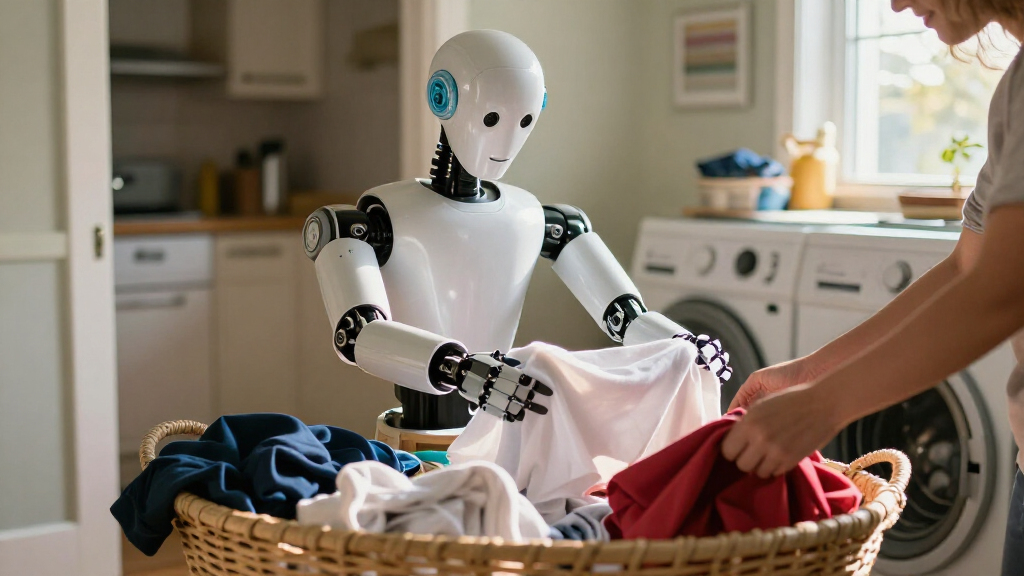

🔍 Read the full analysis: The Chores Dilemma: What Happens When Humanoid Robots Come Home? on ThorstenMeyerAI.com

Get the latest gadgets delivered free with Prime
- Fast, free delivery on millions of items
- Prime Video, Amazon Music and more included
- Member-only deals all year
TL;DR
The Information reported on Oct. 31 that Meta and Shanghai-based robotics company Fourier built a humanoid prototype called Max in about three months. Meta has not announced the robot; according to the report, the company describes the project as internal research and says it has no plans to sell the units.
Meta and Shanghai-based robot maker Fourier reportedly built a five-foot humanoid prototype called Max in about three months, according to a report published by The Information on Oct. 31. Meta has not publicly announced the robot, and the reported goal of helping with household tasks is a longer-term research aim—not evidence that Max can perform chores in homes today.
The Information’s account, as summarized by other outlets, describes Max as weighing about 106 pounds (48 kilograms) and standing roughly 1.5 metres (five feet) tall. It reportedly has a screen that can display facial expressions, speakers, five-fingered hands designed for small objects and an Nvidia Jetson Thor computer. Reuters said it could not immediately verify the report.
According to the coverage, Meta employees saw Max at an internal robotics summit in late August, and work on a second version, Max 2, began in September. The reported redesign includes a different torso, improved hands, a projector and additional sensors intended to help with stairs. These details have not been confirmed in a public product announcement.
The Information reported that Meta characterized its work with Fourier as internal research and experimentation and said it has no plans to sell the units. The report also frames humanoid robots as a possible way to connect Meta’s Muse AI work to a physical machine, with household assistance as a long-term goal. No launch date, price or demonstrated household capability has been announced.
Infographic 01 · Meta’s humanoid, on paper
Max: a humanoid built in about three months
What multiple outlets reported from The Information’s story, and what is not confirmed.
What the report says Max is
From The Information (31 Oct 2026), as carried by Engadget, The Next Web and Investing.com
- Built by Meta with Fourier, a Shanghai robot maker
- Runs on Nvidia Jetson Thor, a computer for robots
- A screen that shows facial expressions, built-in speakers
- Five-fingered hands designed for small objects
- Shown to some Meta staff at an internal summit in late August
- Max 2: new torso, better hands, a projector, sensors for stairs
What you should not take from the headlines
- No Meta announcement. Reuters “could not immediately verify the report.”
- Not for sale. Meta told The Information the work is internal research, with no plans to sell units.
- No chores shown. “Can do household chores” is a goal, not a reported demonstration.
- Dropped: “lifts bottles and toys” and a Muse quote, found only on aggregator sites.
Jetson Thor, per Nvidia: up to 2,070 FP4 teraflops of AI compute, 128 GB memory, 130-watt power envelope; developer kit from $3,499 at launch in August 2025. Meta was named an early adopter.
Sources: The Information (paywalled), reported by Engadget, The Next Web, Investing.com and Reuters, all 31 Oct 2026 · Nvidia, 25 Aug 2025.
Powered by Thorsten Meyer AI
The Gap Between Prototype and Chores
The reported prototype matters because it points to a major technology company testing how AI could operate in physical spaces, including homes. But a robot’s human-like shape and onboard computing do not establish that it can safely or reliably cook, clean, carry objects or adapt to an unfamiliar household. The distance between a prototype and a dependable domestic helper remains substantial.
That gap matters to people who do unpaid care work and to workers paid to clean and maintain homes. The International Labour Organization estimates that people perform 16.4 billion hours of unpaid care work each day, with about three-quarters done by women. It also counts 80 million people employed in domestic work worldwide, 83% of them in informal employment. Those figures describe the scale and gendered distribution of the work—not a forecast of how many jobs robots will replace.
For now, claims about household robots need to be judged against practical performance, cost, supervision and safety, rather than a prototype’s appearance. The available reporting does not show Max completing chores in a real home. Even commercially available competitors have disclosed reliance on human help for some tasks.
Products Worth Considering

DJI Osmo Mobile 8 Standard Combo Gimbal Stabilizer for Phone

Samsung 27-Inch Odyssey QD-OLED G8 4K 240Hz Gaming Monitor

Logitech MX Mechanical Wireless Illuminated Keyboard, Tactile Quiet, Graphite
As an affiliate, we earn on qualifying purchases.
Why Max Could Be Built Quickly
The reported three-month development period does not mean Meta created a humanoid platform from scratch. Fourier already makes robots: in August 2025, it introduced the GR-3, a 165-centimetre, 71-kilogram machine it described as a care robot for settings such as nursing homes and rehabilitation centres. The partnership appears to combine Meta’s AI research with a company that already has robotics manufacturing and design experience.
Max reportedly uses Nvidia’s Jetson Thor, a computer platform intended for robotics. Nvidia made the platform generally available in August 2025 and has said it can run AI workloads onboard. That kind of computing may allow a robot to process some tasks locally, but it does not by itself solve the harder problems of perception, manipulation, navigation and safe operation around people.
Other companies are testing home robots, though their claims and products should not be treated as independent proof that the technology is ready for broad use. 1X sells its NEO home robot for $20,000; the source material says it can rely on remote human “experts” for tasks it does not know. Figure has reported that its robot completed whole chores in 56% of trials across 30 unfamiliar homes. That is a company-reported result, not an independently verified measure of performance across households.
“Reuters said it “could not immediately verify the report.””
— Reuters
What Has Not Been Verified
Meta has not issued a public announcement confirming Max’s specifications, capabilities or development timeline. The account originates with The Information, which is behind a paywall; the supplied material says the details were relayed by other outlets, and Reuters said it could not immediately verify the report. No public demonstration or independent test of Max performing household chores is included.
It is also unclear how much human supervision Max would need, which tasks it can perform, how safely it operates around children or pets, and whether it can handle varied homes. The reported work on Max 2 suggests development is continuing, but there is no confirmed release schedule or evidence that the robot will become a commercial product.
The Next Test Is Real-Home Use
The next meaningful evidence would be a public statement or demonstration from Meta or Fourier that identifies what Max can actually do, under what conditions and with what level of human oversight. If the companies disclose tests, details such as the number of homes, task definitions, failure rates and safety procedures would help readers evaluate the claims.
For now, the project remains a reported research effort rather than a consumer launch. Work on Max 2 is reported to have started in September, but a development milestone is not a promise of sale. Whether these machines can take on routine household work—and how that could affect unpaid caregivers and domestic workers—remains an open question.
Key Questions
Has Meta officially announced the Max robot?
No public announcement is included in the reporting. The Information reported on the prototype, and Reuters said it could not immediately verify the account.
Can Max currently do household chores?
The supplied reporting describes Max as a prototype intended to support research into possible future household assistance. It does not document Max completing chores in a home.
Will Meta sell Max?
According to The Information’s report, Meta said the work with Fourier is for internal research and experimentation and that it has no plans to sell the units. No commercial launch has been announced.
What is reportedly planned for Max 2?
Work reportedly began in September on a version with a redesigned torso, improved hands, a projector and more sensors to help it handle stairs. Those details have not been publicly confirmed by Meta.
What does the report say about domestic work?
The source material cites ILO estimates of 16.4 billion hours of unpaid care work daily and 80 million people employed in domestic work worldwide. These figures show the scale of the work; they do not establish that robots will replace it.
Source: ThorstenMeyerAI.com