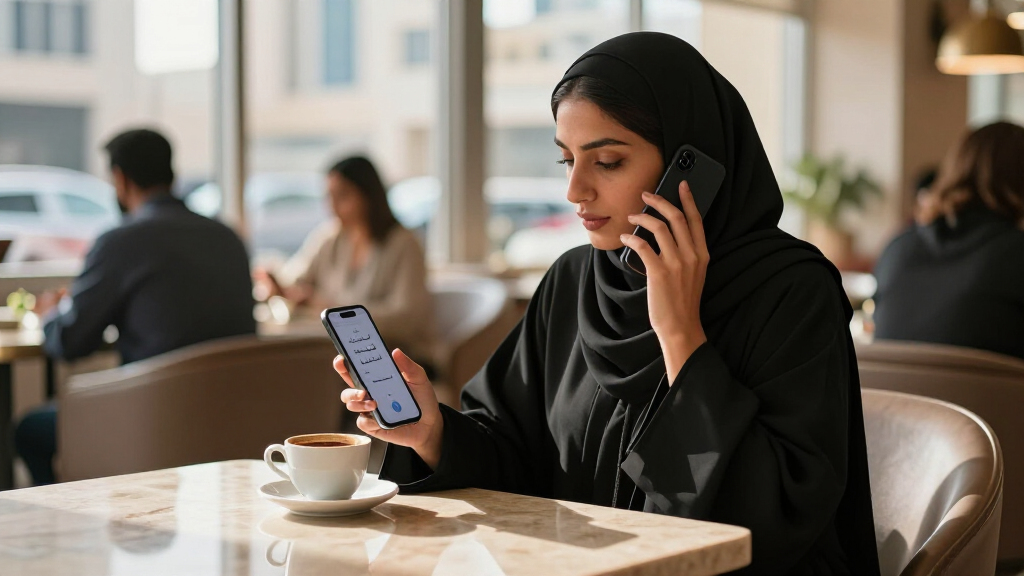

🔍 Read the full analysis: Can An LLM Understand Emirati Dialect And Cultural Context? on ThorstenMeyerAI.com

Get the latest gadgets delivered free — and shop member deals
- Fast, free delivery on millions of items
- Access to Prime Big Deal Days deals on October 6–7
- Prime Video, Amazon Music and more included
TL;DR
Hugging Face says Falcon-Emirati-7B adapts its Falcon-H1-Arabic model to understand and generate Emirati Arabic, combining dialect text, cultural material and synthetic examples. The supplied announcement describes the development approach but does not provide benchmark scores, evaluation details or independent evidence of performance.
Hugging Face has announced Falcon-Emirati-7B, a 7-billion-parameter adaptation of its Falcon-H1-Arabic model intended to understand and generate Emirati Arabic. The company says the project combines dialect writing with material about Emirati culture, but the original analysis and announcement supplied for this report include no benchmark results or independent evaluation showing how well the model handles everyday language.
The model is adapted from Falcon-H1-Arabic, rather than trained from scratch. Hugging Face says the underlying model family has exposure to Modern Standard Arabic, several dialect groups—including Gulf, Levantine, Egyptian and Maghrebi Arabic—and English and other multilingual data. The team selected the family’s 7-billion-parameter version for the Emirati adaptation.
Hugging Face describes that choice as a practical balance between model capacity and the costs of training and serving. Its announcement says a 34-billion-parameter model could offer higher quality at greater expense, while a 3-billion-parameter model might leave less capacity for the desired linguistic and cultural adaptation. Those are the developer’s stated reasons; the supplied material does not give comparative test results for the three sizes.
The company says its training data combined curated Emirati-dialect web content, Modern Standard Arabic material about Emirati culture and identity, and synthetic dialect examples generated using glossaries and style rules. Hugging Face says it tested data mixes and training stages, using human judgment and benchmark scores to guide development. It does not publish the scores, evaluation-set details or the proportions of each data source in the account provided.
Why Emirati Dialect Needs Testing
Arabic models can perform well on formal writing yet struggle with conversational dialect, where vocabulary, grammar and tone differ. The distinction matters in uses such as chat and customer support: a response may be grammatically sound but still misunderstand an idiom, miss a joke or use an unsuitable social register.
Falcon-Emirati-7B’s stated approach treats the challenge as more than replacing formal vocabulary with colloquial words. Hugging Face says it added cultural material to help the model respond to topics involving heritage, customs and social norms. Whether that improves relevance or naturalness for Emirati speakers is not established by the supplied announcement.
The release also raises questions for anyone considering dialect-focused AI: whose speech and writing are represented, and whether systems preserve variation rather than treating a dialect as uniform. Those questions affect the model’s potential usefulness, but the material available does not report results across communities or use cases.
As an affiliate, we earn on qualifying purchases.
From Broad Arabic to Emirati
Falcon-Emirati-7B is presented as a specialization within a broader Arabic model family. Hugging Face describes Falcon-H1-Arabic as covering Modern Standard Arabic and multiple dialect groups, providing a base for further adaptation toward a particular variety. The announcement characterizes Emirati Arabic as a dialect used in everyday conversation and says relevant idioms and cultural references can be difficult to capture in consistent written collections.
The base family is described as using a hybrid architecture that combines State Space Models, including Mamba, with Transformer attention. Hugging Face says the design aims to process long sequences efficiently while retaining attention to longer-range relationships. The source describes context windows of up to 128,000 and 256,000 tokens across the family, but does not specify in the supplied account which window applies to Falcon-Emirati-7B.
The company says dialect adaptation involves choices about data proportions and training stages, and that public guidance on those choices is limited. It reports experimenting with those factors, but the source material does not include the detailed findings needed to assess what changed or why the final configuration was selected.
““the vocabulary, the tone, and the cultural context behind it””
— Hugging Face
As an affiliate, we earn on qualifying purchases.
Performance Evidence Still Missing
The supplied account does not report benchmark scores, evaluation-set details or comparisons with Falcon-H1-Arabic or other Arabic-language models. Hugging Face says it used benchmark scores and human judgment during development, but it does not provide the results or explain how representative the assessments were. Any suggestion that the model approaches native-speaker understanding remains a developer aim, not an independently established result in the material available.
Other details are also missing: the size and composition of each data source, how synthetic examples were checked, and how the model performs across regions, age groups and writing styles. The source mentions material about how Emiratis are perceived and stereotyped, but does not explain how the team addressed the risk of reproducing stereotypes. It also does not specify the model’s release date, access terms or external review status.
Arabic translation app for Emirati dialect
As an affiliate, we earn on qualifying purchases.
As an affiliate, we earn on qualifying purchases.
Release Details and Speaker Tests
Further assessment depends on access to the model, technical documentation and evaluation results. Tests with Emirati Arabic speakers could examine whether its responses sound natural, interpret idioms accurately and distinguish dialect from formal Arabic without erasing social or regional differences.
Comparisons with the underlying Falcon-H1-Arabic model would help show what the Emirati adaptation adds. The supplied source does not give a timetable for those results or identify a publication schedule. Until fuller evidence is available, the announcement establishes the model’s intended purpose and described training approach—not how reliably it meets that purpose.
As an affiliate, we earn on qualifying purchases.
Key Questions
What is Falcon-Emirati-7B?
It is a 7-billion-parameter model that Hugging Face says it adapted from Falcon-H1-Arabic to understand and generate Emirati Arabic.
What data did Hugging Face say it used?
The company describes a mix of curated Emirati-dialect web content, Modern Standard Arabic material about Emirati culture and identity, and synthetic dialect examples created with glossaries and style rules.
Has the model’s performance been independently verified?
The supplied announcement provides no independent evaluation results. It says the team used human judgment and benchmark scores during development, but does not publish those results or the evaluation details.
When can people use the model?
The source material does not specify a release date, access terms or model availability. Those details remain unconfirmed in the information provided.
Primary source: Hugging Face · via ThorstenMeyerAI.com
Halloween Picks
halloween
As an affiliate, we earn on qualifying purchases.