
TL;DR
Get ready for Prime Big Deal Days — try Prime free
Exclusive member deals on October 6–7, plus fast free delivery. Cancel anytime.
As an affiliate, we earn on qualifying purchases.
After two weeks with Tesla’s Hardware 4 and FSD V14 in a 2026 Model Y, the author reports significant improvements in autonomous driving, with many tasks handled autonomously, though some limitations remain. The review offers a practical perspective on the technology’s current state and future potential.
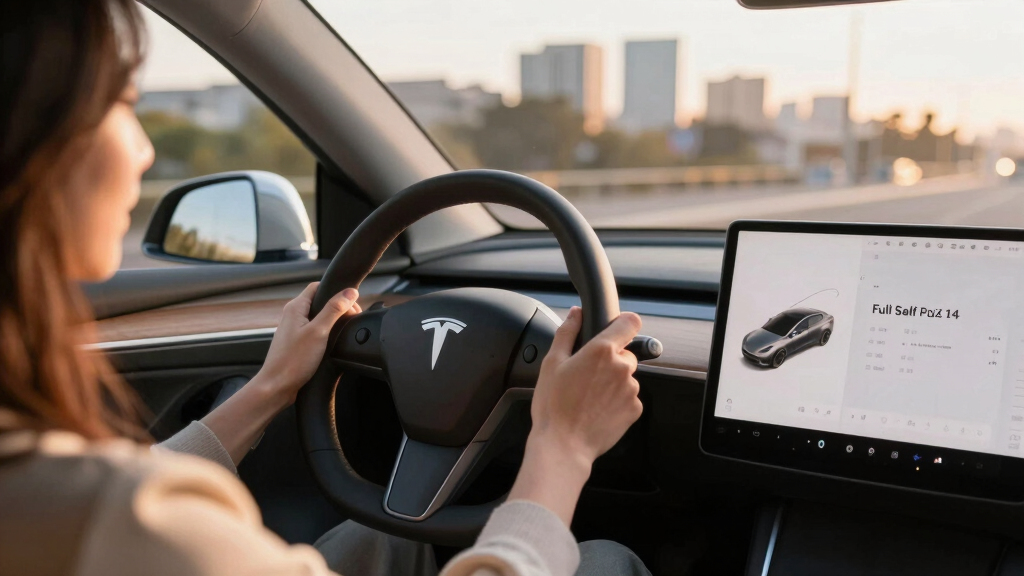
After two weeks of driving a 2026 Tesla Model Y equipped with Hardware 4 and Full Self Driving V14, the owner reports substantial advancements in autonomous driving capabilities, including successful handling of complex maneuvers such as parking and navigation without intervention, marking a significant step forward for Tesla’s self-driving technology.
The reviewer, who previously owned a 2019 Model 3 with Hardware 3, now drives a new Model Y with HW4 and FSD V14. They describe how the system can autonomously back out of garages, navigate to destinations specified via voice or text, and park in various scenarios, including parking lots and driveways. The system’s modes—Sloth, Chill, Standard, Hurry, and Mad Max—allow users to select different driving aggressiveness levels, with FSD V14 generally performing reliably under supervision.
Despite notable improvements, the review notes persistent issues such as GPS inaccuracies, occasional misnavigation (e.g., directing to wrong addresses or looping around airports), and limitations in parking precision, especially in unfamiliar or complex environments. The owner reports that FSD V14 still struggles with precise lane selection at intersections and relies heavily on Google Maps data, which is sometimes outdated or incorrect. Some features, like steering assist, require a subscription fee, marking a change from previous models.
Implications of FSD V14 for Consumer Autonomy
This firsthand account highlights that Tesla’s FSD V14, combined with HW4, has achieved meaningful progress toward autonomous driving, reducing the need for driver intervention in many scenarios. However, it also underscores that full autonomy—Level 4 or higher—remains a work in progress, with current limitations in navigation precision and environmental understanding. For consumers, this means increased convenience but continued supervision is necessary, shaping expectations and regulatory discussions around self-driving technology.
Tesla Model Y Hardware 4 FSD V14 upgrade
As an affiliate, we earn on qualifying purchases.
As an affiliate, we earn on qualifying purchases.
Evolution of Tesla’s Autonomous Driving Technology
Since Tesla introduced its FSD system in 2019, the company has progressively upgraded hardware and software, culminating in the current HW4 and FSD V14 release in 2025. Previous iterations, such as FSD V12, were limited and often required driver oversight. Elon Musk promised Level 4 autonomy within 12 months of HW3, but widespread full autonomy has yet to materialize. The transition to HW4 and V14 marks a significant technological leap, though challenges like GPS accuracy and map data remain hurdles before true full self-driving can be achieved.
“FSD V14 rarely makes a mistake that you must correct, and it handles most driving tasks with minimal intervention.”
— Tesla owner Fritz Hasler
Tesla autonomous driving assist subscription
As an affiliate, we earn on qualifying purchases.
As an affiliate, we earn on qualifying purchases.
Remaining Technical and Regulatory Challenges
While the owner reports significant progress, it is not yet clear whether FSD V14 and HW4 can reliably handle all real-world scenarios, especially in complex urban environments or with outdated map data. The extent of improvements needed for full autonomy and regulatory approval remains uncertain, and Tesla has not confirmed when Level 4 capabilities will be available broadly.
As an affiliate, we earn on qualifying purchases.
Upcoming Software Updates and Regulatory Milestones
Tesla is expected to continue refining FSD V14, addressing current limitations such as GPS accuracy and map data integration. Future updates may improve lane handling and parking precision. Regulatory approvals for fully autonomous operation are also anticipated, which could expand the deployment of higher-level self-driving features. The owner plans to continue testing and sharing updates as these developments unfold.
Tesla navigation GPS correction device
As an affiliate, we earn on qualifying purchases.
As an affiliate, we earn on qualifying purchases.
Key Questions
Can Tesla’s FSD V14 fully replace human drivers?
Currently, FSD V14 offers advanced driver assistance but still requires active supervision. Full Level 4 autonomy has not yet been achieved or approved for widespread use.
What are the main limitations of FSD V14 in real-world use?
GPS inaccuracies, reliance on outdated map data, and occasional misnavigation or lane selection issues remain challenges for the system.
How does the new hardware improve over previous versions?
HW4 features a significantly more powerful computer and improved cameras, enabling better perception and decision-making capabilities compared to HW3 or earlier hardware versions.
Is the subscription fee for steering assist a new requirement?
Yes, Tesla now charges $99/month for steering assist in new models, marking a change from previous models where this feature was included without additional cost.
When might Tesla achieve full autonomous driving?
There is no official timeline, but ongoing software and hardware improvements suggest full autonomy could still be several years away, pending regulatory approval and technical validation.
Source: CleanTechnica
Fall Picks
fall essentials
As an affiliate, we earn on qualifying purchases.