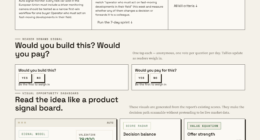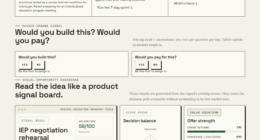

📊 Full opportunity report: IdeaClyst: The Validation Council on ThorstenMeyerAI.com — validation score, market gap, and execution plan.

Get the latest gadgets delivered free — and shop member deals
- Fast, free delivery on millions of items
- Access to Prime Big Deal Days deals on October 6–7
- Prime Video, Amazon Music and more included
TL;DR
IdeaClyst has launched ‘The Validation Council,’ a structured, multi-model process to rigorously evaluate ideas before they reach roadmaps. This approach emphasizes disagreement and evidence-based reasoning to improve decision-making and prevent costly errors.
IdeaClyst has launched ‘The Validation Council,’ a new framework that uses two different AI models to rigorously evaluate ideas before they are approved for development. This development aims to improve decision quality by systematically exposing weak points in ideas through structured disagreement, making it a significant tool for organizations seeking to reduce costly project failures.
The Validation Council is an open-source, provider-agnostic system that employs two AI models—Claude and Codex—to debate and scrutinize ideas via a five-step process. It begins with a research pre-step to gather relevant context and evidence, followed by five deliberation stages: framing, steelmanning, red-teaming, evidence-checking, and final verdict.
Unlike single-model assessments, the council’s opposing models are designed to challenge each other, surfacing objections that might be overlooked otherwise. The process produces an auditable recommendation, including the strongest arguments for and against the idea, along with the reasoning behind the final verdict. The system is built to be low-cost and local-first, running on owned compute, making it accessible for frequent use.
While the framework aims to improve idea validation, experts caution that it cannot eliminate the risk of models being confidently wrong or shared blind spots. The process is intended to reduce sycophancy and foster transparent, evidence-based debate, not to produce absolute truth.
IdeaClyst — the validation council
Most ideas don’t die from being bad — they die from being plausible and untested. A research pre-step, then two models cross-examining the idea before it earns a roadmap slot.
Independent commentary, produced with AI assistance under human editorial oversight. The views are the author’s own and may change. IdeaClyst is open source under MIT, provided “as is” without warranty; see the repository LICENSE. The council’s research, deliberation and verdicts are produced by automated models and may contain errors or shared blind spots — a verdict is auditable reasoning, not validated demand; verify independently before committing. Product and company names are trademarks of their respective owners; mention does not imply endorsement.
Why Structured Disagreement Enhances Decision-Making
The Validation Council’s approach emphasizes that structured disagreement between models can lead to better decision outcomes by surfacing overlooked risks and assumptions. This method offers a cost-effective way to filter out weak ideas early, potentially saving organizations significant time and resources. It shifts the focus from simple approval to transparent reasoning, enabling more informed and auditable choices that improve overall strategic alignment.
As an affiliate, we earn on qualifying purchases.
Background on Idea Validation and AI Decision Tools
Traditional idea validation often relies on single opinions or informal peer review, which can overlook critical flaws. Recent advancements in AI models like Claude and Codex have enabled more systematic approaches to evaluating ideas. Prior to this, efforts to incorporate AI into decision-making have focused on prediction and analysis, but the concept of a multi-model debate framework like IdeaClyst’s Validation Council is a novel step toward structured, transparent idea vetting. The open-source nature and provider-agnostic design reflect a broader movement toward flexible, low-cost AI tools for enterprise decision processes.
“The Validation Council is designed to turn idea assessment into a transparent, evidence-based debate, reducing the risk of costly mistakes from unchallenged assumptions.”
— Thorsten Meyer, founder of IdeaClyst
decision analysis tools for startups
As an affiliate, we earn on qualifying purchases.
As an affiliate, we earn on qualifying purchases.
Unresolved Challenges and Limitations of the Validation Council
While the framework is promising, it remains uncertain how well the models will perform across diverse idea types and domains. The system cannot guarantee the elimination of all flawed ideas, especially since models share training data biases and can be confidently wrong. Additionally, the effectiveness of the process depends on proper implementation and interpretation of the audit trail, which may vary across users and organizations. Further empirical validation is needed to assess its real-world impact.
As an affiliate, we earn on qualifying purchases.
Next Steps for Adoption and Validation of the Framework
IdeaClyst plans to release detailed documentation and encourage early adopters to integrate the Validation Council into their decision workflows. Future developments may include expanding the model set, refining the five-step process, and conducting case studies to evaluate its effectiveness in different industries. Monitoring user feedback and empirical results will be key to understanding its long-term value and potential improvements.
As an affiliate, we earn on qualifying purchases.
Key Questions
How does the Validation Council differ from traditional idea reviews?
The Validation Council uses two AI models to debate and scrutinize ideas through a structured, multi-step process, emphasizing disagreement and evidence, unlike traditional reviews which often rely on single opinions or informal consensus.
Can the system eliminate all flawed ideas?
No, the system cannot guarantee the elimination of all errors. It is designed to surface weaknesses and improve decision rigor but still depends on the models’ capabilities and the quality of evidence provided.
Is the framework open-source and vendor-agnostic?
Yes, the framework is open-source under the MIT license and designed to work with multiple AI models, supporting local deployment on owned hardware.
What are the main limitations of using AI for idea validation?
Models can share biases, confidently produce wrong conclusions, and may not reflect real market conditions. The process also relies heavily on proper interpretation of the debate and evidence.
How will organizations benefit from adopting the Validation Council?
Organizations can make more informed, transparent decisions, reduce costly project failures, and create a repeatable process for idea vetting that emphasizes evidence and structured disagreement.
Source: ThorstenMeyerAI.com
Fall Picks
fall essentials
As an affiliate, we earn on qualifying purchases.