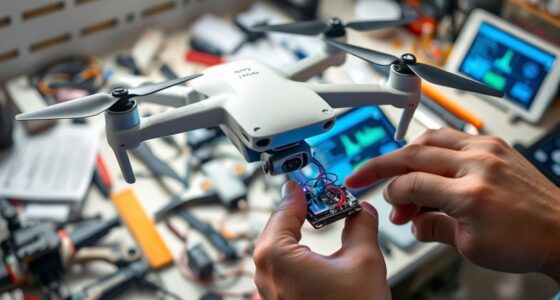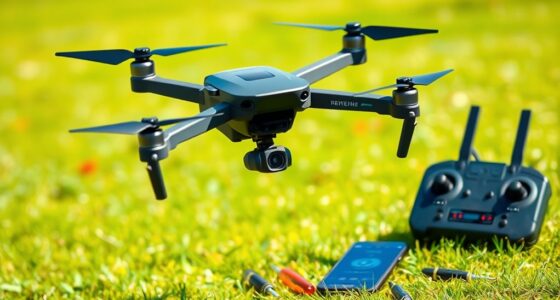
To calibrate your drone’s compass and IMU sensors, start by choosing an open, interference-free area and securing the drone’s propellers. Perform a horizontal 360° spin for the compass and flip the drone vertically to cover all directions. For the IMU, place it on a flat surface and rotate along all axes. If you encounter issues, double-check your environment and repeat the calibration steps. Continue with the guide to learn detailed techniques for peak performance.
Key Takeaways
- Perform compass calibration by rotating the drone horizontally 360° and vertically to expose sensors to all directions.
- Place the drone on a flat, stable surface and follow step-by-step instructions to calibrate the IMU sensors.
- Use open outdoor areas free from metal objects and electromagnetic interference for accurate calibration.
- Conduct advanced calibration techniques, such as 6-sides magnetometer calibration and field calibration, for optimal performance.
- Troubleshoot calibration issues by verifying environment conditions, redoing calibration, and updating firmware and software.
Preparing Your Drone for Calibration
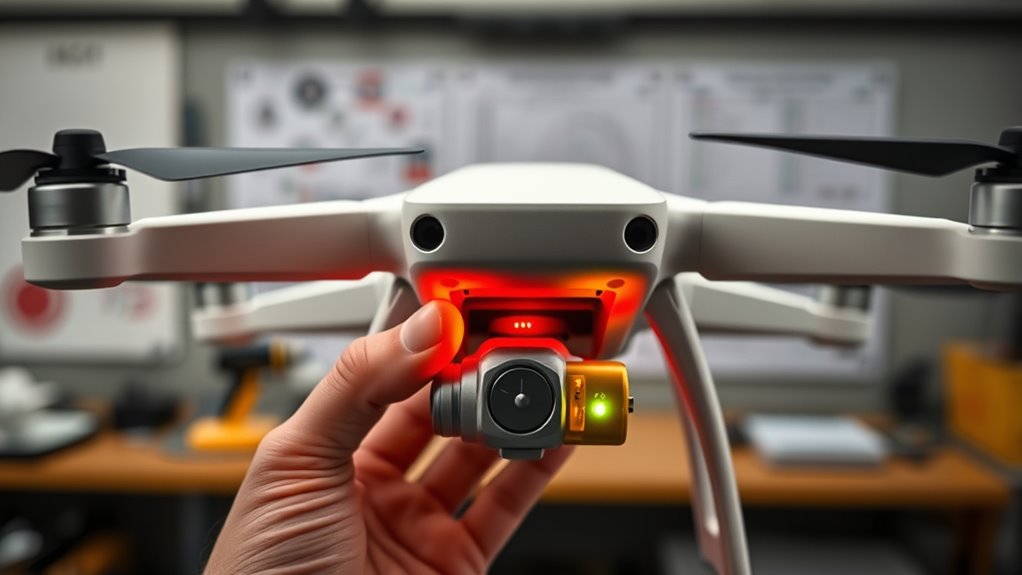
Before you begin calibrating your drone, it’s essential to prepare it properly to guarantee accurate results and prevent damage. Start by securing the propellers to avoid any accidental movement or breakage during calibration. Choose an open outdoor area free from metal objects, power lines, or electromagnetic interference, which can skew sensor readings. Remove any personal metallic items like watches, rings, or belts to prevent magnetometer interference. Make sure your drone’s firmware and companion app are up to date to ensure compatibility and access to the latest calibration features. If prompted, disable obstacle avoidance sensors, as they can interfere with magnetic and sensor readings. Proper preparation helps ensure a smooth calibration process, leading to better flight stability and safety. Additionally, understanding the importance of European cloud innovation can help you recognize the value of reliable, energy-efficient technology supporting your drone operations. Being aware of sensor accuracy can further improve your calibration results and overall flight performance. To achieve optimal calibration, it’s also helpful to review sensor calibration techniques to understand how your drone’s sensors work and how to troubleshoot common issues. Furthermore, ensuring that your calibration environment is free from electromagnetic interference can significantly enhance the precision of your sensor adjustments. Incorporating proper environmental conditions can further optimize calibration outcomes, resulting in more reliable and stable drone flights.
Step-by-Step Guide to Compass Calibration

To guarantee accurate compass calibration, start by accessing your drone’s settings menu and locating the compass calibration option—usually found under Sensors or Safety. Follow the on-screen instructions, which typically involve rotating your drone on multiple axes. Begin with a horizontal 360° spin to expose the magnetometer to all directions. Then, flip the drone vertically and rotate it again to cover all orientations. During this process, hold each position steady until the app confirms calibration, often with a message or LED indicator. If prompted, repeat the rotations to ensure precision. Performing this step carefully helps ensure reliable GPS signals and stable flight performance, especially considering the importance of magnetometer accuracy for navigation. Additionally, ensuring your drone is away from magnetic interference sources during calibration can significantly improve accuracy. Being mindful of environmental factors that affect magnetic readings is crucial for optimal results. Once complete, follow any prompts to reboot or restart the drone’s system. Remember that proper calibration techniques can prevent many common flight issues caused by magnetic disturbances.
How to Properly Calibrate the IMU Sensors

Calibrating the IMU sensors correctly is essential for ensuring your drone maintains stable and accurate flight. To do this, place your drone on a flat, stable surface, then follow your app’s prompts to rotate it along all three axes—yaw, pitch, and roll. Keep the drone steady during each step to ensure precise readings. Proper calibration corrects sensor drift and enhances orientation accuracy. Use the table below to understand key calibration steps:
| Step | Action | Purpose |
|---|---|---|
| Place on a flat surface | Keep drone stationary | Establish baseline |
| Rotate around yaw axis | Spin 360° in place | Calibrate gyroscope |
| Tilt for pitch and roll | Tilt drone forward/backward/side to side | Calibrate accelerometer |
| Confirm calibration success | Follow prompts and restart drone | Finalize sensor calibration |
| Regular calibration checks | Perform routine sensor calibration as recommended by your drone manufacturer | Maintain sensor accuracy |
Additionally, regularly calibrating your sensors helps mitigate sensor drift, maintaining optimal flight performance.
Advanced Calibration Techniques for Optimal Performance
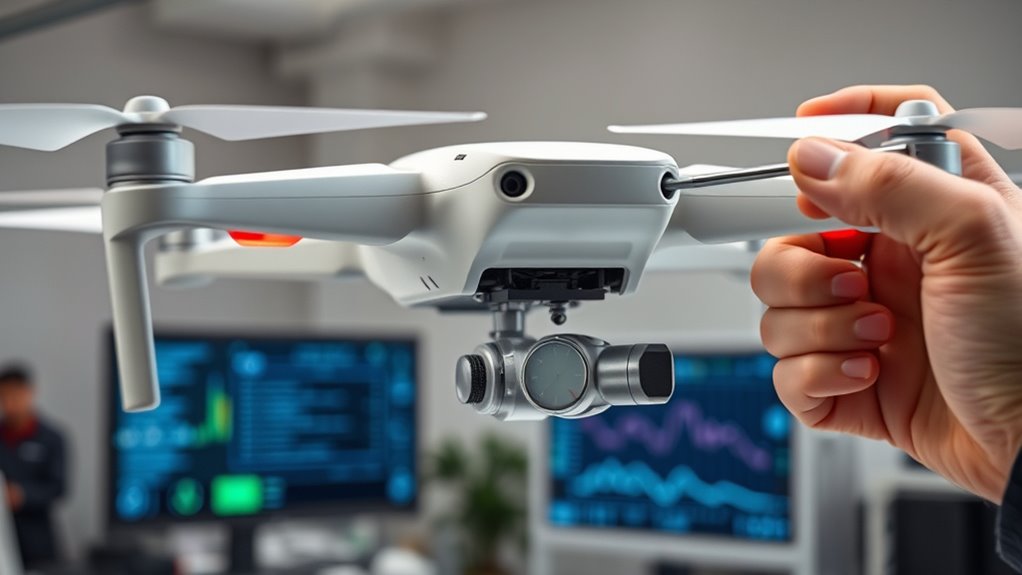
Advanced calibration techniques can substantially enhance your drone’s performance by fine-tuning its sensors beyond basic procedures. Use quick calibration for minor adjustments when first setting up your drone, saving time without sacrificing accuracy. For thorough magnetometer calibration, perform a 6-sides method by orienting your drone on each of its six faces, ensuring all axes are covered. Field calibration, oscillating your drone around its three axes, helps correct sensor biases in dynamic environments without full recalibration. Repeat these advanced calibrations after firmware updates, flying in new locations, or experiencing flight issues like circling or drifting. Some systems allow RC switch-triggered calibration, offering quick, untethered adjustments. These techniques optimize sensor accuracy, improving GPS reliability, flight stability, and overall responsiveness. Considering aviation regulations ensures your calibration procedures meet safety standards and legal requirements, and staying informed about sensor calibration best practices can further enhance your drone’s reliability. Additionally, understanding sensor drift can help you anticipate when recalibration is necessary for maintaining optimal performance. Regularly monitoring your drone’s calibration status can prevent unexpected issues during critical flights.
Troubleshooting Common Calibration Issues
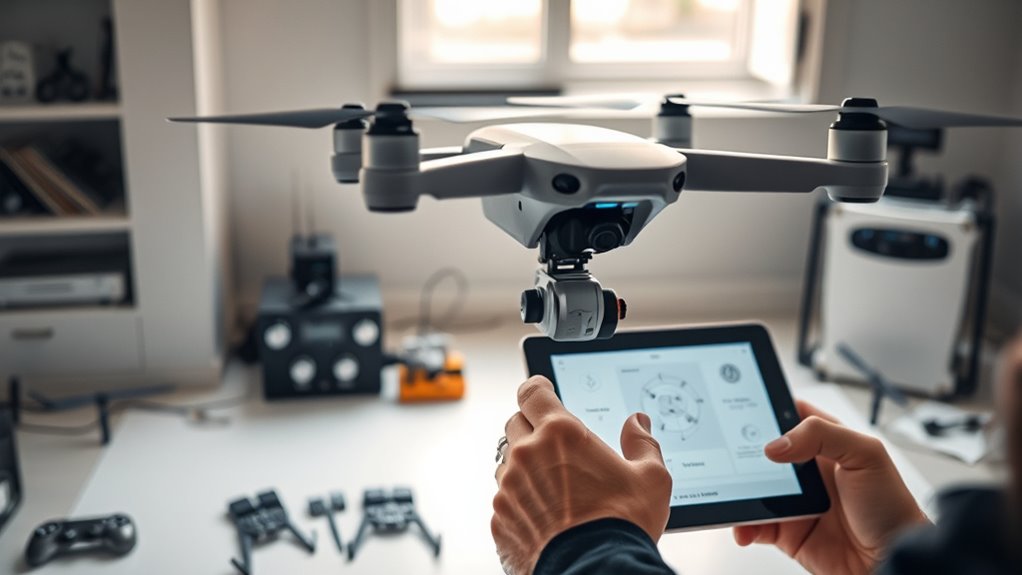
Even with thorough calibration procedures, you might encounter issues that prevent your drone from achieving accurate sensor readings. If calibration fails, double-check that you’re in an interference-free environment, away from metal objects or electromagnetic sources. Confirm you’re following the rotation instructions precisely and holding each orientation still during the process. Sometimes, redoing the calibration multiple times helps resolve inconsistencies. If problems persist, restart your drone and app, then try again. Verify that your firmware and app are up to date, as outdated software can cause calibration errors. For compass issues, perform a full 6-sides calibration or in-field oscillation to recalibrate magnetometers. Regularly inspect for error warnings in your control app and address any flagged issues before flying. Proper systematic troubleshooting ensures reliable calibration for safe, stable flights. Additionally, ensuring your drone’s sensor calibration is current can improve overall flight performance and responsiveness. Maintaining calibration accuracy is essential for consistent and safe drone operation.
Frequently Asked Questions
How Often Should I Calibrate My Drone’s Compass and IMU?
You should calibrate your drone’s compass and IMU every time you update its firmware, fly in a new location, or notice flight instability like drifting or circling. Additionally, perform calibration after crashes or hard landings to guarantee accuracy. Regular calibration, ideally before each major flight, helps maintain GPS accuracy, flight stability, and safety, minimizing risks of flyaways or navigation errors.
Can Calibration Be Done Indoors or Only Outdoors?
You can calibrate your drone indoors, but it’s like trying to tune a musical instrument in a room full of echoes. To get the best results, choose a clear outdoor spot away from metal, power lines, and electronics. Indoor calibration is possible, but interference from nearby objects can skew readings. For accuracy, perform calibration outdoors when possible, ensuring your drone’s compass and IMU are spot-on for safe, stable flights.
What Are Signs of Improper Calibration During Flight?
If your drone drifts, circles, or struggles to hold position, it’s a sign of improper calibration. You might notice unstable flight, inconsistent GPS signals, or erratic movements during hover. Sometimes, the drone may spin or tilt unexpectedly, or you’ll see warning messages about compass or IMU issues. These symptoms indicate calibration problems, so double-check your calibration steps, avoid interference sources, and re-calibrate to guarantee stable, accurate flight performance.
Does Firmware Update Affect Previous Calibration Settings?
Firmware updates can reset or alter your drone’s calibration settings, so you should always verify calibration after updating. The update process may introduce new calibration parameters or fix bugs that affect sensor accuracy. If you notice flight instability or navigation issues post-update, recalibrate your compass and IMU to ensure peak performance. Regular checks help maintain flight stability and prevent potential issues caused by outdated calibration data.
Are There Differences in Calibration Procedures for Different Drone Models?
Yes, calibration procedures can differ between drone models. You need to follow each manufacturer’s specific instructions for compass and IMU calibration, as methods, required orientations, and calibration steps may vary. Always consult your drone’s manual or official app guidance to guarantee proper calibration. Using the correct process helps maintain flight stability, GPS accuracy, and safety, especially when switching between different drone types or after firmware updates.
Conclusion
Now that you’ve calibrated your drone’s compass and IMU, you’re ready to soar with confidence. Remember, a well-calibrated drone is like a finely tuned instrument—precise and reliable. Will you let small missteps steer you off course, or will you trust your skills and calibration to keep you flying smoothly? With these steps in mind, you’re all set to navigate the skies effortlessly and enjoy every flight to the fullest.