

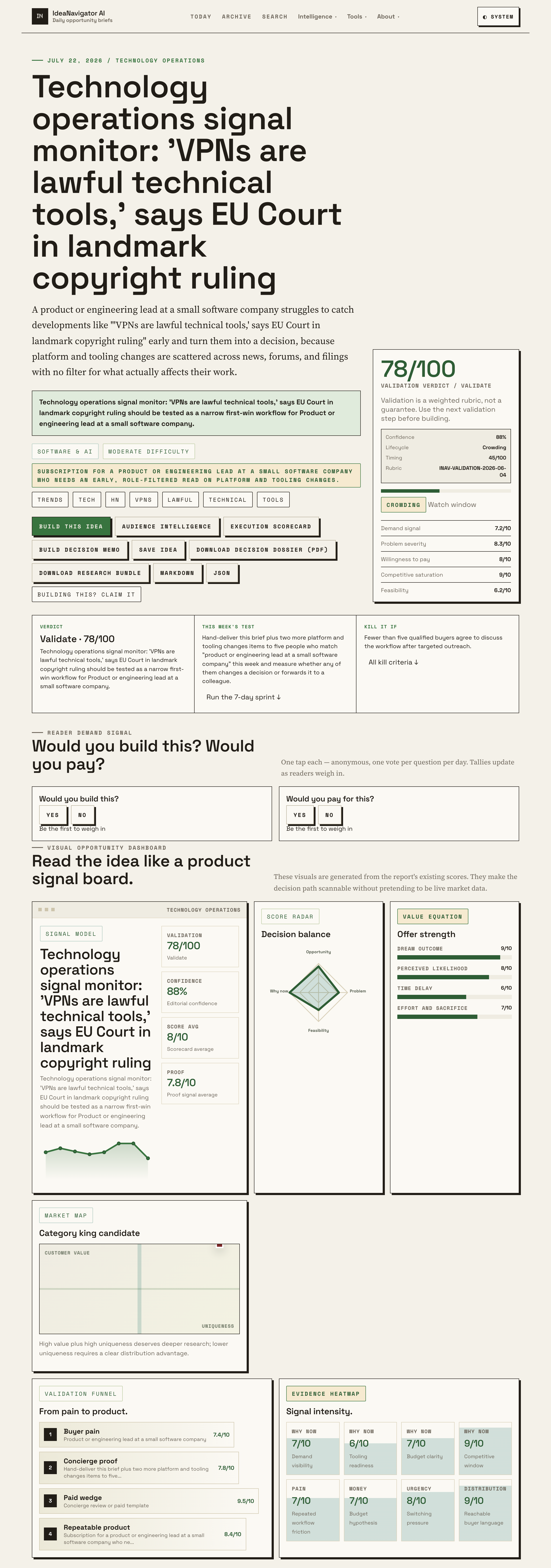
📊 Full opportunity report: The Legal Status Of VPNs Confirmed By EU Court In Landmark Ruling on IdeaNavigator AI — validation score, market gap, and execution plan.
TL;DR
The European Union Court has officially confirmed that Virtual Private Networks (VPNs) are lawful technical tools. This landmark ruling clarifies the legal status of VPNs in the EU, impacting privacy practices and cybersecurity policies. The decision provides legal reassurance for users and providers but leaves some questions about enforcement and scope unanswered.
The European Union Court has confirmed that VPNs (Virtual Private Networks) are lawful technical tools, providing a definitive legal stance on their use within the EU. This ruling clarifies the legal status of VPNs amid ongoing debates about digital privacy and cybersecurity, offering reassurance to users and service providers across Europe.
The EU Court ruling explicitly states that VPNs are legal tools designed to enhance online privacy and security. The decision was made in response to legal challenges concerning the use of VPNs for various purposes, including circumventing restrictions and protecting user data. The court emphasized that VPN technology itself does not violate any laws, and its lawful use is protected under existing EU regulations.
Legal experts say this ruling sets a clear precedent, affirming that VPN providers and users are operating within the law as long as their activities comply with applicable regulations. The ruling does not address specific enforcement measures or restrictions but establishes a legal foundation that VPNs are legitimate tools in the digital landscape.
Legal Clarification Reinforces Privacy Rights in the EU
This ruling is a significant milestone for digital privacy advocates, affirming that VPNs are recognized as lawful tools that support user privacy and data protection. It provides legal certainty for VPN providers and users, potentially influencing policy and enforcement approaches across the EU. The decision also underscores the importance of lawful use, leaving room for future legal debates about misuse or abuse of VPN technology.

TunnelBear VPN, Unlimited Devices, 1-Year Subscription, VPN Software for Internet Privacy, Unlimited Data, Digital Download
A MORE SECURE AND PRIVATE WAY TO BROWSE THE WEB – Protect your data with powerful VPN encryption…
As an affiliate, we earn on qualifying purchases.
As an affiliate, we earn on qualifying purchases.
EU Legal Debates on VPNs and Digital Privacy
Prior to this ruling, legal discussions around VPNs centered on their potential misuse for illegal activities, such as circumventing content restrictions or evading law enforcement. Several EU member states had varying regulations, creating a patchwork of legal standards. The EU Court’s decision clarifies that VPNs, as technical tools, are inherently lawful, aligning with broader EU policies promoting digital rights and privacy.
This development follows increased scrutiny of online privacy tools amid rising concerns over data security and government surveillance. It also responds to ongoing legal challenges faced by VPN providers operating within the EU, seeking a definitive legal stance.
“While the ruling affirms VPNs’ legality, it remains to be seen how enforcement agencies will interpret and implement this decision in practice.”
— Cybersecurity expert

GL.iNet GL-MT6000 (Flint 2) WiFi 6 High Speed Gaming Routers for Wireless Internet, 2 x 2.5G Ethernet Ports, Long Range Computer VPN WiFi Router, Home & Business
***Please update the firmware upon initial setup of the router, as it greatly enhances the device's performance and…
As an affiliate, we earn on qualifying purchases.
As an affiliate, we earn on qualifying purchases.
Remaining Questions About Enforcement and Scope
It is not yet clear how enforcement agencies will interpret this ruling in practice, particularly regarding activities that misuse VPNs for illegal purposes. The court’s decision affirms the legality of VPNs as tools but does not specify restrictions or limitations. Questions also remain about whether the ruling applies uniformly across all EU member states and how it might influence future legislation.
VPN subscription for EU users
As an affiliate, we earn on qualifying purchases.
As an affiliate, we earn on qualifying purchases.
Next Steps for Policy and Legal Enforcement
Legal and regulatory bodies within the EU are expected to review the ruling and may issue further guidance or regulations to clarify permissible VPN activities. VPN providers will likely continue to advocate for policies that protect lawful use, while law enforcement agencies may seek additional measures to address misuse. Monitoring how this legal clarification influences enforcement practices and policy debates will be crucial in the coming months.

GL.iNet GL-MT3000 (Beryl AX) Portable Travel Router, Pocket Wi-Fi 6 Wireless 2.5G Router, Portable VPN Routers WiFi for Travel, Public Computer Routers, Business, Moblie/RV/Cruise/Plane
【DUAL BAND AX TRAVEL ROUTER】Products with US, UK, EU Plug; Dual band network with wireless speed 574Mbps (2.4G)+2402Mbps…
As an affiliate, we earn on qualifying purchases.
As an affiliate, we earn on qualifying purchases.
Key Questions
Does this ruling mean VPNs are legal in all EU countries?
Yes, the ruling affirms that VPNs are lawful technical tools across the EU, but enforcement and specific regulations may vary by country.
Will this ruling impact VPN providers’ operations?
It provides legal reassurance for VPN providers operating within the EU, affirming their activities are protected as long as they comply with applicable laws.
Does the ruling restrict VPN use for illegal activities?
No, the ruling does not endorse illegal activities; it clarifies that VPNs as tools are lawful, but misuse remains subject to existing laws.
Could this ruling lead to new regulations?
Potentially, regulatory bodies may develop further policies to address the use and misuse of VPNs following this clarification.
What are the implications for online privacy rights?
This ruling strengthens the recognition of VPNs as tools that support online privacy, aligning with broader EU policies on digital rights.
Source: IdeaNavigator AI