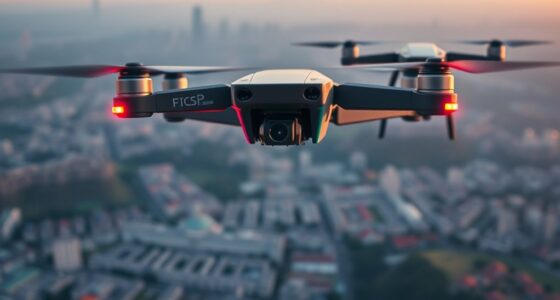
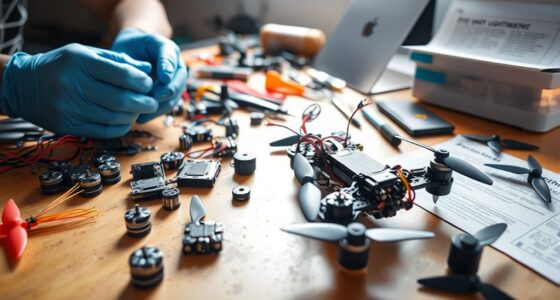
To fly FPV over miles, you use advanced control and transmission tech like fiber-optic systems and radio repeaters to extend range and improve stability. You optimize power with high-density batteries and modular setups, and plan flights carefully with autonomous navigation and obstacle avoidance. Enhancing signal quality through digital protocols and professional antennas boosts clarity. Top drones with long endurance and performance benchmarks show what’s possible. Keep exploring to uncover all the expert tips for mastering ultra-long-range FPV flights.
Key Takeaways
- Utilize advanced control systems like fiber-optic cables and radio repeaters for extended operational range and signal stability.
- Optimize power management with high-capacity batteries, modular setups, and thermal management to maximize flight endurance.
- Implement strategic flight planning and autonomous navigation to efficiently cover long distances while avoiding obstacles.
- Use digital HD transmission and high-quality antennas to maintain video clarity and signal integrity over miles.
- Select high-performance drone models with long-range capabilities, such as fixed-wing or specialized VTOL drones, for extended flight durations.

EVEO Screen Cleaner Spray - Large Screen Cleaner Bottle - TV Screen Cleaner, Computer Screen Cleaner, for Laptop, Phone, Ipad - Computer Cleaning kit Electronic Cleaner (1 Pack)
- Versatile Electronic Screen Cleaner: Suitable for TVs, laptops, phones, and tablets
- Effective Streak-Free Cleaning: Removes dust, fingerprints, and smudges
- Gentle on Sensitive Screens: Safe for LCD, LED, OLED, CRT screens
As an affiliate, we earn on qualifying purchases.
Advanced Control and Transmission Technologies

Advanced control and transmission technologies are revolutionizing long-range FPV drone operations by enabling more reliable and secure communication links. Fiber-optic control systems allow you to extend your operational range up to 60 kilometers, bypassing electronic warfare interference. Repeater drones connect multiple units and adjust cable tension to prevent snagging, ensuring stable links during complex missions. Combining fiber-optic cables with radio frequency repeaters offers redundancy, so you stay connected even if one system faces disruption. These innovations reduce signal loss and improve resistance against jamming, giving you confidence in your control over vast distances. Additionally, smart communication protocols help optimize data transmission and minimize latency across the network. Implementing robust encryption methods further enhances the security of your long-range operations. Utilizing interference mitigation techniques can significantly improve signal integrity in challenging environments. Employing adaptive frequency hopping techniques can dynamically avoid interference and improve connection stability. Incorporating real-time signal analysis allows for proactive adjustments to maintain optimal link quality during mission execution. By integrating these cutting-edge technologies, you can execute deep-strike and reconnaissance missions with precision, safety, and a higher success rate. This evolution notably expands your operational horizon beyond traditional limits.

iO CLEAN Screen Cleaner Spray (16oz - 473ml) – Best Large Cleaning Kit
- Versatile Screen Compatibility: Works on all electronic screens and devices
- Gentle, Scratch-Free Formula: Removes dust and grime without scratching
- Protective, Anti-Static Coating: Leaves a streak-free, smudge-free shine
As an affiliate, we earn on qualifying purchases.
Power Management and Battery Optimization

Effective power management and battery optimization are key to revealing the full potential of long-range FPV drones. You need high energy density batteries paired with efficient battery management systems (BMS) to maximize flight time and range. Choose modular battery setups for quick swaps, reducing downtime during missions. Monitor power consumption carefully; optimizing your drone’s electronics and payload helps extend endurance. Redundant power systems enhance reliability, especially on longer flights. Using lightweight components and streamlining wiring minimizes energy loss. Regularly calibrate batteries and avoid deep discharges to prolong lifespan. Incorporating power consumption techniques can further enhance efficiency and flight duration. Additionally, understanding sound healing science principles can inspire innovative ways to manage vibrations and reduce mechanical energy loss, indirectly benefiting overall power efficiency. Employing thermal management strategies is also crucial to maintain optimal battery performance and prevent overheating. Proper battery maintenance practices further ensure consistent power delivery and longevity. By managing power wisely, you can push your drone’s range further, ensuring longer flights and more mission success without sacrificing safety or performance.

WHOOSH Screen Cleaner and Wipe Kit Duo, 3.7 fl oz + 0.3 fl oz
- Safe for All Screens: Compatible with all screen types and coatings
- Streak-Free Cleaning: Leaves no smudges or residue
- Two Convenient Sizes: Large and travel-sized bottles included
As an affiliate, we earn on qualifying purchases.
Strategic Flight Planning and Autonomous Operations
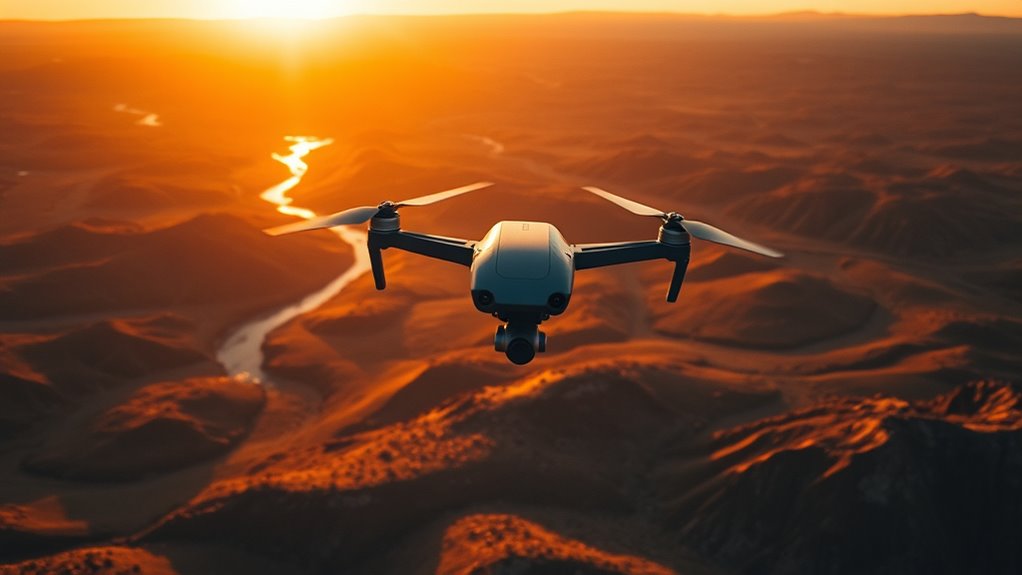
Strategic flight planning and autonomous operations are essential for maximizing the capabilities of long-range FPV drones. You use advanced flight planning software to chart precise routes, avoiding obstacles and optimizing energy use. Autonomous systems, like cloud-based control and onboard AI, enable your drone to execute missions with minimal manual input, ensuring consistent performance over vast distances. VTOL drones support autonomous takeoff, landing, and transit, reducing pilot workload. Integration with connectivity options like Starlink provides reliable, real-time communication beyond visual line of sight. Automated terrain tracking and obstacle avoidance enhance safety during complex maneuvers. By combining detailed planning with autonomous execution, you extend your operational range, improve mission accuracy, and maintain control even in challenging environments. Additionally, selecting appropriate power sources ensures your drone maintains optimal performance throughout extended flights. Properly managing energy consumption is crucial for maximizing flight duration and mission success.

UEQ Foldable 3 in 1 Wireless Charging Station for Apple Magsafe Charger Stand,Fast Magnetic Wireless Charger Station for iPhone 17 Air 16 15 14 13 12 Series,Airpods Pro,Apple Watch Ultra (Pure Black)
- 3-in-1 Wireless Charging: Charges iPhone, Apple Watch, AirPods simultaneously
- Fast Charging Speed: Charges iPhone 16 and Apple Watch in 1.5-2 hours
- MagSafe Compatibility: Built-in N52 magnets for auto-alignment
As an affiliate, we earn on qualifying purchases.
Enhancing Signal Integrity and Video Quality
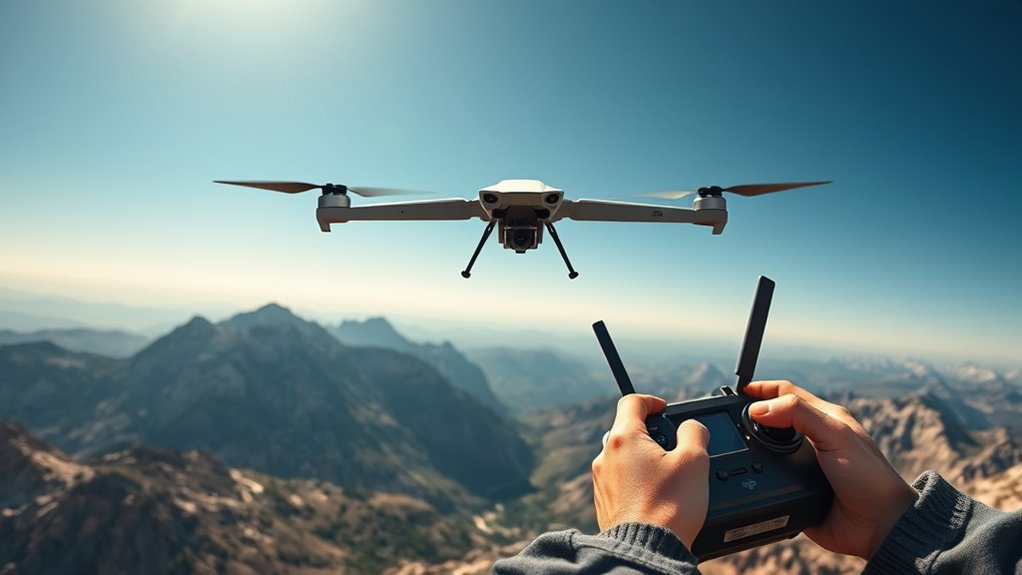
Maintaining high signal integrity and video quality is vital for long-range FPV operations, especially as distances increase and environmental conditions become more challenging. To guarantee reliable control and crisp video feeds, you should use digital transmission protocols that resist interference and offer HD clarity. Ultra-low-noise amplifiers can boost signals without adding noise, while advanced frequency systems like 600MHz and 1400MHz improve range. Redundant systems, including dual RTK modules, provide backup against signal loss. To illustrate, consider this table:
| Signal Type | Advantage | Frequency Range |
|---|---|---|
| Digital | Clear HD, secure | 600MHz-1400MHz |
| Analog | Simpler, low latency | 5.8GHz |
| Redundant | Reliability | Multiple bands |
Implementing advanced frequency systems can significantly extend your FPV range and improve overall reliability. Incorporating professional-grade equipment and ensuring proper antenna placement are additional steps that can further enhance your long-range FPV performance. Additionally, understanding the importance of reliable signal sources can help you select the best components for your setup. Utilizing robust signal sources is essential for maintaining consistent connections over extended distances. Combining these elements elevates your long-range FPV performance.
Cutting-Edge Drone Models and Performance Benchmarks

Recent advancements in drone technology have produced a range of cutting-edge FPV models that set new standards for long-range performance. You can now choose from drones like the ORKID 260VTOL, which offers up to 160 km range and 120 minutes of flight time with modular payloads, or the iFlight Chimera7 Pro V2, capable of flying approximately 30 km with 4K video. The DJI Matrice 350 RTK provides up to 20 km in controlled conditions, while the Parrot Anafi AI utilizes 4G for a range of 23 km. Specialized fixed-wing FPV drones push beyond one-hour flight times depending on battery and payload. These models combine high-capacity batteries, advanced control systems, and innovative design to maximize distance, endurance, and reliability, making long-range FPV flying more accessible and effective than ever. Understanding drone range involves considering factors like battery capacity, aerodynamics, and environmental conditions to optimize flight distances.
Frequently Asked Questions
What Are the Legal Restrictions for Operating Long-Range FPV Drones?
You need to follow your country’s drone regulations, which often require registration, pilot certification, and adherence to altitude and distance limits. Operating beyond visual line of sight usually demands special permissions or waivers. You must avoid restricted areas like airports, military zones, and privacy-sensitive locations. Always check local laws before long-range flights, and use legal safety measures like geofencing and fail-safes to stay compliant.
How Do Environmental Factors Affect Long-Distance FPV Flights?
Environmental factors greatly impact your long-distance FPV flights. Wind can push your drone off course, making control difficult, while rain or fog can interfere with signals and damage electronics. Temperature extremes drain batteries faster and affect drone performance. You need to plan for obstacles like trees or buildings that can block signals. By understanding and adjusting for these conditions, you guarantee safer, more reliable long-range flights.
What Safety Measures Are Recommended for Extended-Range Missions?
You should implement multiple safety measures for extended-range missions. Always conduct thorough pre-flight planning, including route analysis and risk assessment. Use redundant systems like dual communication links and backup power sources to guarantee control at all times. Incorporate obstacle avoidance and geo-fencing software, and monitor battery levels closely. Maintain real-time communication with your team, and have contingency plans ready for emergencies, assuring safe and reliable long-distance operations.
Can Existing Drones Be Upgraded for Longer-Range Capabilities?
You can definitely upgrade your existing drone for longer-range capabilities, but it’s not a walk in the park. You’ll need to enhance your control systems with fiber-optic links or add signal repeaters to boost transmission. Upgrading batteries for higher capacity and optimizing power management also play a key role. By integrating autonomous flight software and advanced video systems, you’ll stretch your drone’s reach and open new mission possibilities.
How Is Data Security Maintained During Long-Distance FPV Operations?
You maintain data security during long-distance FPV operations by using encrypted digital signals, which prevent unauthorized access. You also rely on fiber-optic control systems that transmit data through secure cables, reducing hacking risks. Additionally, employing secure frequency protocols, redundant systems, and anti-jamming technologies helps protect your control and video streams from interference or interception, ensuring your mission stays private and safe over extended ranges.
Conclusion
Mastering long-range FPV flying requires blending advanced tech, smart power use, strategic planning, and quality signals. As the saying goes, “A journey of a thousand miles begins with a single step.” By continually refining your skills and equipment, you can push your limits and achieve miles of breathtaking flight. Remember, patience and persistence are key—success in long-range FPV isn’t just about equipment, but about your dedication to mastering the craft.