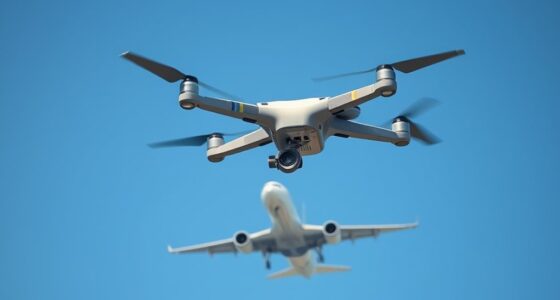
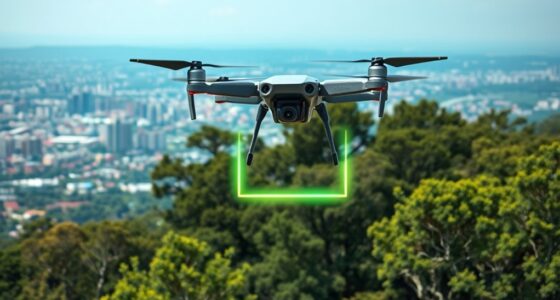
Quadcopters and fixed-wing drones have distinct flight styles. With quadcopters, you get agility, precise maneuvering, and vertical takeoff and landing, making them perfect for tight spaces or detailed inspections. Fixed-wing drones focus on long-distance travel, offering greater endurance and efficiency but require runways or slightly complex launches. Understanding these differences can help you choose the right drone for your needs; exploring further reveals more about their unique capabilities and best uses.
Key Takeaways
- Fixed-wing drones are more efficient for long-distance travel, while quadcopters excel in maneuverability and hovering.
- Quadcopters can take off and land vertically, unlike fixed-wing drones that need runways or catapults.
- Fixed-wing drones require continuous forward motion to stay airborne, limiting their ability to hover or navigate tight spaces.
- Quadcopters provide precise control for inspections and complex maneuvers, whereas fixed wings are suited for rapid area coverage.
- Flight durations are longer for fixed-wing drones (1-3 hours) compared to quadcopters (20-50 minutes).
Structural Design and Engineering Aspects

When comparing the structural design of fixed-wing drones and quadcopters, it’s clear that each has distinct engineering principles tailored to their functions. Fixed-wing drones resemble traditional aircraft, with aerodynamic wings that generate lift as they move forward. They usually have a simple, streamlined structure that minimizes complexity and makes manufacturing easier. In contrast, quadcopters feature four rotors mounted on a lightweight frame, allowing vertical takeoff and landing. Their compact design makes them highly portable and adaptable to various environments. Fixed-wing models tend to be larger and more cumbersome but are optimized for long-distance travel. Quadcopters are smaller and foldable, making them easy to carry and deploy quickly. Each design reflects its purpose: efficiency for fixed wings, agility for multirotors. Innovative European Cloud Servers offer solutions that support these diverse drone technologies through secure, energy-efficient cloud infrastructure.
Flight Duration and Energy Use
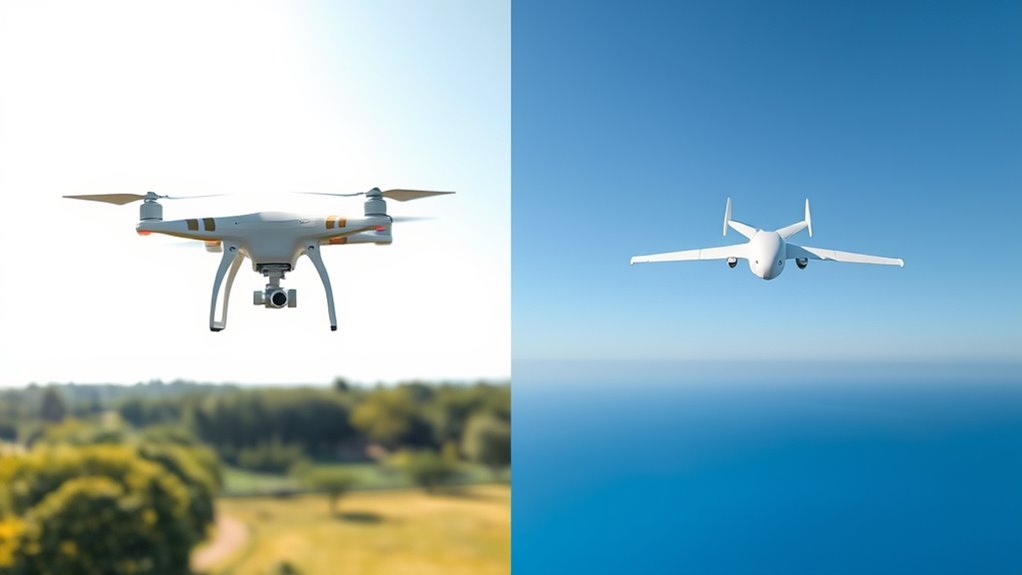
Fixed-wing drones generally stay airborne much longer than quadcopters because their aerodynamic wings generate lift efficiently, reducing energy consumption. They can fly for 1 to 3 hours, thanks to minimal power needed to glide and maintain altitude. In contrast, quadcopters usually last 20 to 50 minutes per battery charge, as they require continuous energy to keep their rotors spinning. Multirotor drones burn significant power just to stay aloft, making extended flights less feasible. Fixed-wing designs consume less energy overall, especially during cruising, allowing for extensive coverage in a single mission. This efficiency makes them ideal for large-area surveys or mapping projects. Additionally, the flight efficiency of fixed-wing drones enables them to perform longer missions with less frequent battery replacements, which is advantageous for long-distance reconnaissance and other time-sensitive tasks. Moreover, their aerodynamic stability contributes to smoother flight paths, further conserving energy. The energy consumption of fixed-wing drones is generally lower because their wings provide lift without continuous power, unlike multirotor designs. Furthermore, their design simplicity reduces maintenance needs and enhances reliability during prolonged operations. Conversely, quadcopters’ higher energy needs limit their flight duration but provide greater maneuverability and precision.
Maneuverability and Flight Capabilities
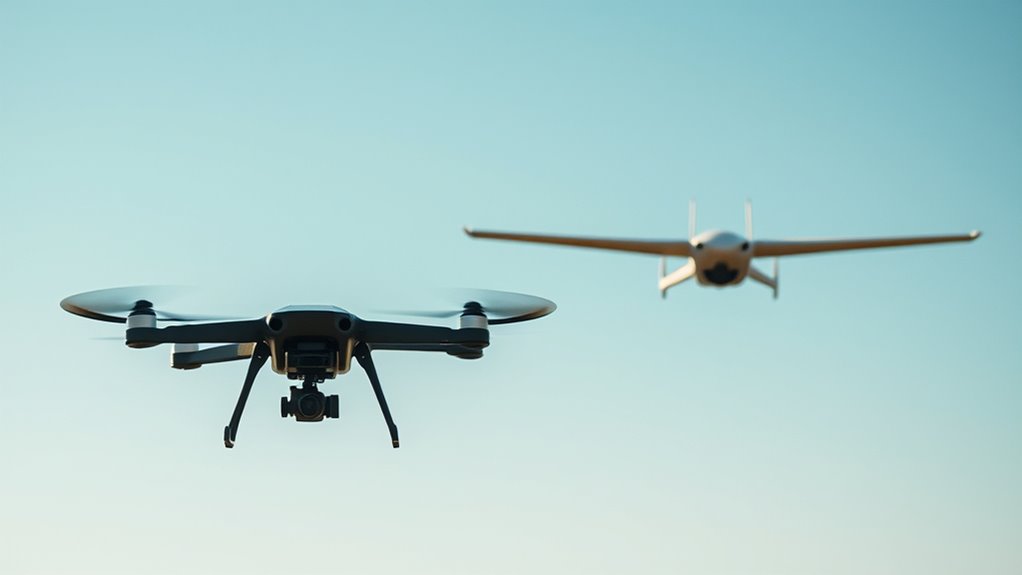
Quadcopters excel in maneuverability and flight control, offering capabilities that fixed-wing drones can’t match. You can hover in place, perform precise aerial maneuvers, and navigate tight spaces with ease. Their ability to ascend, descend, and rotate on any axis makes them ideal for detailed inspections or complex filming. Unlike fixed-wing drones, they don’t need forward motion to stay airborne, giving you more control in confined areas. This versatility allows for quick adjustments and stable positioning during operations.
Quadcopters offer unmatched maneuverability, stability, and precise control in tight spaces and detailed inspections.
- Hover and maintain stable positions
- Execute sharp turns and quick directional changes
- Perform vertical ascent and descent
- Navigate confined or obstacle-rich spaces
- Complete precise, controlled movements for inspection or filming
Launch and Landing Procedures
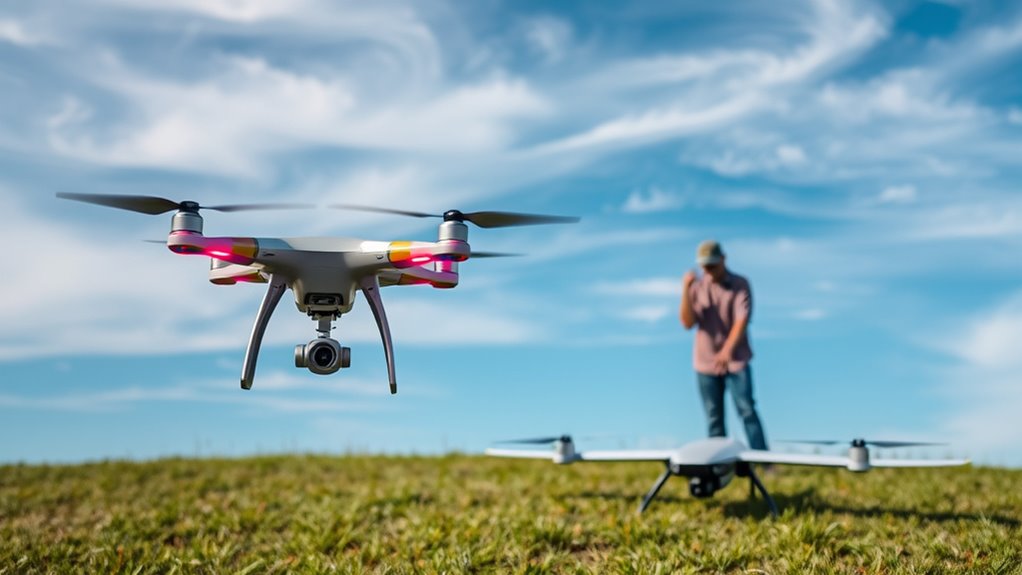
Unlike fixed-wing drones, which often require specialized procedures for takeoff and landing, quadcopters are designed for simplicity and flexibility. You can launch a quadcopter almost anywhere with minimal space; just power up the motors and gently lift off vertically. For landing, you simply hover at a safe height and then slowly descend, stopping the rotors once on the ground. This vertical capability allows for quick, controlled takeoffs and landings in confined or uneven environments. You don’t need a runway or large open area, making quadcopters ideal for urban settings, indoor use, or tight spaces. Their straightforward procedures save time and reduce complexity, enabling you to operate efficiently and safely in diverse conditions. Additionally, connectivity features in smart drones can further enhance ease of use and safety during operation. Understanding drone safety protocols is also essential to prevent accidents and ensure smooth operation. Incorporating proper pre-flight checks can help identify potential issues before takeoff, improving safety and reliability. Being aware of regulations and guidelines can also support responsible drone use and help avoid legal issues.
Data Gathering and Operational Efficiency
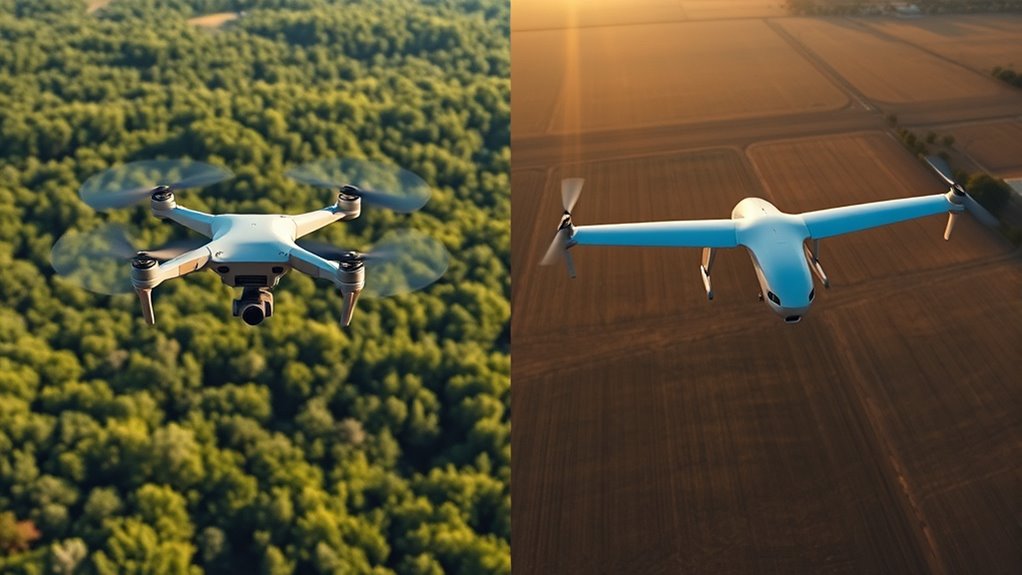
When it comes to data gathering, your choice of drone markedly impacts operational efficiency. Fixed-wing drones excel at covering large areas quickly, making them ideal for expansive mapping projects. They can fly longer distances and stay airborne for hours, reducing the number of missions needed. In contrast, quadcopters provide detailed data in smaller zones with high precision, perfect for inspections or close-up surveys. Your options include:
- Fixed-wing drones for broad, rapid coverage of large sites
- Quadcopters for detailed, high-resolution data collection
- Fixed-wing models with higher endurance and speed
- Quadcopters offering precise maneuverability and hover capabilities
- Cost considerations influencing operational choices and mission scope
Choosing between them depends on your project’s scale, detail requirements, and budget, directly affecting efficiency and data quality.
Frequently Asked Questions
What Are the Maintenance Requirements for Fixed-Wing Versus Quadcopter Drones?
You’ll find that fixed-wing drones require less maintenance because they have simpler structures and fewer moving parts, mainly focusing on wings and basic propulsion systems. In contrast, quadcopters need regular checks on four rotors, motors, and batteries to guarantee stability and safety. Quadcopters also demand more frequent part replacements due to higher wear and tear from frequent takeoffs, landings, and maneuvering.
How Do Weather Conditions Affect the Performance of Each Drone Type?
You might think weather doesn’t matter much, but it substantially impacts both drone types. Strong winds can destabilize quadcopters, making precise hovering difficult and risking crashes. Fixed-wing drones handle gusts better and stay stable thanks to aerodynamic design, but heavy rain or turbulence can still impair their flight or cause damage. Rain and snow can short-circuit electronics, so weather conditions demand careful planning for safe, effective drone operations.
Are There Regulations Specific to Fixed-Wing and Quadcopter Drone Operations?
You should know that regulations vary by location, but generally, fixed-wing and quadcopter drones face similar rules. You need to register your drone if it exceeds weight limits, follow altitude restrictions, and avoid no-fly zones like airports or military areas. Some regions impose additional rules for fixed-wing aircraft due to their longer range and speed, while quadcopters often have restrictions concerning flight in urban or populated areas. Always check local laws before flying.
What Safety Features Are Typically Integrated Into Each Drone Design?
You might worry about safety, but both drone types come equipped with essential features. Quadcopters often include obstacle avoidance sensors, low-battery alerts, and GPS-based return-to-home functions to prevent crashes. Fixed-wing drones may have automatic stall prevention, geofencing, and emergency shutdowns. These safety features help safeguard your equipment and ensure reliable operation, even in challenging environments, giving you peace of mind during your missions.
How Do Payload Capacities Compare Between Fixed-Wing and Quadcopter Drones?
You’ll find that fixed-wing drones generally have higher payload capacities because of their larger size and structural strength, allowing them to carry heavier equipment like cameras or sensors for extended periods. Quadcopters, being smaller and lighter, have limited payloads, typically suitable for lighter cameras or sensors. If you need to transport heavier gear over long distances, fixed-wing drones are more suitable, but for detailed inspections with lighter payloads, quadcopters work best.
Conclusion
Whether you prefer the versatility of quadcopters or the efficiency of fixed-wing drones, understanding their design, endurance, maneuverability, and launch methods helps you choose the right tool. Both styles offer unique strengths—stability and ease for quadcopters, longer flights and coverage for fixed-wings. By recognizing these differences, you can match your mission needs, maximize performance, and achieve your goals with confidence, whether you’re steering tight spaces or covering vast terrains.