
ADS-B technology allows drones to detect airplanes by receiving signals broadcast by aircraft GPS systems on frequencies like 978 MHz and 1090 MHz. Equipped with dual-band receivers, your drone can monitor a wide range of aircraft, even from hundreds of miles away. This early detection improves safety by providing real-time situational awareness, helping you avoid collisions. To understand how these systems work together for safer drone operations, keep exploring the key features and regulations involved.

Get the latest gadgets delivered free with Prime
- Fast, free delivery on millions of items
- Prime Video, Amazon Music and more included
- Member-only deals all year
Key Takeaways
- Drones use ADS-B receivers to pick up signals broadcasted by aircraft on 978 MHz and 1090 MHz frequencies.
- ADS-B provides real-time aircraft position, altitude, speed, and identity data for situational awareness.
- Dual-band detection extends range and improves detection of all types of aircraft, including commercial and general aviation.
- Continuous ADS-B data allows drones to identify nearby aircraft early, supporting collision avoidance beyond visual range.
- Regulatory standards require drones in certain airspaces to be equipped with ADS-B Out for enhanced safety and airspace integration.
Top picks for "dron detect airplan"
As an affiliate, we earn on qualifying purchases.
Understanding ADS-B Technology and Its Role in Drone Safety
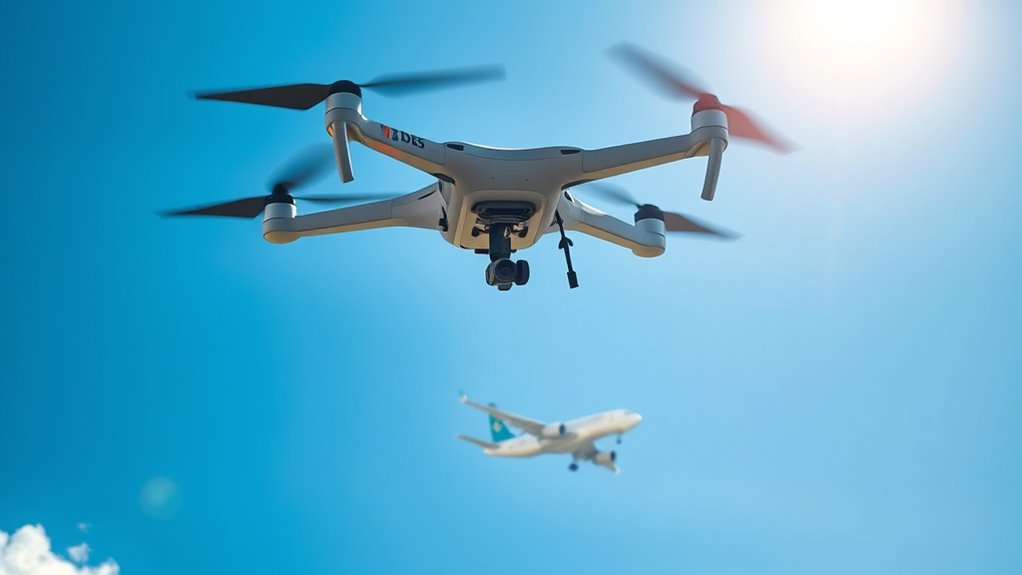
Have you ever wondered how drones can safely operate alongside manned aircraft in busy airspace? It all comes down to ADS-B technology. ADS-B, or Automatic Dependent Surveillance–Broadcast, lets aircraft broadcast their GPS position, altitude, speed, and identity every second. This real-time data helps drones understand where nearby airplanes are, even beyond visual range. Drones equipped with ADS-B receivers can pick up signals on two frequencies—978 MHz and 1090 MHz—covering most aircraft types. This constant stream of precise information improves situational awareness and enables effective collision avoidance. Proper installation and maintenance of ADS-B systems are essential for ensuring consistent performance and safety. The accuracy of ADS-B data is vital for reliable drone operations, as it directly influences the effectiveness of collision avoidance measures. Additionally, high-quality ADS-B signal reception is crucial for maintaining a dependable connection with surrounding aircraft, especially in complex environments. Integration of ADS-B into drone navigation systems is a significant advancement that enhances safety and operational efficiency. By integrating ADS-B, drones can safely share the skies with manned aircraft, supporting safer operations and smoother traffic management in congested airspace. It’s a crucial step toward seamless drone integration into our airspace system.
How ADS-B Receivers Enable Drones to Detect Airplanes
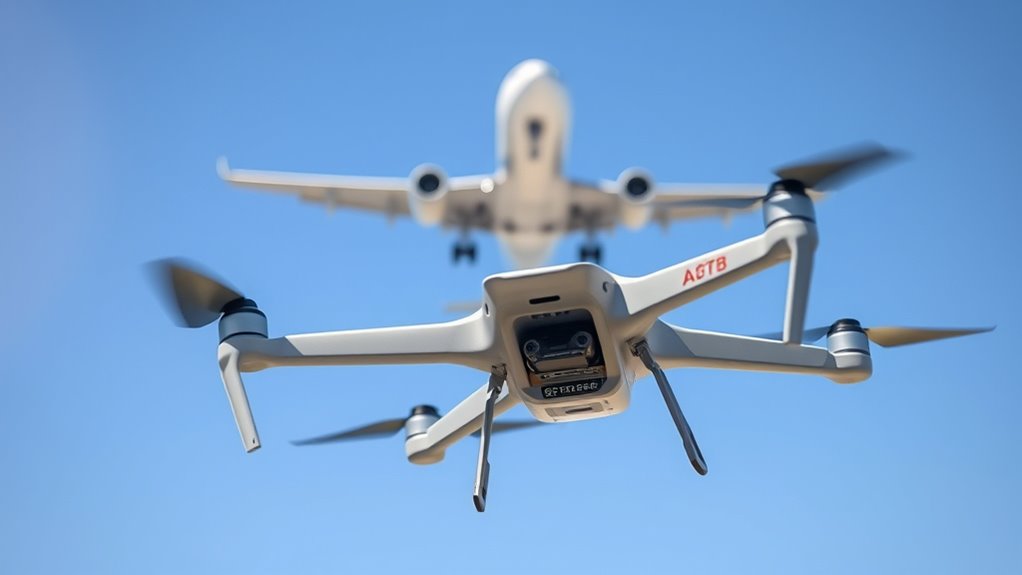
You can rely on dual-band ADS-B receivers to pick up signals on both 978 MHz and 1090 MHz frequencies, ensuring you detect all types of aircraft transponders. These receivers offer extended detection ranges, giving your drone early warning of nearby airplanes even from afar. By integrating this technology, your drone gains precise, real-time awareness of air traffic, making BVLOS operations safer and more reliable. Simple, effective systems help streamline the detection process and enhance overall safety.
Dual-Band Signal Reception
Dual-band ADS-B receivers play a crucial role in enabling drones to detect airplanes by capturing signals transmitted on both the 978 MHz (UAT) and 1090 MHz (Extended Squitter) frequencies. This dual-band capability guarantees that your drone can track a wide range of aircraft, including general aviation and commercial planes. By receiving signals on both frequencies, your drone’s system gains an extensive view of nearby air traffic, reducing blind spots. Additionally, powerful receiver technology ensures consistent performance across different conditions. Incorporating AI-based signal processing can further enhance detection accuracy and adapt to varying environments. Utilizing reliable frequency coverage is essential for comprehensive air traffic detection, especially in complex or busy airspace. Understanding dual-band capabilities helps optimize drone safety systems and improves overall airspace awareness, which is vital for safe drone operation in shared airspace.
Extended Detection Range
Did you know that advanced ADS-B receivers can extend your drone’s detection range to nearly 100 times that of traditional radar systems? This means you can spot and avoid aircraft much earlier, reducing collision risks. These receivers use dual-band technology to pick up signals from both 978 MHz and 1090 MHz frequencies, covering most aircraft transponders. Their enhanced sensitivity and wide coverage allow your drone to monitor airspace from greater distances, even beyond visual line of sight. Here’s a quick comparison:
| Feature | Traditional Radar | Advanced ADS-B Receiver |
|---|---|---|
| Detection Range | Few miles | Up to hundreds of miles |
| Signal Coverage | Limited | Nearly 360 degrees |
| Data Update Frequency | Less frequent | About every second |
This extended range improves safety and operational confidence considerably.
The Advantages of Dual-Band ADS-B Reception for Drone Operations

Using dual-band ADS-B receivers gives you broader airspace coverage and more reliable detection of nearby aircraft. You’ll benefit from consistent updates across both frequencies, reducing blind spots and false alarms. This all-encompassing approach guarantees safer drone operations, especially in complex or congested airspace. Enhancing safety through dual-band technology ensures you stay informed with accurate, real-time data. Incorporating air traffic management systems further optimizes situational awareness and response capabilities in busy environments.
Comprehensive Airspace Coverage
Having extensive airspace coverage is essential for safe and effective drone operations, especially when steering through complex environments. Dual-band ADS-B receivers enhance this coverage by detecting aircraft on both 978 MHz and 1090 MHz frequencies, covering all cooperative aircraft types. This broad detection capability ensures you’re aware of nearby traffic from multiple sources, reducing blind spots. With exhaustive coverage, you can confidently navigate BVLOS missions and crowded airspaces.
- Detects aircraft on both 978 MHz and 1090 MHz frequencies
- Covers all cooperative aircraft types for better awareness
- Extends detection range markedly compared to radar
- Provides 360-degree situational awareness
- Supports safer navigation through busy or complex airspace environments
Enhanced Detection Reliability
Dual-band ADS-B receivers substantially enhance detection reliability for drone operations by capturing aircraft signals across both 978 MHz and 1090 MHz frequencies. This dual capability ensures you can detect a wider range of aircraft, including both UAT and Mode S transponder-equipped planes. By covering all cooperative aircraft types, you reduce blind spots and improve situational awareness, especially in complex or congested airspace. The increased detection range means you get early warnings of nearby aircraft, giving you more time to react and plan safe flight paths. With dependable, real-time data from both bands, your drone’s collision avoidance system becomes more robust. Ultimately, dual-band reception provides a more thorough airspace picture, greatly boosting safety and operational confidence during BVLOS missions.
Integrating ADS-B Data for Enhanced Airspace Situational Awareness

Integrating ADS-B data substantially enhances airspace situational awareness by providing a thorough, real-time view of all airborne objects. You gain a holistic picture of aircraft positions, altitudes, and speeds, reducing collision risks. This integration allows you to monitor both manned aircraft and drones simultaneously, making navigation safer and more efficient. With unified data, you can better anticipate potential conflicts and plan routes accordingly. Clear, actionable insight helps in understanding complex air traffic scenarios and improving safety measures.
Regulatory Guidelines and Compliance for ADS-B in Drone Missions

Regulatory guidelines for ADS-B in drone missions are essential to guarantee safe and compliant operation within national and international airspace. You need to confirm your drone is equipped with approved ADS-B Out systems if flying in controlled or congested areas, especially beyond visual line of sight (BVLOS). The FAA mandates ADS-B Out for certain airspace classes, while ADS-B In remains optional but recommended for better traffic awareness. You must obtain proper authorization, adhere to altitude and operation limits, and keep your equipment maintained according to regulations. Compliance also involves integrating ADS-B data into your flight planning and ensuring your systems meet technical standards. Staying updated on evolving rules helps you operate safely, prevent conflicts, and avoid penalties or legal issues during your drone missions. Additionally, understanding Vetted – wave and wind conditions can improve safety and system reliability during drone flights. Being aware of airspace classifications and their specific requirements further enhances operational safety and regulatory compliance. Regularly reviewing regulatory updates ensures your drone operations remain compliant with current standards and helps you adapt to new requirements as they develop. Incorporating information about airspace restrictions can further help in planning safe and legal drone flights. Moreover, understanding reliable communication links is crucial for maintaining control and safety during complex drone operations.
Technical Features of Advanced ADS-B Receivers for Drones

Advanced ADS-B receivers for drones incorporate cutting-edge hardware and software features that substantially enhance situational awareness and safety. These receivers detect signals on both 978 MHz and 1090 MHz frequencies, ensuring compatibility with all aircraft transponders. Some models include sensors like carbon monoxide alarms, backup attitude sensors, and long-lasting batteries for portability. Integrated weather and traffic data provide real-time alerts, helping you avoid hazards during flight. Auto-adjusting LED brightness improves visibility in different lighting conditions, while rugged designs withstand tough environments. Hardware and software integration allows continuous, high-fidelity tracking, plus historical weather replay to support better decision-making during drone operations. These features collectively enable safer, smarter, and more reliable drone flights near manned aircraft.
The Future of Air Traffic Management With ADS-B and Autonomous Drones

As autonomous drones become more prevalent, air traffic management systems are evolving to handle the increasing complexity of shared airspace. You’ll see integrated systems that combine ADS-B data with real-time drone tracking, creating thorough, 3D situational awareness. This means safer, more efficient coordination between manned aircraft and unmanned vehicles. Advanced platforms will automatically deconflict routes, adjusting drone paths dynamically based on live traffic data. Regulatory frameworks will expand to support widespread ADS-B adoption, particularly for BVLOS operations, enabling drones to operate safely in congested areas. You’ll also benefit from smarter traffic management tools that reduce pilot workload and improve response times. Overall, the future promises a seamless, connected airspace where ADS-B technology ensures safety and coordination as autonomous drones become integral to everyday life.
Frequently Asked Questions
Can Drones Operate Safely Without ADS-B in Complex Airspace?
You can operate a drone safely without ADS-B in complex airspace, but it’s riskier. Without ADS-B, you lose real-time aircraft data, making it harder to detect and avoid other airplanes. To stay safe, rely on visual observers, onboard sensors, and other detection methods. However, integrating ADS-B improves situational awareness and safety, especially for BVLOS flights and crowded airspace, reducing the risk of collisions.
How Does ADS-B Handle Non-Cooperative or Untracked Aircraft?
ADS-B can’t directly detect non-cooperative or untracked aircraft since they don’t broadcast position data. Instead, it relies on cooperative aircraft with transponders. To compensate, you should use additional detection methods like radar, optical sensors, or acoustic devices. Combining these systems with ADS-B enhances your drone’s awareness of all nearby aircraft, helping you maintain safe distances and avoid potential collisions even with untracked aircraft.
What Are the Limitations of ADS-B Detection Range for Drones?
You should know that ADS-B detection range for drones is limited by several factors. Terrain, obstacles, and atmospheric conditions can reduce signal strength and range. Also, aircraft not equipped with ADS-B transponders or operating on different frequencies may go undetected. While advanced receivers extend detection up to nearly 100 miles, actual range varies based on environment, antenna placement, and aircraft transponder capabilities, so always stay cautious.
Are There Privacy Concerns With ADS-B Data Sharing?
Yes, there are privacy concerns with ADS-B data sharing. You might worry that your aircraft’s position and flight details could be accessed by unauthorized parties, potentially revealing sensitive information or compromising security. While ADS-B improves safety, it broadcasts real-time location data openly, which some see as a privacy risk. Balancing transparency for safety with privacy protections remains an ongoing debate among aviation authorities and industry stakeholders.
How Does ADS-B Integration Affect Drone Battery Life and Operation Time?
Think of ADS-B integration as adding a turbocharger to your drone’s engine. It can slightly reduce your flight time because the ADS-B receiver draws extra power, but the trade-off is worth it for enhanced safety and situational awareness. Modern systems are designed to be energy-efficient, so the impact on operation time is minimal. With proper planning, you can maintain long flights while benefiting from real-time air traffic detection.
Conclusion
By understanding ADS-B technology, enabling drones to detect airplanes, and embracing advanced ADS-B receivers, you enhance safety, improve situational awareness, and stay compliant with regulations. Integrating these systems offers better detection, smarter navigation, and future-proofed airspace management. As drone technology evolves, your ability to adapt, your commitment to safety, and your focus on innovation will shape the future of safe, efficient, and responsible drone operations.
Fall Picks
fall essentials
As an affiliate, we earn on qualifying purchases.