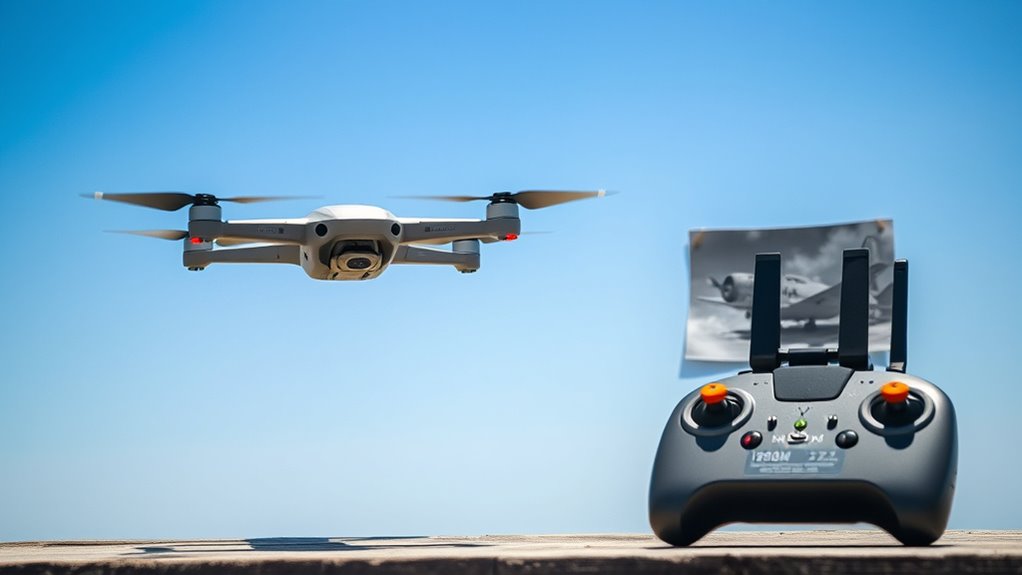
The history of drones shows how they started as military tools for surveillance and combat during the early 20th century, with innovations during WWI, WWII, and the Cold War. Over time, technological advances like GPS, cameras, and sensors made them accessible to civilians. Today, drones are widely used by hobbyists, professionals, and even for entertainment, blending high-tech features with everyday fun. If you continue exploring, you’ll discover how drones keep evolving into versatile gadgets for all.
Open a free Amazon Business account
Business pricing, bulk buying and tax-exempt orders.
As an affiliate, we earn on qualifying purchases.
Key Takeaways
- Early drones originated from military innovations in the early 20th century for reconnaissance and target practice.
- WWII and Cold War advancements focused on long-range control, surveillance, and weaponization of UAVs.
- The 2000s saw regulatory changes and technological improvements enabling civilian and commercial drone use.
- Consumer models like DJI Phantom made drones affordable, user-friendly, and popular among hobbyists.
- Modern drones feature autonomous flight, high-quality cameras, and diverse applications, transitioning from military tools to recreational gadgets.
Early Innovations and the Birth of Aerial Vehicles

Have you ever wondered how drones first came into existence? It all started with simple flying devices like hot-air balloons in 1783, which marked the earliest ideas of unmanned flight. By 1849, the Austrian Navy tried using incendiary balloons to capture Venice, showing how aerial vehicles could serve military goals. In 1896, the first camera was mounted on a UAV, hinting at future surveillance capabilities. Nikola Tesla, in 1915, envisioned unmanned combat vehicles, pushing the boundaries of technology. The following year, A.M. Low created the first self-propelled drone as an aerial target. These innovations laid the groundwork for the evolution of unmanned aircraft, transforming them from experimental contraptions into essential tools for military, scientific, and civilian uses. Advancements in technology continue to expand the capabilities and applications of drones today, including free floating systems that adapt seamlessly to their environments. Additionally, ongoing research into energy-efficient drone designs supports sustainable development within the industry.
Developments During the World War I and Interwar Years

During World War I and the interwar years, significant advancements in drone technology emerged as military strategists recognized the potential of unmanned aircraft. You see, this era saw the birth of the first pilotless aerial devices, sparking new tactics and innovations. You might feel a sense of awe knowing that:
During WWI and the interwar years, groundbreaking drone innovations transformed aerial warfare and inspired future technologies.
- The first self-propelled drone, created in 1916, served as an aerial target, paving the way for future combat applications
- During the interwar years, the Hewitt-Sperry Automatic Airplane and Kettering Bug were developed as unmanned torpedoes, hinting at modern missile systems
- In 1935, the De Havilland Queen Bee entered service, popularizing the term “drone” and demonstrating the military’s focus on unmanned systems
These breakthroughs marked a pivotal turning point, transforming aerial warfare and inspiring subsequent generations of drone technology.
Advancements in Military Drone Technology During WWII and Cold War

World War II and the Cold War era saw remarkable strides in military drone technology as nations sought to enhance their battlefield capabilities. During WWII, over 9,400 OQ-3 target drones were built, primarily used for training and practice. In 1946, the U.S. completed a remote-controlled B-17 Flying Fortress prototype, setting an endurance record by flying 2,600 miles. The Vietnam War marked a significant shift, with increased U.S. investment in drone development. Over 3,000 drones supported security, surveillance, and decoy missions during this conflict. These advancements laid the groundwork for modern military drones, demonstrating their strategic value. The Cold War era pushed further innovations, emphasizing long-range control, real-time surveillance, and integration with missile systems, fundamentally transforming how nations approached aerial warfare.
The Rise of Modern Military Drones in the Late 20th Century

In the late 20th century, technological advances transformed military drones from simple reconnaissance tools into sophisticated weapons platforms. You’ll see how new sensors, navigation systems, and remote operation capabilities shaped their deployment and effectiveness. These innovations profoundly changed warfare strategies, making drone use more precise and impactful.
Technological Advancements and Deployment
The late 20th century marked a pivotal period in the evolution of military drones, driven by rapid technological advancements that transformed their capabilities and strategic importance. You witness how miniaturization, improved sensors, and advanced communications expanded drone roles. These innovations allowed you to:
- *Conduct precise surveillance*, reducing risk to personnel
- *Engage targets with accuracy*, minimizing collateral damage
- *Operate in complex environments*, opening new battlefield strategies
You see the shift from simple remote-controlled devices to sophisticated, autonomous systems. The development of GPS-guided targeting and real-time data transmission boosted operational efficiency. Drones became essential tools for intelligence gathering, reconnaissance, and even targeted strikes. This era laid the groundwork for today’s integrated, multi-mission UAVs, revolutionizing military tactics and transforming warfare forever.
Strategic Impact on Warfare
Have you ever wondered how modern warfare has been reshaped by drone technology? In the late 20th century, drones transformed military strategies by providing persistent surveillance and precise strike capabilities. They enabled nations to gather intelligence without risking pilots’ lives, changing the dynamics of battlefield decision-making. The introduction of armed drones like the MQ-1 Predator allowed for targeted attacks on high-value targets, often in remote or hostile regions, with minimal collateral damage. This shift increased operational flexibility, reduced costs, and extended military reach. As a result, drones became essential tools for counterterrorism, reconnaissance, and decoy operations. Their strategic impact challenged traditional notions of warfare, making conflicts more focused, less risky for soldiers, and increasingly technology-driven. Understanding the proliferation of drone technology has highlighted its significance in modern military operations. Furthermore, advancements in remote operation systems have made drone deployment more accessible and effective for various military and civilian applications, contributing to the rapid evolution of drone capabilities. The rising use of reconditioned batteries in powering drones also underscores the importance of sustainable energy solutions in modern technology. Additionally, ongoing research into autonomous drone systems promises to further revolutionize military tactics and civilian uses alike.
Transitioning to Civilian and Commercial Applications in the 2000s

In the 2000s, regulations began easing, allowing civilian and commercial drones to fly in public airspace. These changes sparked rapid technological advancements, making drones more capable and affordable. As a result, a wide range of industries started adopting drone technology for tasks like inspection, photography, and delivery.
Regulatory Milestones Achieved
How did regulatory milestones facilitate the shift of drones from military tools to everyday civilian and commercial devices? These milestones created a safer, more accessible environment for innovation and adoption. The FAA’s issuance of the first commercial drone certificate in 2006 marked a major breakthrough, opening airspace for business use. This move inspired entrepreneurs and hobbyists alike, fueling excitement and investment. Regulations also established safety standards, reducing risks and building public trust.
- Opening new markets for aerial photography, agriculture, and delivery services
- Encouraging innovation through clear guidelines and certification processes
- Fostering public confidence by ensuring safety and accountability
These steps transformed drones from specialized military equipment into versatile tools integrated into everyday life.
Expansion of Civil Use
The 2000s marked a pivotal shift as drones shifted from primarily military tools to versatile assets in civilian and commercial sectors. During this period, regulatory changes, like the FAA issuing its first commercial drone certificate in 2006, opened airspace for business use. You could now find drones used by law enforcement, for infrastructure inspection, agriculture, and filmmaking. Consumer models such as the Parrot drone in 2010 and DJI’s Phantom series in the mid-2010s made flying accessible to amateurs and professionals alike. Advancements in technology, including GPS integration and smartphone control, lowered barriers to entry. This expansion transformed drones from specialized military equipment into everyday tools, fueling innovation across industries and enabling new business opportunities. The era marked the beginning of widespread adoption outside military applications.
Technological Advancements Enabled
Advancements in drone technology during the 2000s revolutionized their civilian and commercial applications by making them more accessible and versatile. You now have tools that are easier to operate, affordable, and packed with innovative features. The introduction of GPS technology, high-quality cameras, and stabilization systems transformed drones into powerful devices for photography, surveying, and delivery services. These innovations sparked excitement and endless possibilities for hobbyists and entrepreneurs alike.
- Experience breathtaking aerial images with stabilized, high-definition cameras
- Conduct precise mapping and inspections with advanced GPS and sensors
- Explore new markets, from agriculture to filmmaking, fueled by affordable, user-friendly tech
The Democratization of Drone Technology and Consumer Markets

As drone technology became more affordable and user-friendly in the 2010s, it quickly shifted from a specialized military tool to a widespread consumer product. You now hold a device capable of capturing stunning aerial photos, racing through parks, or inspecting roofs. Imagine this evolution with the following:
| Year | Innovation | Impact |
|---|---|---|
| 2010 | Smartphone control | Made flying accessible |
| 2012 | GPS integration | Enabled precise navigation |
| 2014 | Compact design | Increased portability |
| 2016 | Computer vision | Improved obstacle avoidance |
| 2018 | AI-powered features | Enhanced autonomous flight |
This progression brought drones into homes, schools, and small businesses, transforming them into everyday tools and hobbies. You can now explore aerial photography, racing, or DIY projects easily. The net worth of drone companies has also grown substantially, reflecting the expanding market and innovation in the industry.
Key Breakthroughs in Consumer Drone Design and Features

Have you ever wondered what made modern consumer drones so revolutionary? It’s the breakthroughs in design and features that transformed drones from niche tools into everyday gadgets. You now benefit from:
- Integrated GPS and intelligent flight modes that enable precise navigation and autonomous filming
- High-quality cameras with stabilization technology, capturing stunning photos and videos effortlessly
- Advanced sensors and obstacle avoidance systems that make flying safer and more accessible for everyone
- These innovations are made possible by compact, lightweight frames that enhance portability and ease of use. The combination of these features has turned drones into versatile companions for hobbies, photography, and even small business ventures. It’s a game-changer in how you experience and interact with aerial technology, especially as smart home integration continues to expand. Additionally, ongoing advancements in miniaturization and sensor technology are pushing the boundaries of drone capabilities even further.
Integration of GPS, AI, and Advanced Sensors in Drones
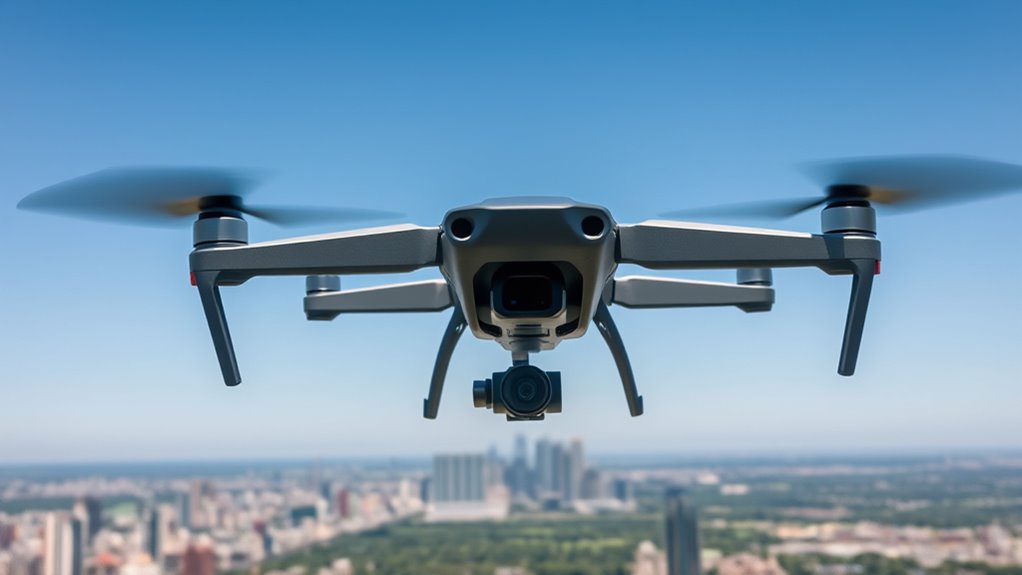
You’ll see how GPS, AI, and advanced sensors work together to make drones more precise and autonomous. These technologies enable drones to navigate accurately, make decisions on their own, and sense their environment better. As a result, drones are becoming smarter and more capable in a wide range of applications. Additionally, the integration of vehicle upgrades allows for improved performance and customization, further enhancing their versatility.
Precision Navigation Systems
Precision navigation systems have transformed drone capabilities by enabling highly accurate movement and positioning. You now rely on GPS, AI, and advanced sensors working seamlessly together to navigate complex environments with confidence. These systems allow drones to fly precisely along planned routes, avoid obstacles in real time, and perform intricate maneuvers. With integrated sensors, you gain situational awareness, making drones smarter and safer. This advancement sparks excitement as drones can now:
- *Navigate treacherous terrain with pinpoint accuracy*
- *Avoid obstacles instinctively, reducing crashes*
- *Perform autonomous missions with minimal human input*
You experience a new level of control and reliability, opening endless possibilities — from detailed mapping to search-and-rescue. This technology elevates drones from simple tools to sophisticated machines capable of complex, autonomous tasks. Incorporates traditional practices for holistic health
Autonomous Decision-Making Capabilities
The integration of GPS, AI, and advanced sensors has transformed drones from merely following programmed routes into autonomous machines capable of making real-time decisions. You now have drones that can analyze their environment, identify obstacles, and adjust their flight paths on the fly, without human input. AI enables these drones to interpret complex data, recognize objects, and respond appropriately, whether avoiding hazards or optimizing navigation. GPS provides precise geolocation, ensuring accurate positioning and route planning. Advanced sensors gather detailed environmental information, such as temperature, proximity, and motion. Together, these technologies empower drones to operate independently in dynamic environments, making them more effective for surveillance, delivery, and exploration tasks. This evolution marks a significant leap toward truly autonomous aerial systems.
Enhanced Environmental Sensing
By integrating GPS, AI, and advanced sensors, drones now possess a sophisticated understanding of their environment that far surpasses basic navigation. This synergy enables real-time obstacle detection, precise mapping, and adaptive flight adjustments. You can feel confident knowing your drone can avoid hazards, identify objects, and make smarter decisions on the fly. Imagine the possibilities: environmental awareness, which allows drones to adapt to changing conditions and improve their performance over time. Additionally, the integration of sensor fusion enhances the drone’s ability to interpret complex data streams for better decision-making.
- Enhanced safety that protects your investment and surroundings
- Accurate data collection for environmental research or infrastructure inspection
- Seamless autonomous operation that makes flying easier and more reliable
These advancements empower drones to perform complex tasks with minimal human input, opening new horizons in agriculture, disaster response, and recreational flying. This integration transforms drones from simple tools into intelligent, responsive devices capable of understanding and reacting to their environment.
Global Adoption and the Emergence of Weaponized Drones

As drone technology has advanced globally, many countries and groups have adopted it for both civilian and military applications. You’ve seen how drones shifted from surveillance tools to weapons platforms, with over three dozen nations and terrorist groups now deploying weaponized drones. These devices are used for reconnaissance, targeted strikes, and even payload delivery. Governments recognize their strategic value, especially in asymmetric warfare, where small, cheap drones outmatch traditional defenses. Non-state actors exploit commercial drones, modifying them for combat or sabotage. This widespread adoption has reshaped conflict zones, blurring lines between combatant and civilian. The proliferation of weaponized drones underscores their importance in modern warfare, making them a critical component of military arsenals worldwide.
The Future of Drones: Trends and Innovations in the Hobbyist Era
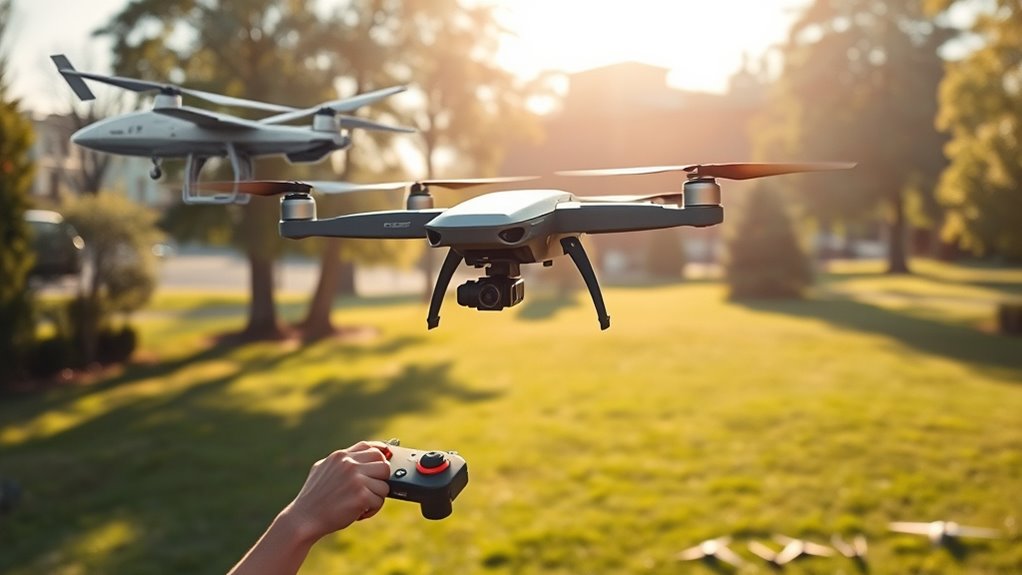
Advances in technology and decreasing costs have propelled drones from specialized military equipment to everyday gadgets accessible to hobbyists and consumers. You can now explore new frontiers with tools that were once exclusive to professionals. Imagine capturing stunning aerial photos effortlessly, racing high-speed drones through challenging courses, or even developing your own custom models. The future promises:
- Smart automation, making flying easier and safer for all skill levels
- Enhanced AI capabilities, enabling autonomous navigation and obstacle avoidance
- Affordable modular systems, allowing customization for hobbies, photography, or racing
These innovations will transform your drone experience, turning what was once a complex skill into an accessible, exciting hobby. As technology evolves, you’ll have more power, creativity, and fun at your fingertips.
Frequently Asked Questions
What Inspired Early Inventors to Pursue Unmanned Aerial Vehicles?
You’re inspired by the challenge of flight and the desire to explore new technology. Early inventors saw potential in unmanned aerial vehicles for military, surveillance, and scientific purposes. They wanted to push boundaries, improve safety, and gain strategic advantages. Your curiosity about flight mechanics and innovation drives you to develop machines that can operate independently, paving the way for both military breakthroughs and civilian applications.
How Did Military Needs Shape Drone Technology During the 20TH Century?
You might be surprised to learn that military needs drove drone innovation throughout the 20th century, pushing boundaries in ways you wouldn’t expect. During World Wars, armies sought unmanned aircraft for reconnaissance and decoys, leading to breakthroughs like the first mass-produced UAV. As conflicts like Vietnam escalated, the technology evolved further, culminating in the sophisticated, weaponized drones used today. Military demands continually shaped drone advancements, transforming them from simple tools into strategic assets.
What Regulations Initially Limited Civilian Drone Development?
Initially, strict FAA regulations limited civilian drone development to guarantee safety and security. You couldn’t fly drones in most airspace without permission, and rules restricted commercial use. These regulations aimed to prevent accidents and unauthorized surveillance. Over time, policies eased, allowing recreational flying and commercial applications. You needed permits or certifications, but these restrictions slowed widespread adoption until updated guidelines made drones more accessible and legal for everyday use.
How Have Consumer Drones Impacted Photography and Videography?
Consumer drones have revolutionized photography and videography by making it more accessible and affordable. You can now capture stunning aerial shots and smooth footage without professional equipment. Their compact size, ease of use, and integrated cameras allow you to explore new perspectives and create cinematic content effortlessly. This democratization of aerial imaging has opened up creative possibilities for hobbyists, filmmakers, and content creators alike, transforming how we document and share visual stories.
What Are the Ethical Considerations Surrounding Weaponized Drones?
You must consider the ethical dilemmas of weaponized drones, like the risk of civilian casualties in targeted strikes. For example, a drone strike in Yemen mistakenly killed innocent villagers, sparking outrage. These tools raise questions about accountability, transparency, and the potential for misuse. You should evaluate the need for security against the moral obligation to minimize harm and ensure strict oversight in deploying such powerful, potentially lethal technology.
Conclusion
As you watch drones soaring through the sky, it’s no coincidence they’ve evolved from military tools to everyday toys. This transformation reflects human ingenuity and a shared desire to explore and innovate. With each new feature—GPS, AI, or advanced sensors—you realize how closely technology and imagination intertwine. The future’s bright, and as you hold your own drone, you’re part of this remarkable journey, witnessing history take flight right in your hands.
Flea & tick season Picks
flea and tick prevention
As an affiliate, we earn on qualifying purchases.