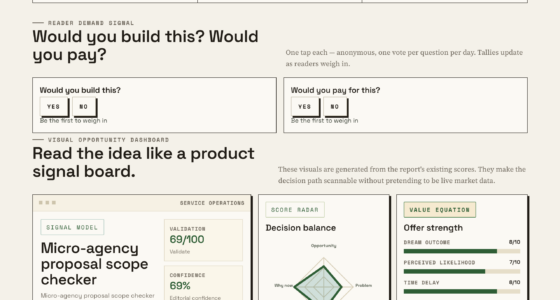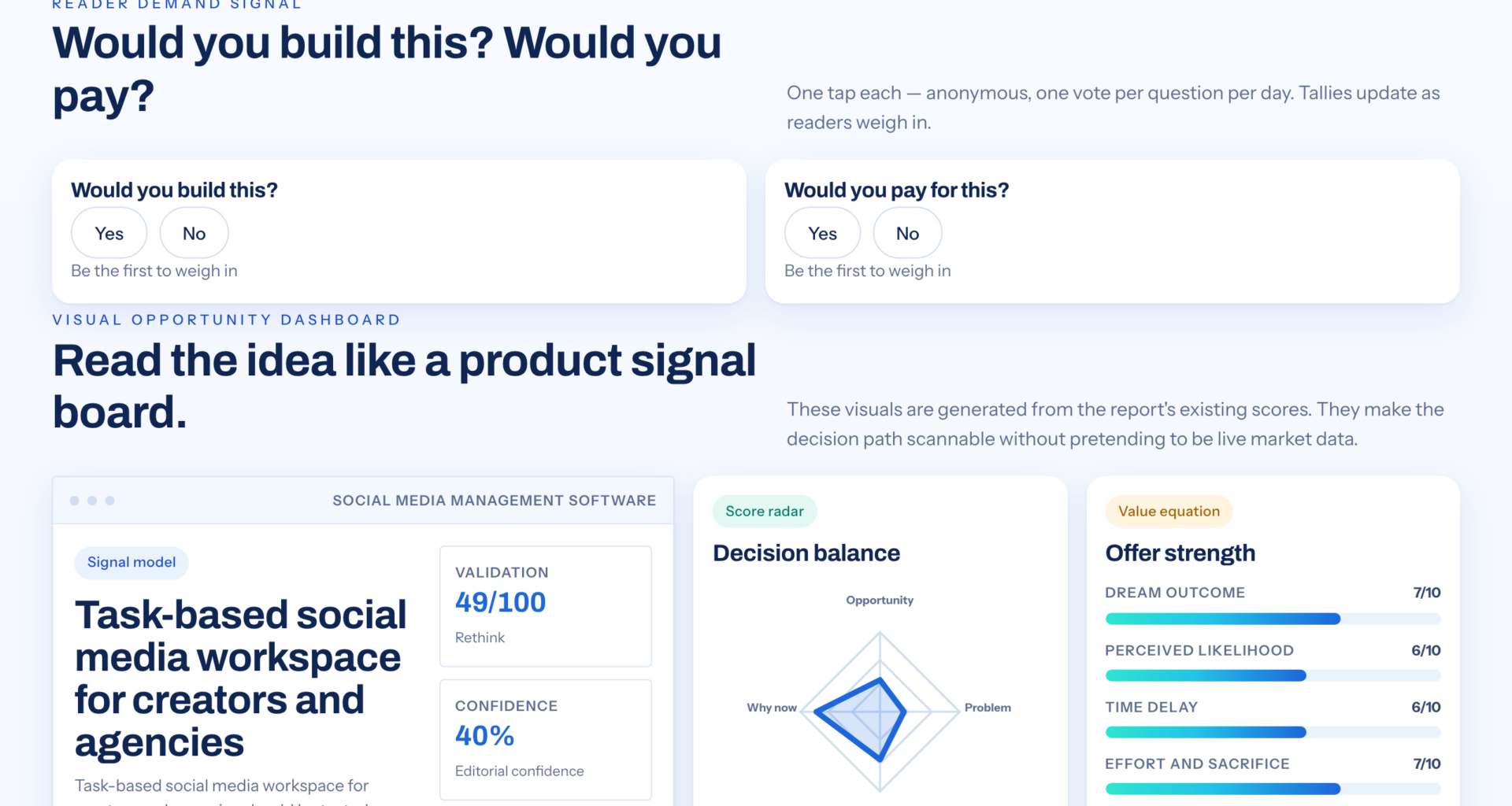

📊 Full opportunity report: Turn Social Media Plans Into Trackable Tasks And Workflows on IdeaNavigator AI — validation score, market gap, and execution plan.

Get the latest gadgets delivered free with Prime
- Fast, free delivery on millions of items
- Prime Video, Amazon Music and more included
- Member-only deals all year
TL;DR
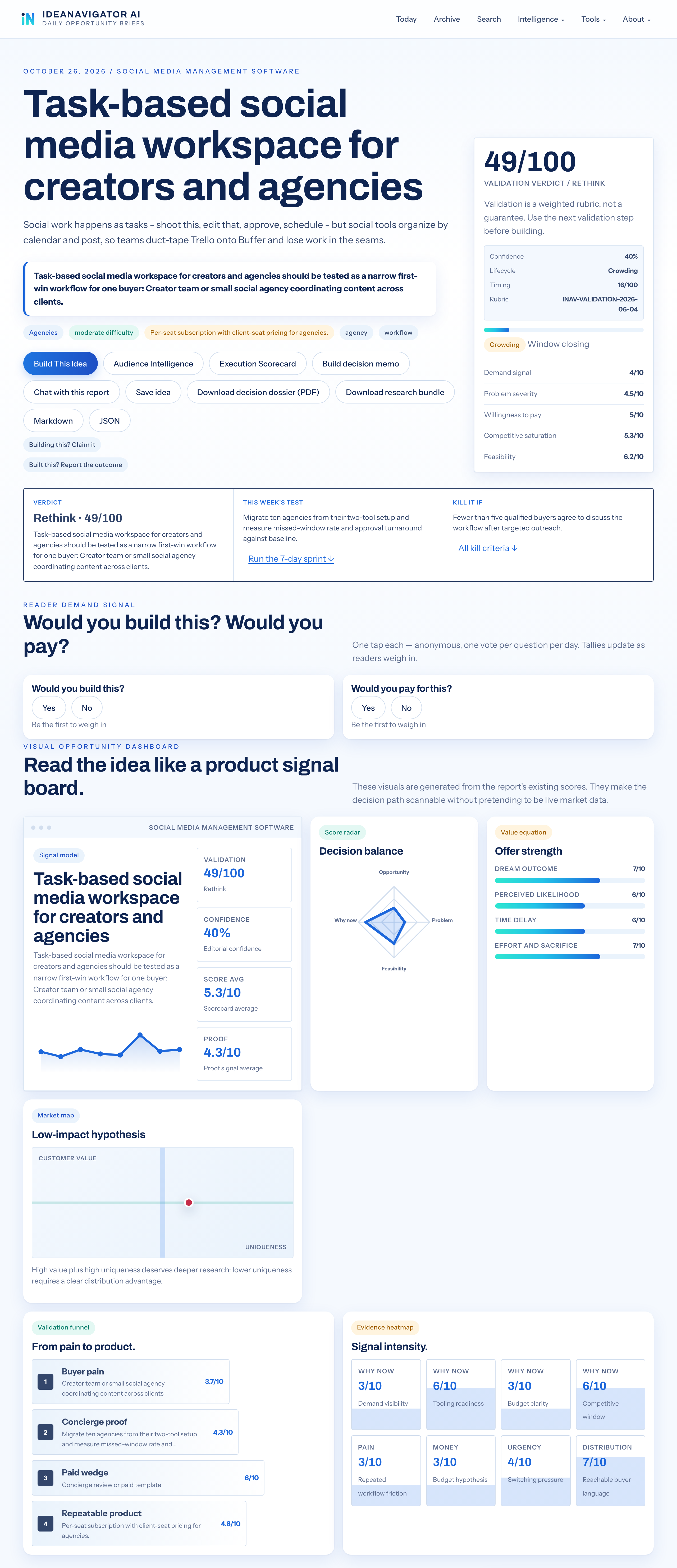
IdeaNavigator AI has outlined a product concept for creators and small social agencies: manage each social post as a task from brief through approval and scheduling. The proposal recommends testing it with 10 agencies and measuring missed posting windows and approval turnaround; no product launch, test results or customer commitments are reported.
IdeaNavigator AI has outlined a proposed social media workspace that would track each post as a task, from initial brief to publication, for creator teams and small agencies managing content across clients. The proposal is a product concept, not an announced launch: it recommends testing the workflow with 10 agencies and comparing missed posting windows and approval turnaround with their existing setup.
The suggested product would combine work tracking and social publishing in one pipeline. Each post would move through stages labeled brief, asset, edit, approval and scheduled, with a client-facing approval link and versioning for creative assets. Scheduling would be built into the workflow after approval, linking a piece of content’s production status to its planned publication.
The intended users are creator teams and small social agencies coordinating work for multiple clients. IdeaNavigator AI frames the problem as a mismatch between how social tools are organized and how teams carry out the work: scheduling products center on calendars and posts, while production involves tasks such as filming, editing and securing approval. Teams may combine a social scheduler with a general project-management tool, leaving work split between systems.
The proposal suggests a per-seat subscription, with pricing for agency client seats. To test the idea, it calls for migrating 10 agencies from their current two-tool setup and measuring missed-window rates and approval turnaround against each agency’s baseline. No results from such a test, pricing figures or confirmed participating agencies are provided.
The proposal addresses an operational problem rather than a new content format: coordinating the steps needed to get a post approved and published. For a small team serving several clients, a missed handoff or unclear approval status can affect a publishing schedule. A shared workflow could make task ownership, asset versions and approval status visible alongside the scheduling step.
That potential benefit remains a product hypothesis, not a demonstrated outcome. The proposed test focuses on missed posting windows and approval turnaround, two measures that could show whether consolidating work helps. The concept does not provide evidence that the approach reduces delays, nor does it compare the suggested product with existing tools.
The commercial question is also unresolved. Agencies might value client-facing approvals and fewer disconnected systems, but the proposal does not establish willingness to pay per seat or whether charging for client seats would fit agency workflows. The suggested pilot is intended to test operational value before those assumptions are treated as validated demand.
Products Worth Considering

DJI Osmo Mobile 8 3-Axis Smartphone Gimbal Stabilizer

Logitech MX Master 4 for Mac, Ergonomic Bluetooth Mouse with Haptic Feedback, Ultra-Fast Scrolling, USB-C Charging, for MacOS, iPadOS, Windo

Apple AirPods Pro 3 Wireless Earbuds with Active Noise Cancellation
As an affiliate, we earn on qualifying purchases.
From Calendars to Production Pipelines
Social media management software commonly supports planning and scheduling posts, while content production can involve a sequence of separate tasks and reviews. The IdeaNavigator AI concept argues that teams often bridge this gap by using a scheduler alongside a generic project tool. In that arrangement, content details and task updates may sit apart from the calendar where publication is managed.
The proposal does not name particular incumbent products or document how widespread this arrangement is. Its rationale is that higher content volume has increased the number of tasks teams must coordinate, while scheduling tools have not necessarily taken on the broader work-management layer. That is the problem framing behind the idea, rather than a market-wide finding supported here by survey figures.
The proposed minimum viable product keeps its scope focused on one buyer group: creator teams or small agencies working across clients. It centers on the post as a unit of work and joins production stages to approval and scheduling. The plan does not specify platform integrations, supported social networks, reporting features or a release schedule.
Demand and Pilot Results Remain Open
No working product, launch or pilot outcome is reported. It is not clear whether development has started, which agencies might participate, how long a test would run or what tools the participants currently use. The proposal also gives no baseline values or thresholds for deciding whether missed-window rates or approval times have improved.
Other product details remain unspecified, including supported publishing platforms, integrations, security and permissions, asset storage limits, and how client approvals would work in practice. The proposed pricing model is not accompanied by rates or evidence of customer willingness to pay. Claims about rising content velocity and gaps in incumbent products are presented as the opportunity’s rationale, not quantified market research.
A Ten-Agency Test Is Proposed
The next step described is a pilot with 10 agencies, migrating their existing two-tool workflows and tracking missed posting windows and approval turnaround against a baseline. The concept does not say that the pilot has begun or set a date for it.
If such a test proceeds, its results could help establish whether a unified task pipeline improves coordination and whether agencies would pay for it. Until participants, measurements and outcomes are disclosed, the workspace remains a proposed product direction rather than a validated service.
Source: IdeaNavigator AI
Key Questions
Has the social media workspace launched?
No launch is reported. The material describes a product concept and a proposed validation test.
Who is the proposed workspace for?
It is aimed at creator teams and small social agencies coordinating content for multiple clients.
What would the product include?
The proposed workflow would track each post through briefing, asset preparation, editing, approval and scheduling, with client approval links and asset versioning.
How would the idea be tested?
The proposal recommends working with 10 agencies and comparing missed posting windows and approval turnaround with each agency’s baseline. No results or schedule are provided.
What is known about pricing?
The suggested model is a per-seat subscription with client-seat pricing for agencies. No prices or customer commitments are reported.
Source: IdeaNavigator AI