TL;DR

Get the latest gadgets delivered free with Prime
- Fast, free delivery on millions of items
- Prime Video, Amazon Music and more included
- Member-only deals all year
The RepRapMicron project says its PIKA V0.02 prototype has achieved repeatable positioning of approximately 1μm and reliable accuracy of 10μm or better in an approximately 8mm cubic workspace. Its project documentation also describes depositing UV-resin droplets as small as 4μm, but the results are project-reported and do not establish independent validation or a general-purpose microfabrication capability.
RepRapMicron, an open project developing a compact machine for micron-scale fabrication, says its recommended PIKA V0.02 hardware can position repeatably to about 1μm and achieve reliable accuracy of 10μm or better within an approximately 8mm-cubic work area. The project’s GitHub documentation also reports depositing UV-resin droplets as small as 4μm, a result that points to a possible low-cost route for experiments at scales usually associated with specialized equipment.
The figures come from the project’s own documentation, which describes PIKA V0.02 as the current recommended build and marks it complete around May 2026. It reports repeatable positioning of approximately 1μm, with reliable accuracy of 10μm or better across a small working volume. Positioning repeatability and accuracy describe different performance characteristics; the documentation does not say the machine consistently fabricates every feature to 1μm.
For deposition tests, the project says a fine probe etched using the PIKA mechanism deposited UV-resin droplets as small as 4μm. It also reports curing resin lines 9μm wide using a fibre-optic probe. These are project-reported demonstrations, not results independently assessed in the supplied source. The documentation describes a 0.5mm “Benchy” test model printed with a 4μm layer height, but does not provide independent measurement data or a full account of repeatability across multiple finished prints.
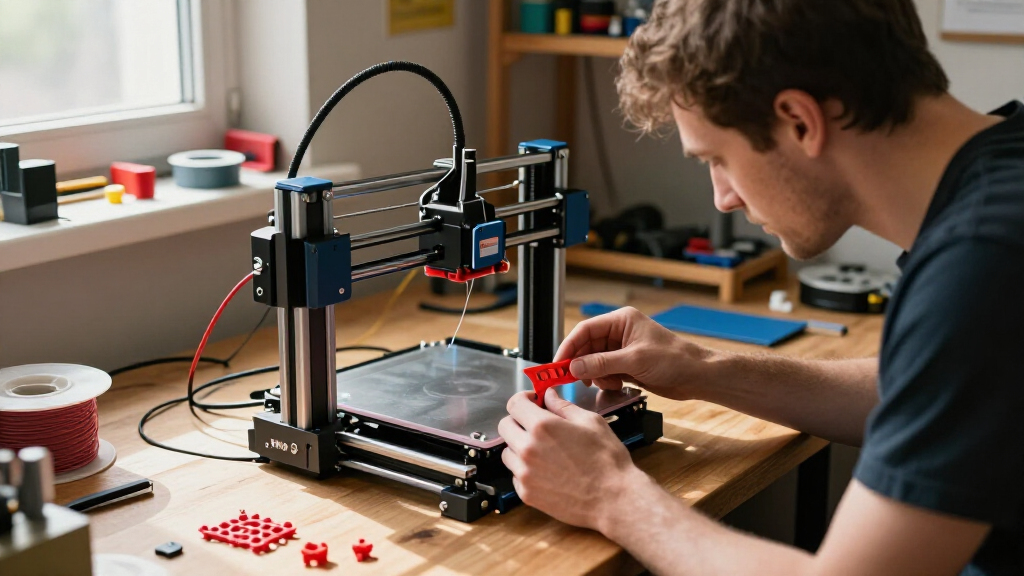
The prototype uses a three-axis arrangement driven by NEMA17 stepper motors, according to the project overview. The documentation says users can choose their own drive hardware and firmware. Its optical setup uses USB microscopes for setup and positioning, with a conventional bench microscope suggested for examining output. The project presents these design choices as part of a buildable system, rather than specifying a single complete, standardized machine configuration.
A Small Platform for Microfabrication
If the reported results can be reproduced, RepRapMicron could give researchers, educators and technically skilled hobbyists a lower-cost way to test fabrication methods at the micron scale. The project draws on the RepRap model of open, adaptable fabrication: publish designs and methods so others can build, modify and improve the equipment. A compact platform could be useful for prototyping or for experiments involving small structures, without requiring access to industrial-scale facilities.
The claims should not be read as evidence that this prototype can manufacture commercial microchips or replace established semiconductor processes. The documentation describes a limited work volume and particular resin-deposition demonstrations, not a complete process for making electronic devices. Its potential significance lies in opening up experimentation and tool development; practical use will depend on performance, reproducibility, material choices and the ability to manipulate finished objects at this scale.
As an affiliate, we earn on qualifying purchases.
From Open Microscopy to Fabrication
RepRapMicron says its approach builds on 3D-printed microscope platforms developed by the OpenFlexure Project. The project credits those platforms with making the initial precision possible, while noting that later variations were adapted for prototyping and fabrication. Its objective has two parts: develop a macro-scale machine that can fabricate and manipulate micron-scale objects, and learn techniques that could eventually support systems printed at much smaller scales.
The project’s earlier MAUS C V0.04 design is described as a testbed for flexure components, with best-case positioning of about 5μm over a 4mm square; the documentation says its motion is not linear and marks the version deprecated. PIKA is the project’s current recommended design. The project also identifies challenges beyond moving a probe: micron-scale work requires ways to detach, transport, rotate, position and maintain small assemblies that people cannot handle directly.
““The µRepRap is intended to be a RepRap (a replicating 3D printer) capable of micron (1/1000th of a millimetre, or 1µm) and sub-micron fabrication, made with only common and easily accessible materials.””
— RepRapMicron project documentation
As an affiliate, we earn on qualifying purchases.
How Reproducible Are the Results?
The supplied documentation is a project source, and it does not provide independent testing or a detailed measurement protocol for the PIKA performance figures. It is unclear how the stated positioning and deposition results vary across builds, operators, materials or environmental conditions. The source also does not establish whether the smallest reported droplets can be produced consistently, or whether they represent a one-off demonstration.
Other practical details remain open, including the complete cost of a build, how long setup and calibration take, and what range of materials can be handled. The project’s stated aim includes eventual micron-scale replication, but the supplied material describes a macro-scale machine for making or manipulating much smaller objects; it does not show that a printer fabricated at the micron scale is already available.
high precision stepper motor NEMA17
As an affiliate, we earn on qualifying purchases.
As an affiliate, we earn on qualifying purchases.
Builds and Testing Ahead
The project documentation directs interested users to the PIKA V0.02 build information and says day-to-day progress is recorded on the RepRap blog. Further public builds, measurement details and replicated demonstrations would help establish how reliably other users can achieve the stated performance. The supplied source does not name a scheduled test, release date or independent evaluation.
For now, the next evidence to watch for is documentation of additional machines and repeatable results across the reported work area. That would help clarify whether RepRapMicron can serve as a practical open fabrication platform, beyond a promising project prototype.
USB microscope for microfabrication
As an affiliate, we earn on qualifying purchases.
As an affiliate, we earn on qualifying purchases.
Key Questions
What is RepRapMicron?
RepRapMicron is an open project developing a compact, RepRap-inspired system for fabricating and manipulating objects at micron scales. Its current recommended design in the supplied documentation is PIKA V0.02.
What performance does PIKA V0.02 report?
The project reports approximately 1μm repeatable positioning and reliable accuracy of 10μm or better within an approximately 8mm-cubic volume. It also reports 4μm UV-resin droplets and 9μm cured lines; these figures have not been independently verified in the supplied source.
Does RepRapMicron make microchips?
The supplied material does not show that it can manufacture commercial microchips. It describes a prototype for micron-scale positioning and resin deposition, with a broader goal of enabling accessible fabrication experiments.
Is PIKA V0.02 independently validated?
No independent validation is included in the source material. The performance figures are reported by the project; details about independent measurement, repeatability across builds and testing conditions remain unclear.
Source: hn
Halloween Picks
halloween
As an affiliate, we earn on qualifying purchases.