📊 Full opportunity report: Improve Data Center Capacity Management With Detailed Rack Tracking on IdeaNavigator AI — validation score, market gap, and execution plan.
TL;DR
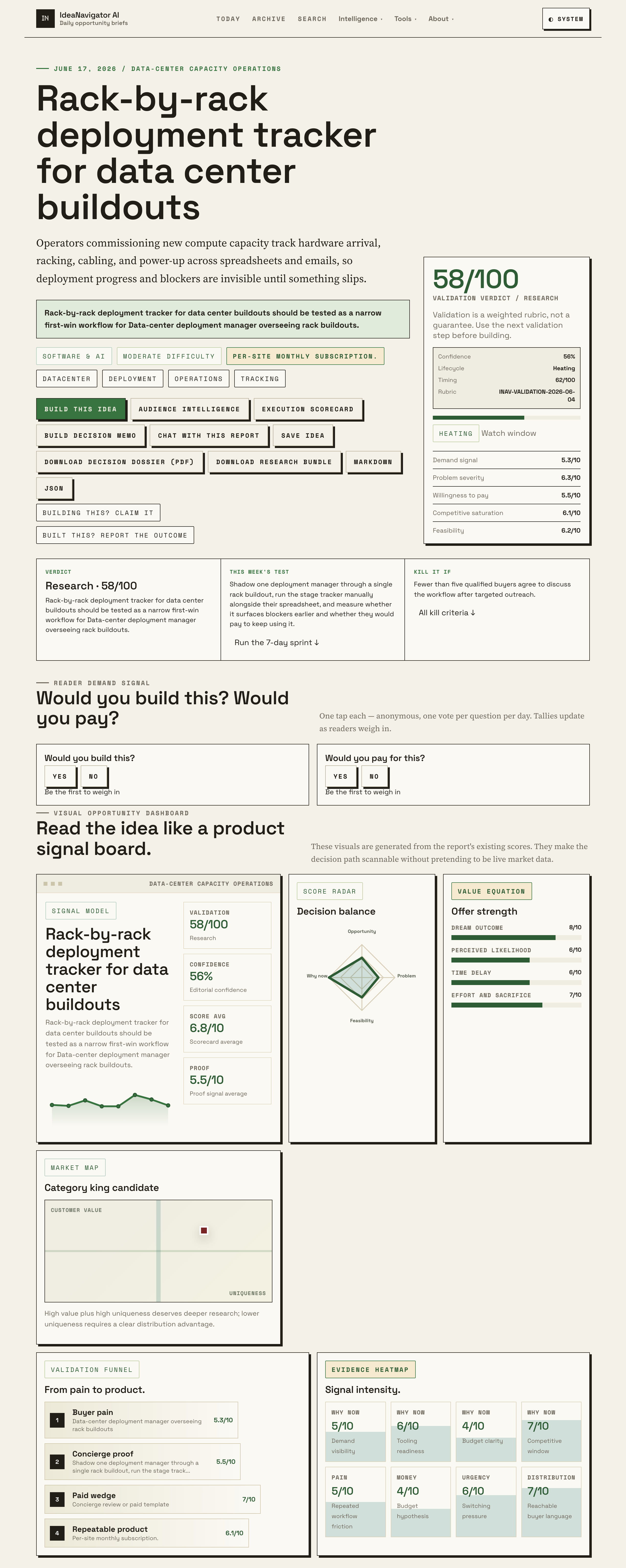
A new deployment tracker for data centers enables operators to monitor rack buildout stages in real-time, reducing delays and improving capacity management. The tool is being tested as a first step toward more efficient buildouts.
A new rack-by-rack deployment tracker is being tested with data center operators to enhance capacity management by providing real-time visibility into the buildout process. This development is significant as it addresses a critical industry challenge: tracking hardware deployment progress across multiple stages.
The proposed system allows a deployment manager to log each rack through fixed stages — delivered, racked, cabled, powered, validated — and view a live percentage of completion for each site. The tracker aims to replace or supplement existing manual methods, such as spreadsheets and email updates, which often lead to delays and unseen blockers.
According to sources familiar with the project, the tracker is currently in a testing phase where it is being used alongside manual spreadsheets to assess whether it can surface issues earlier and improve overall buildout efficiency. The initial focus is on a single site, with plans to expand if successful. The tracker operates on a per-site subscription model, suggesting a potential new revenue stream for capacity operations providers.
Impact of Real-Time Rack Tracking on Data Center Efficiency
This development could significantly improve capacity planning and deployment timelines for data centers, especially amid record demand driven by AI and cloud workloads. By providing real-time insights, operators can identify and resolve blockers sooner, reducing costly delays and optimizing resource utilization. The approach also offers a scalable solution for managing thousands of racks across multiple sites, addressing a key pain point in rapid buildouts.
data center rack deployment tracking software
As an affiliate, we earn on qualifying purchases.
As an affiliate, we earn on qualifying purchases.
Industry Need for Better Deployment Oversight
The data center industry is experiencing record buildout activity, driven by demand for AI, cloud, and high-performance computing. Operators currently rely heavily on manual tracking methods, which are prone to errors and delays. As build timelines shrink, the need for purpose-built tools to monitor progress in real-time has become urgent. This tracker emerges as a targeted solution to improve transparency and efficiency, with the potential to become a standard part of capacity management workflows.
rack-by-rack deployment management tool
As an affiliate, we earn on qualifying purchases.
As an affiliate, we earn on qualifying purchases.
Uncertainties Around Deployment Tracker Effectiveness
It is not yet clear how accurately the tracker will surface blockers or how much it will improve deployment speed compared to manual methods. The testing phase is ongoing, and results are still being evaluated. Additionally, questions remain about the scalability of the solution across different site sizes and operational workflows.
real-time data center capacity monitoring system
As an affiliate, we earn on qualifying purchases.
As an affiliate, we earn on qualifying purchases.
Next Steps in Tracker Validation and Deployment
The next phase involves shadowing a deployment manager through a full rack buildout, comparing manual tracking with the new system to assess its effectiveness. If results are positive, plans include expanding the trial to additional sites and refining the tool based on user feedback. Commercial rollout could follow later this year, with subscription plans tailored to different capacity needs.
data center hardware deployment tracker
As an affiliate, we earn on qualifying purchases.
As an affiliate, we earn on qualifying purchases.
Key Questions
How does the deployment tracker improve existing processes?
The tracker offers real-time visibility into each rack’s build stages, reducing reliance on manual spreadsheets and emails, which can be slow and error-prone. It helps identify delays early and streamlines communication among teams.
Will this tool be suitable for all data center sizes?
The initial focus is on a single site, but the design aims to be scalable. Effectiveness across larger or more complex deployments will depend on trial results and subsequent refinements.
What are the costs associated with adopting this tracker?
The system is planned to operate on a per-site monthly subscription basis, with pricing likely reflecting the scale of deployment and features required.
When will the tracker be available for broader use?
Following successful testing and validation, a commercial launch could occur within the next few months, possibly later this year.
Source: IdeaNavigator AI