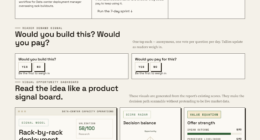

📊 Full opportunity report: The Future Of Security Is AI-Enabled: What You Should Expect on ThorstenMeyerAI.com — validation score, market gap, and execution plan.
TL;DR
A critical security flaw in a popular hardware wallet was exploited, revealing a new era where AI-assisted tools are central to cybersecurity. This shift impacts all digital security practices moving forward.
On July 30, a security breach drained over one billion dollars in Bitcoin from nearly 1,200 wallets, exploiting a bug in a widely used hardware wallet’s firmware. This incident underscores the emerging role of AI-assisted tools in both discovering and exploiting vulnerabilities, signaling a shift in cybersecurity that affects all digital assets.
The breach was caused by a firmware update in March 2021 that rerouted the device’s key generation process from a hardware random-number generator to a deterministic software fallback. This change reduced entropy from over 128 bits to approximately 40-72 bits, making private keys vulnerable to brute-force attacks. Attackers, after understanding the flaw, used automated scripts to generate and scan private keys against the blockchain, draining wallets in less than an hour. The hardware wallet maker, Coinkite, acknowledged the error, attributing it to an engineering mistake. Despite recent AI-assisted firmware audits, the flaw went undetected, highlighting the limitations of current security measures.
While there is no public evidence confirming AI’s direct involvement in executing the attack, experts suspect that AI tools likely played a role in the rapid discovery and automation of the exploit, given the timing and sophistication. The incident is a clear sign of how AI-driven processes are now integral to both offensive and defensive cybersecurity strategies, not only in crypto but across digital infrastructure.
A firmware error shrank the pool that “random” keys were drawn from. A searchable pool is a drainable one. Here is the mechanism, conceptually — no operational detail.
A March 2021 firmware update rerouted key generation from the device’s hardware random-number generator to a deterministic software fallback — drawing seeds from a dramatically smaller universe.
Once the flaw is understood, the whole attack runs on an ordinary machine — no internet needed until the final move.
Implications of AI-Driven Security Flaws for Digital Assets
This incident illustrates a broader shift where AI-enabled tools are transforming cybersecurity. AI can accelerate vulnerability discovery, automate exploits, and challenge traditional security paradigms. For users, this means increased risk but also new opportunities for defense, making it essential to adapt security practices to this emerging landscape.
As an affiliate, we earn on qualifying purchases.
Recent Trends in AI and Cybersecurity Vulnerabilities
Over the past few years, AI has increasingly been integrated into security workflows, from automated code reviews to threat detection. However, the recent hardware wallet breach reveals a paradox: AI’s capabilities can both enhance security and enable more sophisticated attacks. The bug, sitting dormant for over five years, was only discovered after the advent of advanced AI models and open-source tools that can rapidly analyze code and identify vulnerabilities. This pattern suggests that as AI tools become more accessible and powerful, they will play a central role in both defending and attacking digital systems.
Industry experts have noted that traditional security audits, even those assisted by AI, are not infallible, especially when human oversight fails. The incident underscores the need for continuous, AI-augmented security measures that can adapt to evolving threats.
"This is the sober reality of a new AI paradigm, where AI-assisted code review can surface latent bugs faster than the industry's most seasoned experts."
— Rodolfo Novak, CEO of Coinkite
As an affiliate, we earn on qualifying purchases.
Unclear Role of AI in Actual Attack Execution
There is no direct evidence confirming that AI was used to execute the attack. While experts suspect AI-assisted tooling facilitated the rapid discovery and automation, this remains an inference rather than confirmed fact. The precise involvement of AI in the attack chain is still under investigation, and details are yet to be disclosed by authorities or the attackers.
As an affiliate, we earn on qualifying purchases.
Next Steps for Industry and Security Practices
Security firms and hardware manufacturers are expected to enhance AI-driven code audits and vulnerability detection methods. Industry-wide, there will be increased emphasis on integrating AI tools into security protocols, alongside stricter firmware review processes. Meanwhile, users should prioritize hardware updates and adopt multi-layered security measures. Ongoing investigations will clarify the extent of AI’s role and how to better defend against such sophisticated exploits in the future.
As an affiliate, we earn on qualifying purchases.
Key Questions
Could AI have prevented this hardware wallet breach?
While AI-assisted audits may have identified the flaw earlier, the breach demonstrates that current AI tools are not yet foolproof. Enhanced, continuous AI security measures are necessary to better prevent such vulnerabilities.
Is AI responsible for the attack, or just aiding it?
There is no confirmed evidence that AI directly executed the attack. Experts believe AI likely played a role in rapid vulnerability discovery and automation, but the attack was ultimately carried out by exploiting the firmware bug.
What does this mean for future cybersecurity threats?
This incident signals that AI will be central to both offensive and defensive cybersecurity strategies. Organizations must adapt quickly to incorporate AI into their security frameworks to stay ahead of increasingly sophisticated threats.
What practical steps can users take now?
Users should update their hardware wallets with the latest firmware, enable multi-factor authentication where possible, and stay informed about security advisories related to their devices.
Source: ThorstenMeyerAI.com